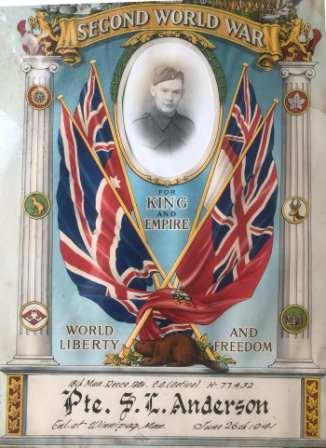
Commemoration for Stewart Lyon Anderson. (Courtesy of the William Anderson family)
September 23, 2025. While in Europe for the 80th Anniversary of Liberation Commemoration events, Pieter placed flags at the graves of 383 soldiers he’s researched over the years, which took us to 14 cemeteries in The Netherlands and Belgium. Out of this total, 156 flags were placed at the Canadian War Cemetery in Holten, The Netherlands.
Pieter’s research results are faster than I can keep up with, and so several of the graves we visited were for soldiers whose stories have yet to be told. One of these is the subject of this posting: Stewart Lyon ANDERSON, who was born in Rignold, Manitoba on November 22, 1919, the son of William and Isabella (nee Lyall) Anderson.
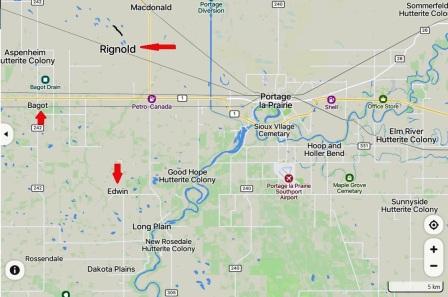
Map showing Rignold, Bagot, and Edwin. (Map source: http://www.mapcarta.com)
Pieter’s search for a photo of Stewart ended when he got in contact with Lindsay Edmunds–Judson and her mother, Lana McCleary Edmunds, daughter of Stewart’s sister Agnes ‘Isabelle’. “…Mum is so excited to be part of this!…” Lindsay wrote. “…How wonderful that your birth and upbringing has undoubtedly fostered your interest in this project which will be bringing joy to so many….”
Lana explained that “…two of Mum’s brothers and one sister served. Stewart was killed. Willie came home a broken man and died because of that. Elizabeth showed us how to be the most wonderful aunt. In Mum’s last days, she called for Stewart in her sleep- he had been the favourite I think….” Stewart’s brother William served with the Princess Patricia Light Infantry and was wounded in Italy. His sister Elizabeth served at the First Base Post Office in London, England.
….Stewart enlisted in April 1941…
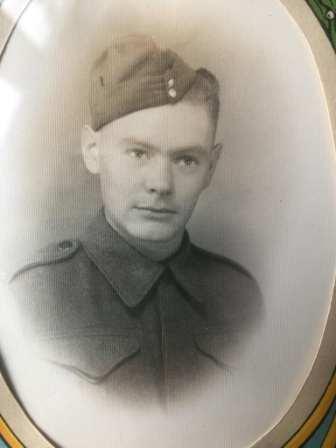
Stewart Lyon Anderson. (Courtesy of the William Anderson family)
Stewart grew up in Bagot, Manitoba, attended school in Edwin, and worked on his parents’ farm before enlisting under the National Resources Mobilization Act (NRMA) at the No. 10 NRMA Clearing Depot in Portage La Prairie, Manitoba on April 17, 1941 and began basic training at No. 100 Canadian Army (Basic) Training Centre (CABTC) in Portage La Prairie. (See https://en.wikipedia.org/wiki/National_Resources_Mobilization_Act)
He was described as having red hair and blue eyes, that he was cheerful and neat, robust in appearance, and that he enjoyed swimming and playing softball.
A little over a month later, on June 25, 1941, Stewart enlisted in the Active Army at No. 10 District Depot in Winnipeg, Manitoba, and was immediately attached to A15 Canadian Infantry Advanced Training Centre (Rifle) at Camp Shilo in Shilo, Manitoba.
He remained there until September 4, 1941, when he returned to No. 10 District Depot in Winnipeg, and attached to the Tradesman Training Wing of the 18th (Manitoba) Reconnaissance Battalion, ‘D’ Company, for basic training.
From December 19, 1941 until January 7, 1942, Stewart was granted a furlough, for what turned out to be the last time he saw his family.
….Stewart was assigned to the 18th (Manitoba) Reconnaissance Battalion…
Stewart was transferred to 18th (Manitoba) Reconnaissance Battalion’s ‘D’ Squadron on February 2, 1942, and sent to Work Point Camp in Esquimalt, British Columbia. While Work Point Barracks served as the headquarters for Military District 11, which oversaw Canadian military operations in British Columbia, Stewart was there for a driver operator course.
On February 5, 1942, the 18th (Manitoba) Reconnaissance Battalion was re-designated as the 18th (Manitoba) Armoured Car Regiment and was part of the Canadian Armoured Corps.
Stewart remained at Work Point Camp until May 4, 1942, when he returned to his unit at Otter Point in Sooke, British Columbia.
….Stewart qualified as a driver operator…
On July 13, 1942, after qualifying as a Driver Operator Class III, Stewart and the rest of the 18th (Manitoba) Armoured Car Regiment moved to Debert, Nova Scotia, for final training and preparation before going overseas.
While at Debert, Stewart qualified as a Driver i/c Class III Wheeled on July 21, 1942. (The term ‘Driver i/c’ refers to ‘Driver, internal combustion’. Class III meant he was qualified to drive heavy trucks and armoured cars, but not tanks.)
….Stewart left Canada for overseas service….
On August 22, 1942, Stewart was aboard the ‘Letitia’ with the 18th (Manitoba) Armoured Car Regiment when they sailed from Halifax, Nova Scotia for the United Kingdom, as part of the Scotland bound convoy T-20. Upon arriving in Glasgow, Scotland on August 31, 1942, they remained on board until September 2.
While in the United Kingdom, the 18th (Manitoba) Armoured Car Regiment trained for their role as a reconnaissance unit for the II Canadian Corps. As a reconnaissance unit, its purpose would be to gather tactical information for its parent infantry division, scouting ahead and screening flanks.
Initially based in Aldershot, England, the Regiment trained in Bramley, Surrey, and other locations, from November 1942 to June 1943.
On December 16, 1942, the regiment was re-designated the 18th Armoured Car Regiment (12th Manitoba Dragoons).
….Stewart landed in Normandy a month after D-Day…
On July 8, 1944, Stewart and his Regiment left England, landing the next day at Juno Beach in Normandy, France. They were reported to have brought 72 Staghounds with them, an armoured vehicle that could also be used as a scout car.

T-17E1 Staghound armoured cars of “A” Squadron, 12th Manitoba Dragoons, in the Hochwald, Germany, March 2, 1945. The first car has tire chains on all four wheels. (Photo courtesy of Library and Archives Canada, taken by Jack H. Smith)
As a self-contained unit attached directly to II Canadian Corps, they had long range reconnaissance regiment, equipped with a wireless transmitting and receiving set, for their role as scouts in finding the best roads for the troops. Providing route information over the radio was of great importance to the troops that followed in their path, often 50 or more kms behind.
In an entry on the ‘Flames of War’ website (see https://www.flamesofwar.com), John (Jock) Buckmaster wrote that as they reached Belgium, “….Nieuwport, Ostend and Bruges were all liberated by the Dragoons, with Bruges and Ostend naming roads and squares after the regiment…”
After the war ended, a memorial in Zeebrugge, Belgium was placed to honour the 18th Armoured Car Regiment (12th Manitoba Dragoons), who liberated the city on November 3, 1944.
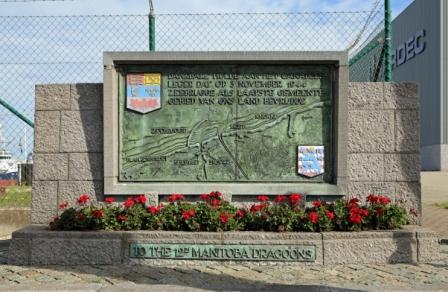
Memorial of the liberation of Zeebrugge (Belgium) on November 3, 1944 by the 12th Manitoba Dragoons. (Photo courtesy of Wikipedia, taken by Marc Ryckaert)
The ‘Flames Of War’ entry went on to note that by late 1944, “…the front-line between German and Canadian troops was now the Maas River, and for three months the Dragoons patrolled the river in one of the coldest, wettest, winters to hit the region. The regiment ….. liberated multiple cities, including Lichtenvoorde, Leeuwarden, and Almelo…” in The Netherlands “…before heading into Germany….”
The Regiment experienced difficulties in Germany. “….Heading into the Hochwald forest proved difficult for the regiment, as the armoured cars did not fare well in the restricted terrain. The weight of the Staghounds proved to be a problem when recovering bogged-down vehicles…” At one point, horses from a German village were needed “….to pull two 14-ton Staghounds from the mud…” The Regiment continued “…through Bad Zwischenahn, and further into the Hochwald forest…”
….Stewart lost his life during the Battle for the Küsten Canal…

Map showing location of Küsten Canal, and Esterwegen where Stewart Anderson was initially buried. (Map source: Google maps)
The next objective for Allied troops was the clearing of the 70 km (43 mi) long, 100-metre (330 ft) wide, Küsten Canal, a significant obstacle to Allied forces advancing from the Ems estuary into Germany.
In the ‘Regimental History of the 18th Armoured Car Regiment (12th Manitoba Dragoons)’, published in 1945, author Charles Eric Henry writes that “…the Regiment was detailed to take over a sector of the Küsten Canal 14 April 1945….The enemy did not seem to be overactive but did send over quite a few shells. The main task seemed to be to remain on the southwest side of the canal until the friendly troops on the other side had worked their way along it to a point opposite our positions…”
Unfortunately, casualties still occurred, and on April 19, 1945, Stewart was one of 5 men who lost their lives during the Battle for the Küsten Canal. The War Diary for that day recorded that “…17 Troop lost their Sgt’s Stag and all his crew on a mine today. It took place at 14:33 hours…The mine completely destroyed the Stag and caused a crater 20 feet by 20 feet. It must have been one of these marine mines containing some 500 pounds of explosives…”
In addition to Stewart, the rest of the crew that died were:
- Sgt Alexander James BALFOUR of Lindsay, Ontario, aged 25
- Trooper Patrick James DEVINE of North Bay, Ontario, aged 22
- Trooper Merle Vincent HAMILTON of Brookfield, Colchester County, Nova Scotia, aged 26
- Trooper Willard James MORRIS of St. James (now part of Winnipeg), Manitoba, aged 23
Another Manitoba soldier who lost his life on April 19, 1945 was Andrew KERELCHUK of Zbaraz, Manitoba, who was serving with the Argyll and Sutherland Highlanders of Canada. You can read his story at https://onthewarmemorialtrail.com/2022/08/24/the-wwii-soldier-born-in-zbaraz-who-lost-his-life-during-the-battle-of-the-kusten-canal/
….Stewart is buried in the Canadian War Cemetery in Holten….
Stewart was temporarily buried in Esterwegen, Germany, before being reburied in the Canadian War Cemetery in Holten, The Netherlands.

Pieter beside the grave of Stewart Lyon Anderson, after he’d placed flags of Canada and Manitoba. (Photo credit: Daria Valkenburg)
“…To visit his grave has been something I’ve always wanted to do….” Lana explained to Pieter. “…Thank you so much for your work with this project. I hope you know how much it meant to Stewart’s three sisters to know his grave was tended. My imagination has me enjoying a flask of tea while I soak in the peace and beauty that resulted from the pain and loss of war….”

Stewart Lyon Anderson is remembered on the grave of his parents at Hillside Cemetery in Portage La Prairie, Manitoba. (Photo source: Find A Grave)
Thank you to Lana McCleary Edmunds and Lindsay Edmunds–Judson for providing photos and information on Stewart.
The flags placed at Stewart’s grave were donated. Our thanks go to:
- Alan Waddell, Constituent Assistant, on behalf of Heath MacDonald, MP for Malpeque, for the Canadian flag.
- Brad Robertson, Chief of Protocol, Government of Manitoba, on behalf of Wab Kinew, Premier of Manitoba, for the Manitoba flag.
Staghound Fatality Part 2 will be about Merle Vincent HAMILTON of Brookfield, Nova Scotia.
Pieter encourages readers with photos to come forward so that eventually all the known graves of Canadians buried in Holten will have a photo displayed by their grave. Email him at memorialtrail@gmail.com.
© Daria Valkenburg
….Want to follow our research?…
If you are reading this posting, but aren’t following our research, you are welcome to do so. Our blog address: https://onthewarmemorialtrail.com/
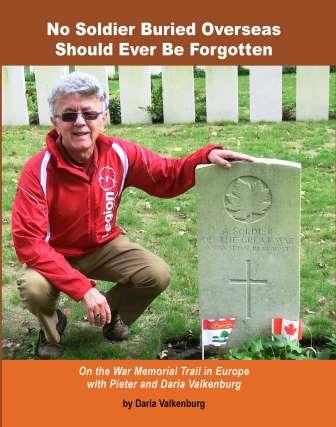 4 countries, 6 weeks, 7,000 km – an unforgettable war memorial journey in Europe…. Daria’s book ‘No Soldier Buried Overseas Should Ever Be Forgotten‘ is available in print and e-book formats. Net proceeds of book sales help support research costs and the cost of maintaining this blog. For more information see https://nosoldierforgotten.com/
Subscribe to our YouTube Channel: On The War Memorial Trail With Pieter Valkenburg: https://www.youtube.com/channel/UCJ591TyjSheOR-Cb_Gs_5Kw.
Never miss a posting! Subscribe below to have each new story from the war memorial trail delivered to your inbox.
 August 24, 2022. When researchers at the Information Centre at the Canadian War Cemetery in Holten, The Netherlands honoured 27 soldiers of Ukrainian heritage that are buried in the cemetery, they didn’t have photos of 4 soldiers. Could Pieter help?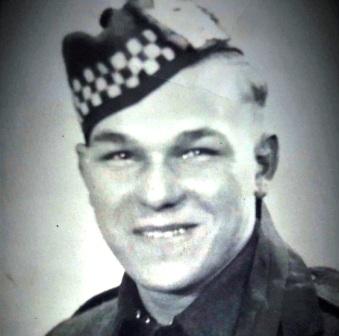



 On The War Memorial Trail Research Project........ with Pieter and Daria Valkenburg