February 6, 2026. Last spring we were in The Netherlands and Belgium for the 80th Anniversary of Liberation Commemoration events. We placed flags at the graves of 383 soldiers in 14 cemeteries, plus visited a number of memorials, museums related to WWII, and even did a battlefield tour.
We had one last adventure on our 2025 European War Memorial Tour – a trip to Germany to follow the route taken by Canadian troops during the winter of 1945.
We had been in Mook, near Groesbeek, in The Netherlands, as we’d been invited to attend a Faces To Graves Groesbeek meeting, at which we had been surprised with a Faces To Graves Groesbeek ‘coin’ and a certificate for the work done in researching soldiers, finding families, and sharing photos. (See https://onthewarmemorialtrail.com/2025/05/30/on-the-war-memorial-trail-pieter-and-daria-honoured-by-faces-to-graves-groesbeek-foundation/)
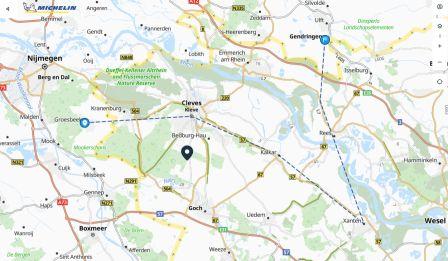
Route taken into Germany from Groesbeek to Kleve, Kalkar, Xanten, Bienen (now part of Rees), and Gendringen. (Map source: Michelin Maps)
Instead of returning to Zaltbommel, where we were staying, Pieter decided to drive into Germany and follow the route taken by Canadian troops in the winter of 1945. We first travelled to Kleve, then went on to Kalkar, from there to Xanten, and then to Bienen, which is now part of Rees. From Bienen we returned to The Netherlands and made a very brief stop in Gendringen.
.…Our first stop was Kleve…
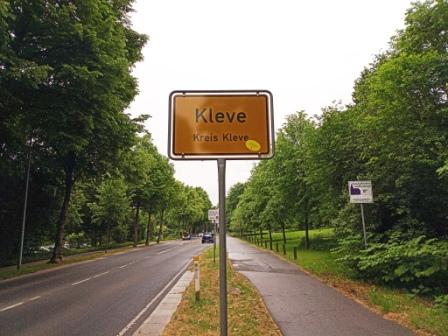
Canadian troops would have travelled along this route into Kleve. (Photo credit: Daria Valkenburg)
Kleve was bombed heavily before being captured by Allied troops on February 11, 1945 during Operation Veritable, as the 21st Canadian Army Group and British troops fought their way through the difficult terrain of the Reichswald Forest. The goal of Operation Veritable was to reach the Rhine, part of a pincer movement to allow Allied troops to advance towards Berlin. (See https://en.wikipedia.org/wiki/Operation_Veritable)
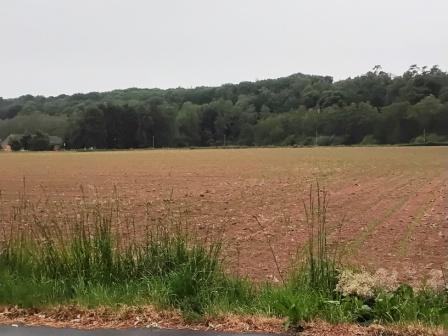
The dense wooded area of the Reichswald Forest. (Photo credit: Daria Valkenburg)
When the Allies crossed the border into Germany they entered the Reichswald Forest, a densely wooded area, as we saw from the road. It wasn’t hard to understand how the Germans had turned the forest into a death trap during WWII. The already natural obstacles of a forested area were heavily reinforced by German troops and rigged with trenches, mortar pits, barbed wire, mines, and anti-tank ditches.
Two major roads provided the only means of an Allied approach, while inside the forest there were no surfaced roads. Zig-zagged paths snaked through the woods, making it ideal for preparing ambushes to trap Allied troops.
Canadian and British troops were forced to advance on a narrow front, with their movements further restricted by bad weather and mud….as well as German ambushes.
On this journey through Kleve and the road bordering the Reichswald, we remembered:
- John ‘Weston’ CAMPBELL: https://onthewarmemorialtrail.com/2024/09/30/on-the-war-memorial-trail-the-wwii-soldier-from-clermont-killed-during-operation-veritable/
…..Kalkar was the scene of brutal battles in February 1945….
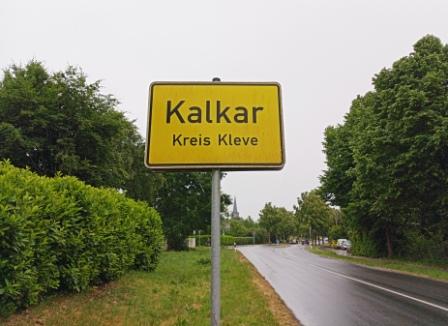
Canadian troops continued from Kleve towards Kalkar. (Photo credit: Daria Valkenburg)
About 10 km (6 miles) south-east of Kleve is Kalkar, scene of two terrible battles that Canadian troops participated in during Operation Veritable.
First came the Battle of Moyland Wood, which lasted a brutal six days, from February 16–21, 1945, in which several Canadian Regiments, such as the Regina Rifle Regiment, Canadian Scottish Regiment, and Royal Winnipeg Rifles fought to clear German paratroopers from a key position near Kalkar. (See https://legionmagazine.com/clearing-moyland-wood/)
The goal of the Battle of Keppeln, fought on February 26, 1945, was to break the German Siegfried Line during Operation Blockbuster, the last part of Operation Veritable. (See https://en.wikipedia.org/wiki/Operation_Blockbuster) Troops encountered heavy artillery and mortar fire in intense fighting from German paratroopers, and had to make their way through heavy mud and minefields.
The battle finally ended when Canadian troops used flame-throwing Wasp carriers to clear German-held houses in Keppeln. The village needed to be secured as part of a push towards Uedem. The capture of Keppeln allowed Canadian forces to clear the Kalkar Ridge and proceed towards the Hochwald Forest gap, and later to break through to the Rhine.
As we passed Kalkar on our way towards the Hochwald Forest, we remembered:
- Norman Victor Holgate BUCHANAN: https://onthewarmemorialtrail.com/2023/11/08/on-the-war-memorial-trail-a-monument-in-st-claude-led-to-a-photo-of-a-wwii-soldier/
- Thomas ‘Tom’ Alfred BROWN: https://onthewarmemorialtrail.com/2024/01/25/on-the-war-memorial-trail-the-successful-search-for-a-photo-of-wwii-soldier-thomas-alfred-brown-left-us-with-a-mystery/
- Donald Roy CARTER: https://onthewarmemorialtrail.com/2024/06/09/on-the-war-memorial-trail-the-wwii-soldier-from-central-blissville-killed-along-the-goch-calcar-road/
- Arthur GAUDET: https://onthewarmemorialtrail.com/2025/02/12/on-the-war-memorial-trail-the-wwii-soldier-from-prince-edward-island-who-lost-his-life-in-germany-two-days-before-his-21st-birthday/
- Cecil Edward GOODREAU: https://onthewarmemorialtrail.com/2022/06/17/on-the-war-memorial-trail-in-north-bay-remembering-ww2-soldier-cecil-edward-goodreau/
- Frank Edward MCGOVERN: https://onthewarmemorialtrail.com/2020/12/09/the-search-for-a-photo-of-frank-edward-mcgovern-moves-to-youtube/
- Bernard ‘Barney’ Reuben MCGUIGAN: https://onthewarmemorialtrail.com/2021/12/23/on-the-war-memorial-trail-the-photo-search-for-barney-mcguigan-is-successful/ and https://onthewarmemorialtrail.com/2020/08/07/on-the-war-memorial-trail-the-search-for-barney-reuben-mcguigan/
- Elbridge Wellington MILLER: https://onthewarmemorialtrail.com/2021/04/15/on-the-war-memorial-trail-atlantic-canada-remembers-part-9/
- Alfred Louis PITAWANAKWAT (PITWANAKWAT): https://onthewarmemorialtrail.com/2021/09/06/on-the-war-memorial-trail-remembering-ww2-soldier-alfred-louis-pitawanakwat-pitwanakwat/
….The Hochwald Forest was where the Battle of Hochwald Gap was fought….
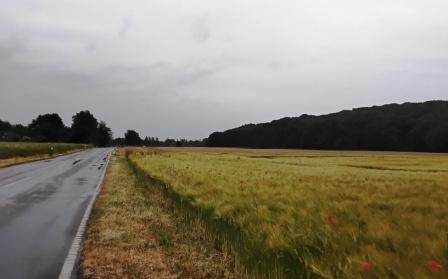
The road bordering the Hochwald Forest was bleak and lonely on the rainy day we drove on it. (Photo credit: Daria Valkenburg)
From Kalkar we turned off the road to go along the Hochwald Forest. It was perhaps fitting that by this time it was raining, with bleak, grey skies, as so many tears would have been shed here during the winter of 1945. We were alone on this road, with the Hochwald off in the distance, and the only colour coming from the red poppies growing in the field by the road.
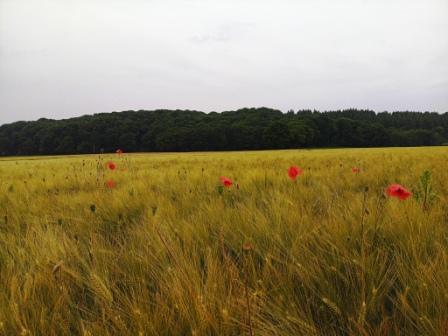
Red poppies grew along the road bordering the Hochwald Forest. (Photo credit: Pieter Valkenburg)
The Hochwald Forest was a second, separate defensive line located about 10 km (six miles) east/southeast of the Reichswald, stretching toward the Rhine. It was where the Battle of Hochwald Gap, part of Operation Blockbuster, was fought between February 28 and March 1, 1945, the final push by Canadian troops towards the Rhine River. (For more information, see https://canadianbattlefieldtours.ca/operation-blockbuster/ and https://civilianmilitaryintelligencegroup.com/10742/the-battle-of-hochwald-gap-one-of-the-largest-armor-engagements-you-probably-have-never-heard-of)
On this bleak and lonely road bordering the Hochwald Forest, we remembered:
- Gerald Burnell COOLEN: https://onthewarmemorialtrail.com/2021/11/28/on-the-war-memorial-trail-atlantic-canada-remembers-part-11/
- Ange-Aimé LECLAIR: https://onthewarmemorialtrail.com/2024/11/27/on-the-war-memorial-trail-the-wwii-acadian-soldier-serving-with-le-regiment-de-maisonneuve-who-made-the-ultimate-sacrifice-in-the-hochwald-forest/
- John ‘Jack’ Richard MARACLE: https://onthewarmemorialtrail.com/2022/07/17/on-the-war-memorial-trail-remembering-ww2-soldier-john-jack-richard-maracle/
- Edward Gabriel PERRY: https://onthewarmemorialtrail.com/2024/07/06/on-the-war-memorial-trail-the-wwii-soldier-from-st-nicholas-who-lost-his-life-during-the-battle-of-hochwald-gap/
- Anthony PETTA: https://onthewarmemorialtrail.com/2022/06/29/on-the-war-memorial-trail-in-north-bay-the-ww2-soldier-who-was-appointed-company-sergeant-major/
- Lawrence Arthur RUDOLPH: https://onthewarmemorialtrail.com/2024/01/06/on-the-war-memorial-trail-the-wwii-soldier-from-liscomb-who-lost-his-life-due-to-sniper-fire-in-germany/
- Ralph Kenneth SILLIKER: https://onthewarmemorialtrail.com/2024/04/18/on-the-war-memorial-trail-the-wwii-soldier-from-oleary-who-lost-his-life-during-operation-churchill/
- Clarence Wilfred WAKEGIJIG: https://onthewarmemorialtrail.com/2021/08/09/on-the-war-memorial-trail-remembering-ww2-soldier-clarence-wilfred-wakegijig/
….Xanten is now the home of an archeological park…
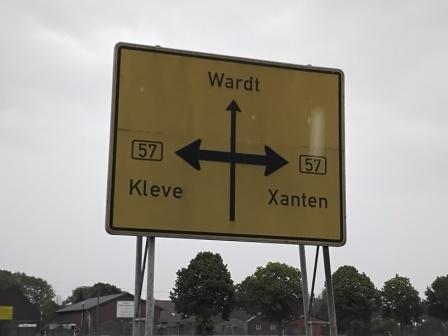
We followed the road from Kleve to Xanten. (Photo credit: Daria Valkenburg)
After detouring onto the road along the Hochwald, we returned to the highway and travelled to Xanten, 26 km (16 miles) from Kleve. The battle to capture Xanten, near the end of Operation Blockbuster, was the responsibility of Canadian troops of 2nd Canadian Infantry Division, in early March 1945. (See https://legionmagazine.com/the-taking-of-xanten/)
Beginning on March 8, each brigade was accompanied by two squadrons of flame-throwing tanks, with enemy artillery positions attacked by air support. German troops were desperate to win against the Allies, and fought fiercely, but in the end they evacuated Xanten in the middle of the night on March 10 into March 11.
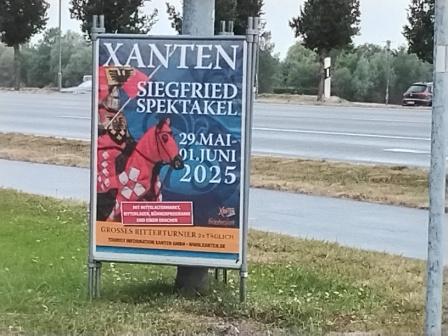
Poster advertising the upcoming Siegfried Spectacle in Xanten. (Photo credit: Pieter Valkenburg)
Much of Xanten had been destroyed during WWII, but today it’s the site an archeological park, with no reminders of WWII – at least none that we saw. When we drove through the town, we noticed a large poster advertising a medieval festival to honour Siegfried, a hero of Xanten, billed as a reunion with knights, jugglers, and dragons! It was an odd note on this solemn journey we were taking, in which we remembered:
- Thomas Beresford BIG CANOE: https://onthewarmemorialtrail.com/2021/10/07/on-the-war-memorial-trail-remembering-ww2-soldier-thomas-big-canoe/
- Joseph ‘Albert Noel’ LAMONTAGNE: https://onthewarmemorialtrail.com/2025/02/05/on-the-war-memorial-trail-the-wwii-soldier-from-saint-basile-who-lost-his-life-during-the-advance-towards-xanten/
….In Bienen we looked for the memorial plaque honouring North Novies who died during the Battle of Bienen….
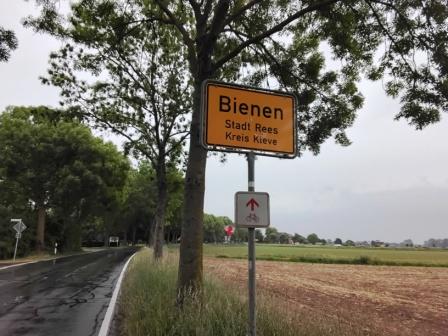
We travelled to Bienen from Xanten. (Photo credit: Daria Valkenburg)
From Xanten, we began the journey back into The Netherlands, with a slight detour along the way to Bienen, the scene of the Battle of Bienen on March 25, 1945. In 2023 we’d done a multi-part series on several soldiers from the North Nova Scotia Highlanders Regiment who had died in this battle. We wanted to see a memorial plaque, which was on a wall behind a church in Bienen.
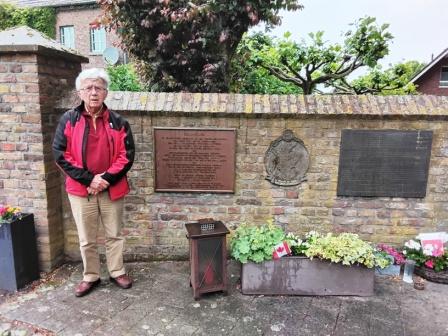
Pieter beside the memorial plaque behind a church in Bienen. (Photo credit: Daria Valkenburg)
Alice van Bekkum, Chair Faces To Graves Foundation Groesbeek, had told us that the memorial plaque by the church in Bienen, Germany, commemorating the lives lost by the North Nova Scotia Highlanders during the Battle of Bienen on March 25, 1945, was the “…first German/Canadian (Commonwealth) monument in Germany….”
It might have been raining while we were by the memorial plaque, but we made sure to remember:
- Clifford BATEMAN: https://onthewarmemorialtrail.com/2023/03/16/on-the-war-memorial-trail-the-battle-of-bienen-part-4-the-wwii-soldier-from-a-small-fishing-village-in-newfoundland-who-lost-his-life-in-germany/
- John Joseph BOHON: https://onthewarmemorialtrail.com/2023/03/18/on-the-war-memorial-trail-the-battle-of-bienen-part-5-the-wwii-soldier-whose-parents-immigrated-to-save-their-family-from-war/
- Ralph Schurman BOULTER: https://onthewarmemorialtrail.com/2023/03/07/on-the-war-memorial-trail-the-battle-of-bienen-part-2-the-wwii-battle-drill-instructor-from-oleary/
- Lawrence William BULGER: https://onthewarmemorialtrail.com/2024/08/19/on-the-war-memorial-trail-the-bulger-brothers-part-2-the-wwii-stretcher-bearer-from-foxley-river-killed-during-the-battle-of-bienen/
- Charles ‘Marshall’ CARSON: https://onthewarmemorialtrail.com/2023/03/12/on-the-war-memorial-trail-the-battle-of-bienen-part-3-the-wwii-soldier-from-cape-tormentine-who-lost-his-life-in-germany/
- Harry William DOUCETTE: https://onthewarmemorialtrail.com/2021/02/09/on-the-war-memorial-trail-atlantic-canada-remembers-part-6/
- Marven Glenroy HARVEY: https://onthewarmemorialtrail.com/2023/03/26/on-the-war-memorial-trail-the-battle-of-bienen-part-8-the-wwii-soldier-with-7-brothers-who-also-served/
- Kitchener ‘Kitty’ LANGILLE: https://onthewarmemorialtrail.com/2023/03/21/on-the-war-memorial-trail-the-battle-of-bienen-part-6-the-wwii-soldier-from-new-glasgow-nicknamed-kitty/
- Marvin William MCGREGOR: https://onthewarmemorialtrail.com/2023/04/02/on-the-war-memorial-trail-the-battle-of-bienen-part-9-the-wwii-soldier-from-west-jeddore-killed-in-germany/
- Austin Havelock MUNROE, plus a list of the 39 soldiers: https://onthewarmemorialtrail.com/2022/11/29/on-the-war-memorial-trail-the-search-for-a-photo-of-austin-havelock-munroe-is-on-youtube/ and https://onthewarmemorialtrail.com/2023/05/14/on-the-war-memorial-trail-the-battle-of-bienen-part-12-the-wwii-soldier-from-little-dover-who-lost-his-life-in-germany/
- Wilfred ‘Willy’ Joseph POWER: https://onthewarmemorialtrail.com/2023/04/10/on-the-war-memorial-trail-the-battle-of-bienen-part-10-the-wwii-soldier-who-wanted-to-be-a-paratrooper/
- Louis Allan SEXTON: https://onthewarmemorialtrail.com/2023/03/23/on-the-war-memorial-trail-the-battle-of-bienen-part-7-the-wwii-soldier-from-quebec-who-has-never-been-forgotten-by-his-family/
- Edison Alexander SMITH: https://onthewarmemorialtrail.com/2023/03/04/on-the-war-memorial-trail-the-battle-of-bienen-part-1-the-wwii-soldier-whose-body-shielded-a-wounded-major/
- John Lewis WALLACE: https://onthewarmemorialtrail.com/2023/05/02/on-the-war-memorial-trail-the-battle-of-bienen-part-11-the-wwii-soldier-from-canning-who-lost-his-life-in-germany/
….The final stop on our journey of remembrance was in Gendringen….

Pieter by the memorial in the cemetery in Gendringen. (Photo credit: Daria Valkenburg)
From Bienen, we returned to The Netherlands, stopping for a few moments in Gendringen, where 3 soldiers who had been researched by Pieter had lost their lives. Although it was still raining, we wanted to see the memorial, located in a cemetery in Gendringen.
The text on the memorial means ‘so that we don’t forget’, or, as said more commonly during Remembrance Services in Canada, ‘lest we forget’. While at the memorial, we remembered:
- Edmond COULOMBE: https://onthewarmemorialtrail.com/2021/12/24/on-the-war-memorial-trail-the-successful-search-for-a-photo-of-ww2-soldier-edmond-coulombe/
- Peter HYDICHUK: https://onthewarmemorialtrail.com/2025/11/15/on-the-war-memorial-trail-remembrance-week-2025-the-wwii-soldier-who-was-never-forgotten-by-his-girlfriend-and-her-family/
- Alphonse ROBERT: https://onthewarmemorialtrail.com/2021/04/15/on-the-war-memorial-trail-atlantic-canada-remembers-part-9/ and https://onthewarmemorialtrail.com/2021/10/12/on-the-war-memorial-trail-an-update-on-the-story-of-ww2-soldier-alphonse-robert/
By now, it was well after 4 pm, with the rain making the skies very grey. We were tired and still had a long drive back through heavy traffic to our hotel in Zaltbommel. Luckily, Pieter is a genius at staying calm in traffic, and we arrived safely, in time to enjoy a quiet and relaxing dinner.
This concludes the stories of the highlights of our 2025 European War Memorial Tour to commemorate the 80th Anniversary of the Liberation of Europe.
Our trip is now long over, but the research work continues for Pieter. If you have photos or information to share about soldiers buried in The Netherlands or Belgium, please email him at memorialtrail@gmail.com, or comment on the blog.
© Daria Valkenburg
….Want to follow our research?…
If you are reading this posting, but aren’t following our research, you are welcome to do so. Our blog address: https://onthewarmemorialtrail.com/
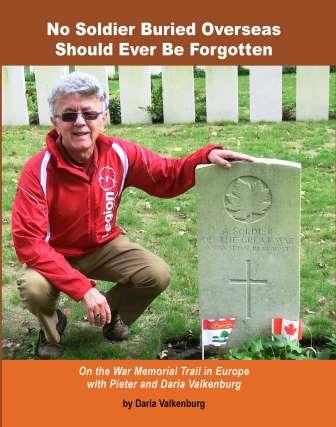 4 countries, 6 weeks, 7,000 km – an unforgettable war memorial journey in Europe…. Daria’s book ‘No Soldier Buried Overseas Should Ever Be Forgotten‘ is available in print and e-book formats. Net proceeds of book sales help support research costs and the cost of maintaining this blog. For more information see https://nosoldierforgotten.com/
Subscribe to our YouTube Channel: On The War Memorial Trail With Pieter Valkenburg: https://www.youtube.com/channel/UCJ591TyjSheOR-Cb_Gs_5Kw.
Never miss a posting! Subscribe below to have each new story from the war memorial trail delivered to your inbox.




 On The War Memorial Trail Research Project........ with Pieter and Daria Valkenburg