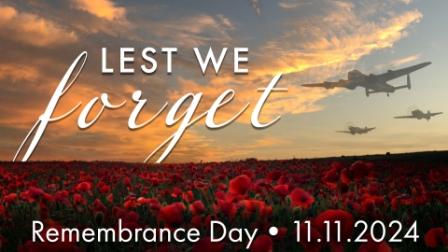
November 7, 2024. As we reflect on the service and sacrifices made by so many who have served, both during conflicts and in peacetime, I took a look back at previous stories told over the years. 2024 commemorates 100 years of service for the Royal Canadian Air Force (RCAF) as a distinct military element, and so it seemed appropriate to dedicate this posting to stories previously told of those who served in the RCAF during WWII.
…The Air Force Heritage Park in Summerside has a commemorative stone honouring Flight Officer Joe McIver….

Entrance to Air Force Heritage Park in Summerside. (Photo credit: Daria Valkenburg)
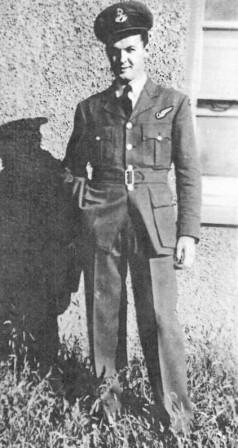
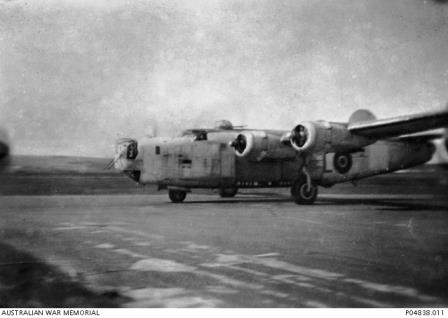
Several years ago we visited the Air Force Heritage Park in Summerside to look at the commemorative stone honouring Flight Officer Joseph ‘Joe’ Charles MCIVER of Kinkora, Prince Edward Island. Joe was the navigator aboard B24 Liberator MkVIII EV895 on November 18, 1944, when it went down near the Arctic Circle while on anti-submarine patrol looking for a suspected U-boat off Gardskagi, Iceland. There were no survivors.
You can read his story at:
- https://onthewarmemorialtrail.com/2019/08/17/the-ww2-flight-officer-whose-plane-went-down-while-on-patrol-near-the-arctic-circle/
- https://onthewarmemorialtrail.com/2023/01/14/on-the-war-memorial-trail-a-wwii-letter-from-somewhere-in-north-russia/
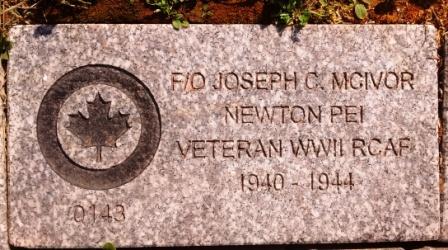
Commemorative Stone at Air Force Heritage Park, Summerside, Prince Edward Island. (Photo credit: Pieter Valkenburg)
… Pilot Elmer Muttart saved his crew and the Dutch village of Wons but sacrificed his own life to do so ….
The very first airman whose story was researched by Pieter was that of Elmer Bagnall MUTTART of Cape Traverse, Prince Edward Island, whose name is listed on the Cenotaph outside the Borden-Carleton Legion. Elmer was the pilot aboard Halifax L9561 when it was shot twice by German night fighters on October 12, 1941, while the plane was on its way to a bombing raid on Bremen, Germany.
After ordering the crew to bail out, Elmer managed to steer the burning plane away from the Dutch village of Wons, in the province of Friesland, before it crashed in a farmer’s field, just outside the village. He was the only casualty and is buried in Harlingen General Cemetery in The Netherlands. The rest of the crew spent the war years in prisoner of war camps before being liberated. On October 12, 2019, a memorial panel was placed near the crash site in Wons to honour Elmer and his crew, an emotional journey for all of us who attended.
You can read his story here:
- https://onthewarmemorialtrail.com/2017/07/28/the-elmer-bagnall-muttart-story/
- https://onthewarmemorialtrail.com/2019/12/02/the-memory-of-elmer-muttart-lives-on/
- https://onthewarmemorialtrail.com/2020/05/15/the-halifax-l9561-crew-remembered-in-wons/
- https://onthewarmemorialtrail.com/2019/11/18/on-the-war-memorial-trail-the-memorial-panel-in-wons-is-unveiled/
- https://onthewarmemorialtrail.com/2018/02/07/on-the-war-memorial-trail-at-the-politiek-farm-in-wons/
- https://onthewarmemorialtrail.com/2020/01/31/he-died-that-we-might-live-video-is-now-on-youtube/
… Pilot Hubert Hall was a prisoner of war after his plane was shot down in 1942 ….
John ‘Hubert’ HALL of Summerside, Prince Edward Island, was the pilot aboard Wellington Z1203, which crashed in The Netherlands near Mijdrecht on the night of March 28/29, 1942. Hubert spent the remainder of the war years as a prisoner of war in POW camp Stalag Luft III, located in present-day Żagań, Poland, before returning home to Canada.
You can read his story at:
- https://onthewarmemorialtrail.com/2023/10/23/on-the-war-memorial-trail-an-island-airman-in-stalag-luft-iii-part-1-2-families-connected-by-1-letter-from-a-pow-camp/
- https://onthewarmemorialtrail.com/2023/10/30/on-the-war-memorial-trail-an-island-airman-in-stalag-luft-iii-part-2-escape-from-the-pow-camp/
… Navigator Bunky FitzGerald is in an unmarked grave after Halifax W1175 crashed off the Dutch coast….
Rowan Charles ‘Bunky’ FITZGERALD, of Charlottetown, Prince Edward Island, was the navigator aboard Halifax W1175 of the 405th Vancouver Squadron RCAF when it was hit by shellfire (flak) as the plane was returning from Bremen, Germany on the morning of June 28, 1942.
The plane crashed into a sandbank in the Wadden Sea, off the Dutch coast between the Island of Texel and the mainland, 15.5 km from Harlingen, in the province of Friesland. There were no survivors. Only one crew member’s body was identified, and was buried in Harlingen General Cemetery in The Netherlands. His grave is between 3 unknown graves, one of which may just contain the remains of Bunky FitzGerald.
You can read his story at:
… Pilot Lorne MacFarlane survived all his flights and returned home…
Pilot Lorne MACFARLANE, of Fernwood, Prince Edward Island, successfully flew 40 missions overseas and was then assigned to fly dignitaries, mail, and personnel between England and the front lines until the war ended. After returning safely back to Canada, he was the Officer In Charge at RCAF No 1 Radio and Navigation School in Summerside, Prince Edward Island.
You can read his story at:
… Wireless operator Bob Dickie almost made it safely back to England…
Robert ‘Bob’ James DICKIE, of Carlton (now Borden-Carleton), Prince Edward Island, was the wireless operator aboard Lancaster JB312 on February 21, 1944 when it collided with another plane during a bombing sortie in Stuttgart, Germany. Although badly damaged, the plane was able make it back to England, but then crashed as it approached the runway. There were no survivors. Bob is buried at Cambridge City Cemetery in England.
You can read his story at:
… Pilot Leonard Unwin’s plane crashed on Christmas Eve…
Pilot Leonard Arthur UNWIN, of Windsor, Ontario, was a flying instructor in Summerside, Prince Edward Island and Moncton, New Brunswick, before going overseas in May 1943. On December 24, 1944, he left from his base in Belgium, one of the pilots in a section of 4 Typhoon planes on an armed reconnaissance in the Utrecht area in The Netherlands. While attacking a convoy of three German trucks in Woudenberg, the plane’s tailpiece broke off, the plane destabilized, and crashed. He’s buried in Woudenberg Municipal Cemetery in The Netherlands.
You can read his story at:
… Flight student Ralph McCutcheon lost his life in a training accident…
Flight student Ralph Gordon MCCUTCHEON, of Toronto, Ontario, but who was born in Buffalo, New York, USA, lost his life in a tragic accident that happened during his training at the No. 9 Service Flying Training School RCAF in Summerside, Prince Edward Island on the morning of June 11, 1942. While training in a Harvard MK2 plane, it crashed in a farm field in North Tryon, Prince Edward Island.
You can read his story at:
- https://onthewarmemorialtrail.com/2020/08/20/on-the-war-memorial-trail-the-1942-plane-crash-in-north-tryon/
- https://onthewarmemorialtrail.com/2022/02/20/on-the-war-memorial-trail-ww2-flight-student-ralph-mccutcheons-family-remembers/
… Gunner William Andrew Hood was aboard the last flight of Halifax JD215…
William Andrew HOOD, of Little Bras D’or, Cape Breton Island, Nova Scotia, was the mid-upper gunner aboard Halifax JD215 when it was shot down over The Netherlands on June 29, 1943. None of the crew survived. He’s buried in Eindhoven General Cemetery in Eindhoven, The Netherlands.
You can read his story at:
… Navigator Arnold Hupman was aboard Lancaster X KB728 VR-V when it exploded over Arnhem, The Netherlands…
Navigator Arnold Freeman HUPMAN, of East Side of Ragged Island, Shelburne County, Nova Scotia, lost his life when the Lancaster bomber he was in, Lancaster X KB728 VR-V, was attacked by a German night fighter and exploded on the outskirts of Arnhem, The Netherlands as it was returning from a bombing operation against the synthetic oil plant at Sterkrade in Germany on the night of June 16 to 17, 1944. There were no survivors, and all 7 crew members are now buried in the Canadian War Cemetery in Groesbeek, The Netherlands.
You can read his story at:
… Pilot Douglas MacKenzie did not survive the last flight of Halifax DT630…
Jack ‘Douglas’ MACKENZIE, of Winnipeg, Manitoba, was the pilot of Halifax DT630 (call sign VR-T), one of 8 heavy Halifax bombers sent on a night raid to Hamburg, Germany on February 3, 1943. It was shot down by a night fighter over the province of Drenthe in The Netherlands. 4 men died, including Douglas, while 3 survived and spent the remainder of the war in prisoner of war camps. He’s buried in Sleen General Cemetery in The Netherlands, along with the other 3 casualties of that flight.
You can read his story at:
… Pilot Dusty Millar’s spitfire ran out of fuel and crashed…
George Glenn ‘Dusty’ MILLAR, of Winnipeg, Manitoba, was killed on September 28, 1944 while flying a Spitfire Mark IX on patrol with his squadron over Nijmegen, The Netherlands. After Dusty reported on his radio that the plane was low in fuel, it crashed southeast of Weibosch near Schijndel, in the Dutch province of Noord-Brabant. He is buried in Uden War Cemetery in The Netherlands.
You can read his story at:
May we never forget the sacrifices made by these airmen, and their families, during WWII. Unfortunately, while we live free in Canada, so many people today live in a war zone and are experiencing death, uncertainty, and insecurity in not knowing what will happen next. Lest we forget is never more appropriate.
If you have a story to tell, please let Pieter know. You can email him at memorialtrail@gmail.com, comment on the blog, or send a tweet to @researchmemori1.
© Daria Valkenburg
….Want to follow our research?….
If you are reading this posting, but aren’t following our research, you are welcome to do so. Our blog address: https://onthewarmemorialtrail.com/
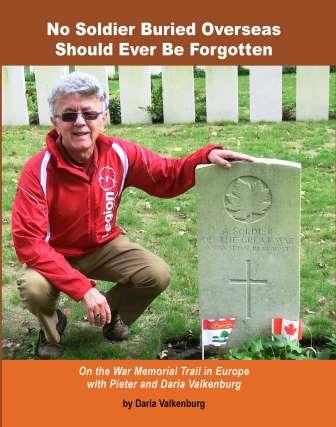 4 countries, 6 weeks, 7,000 km – an unforgettable war memorial journey in Europe…. Daria’s book ‘No Soldier Buried Overseas Should Ever Be Forgotten‘ is available in print and e-book formats. Net proceeds of book sales help support research costs and the cost of maintaining this blog. For more information see https://nosoldierforgotten.com/
You are also invited to subscribe to our YouTube Channel: On The War Memorial Trail With Pieter Valkenburg: https://www.youtube.com/channel/UCJ591TyjSheOR-Cb_Gs_5Kw.
Never miss a posting! Subscribe below to have each new story from the war memorial trail delivered to your inbox.



 On The War Memorial Trail Research Project........ with Pieter and Daria Valkenburg
