July 24, 2023. When Pieter was contacted by Ivan MacDonald about Ivan’s father, we initially thought we would be researching a WWII soldier from Prince Edward Island. We were wrong. Ivan’s father, Angus Clayton MACDONALD, served in WWI!
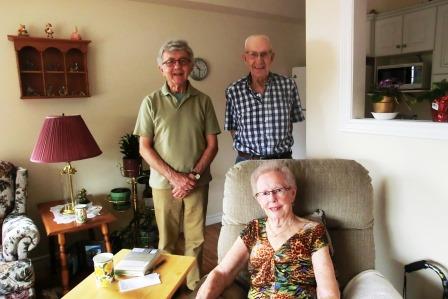
Pieter with Ivan MacDonald and Ivan’s wife Edna. (Photo credit: Daria Valkenburg)
“…He was brought up by his grandparents in Mount Tryon…” Ivan explained.
Ivan’s nephew, Philip MacDonald, sent us the Service Regimental Number for Angus, which meant Pieter could easily find the WWI Service File. “…Angus MacDonald was my grandfather. He was born on May 2, 1896 to a single mom, Alice MacDonald, who later married John Heatly (aka Hately) from Tryon. Grampy was raised by Donald and Christy MacDonald so this is how as a boy he learned to speak Gaelic….”
…Angus enlisted in Charlottetown…

Angus Clayton MacDonald. (Photo courtesy of the MacDonald Family. Photo colourization by Pieter Valkenburg)
On August 29, 1917, the Military Service Act came into effect, stating that all males between 20 and 45 were subject to conscription until the end of the war. (See https://www.thecanadianencyclopedia.ca/en/article/military-service-act)
The enlistment form for Angus noted that he had been drafted when he enlisted with H Company, 1st Depot Battalion, Nova Scotia Regiment, in Charlottetown, Prince Edward Island, on March 21, 1918. In the form, he stated that he was born on May 2, 1897 in Tryon, Prince Edward Island, and was a farmer. (This was a year later than other records stated.)
We asked Ivan if Angus had enlisted at the same time as any relatives or friends, and he said he didn’t know. We found that Bruce Sutherland MCKAY, who grew up not far from Angus, enlisted on the same day in the same Regiment. (See https://onthewarmemorialtrail.com/2019/04/22/the-ww1-soldier-who-never-made-it-to-the-front/)
…Angus sailed to England aboard the SS Scotian…
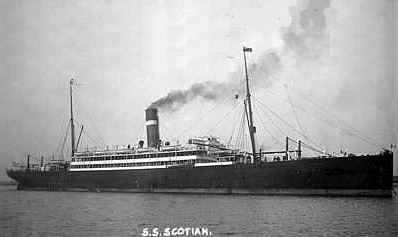
Angus Clayton MacDonald and Bruce Sutherland McKay travelled to England on the same voyage aboard the troopship Scotian. (Photo source: https://birtwistlewiki.com.au/wiki/HMT_Scotian)
Within a few weeks of enlistment Angus was on his way to the United Kingdom, aboard the troopship SS Scotian, arriving in Liverpool, England on April 28, 1918.
Upon arrival, Angus was sent to Segregation Camp, Frensham Pond, in Bramshott. This was a prudent measure as the first wave of infectious diseases had already affected men held in crowded conditions. In April 1918, senior military officials had set up segregation camps to hold arrivals from Canada for 28 days before joining their units.
Bruce Sutherland McKay was on the same voyage, but once they docked in England, their paths diverged as McKay had developed scarlet fever during the journey.
On May 5, 1918, Angus was admitted to the 12th General Hospital in Bramshott with mumps. It wasn’t until July 10, 1918 that he was discharged, assigned to the 2nd Canadian Convalescent Depot (CCD) and sent to the Nova Scotia Regimental Depot (NSRD), which was at Bramshott. This was the facility behind the front used to assemble men and to store and administer equipment and materials.
On August 10, 1918, he was deemed fully recovered and transferred to the 17th Canadian Reserve Battalion in Bramshott for training and preparation for the fighting at the front.
…Angus qualified as a marksman…
Philip had wondered if the crossed rifles on the sleeve of his grandfather’s uniform had any significance. It meant that he had successfully passed a marksman course, which entitled him to wear crossed rifles on his uniform. A marksman was not a sniper, which required further training. (See https://en.wikipedia.org/wiki/Marksman)
On October 26, 1918, Angus was transferred to the 85th Battalion (Nova Scotia Highlanders) and sent to France. (For more information, see https://en.wikipedia.org/wiki/85th_Battalion_(Nova_Scotia_Highlanders),_CEF)
The war was nearing its end, with much of the German Army in retreat following the Battle of Valenciennes on November 1, 1918. (See https://en.wikipedia.org/wiki/Battle_of_Valenciennes_(1918))
Allied troops kept up the pressure with a general advance, and on November 4, 1918, the 3rd and 4th Canadian Divisions arrived on both sides of the Valenciennes-Mons road. The Allied objective? Cross the French border into Belgium and forge a passage through the parallel rivers of the Grand Honnelle and Petite Honnelle, moving the battlefront towards the line between Mons on the left and Aulnois on the right.
…Angus was wounded in the last week of WWI…
On November 5, 1918, the Passage of the Grande Honnelle Battle began around Honnelles, and lasted until November 7, 1918. Located in Belgium, Honnelles is a small village near the French border, located near the Petite Honnelle river. (See https://en.wikipedia.org/wiki/Passage_of_the_Grande_Honnelle)
The 85th Battalion was part of the 4th Canadian Division, which initially stayed on the French side of the border before crossing the border into Belgium. On November 6, 1918 Angus received gunshot wounds to both arms and was sent to the 23rd Casualty Clearing Station.
On November 10, 1918, Angus was transferred to the No. 22 General Hospital in Camiers, France before being transported back to England on November 27, 1918. He was hospitalized at Clandon Park House until January 30, 1919. (See https://en.wikipedia.org/wiki/Clandon_Park_House)
From Clandon Park, he was transferred to Woodcote Park Military Convalescent Hospital in Epsom, until he was discharged on February 19, 1919. (See https://wartimememoriesproject.com/greatwar/hospitals/hospital.php?pid=18196)
Upon discharge he returned to the 17th Reserve Battalion camp, located in Ripon in North Yorkshire, before being sent on March 19, 1919 to Kinmel Park Camp in Wales, about 48 km from Liverpool, where he and other soldiers waited their turn to board a ship back to Canada.
Competition for shipping among the Allied powers, labour disruption due to strikes by dockworkers, seamen, miners and police, and shortages of food and coal made for miserable conditions.
Luckily, Angus didn’t have to wait long before he boarded the SS Megantic, returning to Canada and receiving his discharge certificate on April 16, 1919 in Charlottetown, Prince Edward Island.
…Civilian life with a wife and children…
Upon returning to civilian life, Angus worked in fishing for Harry Crossman in Cape Traverse, Prince Edward Island. He bought a motorcycle, and on a trip to visit his aunt in Lower Bedeque, he met Ruby Frances Rose of nearby Chelton. They married on October 27, 1921 and raised 3 sons and a daughter.

Ruby and Angus MacDonald with son Eldon in 1922. (Photo courtesy of the MacDonald family)
“…Eldon was the oldest, born in 1922. I was born in 1930. Herbert, who was Philip’s father, was born in 1933…” Ivan told us.
“…In the 1930s he sold Plymouth cars in Summerside, but times were very tough due to the Depression…” Ivan recalled. “…He was very smart, and could do mechanical work, carpentry, build a flue, just as a few examples. He had a small workshop and made axe handles….”
…Angus died in 1979 following a stroke…
After suffering a stroke, Angus died a few months later, on April 30, 1979 at Prince County Hospital in Summerside, Prince Edward Island. He was buried at the Lower Bedque Cemetery.
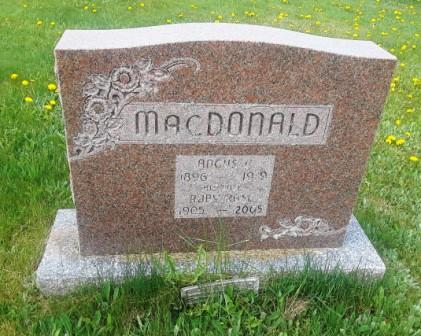
Grave of Angus Clayton MacDonald at Lower Bedeque Cemetery. (Photo source: http://www.findagrave.com)
Philip MacDonald wrote Pieter to say “… I very much enjoy the stories of all the veterans you and your wife have written for the County Line Courier. I feel it is important to recognize that these men had a life and family they left behind because their country asked them to do so. I’m not sure this is something many of us really consider when we hear the names being read once a year on Remembrance Day…”
Thank you to Ivan and Edna MacDonald for sharing information about Ivan’s father, and to Philip MacDonald for sharing information and finding his grandfather’s Service Regimental Number.
Do you have a story to tell? Pieter encourages you to email him at memorialtrail@gmail.com, comment on the blog, or tweet to @researchmemori1.
© Daria Valkenburg
…Want to follow our research?…

If you are reading this posting, but aren’t following our research, you are welcome to do so. Our blog address: https://onthewarmemorialtrail.com/
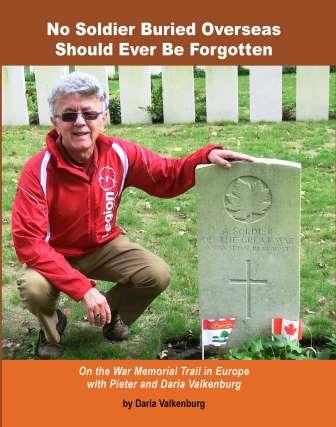 4 countries, 6 weeks, 7,000 km – an unforgettable war memorial journey in Europe…. Daria’s book ‘No Soldier Buried Overseas Should Ever Be Forgotten‘ is available in print and e-book formats. Net proceeds of book sales help support research costs and the cost of maintaining this blog. For more information see https://nosoldierforgotten.com/
Subscribe to our YouTube Channel: On The War Memorial Trail With Pieter Valkenburg: https://www.youtube.com/channel/UCJ591TyjSheOR-Cb_Gs_5Kw.
Never miss a posting! Subscribe below to have each new story from the war memorial trail delivered to your inbox.




 On The War Memorial Trail Research Project........ with Pieter and Daria Valkenburg