January 6, 2024. In going through the photo wish lists for soldiers buried in The Netherlands, Pieter often picks a name based on location – especially if we are planning to visit that area – or by name. Lawrence Arthur RUDOLPH, listed as being from Guysborough, got his attention for both reasons. We’d had very good luck with soldiers from Guysborough, and the surname Rudolph was one he thought might be easier to trace.
Pieter was in luck as he was soon in contact with Elsie Hartling, whose mother, Lillian M. Rudolph, was Lawrence’s sister, and she had a photo, which was kindly sent to us by her nephew Andrew Hartling.
Born December 31, 1923 in Liscomb, Guysborough County in Nova Scotia, Lawrence was the son of Basil Melbourn and Elsie Rudolph. Before enlisting with the No. 6 District Depot on April 21, 1943 in Halifax, Nova Scotia, he was employed as a pipe fitter.

Lawrence Arthur Rudolph. (Photo courtesy of Elsie Hartling)
On April 30, 1943, Lawrence was sent to No. 60 Canadian Army Basic Training Centre (CABTC) in Yarmouth, Nova Scotia for initial training. After completing his basic training, he was assigned to A2 Canadian Artillery Training Centre (CATC) in Petawawa, Ontario for training as a gunner.
On November 1, 1943, Lawrence was transferred to No. 1 Training Brigade in Debert, Nova Scotia, in preparation for overseas service.
… Lawrence left Canada for overseas service in December 1943…
On December 15, 1943 Lawrence left Canada for the United Kingdom. Upon arriving on December 21, 1943 he was assigned to 2nd Canadian Artillery Reinforcement Unit (CARU).
Then, on January 14, 1944, Lawrence was transferred to the 5th Canadian Anti-Tank Regiment, Royal Canadian Artillery, and underwent further training, qualifying as a Driver i/c (Wheeled) on May 9, 1944. (The term ‘Driver i/c’ refers to ‘Driver, internal combustion’. Wheeled refers to wheeled vehicles.)
Preparations for going to the front were ongoing, but, as noted in ‘The History of the 5th Anti-Tank Regiment’, a compilation edited by John P. Claxton, “….at first light on 18th July 1944, the Regiment moved off in convoy, destination was Tilbury Docks, and the trip to the Marshalling Area was made without incident….”
It took time to load vehicles and equipment onto the ships, but “…in due course and with numerous pauses for tea, civilian longshoremen completed the task of loading vehicles into the holds of ships….”
… Lawrence left for France in July 1944 with his Regiment…
“…After a couple of days at anchor at South End…” Lawrence left for France with his Regiment on July 21, 1944 when “…the convoy moved out of the Thames Estuary and through the channel under cover of darkness and a light mist…”
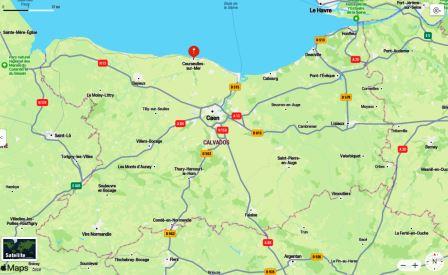
The 5th Canadian Anti-Tank Regiment arrived at Courceulles-Sur-Mer and then travelled down towards Caen and Falaise. (Map source: Wikipedia)
They arrived “…off the beaches at Courceulles-sur-Mer, Normandy in a blaze of anti-aircraft fire…Further delay was caused by rough weather and scarcity of landing craft…..”
Finally, after several days, all personnel and equipment reached land, and “…the Regiment proceeded through pulverized villages and over the remains of country roads to our concentration area near Graye-sur-Mer….”
The Regiment fought its way across France, going past Caen to the Falaise Gap, into the Somme. By September 1944 they reached Belgium, and began the push towards Antwerp, and then, in mid-October, into The Netherlands.
… Lawrence lost his life during Operation Blockbuster…
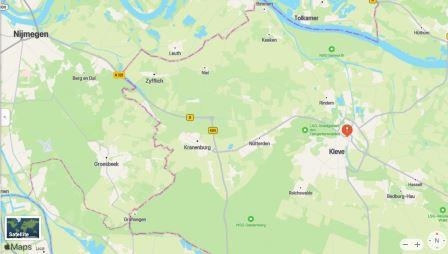
The 5th Canadian Anti-Tank Regiment left The Netherlands for Germany. On February 27, 1945 Lawrence Rudolph lost his life near present day Bedburg-Hau, Germany, during Operation Blockbuster. (Map source: Wikipedia)
The Regiment’s time in The Netherlands ended on February 22, 1945, “… when the Regiment moved to concentration areas south of Cleve in Germany….” to participate in Operation Blockbuster. (See https://en.wikipedia.org/wiki/Operation_Blockbuster)
“…..Operation Blockbuster began at dawn on the 26th February, in abominable weather. The state of the ground precluded use of towed 17-pounder guns, but our Crusader Towers did outstanding work. Loaned with drivers to the assaulting formation, they were used as armoured troop carriers to get the infantry through heavy fire on their objectives, and then were employed to move casualties and supplies….”
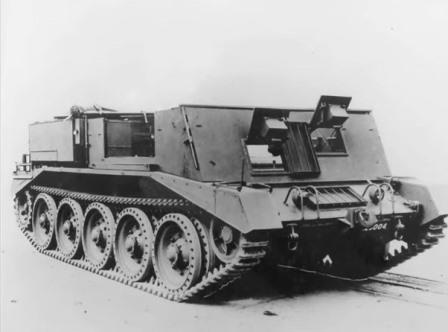
A Crusader Tower was a tracked vehicle with room for a gun crew. (Photo source: YouTube WW2TV Crusader Gun Tractor)
Casualties were heavy, due to “…high velocity gun, artillery, and extensive minefields…” The weather deteriorated. By February 27, 1945, “…continuous deluges of rain with occasional wet snow, combined with the volume and weight of traffic, were rapidly converting roads into impassable masses of mud and dislodged cobblestones…”
Lawrence was in the midst of this, as the Crusader Towers were needed “….to move ammunition to the field guns…” followed by moving “….the guns themselves which were up to their muzzles in bog…”
At some point on the morning of February 27, 1945, Lawrence lost his life due to sniper fire. The War Diary entry for February 27, 1945 for the 14th Battery of the 5th Canadian Anti-Tank Regiment recorded that at 9 am the battery was “…. ordered to proceed further ….” towards Keppeln. “…Half-track, while being towed, struck a carrier. Captain Gerla, Sergeant Carmicheal take Lt Sheid’s carrier to lead convoy. Lt Sheid proceeded back to Ech at Hau with carrier. On route to battery area, convoy fired on by snipers. Gunner Rudolph was killed and died instantly….” Hau is present-day Bedburg-Hau, just a few km from Kleve.
… Lawrence is buried in the Canadian War Cemetery in Groesbeek…
Lawrence was initially buried in a temporary cemetery 4.8 km (3 miles) south of Kleve, Germany. In 1946, he was reburied in the Canadian War Cemetery in Groesbeek, The Netherlands.

Grave of Lawrence Arthur Rudolph at the Canadian War Cemetery in Groesbeek. (Photo source: Find A Grave)
Thank you to Elsie and Andrew Hartling for sharing a photo of Lawrence Arthur Rudolph, and to the contributors at WW2Talk for information on the Crusader Tower. Do you have photos or information to share? Email Pieter at memorialtrail@gmail.com, or comment on the blog.
© Daria Valkenburg
….Want to follow our research?….
If you are reading this posting, but aren’t following our research, you are welcome to do so. Our blog address: https://onthewarmemorialtrail.com/
 4 countries, 6 weeks, 7,000 km – an unforgettable war memorial journey in Europe…. Daria’s book ‘No Soldier Buried Overseas Should Ever Be Forgotten‘ is available in print and e-book formats. Net proceeds of book sales help support research costs and the cost of maintaining this blog. For more information see https://nosoldierforgotten.com/
You are also invited to subscribe to our YouTube Channel: On The War Memorial Trail With Pieter Valkenburg: https://www.youtube.com/channel/UCJ591TyjSheOR-Cb_Gs_5Kw.
Never miss a posting! Subscribe below to have each new story from the war memorial trail delivered to your inbox.
 On The War Memorial Trail Research Project........ with Pieter and Daria Valkenburg