March 2, 2026. The search for photos of soldiers who lost their lives in wartime sometimes takes Pieter on unexpected paths. Whenever possible, he tries to help other researchers. One of them was David Archer, who explained that he was “…with the 48th Highlanders army reserve in the 1970s….”
Over the past 20 plus years, David has been looking for photos of members from that Regiment, and when he wrote to Pieter, he said that “… there is one PEI soldier on my cold list. His name is Kevin Delorie KIA Dec 20th 1943. …”
Pieter decided to help find a photo, and the search for a photo of WWII soldier Kevin Joseph DELORIE began. Pieter’s initial research found that most of the family moved to Oregon (USA), but one sister, Margaret ‘Clare’, married a Murphy and remained in Canada.
….A newspaper appeal led to family and a photo of the soldier…
In the hope to find family, Charlotte MacAulay, Editor of the Eastern Graphic newspaper was contacted, and she agreed to publish a photo appeal. (See EAG-A04-102324-K Searching for photo of Kevin Delorie)
Within hours of the article being published, Pieter received a phone call from Bernice Delory in Georgetown, Prince Edward Island, saying that Clare had a photo at one time. Bernice gave Pieter contact information for Clare’s daughter, Tammy Murphy, in Halifax. When he called her, Tammy said that her brother, Tim Murphy, a retired teacher in Montague, may have photos.
She called Tim and it wasn’t long before we were on our way to Montague to meet Tim, Clare, and Clare’s nephew, Norbert Murphy, who brought the photos. Charlotte MacAulay came as well, to do a follow-up story. (See EAG-A11-110624 C Remembering Kevin Delorie) “…It’s wonderful that Kevin is being honoured…” Clare said.
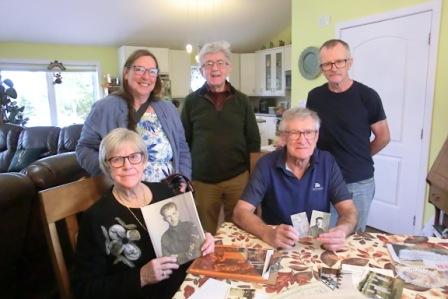
Left to right: Clare Murphy holding a photo of her brother Kevin, Charlotte MacAulay, Pieter, Norbert Murphy, Tim Murphy. (Photo credit: Daria Valkenburg)
Born June 30, 1923 in Newport, Prince Edward Island, Kevin was the son of Eugene and Catherine ‘Katie’ (nee McDonald) Delorie.
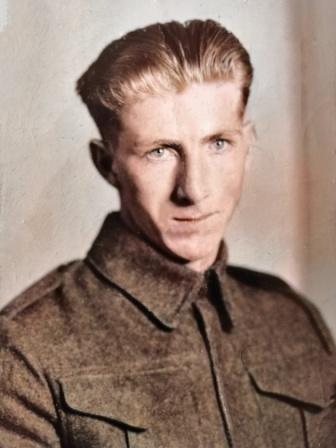
Kevin Joseph Delorie. (Photo courtesy of the Delorie Family. Photo colourization: Pieter Valkenburg)
When he enlisted on August 15, 1940 with the Prince Edward Island (PEI) Highlanders in Charlottetown, Prince Edward Island, Kevin stated he was born in 1921, adding 2 years to his actual age of 17. At 6 feet 4 inches (1.93 metres), he was very tall! Clare told us that she had travelled with her brother from Newport to Charlottetown on the day that he enlisted.
After completing his basic training at No. 62 Canadian Army (Basic) Training Centre in Charlottetown, he joined others from PEI Highlanders in serving at the Halifax Fortress (specifically the Halifax Citadel and surrounding areas in Nova Scotia), tasked with guard duties and receiving additional training in the Halifax/Dartmouth area as part of Canada’s home defence.
Kevin remained in Halifax until June 3, 1941, when he was sent to Valcartier, Quebec in preparation for guard duty in Newfoundland. Another Islander was with him – Daniel ‘Dan’ Peter MACKENZIE. (See https://onthewarmemorialtrail.com/2023/06/29/on-the-war-memorial-trail-the-wwii-soldier-from-victoria-cross-fatally-wounded-during-the-liberation-of-posterenk/)
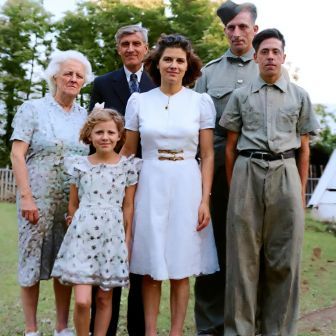
Back row: Kevin Delorie with his parents Katie and Eugene. Front row: siblings Clare, Rose, and Francis. (Photo courtesy of the Delorie Family. Photo restoration and colourization: Pieter Valkenburg)
… Kevin was sent to Newfoundland as part of ‘W’ Force….

Location of Botwood Military Base in Newfoundland. (Map source: http://postalhistorycorner.blogspot.com/2012/12/wwii-canadian-forces-in-newfoundland.html)
After France was occupied by the Germans in 1940, Newfoundland’s defensive position became more precarious. That same year, Canada assumed responsibility for the defence of Newfoundland with the establishment of ‘W Force’, a Canadian garrison force responsible for defending Newfoundland against enemy invasion and attacks, and providing security for existing and proposed defence facilities during WWII. It included infantry, artillery, and anti-aircraft units. (See https://en.wikipedia.org/wiki/Military_history_of_Newfoundland_during_World_War_II)
On July 23, 1941, as part of ‘W Force’, Kevin was sent to Botwood, Newfoundland. In addition to the PEI Highlanders, troops from the Black Watch of Canada, Royal Rifles of Canada, The Algonguin Regiment, Queens Own Rifles, also served at various times. While an RCAF base in Botwood had aircraft patrolling the east coast of the Atlantic, Canadian Army personnel based at Botwood were charged with protection of military facilities that had been installed there, as well as in Gander. (See https://www.heritage.nf.ca/articles/politics/botwood-base.php)
…..Four other soldiers were in Botwood…..
Kevin was in Botwood at the same time as four other soldiers whose stories have been told on this blog:
- Albert Joseph COTE: https://onthewarmemorialtrail.com/2022/07/27/on-the-war-memorial-trail-the-wwii-stretcher-bearer-whose-compassion-cost-him-his-life/
- Carman Edward GILLCASH: https://onthewarmemorialtrail.com/2022/10/22/on-the-war-memorial-trail-the-wwii-soldier-from-glenwood-killed-during-the-battle-of-the-delfzijl-pocket/
- Daniel ‘Dan’ Peter MACKENZIE: (See https://onthewarmemorialtrail.com/2023/06/29/on-the-war-memorial-trail-the-wwii-soldier-from-victoria-cross-fatally-wounded-during-the-liberation-of-posterenk/)
- James ‘Frank’ MOSSEY: https://onthewarmemorialtrail.com/2022/08/09/on-the-war-memorial-trail-the-wwii-soldier-from-souris-killed-during-the-liberation-of-posterenk/
On March 1, 1943, Kevin was temporarily promoted to the rank of Lance Corporal. Then, on March 20, 1943, he left Newfoundland, and was sent to Sussex, New Brunswick. On June 2, 1943, Kevin was transferred to the No. 1 Transit Camp in Windsor, Nova Scotia, for final preparation and training before being sent overseas.
…..Kevin was in North Africa before going on to Italy….
Kevin boarded a ship on June 10, 1943, which left Canada on June 11, 1943. Upon arriving in the United Kingdom on June 18, 1943, he was posted to No. 7 Canadian Infantry Reinforcement Unit (CIRU), where he reverted back to the rank of private. Training continued to prepare troops who would be part of the Central Mediterranean Force (CMF).
On September 12, 1943, Kevin was transferred to the West Nova Scotia Regiment’s X-4 Reinforcement List, and boarded a ship that left the United Kingdom. He arrived in North Africa on September 23, 1943, and was attached to ‘B’ Company of the 3rd Battalion of the British North Africa Force (BNAF), prior to being sent on to Italy.
On October 7, 1943 he wrote a note to his mother, confirming that he was “…now down in North Africa….” He went on to write that “…I haven’t had any mail for 6 weeks…” and commented that “….the weather is fairly warm. We buy lots of fruit such as grapes and melons. The oranges will soon be ripe…”
Mail arrived for Kevin, as he noted in an October 23, 1943 letter to his father. He was still in North Africa, but had been reassigned to D Company, 1st Battalion, No. 1 Canadian Base Reinforcement Depot (CBRD), Canadian Army, BNAF.
On November 12, 1943, Kevin was part of the 4th Battalion and on his way to Italy with the CMF and the Allied Army in Italy (AAI) for the Italian Campaign, joining the West Nova Scotia Regiment, as it prepared to move towards Agnone, on November 29, 1943, one of 42 reinforcements. (See https://en.m.wikipedia.org/wiki/Italian_campaign_(World_War_II))
On December 6, 1943, Canadian forces, along with British, Indian, and New Zealand infantry divisions, began the Moro River Campaign, a series of large-scale assaults on major crossing points along the Moro River in Eastern Italy, with the objective of securing a large bridgehead along the defensive line. The intention was to breach the German Army’s Winter Line defensive system and advance to Pescara—and eventually Rome. (For more information see https://en.wikipedia.org/wiki/Moro_River_Campaign)
…..Kevin was transferred to the 48th Highlanders Regiment….
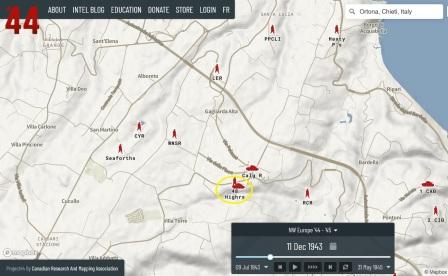
Position of 48th Highlanders on December 11, 1943 (see yellow circle). WNSR to the left shows the position of the West Nova Scotia Regiment that Kevin had been with. (Map source: Project 44)
On December 11, 1943, he was transferred to ‘B’ Company of the 48th Highlanders Regiment, joining them after they had moved from the Ortona area towards Villa Torre. In what would be his last letter home, he wrote to his mother on December 14, 1943. “….Just a few lines to say I’m OK and to give you another address. I am now with the 48th Highlanders. Aeneas Johnston and I came to the same company. I don’t know where Charlie MacDonald is, he went to some other company…”
Kevin was referring to Aeneas Daniel JOHNSTON, born in Primrose, Prince Edward Island, was the son of Joseph and Gertrude Johnston, and husband of Mary Johnston. Aeneas had been killed on December 8, 1943 and is buried in Moro River Canadian War Cemetery in Italy.
It’s possible that Kevin was referring to Charles James MACDONALD, who was born in New Annan, Prince Edward Island, son of Mr. and Mrs. Joseph MacDonald. He died July 8, 1944 while serving with the North Nova Scotia Highlanders, and is buried in Beny-Sur-Mer Canadian War Cemetery in France.
…..Kevin was listed as MIA on December 20, 1943….
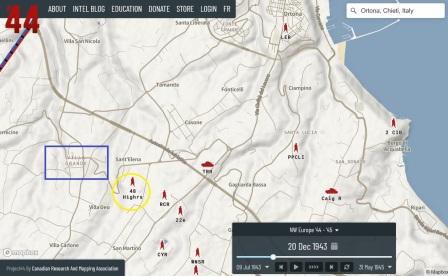
Position of 48th Highlanders on December 20, 1943 (see yellow circle) as they attempted an attack on Villa Grande (see blue square). (Map source: Project 44)
The war diary for December 20, 1943 indicated that an attack on Villa Grande was not as successful as hoped. “….Essex Regiment ….attempted to take Villa Grande and failed….Ordered by Brigade to send one Company…. ‘B’ Company attacked 1500 hours, but tanks bogged down, and Company pinned down….Tanks encountered minefield and was mined….Under cover of dark, ‘B’ Company withdrew to position around tanks…” Kevin was never seen again, and he was listed as Missing In Action (MIA) and presumed dead.
Kevin’s family was notified that he was missing, and of course hoped that he was not killed, but had been taken prisoner of war.
Clare had gone to church, and through a miscommunication, didn’t know what happened to her brother until the moment the priest asked the congregation to pray for the fallen… and Kevin’s name was mentioned. “…I was 13 at the time…” she said. “…Helen Farrell had a phone in her store and was supposed to tell me, but didn’t get the message to me in time…”
…..The 48th Highlanders Chaplain wrote what happened on December 20, 1943….
A January 12, 1944 letter written to Kevin’s mother by Padre Stewart Bland EAST, Chaplain for the 48th Highlanders Regiment, provided an account of what happened. “….I write to assure you that everything in our power has been done to locate his body and that we have failed. The full story is as follows.
On the afternoon of 20 December, one Company of the Highlanders were given instruction to capture an enemy position. The attack was not a success because the tanks were unable to proceed because of mines.
When the Company returned to their position, five men were missing. The bodies of only three of these have been found, in spite of a thorough search. All I can suggest is that your son was buried by the Germans or was not killed as reported, but was wounded and taken prisoner…”
Although the letter was dated January 12, 1944, it was not mailed until much later, as a March 27, 1944 postscript explained that he had only received the day before a mailing address, and asked if she had received any further word about Kevin’s fate.
The 3 soldiers that Padre East mentioned as being found were:
- Cpl Alexander John MACKINNON, born in Whycocomagh, Cape Breton Island, Nova Scotia, aged 26
- Cpl Eric Morris NETTLETON of Hamilton, Ontario, aged 21
- Pte Jack STEWART of Hastings, Ontario, aged 34
All 3 are now buried in Moro River Canadian War Cemetery.
…..Kevin is buried in Moro River Canadian War Cemetery….
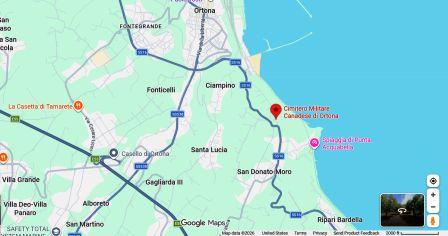
Moro River Canadian War Cemetery. To the far left is Villa Grande, near where Kevin Delorie lost his life. (Map source: Google maps)
Kevin’s distraught family kept in contact with the Department of National Defence, and asked the Canadian Red Cross for help in locating him. In June 1945, his body was found, and he was buried in the Moro River Canadian War Cemetery, located near the Adriatic Sea, 5 km (3 miles) from San Donato-Moro, near Ortona in Italy.
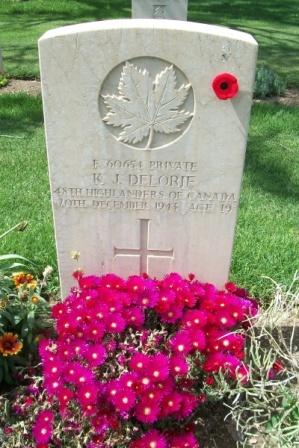
Grave of Kevin Joseph Delorie in Moro River Canadian War Cemetery in Italy. (Photo source: Canadian Virtual War Memorial)
Thank you to Charlotte MacAulay of the Eastern Graphic for publicizing the search for a photo of Kevin Delorie. A huge thank you goes to Clare Murphy, Tim Murphy, and Norbert Murphy for sharing photos and information.
Do you have a story to tell? Email Pieter at memorialtrail@gmail.com or comment on the blog.
© Daria Valkenburg
….Previous postings on soldiers killed in Italy….
Kevin Delorie is not the only soldier from Prince Edward Island killed in Italy, and whose story has previously been told on this blog. See:
- Albert Eugene ARSENAULT: https://onthewarmemorialtrail.com/2020/10/09/the-ww2-soldier-killed-in-action-while-crossing-the-foglia-river-in-italy/
- George Alfred DUNN: https://onthewarmemorialtrail.com/2020/03/10/the-ww2-soldier-from-emerald-junction-who-lost-his-life-in-italy/ and who is also buried in Moro River Canadian War Cemetery.
- Ernest Murray NORTON: https://onthewarmemorialtrail.com/2019/02/13/the-last-valentine-from-a-wwii-soldier/ and https://onthewarmemorialtrail.com/2020/05/12/commemorative-coins-from-west-nova-scotia-regimental-association/
- Arnold Dudley TAYLOR: https://onthewarmemorialtrail.com/2021/01/02/on-the-war-memorial-trail-the-ww2-soldier-killed-in-action-while-trying-to-break-the-gothic-line-in-italy/
….Want to follow our research?…
If you are reading this posting, but aren’t following our research, you are welcome to do so. Our blog address: https://onthewarmemorialtrail.com/
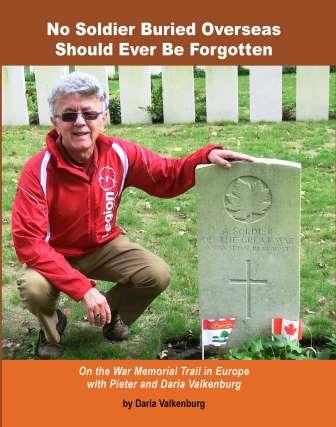 4 countries, 6 weeks, 7,000 km – an unforgettable war memorial journey in Europe…. Daria’s book ‘No Soldier Buried Overseas Should Ever Be Forgotten‘ is available in print and e-book formats. Net proceeds of book sales help support research costs and the cost of maintaining this blog. For more information see https://nosoldierforgotten.com/
Subscribe to our YouTube Channel: On The War Memorial Trail With Pieter Valkenburg: https://www.youtube.com/channel/UCJ591TyjSheOR-Cb_Gs_5Kw.
Never miss a posting! Subscribe below to have each new story from the war memorial trail delivered to your inbox.
 On The War Memorial Trail Research Project........ with Pieter and Daria Valkenburg