May 29, 2024. This is the 10th year that Pieter has been helping researchers at the Canadian War Cemetery in Holten, The Netherlands to find photos of soldiers buried there. He began with a list of soldiers who were from Prince Edward Island. It wasn’t until a year later that newspaper articles were published with stories related to Pieter’s research, and three years before this blog began in 2017. Since then, the scope of his ‘little research project’ has expanded several times to include soldiers from across Canada and several cemeteries.
Back in 2014, Pieter was initially sent a list of 9 names, one of which was Maurice James HUGHES, who was born December 19, 1919 in Charlottetown, Prince Edward Island, the son of James M. and Nora (nee Gallant) Hughes.
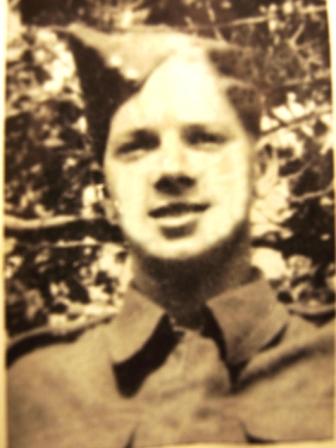
In the search for a photo of Maurice, Pieter ran into one stumbling block after another. He’d found family members, but none ever responded to inquiries. Then, in the fall of 2019, we met with Ray Arsenault, a member of the Royal Canadian Legion in Charlottetown, who brought a scrapbook he’d received from a friend, Kaye Collins, which contained photos and articles about soldiers from the newspaper. In a moment of serendipity that happens all too rarely, there was a photo of Maurice!
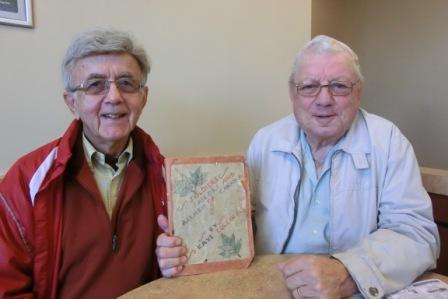
Pieter with Ray Arsenault and the scrapbook in which a photo of Maurice James Hughes was found. (Photo credit: Daria Valkenburg)
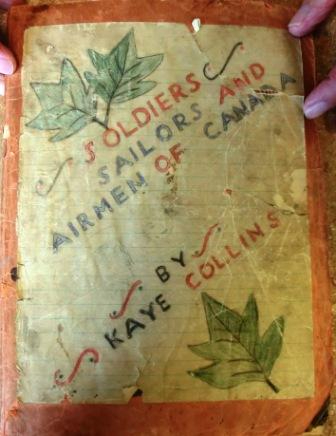
The scrapbook collated by Kaye Collins that contained a picture of Maurice James Hughes. (Photo credit: Daria Valkenburg)
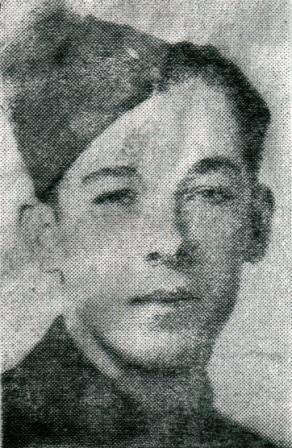
Picture of Maurice James Hughes found in the scrapbook collated by Kaye Collins.
…In 2023 a family member contacted us….
Four years after receiving the photo from Ray Arsenault, Pieter received an email from Lisa Hughes Bell: “… I recently read an article about you, regarding a face for every grave. My Great-Uncle was buried at the Holten Cemetery …. His name was Maurice J. Hughes from Charlottetown….”
Lisa included a similar photo to what we’d already received. After acknowledging her email, we received another email. “…I really don’t know much about Maurice, but am really excited about doing research to find out as much as I can. My Grandfather (Maurice’s brother Frank) was in the Navy and really didn’t talk much about the war. We always knew that he never got over losing his big brother.…”
As so often happens when family learns that a soldier died so close to the end of WWII, Lisa noted that “…there has always been a sadness in our family about Maurice because he died May 2, 1945, so close to coming home….” She ended by saying that the family “….would be pleased if you did a story on Maurice…” Since Maurice’s story had not yet been told on this blog, we decided to do so.
….Maurice was a signalman….
According to a May 10, 1945 obituary in The Guardian, he had been “…a popular member of the Maritime Electric’s staff…” as an assistant fireman before enlisting for active service as a signalman with the No. 6 District Signals, Royal Canadian Corps of Signals (RCCS) in Charlottetown on October 28, 1939.
A signalman was a specialist responsible for military communications, doing works such as radio or telephone operators, laying cables for communications, and relaying messages for field commanders at the front line.
Before joining the active service, Maurice had joined the No. 6 District Signals militia on May 17, 1937 in Charlottetown.
After completing his basic training, Maurice was sent to Halifax, Nova Scotia. Then, on June 16, 1940, he was transferred to No. 3 Canadian Infantry Division, Signals.
On July 5, 1940, he reported for duty at Barriefield Camp in Kingston, Ontario. This was the home of the Royal Canadian Corps of Signals. NOTE: As of 1966, Barriefield Camp was renamed Canadian Forces Base Kingston (CFB Kingston).
Next, Maurice was sent to Sussex Camp, New Brunswick for training as a linesman on October 15, 1940, and qualified as a Tradesman Group C Linesman on February 25, 1941.
Then, in preparation for overseas service, Maurice was assigned to No. 1 Training Brigade in Debert, Nova Scotia on July 5, 1941.
…Maurice left Canada for overseas service – including D-Day….
On July 19, 1941, Maurice and his Regiment left Canada from Halifax, Nova Scotia, arriving in Avonmouth in the United Kingdom on July 31, 1941. His training continued, as extensive preparations began for Operation Overlord (the larger Normandy invasion) and Operation Neptune (the English Channel-crossing portion of Operation Overlord) on June 6, 1944 – what we know today as D-Day.
Assigned to the 3rd Canadian Infantry Division, the role of the Signal Corps was to ensure smooth communications on that fateful day. (See https://www.veterans.gc.ca/en/remembrance/history/second-world-war/normandy-1944)
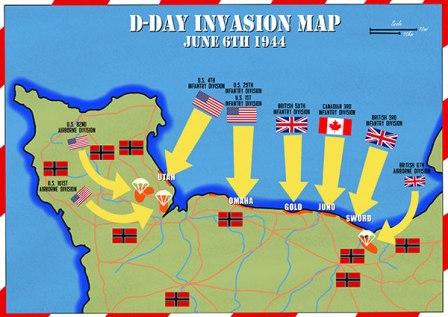
D-Day invasion map. The Canadians landed on Juno Beach in Normandy, France. (Map source: https://www.ddaylepe.org.uk/index.php/overlord-neptune/)
…Maurice was recommended for a Military Medal for an incident that happened on D-Day….
No mention was made of what Maurice encountered during the day, but just before midnight on June 6, 1944, Maurice and two other signalmen, E. W. MARTIN and J. D. MCPHEE, were near Banville, when they encountered German soldiers. Lt. (later Captain) J. W. GROSS reported that as the 3 men were “….returning from 7 Canadian Infantry Brigade Headquarters to 12 Canadian Field Regiment with a line, they were 1 ½ miles from our exchange and making a crossing at a crossroads…”
They’d encountered sniper fire all night, so Martin was in a ditch, covering the other two with a Bren gun. Suddenly, “… a German soldier walked out from a side road….” and surrendered. Unfortunately, a German officer also stepped out and began shooting at Maurice and McPhee, which ended when Martin opened fire.
Then, “....a German Major came up….” and told them that his whole company, part of the 11th Grenadier Regiment, wanted to surrender. As the Germans “.…came up they handed over their arms and were searched by the three linesmen…” Within 15 minutes they had 60 prisoners of war.
This was not the end! “… About 20 minutes later two Canadian officers came upon the scene and joined the three linesmen…” as the contingent, except for Maurice, moved toward Banville.
Maurice “... stayed at the cross roads and 30 more surrendered to him. He moved them along the road and joined the party….”
After the prisoners of war were taken to the POW cage on the beach, the linesmen continued their work and finished laying the line!
The three linesmen were recommended for a Military Medal for their actions, but sadly, their bravery and actions in having so many Germans surrender to them was not rewarded. The recommendation for a Military Medal was not approved.
….A Canadian Army Newsreel film was taken in The Netherlands….
Following upon the success of D-Day, Maurice and his Regiment were involved in the Allied advance through Northwest Europe. In The Netherlands, a Canadian Army Newsreel briefly filmed members of the Royal Canadian Corps of Signals (RCCS). Film Source: Library and Archives Canada. Take a look:
….The Regiment moved into Germany on April 26, 1945….
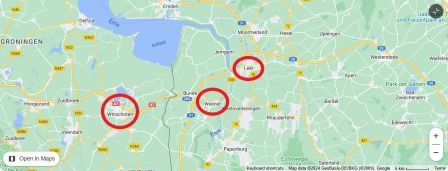
Map shows location of Winschoten, The Netherlands, as well as Weener and Leer in Germany. (Map source: http://www.google.ca)
In the last week of April 1945, the Regiment prepared to leave The Netherlands. The after-action report on communications in the Regiment’s War Diary noted that after leaving Winschoten, The Netherlands, the “…Divisional Headquarters moved onto Germany on 26 April 1945…” and re-established “…preparatory for the operation to capture Leer….” on April 28, 1945.
In order to have communications available, a “…cable was taken across the River Ems at Weener, one circuit to connect 7 Canadian Infantry Brigade, which was on the opposite side of the river, and one circuit was extended to the bridge site on the river Leda, ready to be extended when 9 Canadian Infantry Brigade crossed into Leer. A line was laid to 16 Field Company RCE and extended on to a point on the Ems where the rafts were being assembled...”
….Maurice lost his life near Leer, Germany….
Lt. Colonel George Clarence LEECH, the Commanding Officer of Maurice’s unit, had recorded in his personal notes that Maurice, whose nickname was ‘Maw’, was very well liked and had not only participated in D-Day, but had been in the front line from then until his death on May 2, 1945 when the jeep he was riding in was hit by a mine.
On May 9, 1945, Lt. Colonel LEECH wrote a letter of condolence to Maurice’s mother, saying that “….Cpl Hughes was killed while riding in a jeep with Sgt Nixon on May 2nd when it ran into an enemy mine and blew up. He did not suffer at all as death was instantaneous….” Sgt E. C. ‘Nick’ NIXON was seriously wounded, but survived.
Lt. Colonel Leech went on to note that “…Maurice was one of my finest Corporals. Since enlisting in 1939, he has given everything for the cause which we have been fighting for have at lost won…” Germany had signed an unconditional surrender, ending the war in Europe, on May 8, 1945, just a few days after Maurice lost his life.
.…Maurice is buried in Holten ….
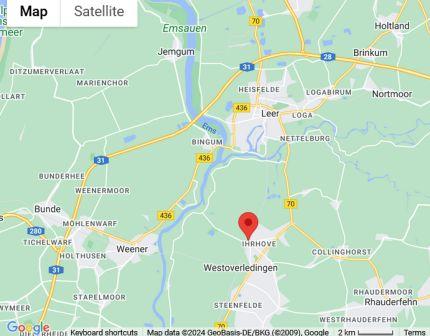
Map shows location of Ihrhove, Germany, where Maurice James Hughes was initially buried. (Map source: Google)
Maurice was originally buried in a temporary Canadian Military Cemetery in Ihrhove, Germany. In his letter, Lt Colonel Leech wrote that the “…burial service was conducted by Father McCarney…” and that “….most of the men of his section attended his funeral…”
On March 12, 1946, Maurice was reburied in the Canadian War Cemetery in Holten, The Netherlands.
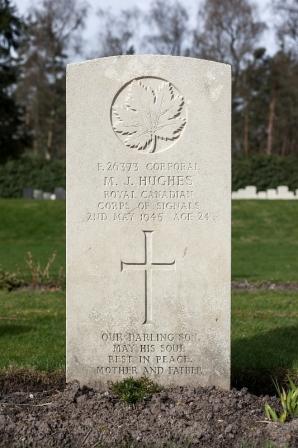
Grave of Maurice James Hughes in the Canadian War Cemetery in Holten, The Netherlands. (Photo courtesy of the Canadian Virtual War Memorial)
After the war ended, many Dutch people adopted a soldier’s grave, as a way to give thanks for the sacrifices made by Allied soldiers. Maurice’s grave was adopted by Mr. J. Schut from Deventer. In a January 14, 1949 letter to the Department of Defence, he stated that he was 38 years old and asked that his letter be sent to Maurice’s family so they would know that Maurice would not be forgotten. An abridged English translation of his letter was forwarded to Maurice’s father on February 28, 1949.
Thank you to Ray Arsenault for providing a photo from the scrapbook collated by Kaye Collins, and to Lisa Hughes Bell for sharing how the family felt about the loss of Maurice. Do you have photos or information to share? Email Pieter at memorialtrail@gmail.com, comment on the blog, or tweet to @researchmemori1.
© Daria Valkenburg
….Want to follow our research?….
If you are reading this posting, but aren’t following our research, you are welcome to do so. Our blog address: https://onthewarmemorialtrail.com/
 4 countries, 6 weeks, 7,000 km – an unforgettable war memorial journey in Europe…. Daria’s book ‘No Soldier Buried Overseas Should Ever Be Forgotten‘ is available in print and e-book formats. Net proceeds of book sales help support research costs and the cost of maintaining this blog. For more information see https://nosoldierforgotten.com/
You are also invited to subscribe to our YouTube Channel: On The War Memorial Trail With Pieter Valkenburg: https://www.youtube.com/channel/UCJ591TyjSheOR-Cb_Gs_5Kw.
Never miss a posting! Subscribe below to have each new story from the war memorial trail delivered to your inbox.
 On The War Memorial Trail Research Project........ with Pieter and Daria Valkenburg