
Stanley McBeath’s family lives in Rexton, New Brunswick. (Photo credit: Daria Valkenburg)
February 3, 2024. When Pieter looks for family of a soldier whose name is on a photo wish list for one of the Canadian War Cemeteries in The Netherlands, he never knows what to expect. After he decided to research Stanley Leigh MCBEATH, whose family lived in Rexton, New Brunswick, Pieter wrote to St. Andrews United Church in Rexton and also called the minister. He did that after finding a newspaper article about a Memorial Service held in August 1945 for Stanley and another WWII soldier from Rexton, James Edward SULLIVAN.
Shortly after his inquiry, Pieter received a call from Janice Little, who explained that she was Stanley’s niece, daughter of his sister Audrey, and yes, she had a photo.
…Stanley enlisted in 1939….
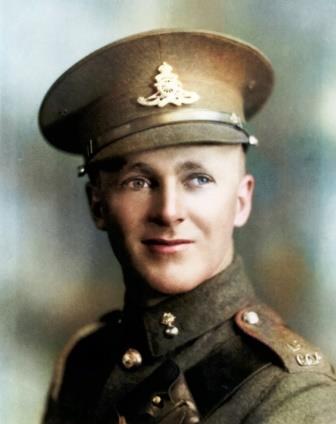
Stanley Leigh McBeath. (Photo courtesy of the McBeath Family. Photo colourization by Pieter Valkenburg)
Born April 24, 1916 in Peter’s Mill, Kent County, New Brunswick, Stanley was the eldest son of Richmond Noble and Lilly Victoria (nee Peters) McBeath. Before enlisting with the 15th Heavy Battery of the 3rd (New Brunswick) Coast Brigade in St. John, New Brunswick on September 12, 1939, Stanley had been working for two years for H. Gauvin, who owned a garage in Rexton. He also helped his parents on their farm. In his Occupational History Form, he indicated an interest in remaining in the army after the war ended.
After completing his basic training in St. John, Stanley was sent to Halifax to complete a Range Finders course. A Range Finder was a key piece of equipment, used in machine guns, to measure distances to remote objects, and required expertise and skill to operate. Soldiers selected for this specialist training were machine gunners, or mortarmen, with good eyesight and an elementary knowledge of mathematics. Stanley completed this course on April 20, 1941.
…Stanley served with the 108th Battery as part of Atlantic Command….
On May 15, 1942, Stanley was transferred to the 108th Battery and posted to Ives Point, Nova Scotia. The battery was part of Atlantic Command, whose role was to strengthen and administer home defence facilities on Canada’s Atlantic Coast.
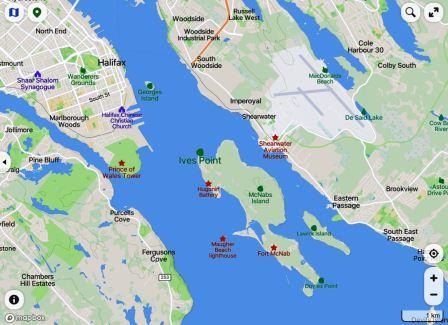
Location of Ives Point. (Map source: https://mapcarta.com)
…Stanley was in Goose Bay as a gunner with an anti-aircraft battery….
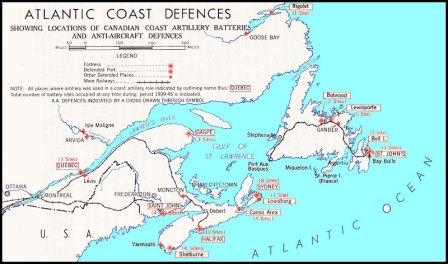
Atlantic Coast Defences during WWII. (Source: https://www.ibiblio.org/hyperwar/UN/Canada/CA/SixYears/maps/SixYears-1.jpg)
On October 15, 1942, Stanley was posted to Goose Bay, Labrador, temporarily attached to 30th Anti-Aircraft Battery. (NOTE: Newfoundland and Labrador became part of Canada on March 31, 1949.)
Canada had built a massive air base at Goose Bay, Labrador as an alternative to Gander for transatlantic operations. This base became operational in late 1941. (See https://www.heritage.nf.ca/articles/politics/goose-bay-base.php) The bases at Gander and Goose Bay were vital links in the ferrying of military aircraft to Britain. Anti-aircraft crews were part of coastal defence.
Stanley remained in Goose Bay until July 23, 1943 when he was posted to Gaspe, Quebec, and reassigned back to the 108th Battery. On November 26, 1943 he was sent to Shelburne, Nova Scotia for further training.
…Stanley qualified as a Canadian Armoured Corps Operator….
On April 18, 1944 Stanley was transferred to No. 1 Transit Camp in Windsor, Nova Scotia. Not long after that, on May 17, 1944, he was posted to No. 1 Canadian Armoured Corps Training Regiment (CACTR) in Borden, Ontario for additional training. On October 7, 1944 he was qualified as a Canadian Armoured Corps (CAC) Operator.
Then, in preparation for overseas service, Stanley was assigned to No. 1 Canadian Armoured Corps Trained Soldiers Regiment (CACTSR), still in Borden, Ontario.
…Stanley left Canada for overseas service….
On November 25, 1944 Stanley left Canada, arriving in the United Kingdom on December 5, 1944, where he was assigned to No. 3 Canadian Armoured Corps Reinforcement Unit (CACRU).
On December 10, 1944, Stanley wrote a letter to his Aunt Janie McBeath, the sister of his father, who was a nurse in New York. He gave his impression of England and noted the differences he saw for Christmas, which would be in two weeks.
“…Suppose that over in the US and Canada everything is taking on the holiday season, but here there is nothing at all. But considering what this country has been through, I suppose it is a wonder it still exists. What has impressed me most is the sense of great age and changelessness (if there is such a word) – wars may come and go and times may have great changes, but this island goes on undisturbed by it all…”
While in the United Kingdom, Stanley was temporarily attached to No. 2 Canadian Armoured Corps Reinforcement Unit (CACRU) while he took a gunnery course, which he completed on January 9, 1945.
…Stanley left the United Kingdom for Northwest Europe….
On March 24, 1945, Stanley was assigned to the X-4 Reinforcement list of the Canadian Armoured Corps as a Gunner Operator ‘C’ of the 9th Battalion and sent to North Western Europe.
On April 1, 1945 he was assigned to the 28th Canadian Armoured (British Columbia) Regiment, joining the Regiment in Germany as it travelled along the road between Calcar and Kleve, and crossed the Rhine River.
By April 3, 1945 the Regiment had crossed the border back into The Netherlands, near Lochem, for a few days before returning to Germany.
In a letter to his Aunt Janie, written on April 7, 1945, Stanley mentioned an experience in The Netherlands. “….Seen a show under kind of odd surroundings the other nite (sic.. night) – it was put on with a Dutch cow barn used as a theatre. But the cattle didn’t seem to mind…. At any rate the smell was familiar to me….”
Stanley went on to explain that he was in a Regiment. “…Belong to a unit now – not a bad outfit but don’t know any of them. It’s taken a long, long time to get this far but am getting nearer the goal of ’39 all the time…” Stanley was referring to 1939 when he enlisted for active service.
The Regiment reached Oldenburg, Germany on April 10, 1945 and the war diary daily reported encountering fierce resistance from the Germans.
The Battle for the Küsten Canal near Friesoythe and the advance slightly northwards towards Edewecht resulted in many casualties. Just after midnight on April 17, 1945, Stanley was in ‘B’ Squadron as the Regiment’s tanks supported the Algonquin Regiment during the first crossing of the Küsten Canal in assault boats. (See https://www.canadiansoldiers.com/history/battlehonours/northwesteurope/kustencanal.htm)
On Friday, April 20, 1945, the war diary entry for the 28th Canadian Armoured (British Columbia) Regiment noted that “… ‘B’ Squadron was still under command of the Algonquin Regiment…” and had moved to the location of the Regimental Headquarters between Friesoythe and Edewecht.
…Stanley lost his life on the road between Friesoythe and Edewecht….
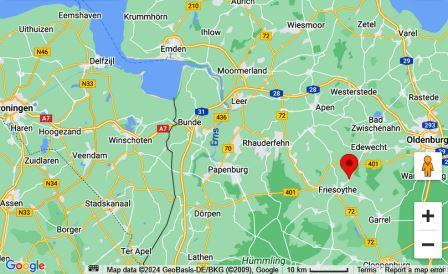
Map shows the location where Stanley McBeath lost his life, using the coordinates from the war diary of the 28th Canadian Armoured (British Columbia) Regiment. (Map source: Google maps)
The war diary entry for Saturday, April 21, 1945 for the 28th Canadian Armoured (British Columbia) Regiment: “…Weather mild and warm….. ‘A’ Squadron remained under command of Argyll and Sutherland Highlanders of Canada and worked troops up with the forward infantry…. Lt Warmald was wounded and only two tanks of his troop reached their objective. Another tank of ‘A’ Squadron was bazooked…” Troops were sent to “…assist infantry in the evacuation of the wounded…”
Somehow, in the confusion Stanley was initially reported missing, but later it was confirmed that he had been mortally wounded and died on April 21, 1945, three days before his 29th birthday.
Stanley’s parents received a telegram from the Department of Defence on April 30, 1945, informing them that Stanley was missing. This was followed up with a May 3, 1945 telegram saying he was ‘officially killed in action on April 21, 1945’.
…An error by the Director of Records left Stanley’s family with false hope….
However, on May 7, 1945 the Moncton Times newspaper published a list of soldiers from New Brunswick who had been liberated from prisoner of war camps, and among the names was Stanley Leigh McBeath!
You can imagine the confusion, mixed with hope, for the McBeath family. Richmond McBeath, Stanley’s father, wrote to the newspaper and asked where the information came from. In a May 10, 1945 letter to the Department of Defence’s Director of Records, Richmond noted the response he got from the Moncton Times, saying that “…in their reply, they said ‘The Canadian Press’ which got the information from the Director of Records…”
Richmond quite correctly stated that “…we do not understand this and ask for prompt confirmation or denial of your telegram of May 3…”
On May 14, 1945, Richmond received a telegram from the Director of Records, confirming that Stanley had died on April 21, 1945, as per the May 3, 1945 telegram. “…Trooper McBeath’s name was erroneously released to the press as a liberated prisoner of war, but appeared on the official casualty list dated 10th May as killed in action…”
An apology was also provided. “…Sincerely regret the anxiety caused by the release of your son’s name as a liberated prisoner of war in error…” It was small comfort for a family left in limbo for several days, hoping to hear that Stanley was alive.
….Stanley is buried in the Canadian War Cemetery in Holten….
Stanley was initially buried in the Temporary Canadian Military Cemetery in Friesoythe, Germany before being reburied on March 9, 1946 in the Canadian War Cemetery in Holten, The Netherlands.
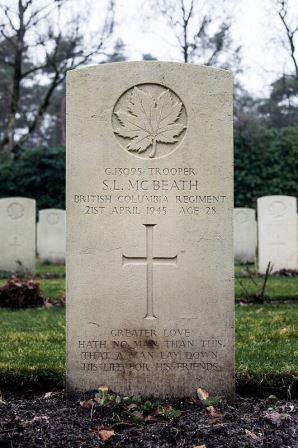
Grave of Stanley Leigh McBeath in the Canadian War Cemetery in Holten, The Netherlands. (Photo source: Canadian Virtual War Memorial)
….We met Stanley’s nieces….

Janice Little (left), Pieter, Gayle McBeath (right). (Photo credit: Daria Valkenburg)
In researching Stanley’s story, we were delighted to have the opportunity to meet Janice Little and her cousin, Gayle McBeath, who is the daughter of Stanley’s brother Harold.
In both of his surviving letters to his Aunt Janie, Stanley had mentioned that he hadn’t seen his brother Harold, who was with the North Shore (New Brunswick) Regiment. Janice and Gayle told us that they did have a chance to talk to each other – two days before Stanley passed away.

Stanley’s surviving siblings. Standing left to right: Helen, Audrey. Seated, left to right: Harold, Dorothy. (Photo courtesy of the McBeath Family)
Janice and Gayle shared a photo of Stanley’s surviving siblings, and explained that the houses they themselves live in were part of the family farm where Stanley had grown up.
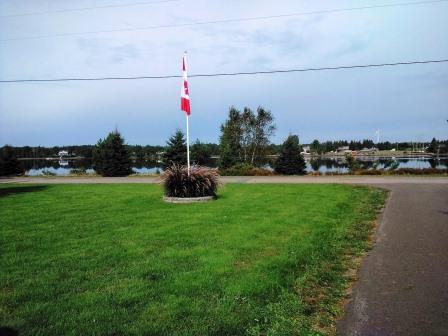
View from the street where Stanley grew up. (Photo credit: Daria Valkenburg)
Stanley’s parents never forgot their son, ensuring his name was engraved on their gravestone. Janice and Gayle took us to visit the grave at the St. Andrews United Church Cemetery in Rexton.

Stanley is listed on his parents’ grave at St Andrews United Church Cemetery in Rexton, New Brunswick. (Photo credit: Daria Valkenburg)
Thank you to Janice Little and Gayle McBeath for sharing photos and information. Do you have photos or information to share? Email Pieter at memorialtrail@gmail.com, comment on the blog, or tweet to @researchmemori1.
© Daria Valkenburg
….Want to follow our research?….
If you are reading this posting, but aren’t following our research, you are welcome to do so. Our blog address: https://onthewarmemorialtrail.com/
 4 countries, 6 weeks, 7,000 km – an unforgettable war memorial journey in Europe…. Daria’s book ‘No Soldier Buried Overseas Should Ever Be Forgotten‘ is available in print and e-book formats. Net proceeds of book sales help support research costs and the cost of maintaining this blog. For more information see https://nosoldierforgotten.com/
You are also invited to subscribe to our YouTube Channel: On The War Memorial Trail With Pieter Valkenburg: https://www.youtube.com/channel/UCJ591TyjSheOR-Cb_Gs_5Kw.
Never miss a posting! Subscribe below to have each new story from the war memorial trail delivered to your inbox.
 On The War Memorial Trail Research Project........ with Pieter and Daria Valkenburg
