On The War Memorial Trail…..The WWI Voyage To Europe Of The 26th (New Brunswick) Battalion

March 31, 2026.  111 years ago, on June 13, 1915, 1,148 soldiers – 42 officers and 1,106 other ranks – from the 26th New Brunswick Battalion boarded the Anchor Line Steamship ‘Caledonia’ and left the Saint John, New Brunswick harbour, enroute to the United Kingdom, for military service in the WWI battlefields in Europe.
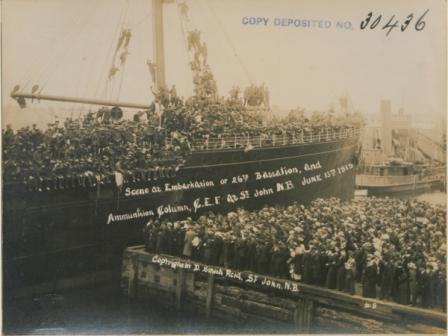
Scene at embarkation of 26th Battalion and ammunition column CEF, St. John, New Brunswick, June 13, 1915. No. 9.  (Photo source: D. Smith Reid, Public domain, via Wikimedia Commons)

When the battalion returned home at the end of the war, only 4 of the original 42 officers and 113 of the original 1,106 other ranks were still with the battalion.  The others had been killed, wounded, or transferred to other battalions.

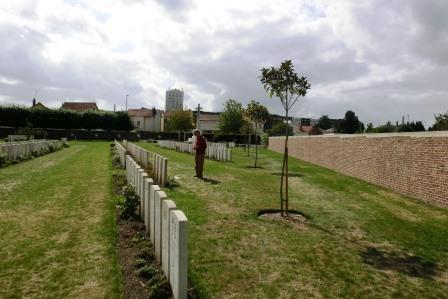
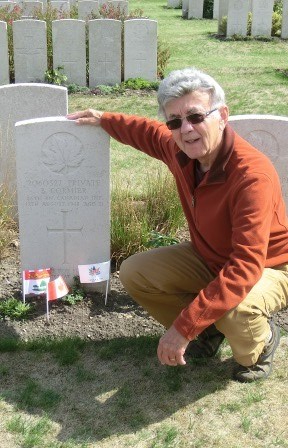
One of the soldiers who never returned home was Private Arthur Clinton ROBINSON of Tryon, Prince Edward Island, who was born July 20, 1896, the son of Albert James Robinson and Flora P. Scruton. 110 years ago, on March 27, 1916, he was killed during the Actions of St Eloi Craters when shell fire hit the trenches southeast of Kemmel, which is only 10 km (6 miles) south west of Ypres.  He was buried at La Laiterie Military Cemetery in Belgium.

One of the names listed on the Cenotaph outside the Borden-Carleton Legion in Prince Edward Island, we have not yet found of a photo of him, and neither has his family. 

….The ‘Caledonia’ arrived in Canada from Egypt …

But, in 1915, most of the soldiers preparing to go overseas didn’t know what horrors of war lay ahead of them. When the S. S. ‘Caledonia’ arrived in Saint John, an article in the June 12, 1915 edition of the St. John Standard newspaper reported that it had arrived the day before from Sydney, Nova Scotia.  It had travelled from Alexandria, Egypt after delivering wounded Australian soldiers from Turkey. “…The Caledonia has been transporting troops since early in December and spent some time in the Dardanelles…” and was in the midst of heavy fighting.  The Dardanelles is a narrow strait of northwestern Turkey that divides Europe from Asia. (See https://www.iwm.org.uk/history/a-short-history-of-the-dardanelles-campaign)

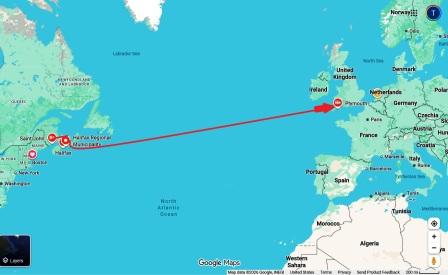
After the ‘Caledonia’ left Saint John at 11:30 am on Sunday, June 13, 1915, it sailed to Halifax, Nova Scotia, arriving the next day, where 250 members of the Heavy Artillery, 50 from Nova Scotia Cycle Corps, and 250 reinforcements from the 10th Nova Scotia Battalion, joined the ship for its voyage to Plymouth, England.

The ship didn’t leave Halifax until the following morning, as recorded in the Plymouth Evening Mail newspaper on June 24, 1915. “…The troops at once went aboard the transport, but there was a large quantity of ammunition to put aboard and there were the 4.7 guns and howitzers. In consequence the Caledonia remained at pier until 9:30 the next morning when she sailed down the harbour, followed by the best wishes of the thousands of loyal people

….The voyage of the ‘Caledonia’…

The ‘Caledonia’ travelled from Saint John, New Brunswick to Halifax, Nova Scotia, and then across the Atlantic Ocean to Plymouth, England.  (Map source: Google maps)

A description of the voyage in the July 20, 1915 Caledonia Telegraph Journal included excerpts from the diary of Corporal Clarence Beverley SMITH of the 26th Battalion.  “…June 17. Very rough weather, many very sick. June 18. Weather smoother, but not calm. Most of the men too sick for any actual drill; most lying around decks. June 19. Weather very smooth. Expect to get to England about Wednesday evening. June 20. Weather very calm.  The ocean is just like a river and the boat makes good progress. June 21. Weather very calm. Received orders of absolute quiet and silence with no lights at night.  June 22. Weather very calm and very warm.  June 23. We were picked up by a British destroyer which stood by us until we arrived at Devonport about 10 am. June 24. We were boarded by the doctor and other officials and tied up at the wharf. About 2 pm we were put on board a train and got into Sandling Camp 1 am on June 25. Altogether, the voyage was a very pleasant one…

Private William John SWETKA, with the Signalling Division of the 26th Battalion, gave a similar account, published in the July 14, 1915 edition of the St. John Standard newspaper. He had a bit more to say as the ship arrived in Plymouth, England on June 24, 1915. “…About six o’clock passed Eddystone lighthouse. In about an hour entered Plymouth harbour. Several steamers with invalids from the Dardanelles were there.  They cheered us. We were towed into the inner harbour. There are quite a few cruisers, destroyers, etc in dock being repaired. Harbour is full of war vessels of all kinds…

The soldiers were in England only for a short period, as by the end of August 1915, the 26th Battalion began preparations for a move into France.  On September 13, 1915 an advance party left England, followed 2 days later by the troops, who arrived in Boulogne, France in the early hours of September 16, 1915. 

….More about Arthur Clinton Robinson…

Unlike Arthur Robinson, Clarence Smith and William Swetka survived WWI and returned home.  To read more about Arthur, see:

Thank you to Shawn Rainville for newspaper searches about the Caledonia’s voyage in 1915.  Meanwhile, Pieter’s research efforts to find photos and families of soldiers continue. Do you have a photo of Arthur Clinton Robinson to share, please email Pieter at memorialtrail@gmail.com, or comment on the blog.    

© Daria Valkenburg

….Want to follow our research?…

If you are reading this posting, but aren’t following our research, you are welcome to do so.  Our blog address: https://onthewarmemorialtrail.com/
4 countries, 6 weeks, 7,000 km – an unforgettable war memorial journey in Europe…. Daria’s book ‘No Soldier Buried Overseas Should Ever Be Forgotten‘ is available in print and e-book formats.  Net proceeds of book sales help support research costs and the cost of maintaining this blog. For more information see https://nosoldierforgotten.com/

Subscribe to our YouTube Channel: On The War Memorial Trail With Pieter Valkenburg: https://www.youtube.com/channel/UCJ591TyjSheOR-Cb_Gs_5Kw

Never miss a posting!  Subscribe below to have each new story from the war memorial trail delivered to your inbox.

On The War Memorial Trail….On The Road To Rouen

October 1, 2017.  Leaving the Arras area, which we had thought was busy enough, was an experience, as now we encountered toll roads.  We soon learned to dread the words ‘gare de péage’.  While all the toll booths have iconic names, like the first one we pulled up at, named ‘Jules Verne’, they are now mostly automated, and you need cash or a debit or credit card.

…. ‘Gare de péage’ meant frustration in trying to pay a toll in Normandy….

If you are one of the modern people thinking ‘Dinosaur’, let me describe the experience.  First off, the box where you have to pay is designed to accommodate truckers, not people in dinky toy cars like the majority of cars used in Europe.  Most people do not have the rubber arms needed to reach up to drop the money in, so each toll booth encounter takes longer than it would if you paid an attendant, as car doors open and people try to squeeze out in the available space to drop their money in manually, or pay by card.  And of course, you need first to figure out WHERE you place your money as there is more than one slot.

If you use cash, as we did, you soon also learned that it’s best to have exact change, as otherwise you have to WAIT for change and then reach up to another slot to get your money.  Anyone in a hurry sometimes leaves their change behind!

PEI is not alone in charging heavy tolls.  We left 7.70 euros at Jules Verne, only to encounter another toll booth 6 minutes later!  At this one we picked up a ticket which cost us another 5.70 euros half an hour later.  The count so far … 13.40 euros.  In Canadian dollars it comes to about $19.75, and the day was just beginning.

…. We were on the right street but in the wrong community!….

It took us just over 2 ½ hours to get to Rouen from Mont St. Eloi, and, following the GPS instructions to the St. Sever Cemetery, arrived at Boulevard Stanislas Girardin, only to find it was in downtown Rouen.  No cemetery in sight!  The streets are extremely narrow, jam packed with cars and pedestrians and most of the streets one way traffic only.  We finally gave up trying to figure out what had gone wrong and stopped in front of a short driveway into a huge government building behind a walled gate, and asked a passerby for help.

The poor man looked at our sheet from the Commonwealth War Graves Commission and finally said, very kindly, that we were on the right street, but not in Rouen.  The cemetery was in a nearby community.  Sure enough, when we looked at the cemetery location instructions, it said it was “situated on the eastern edge of the southern Rouen suburbs of Le Grand Quevilly and Le Petit Quevilly.”  But what we didn’t understand was why we’d been directed downtown when we had the right street.

The man explained that it was in either Le Grand Quevilly or Le Petit Quevilly, he wasn’t sure which.  So, the GPS got reprogrammed for Le Grand Quevilly.  The word “suburb” was a misnomer.

While this discussion had been going on, traffic was backing up as people wanting to get into or out of the government driveway were held up as we were blocking the road.  Not one person honked or showed any impatience!  We thanked the man for his help, and then slowly backed up onto the traffic, and made our way out of town.

…. A car salesman steered us in the right direction to the cemetery….

Le Grand Quevilly was a short distance away, but it was not the location of the cemetery.  We pulled into a car dealership to ask directions, only to find out that France shuts down for lunch break.  Everything was locked up, but we found a salesman in a tent on the lot, reading his emails.

I’m from a different country,” he said, when we asked about the cemetery.  Then he made us laugh when he went on to say, “I’m from Paris.”  But he was very effective at finding someone who could help us and that’s when we learned that we wanted to be in Le Petit Quevilly, and how to get there.

In Le Petit Quevilly, on a street by the same name as in Rouen (what are the odds?), we were able to find St. Sever Cemetery Extension, the location where Bazil Cormier is buried.

CIMG8598 Sep 7 2017 sign directing us to St Sever Cemetery Extension

Sign to the St. Sever Cemetery in Le Petit Quevilly. (Photo credit: Daria Valkenburg)

According to the information provided by the Canadian War Graves Commission, during WWI, Commonwealth camps and hospitals were stationed on the southern outskirts of Rouen.  Most hospitals remained there during the war.  A number of those who died in the hospitals were buried in other cemeteries, but the majority were buried at St. Sever Cemetery.  In September 1916, the Extension, where Bazil Cormier is buried, began.

In WWII, Rouen was again a hospital centre, and several Commonwealth soldiers who were prisoners of war during the German occupation are buried in the Extension.

…. St. Sever Cemetery Extension was huge….

St. Sever Cemetery Extension is the largest cemetery we’ve been to so far, with 8,348 WWI Commonwealth burials, 10 of them unidentified, 328 WWII Commonwealth burials, 18 of them unidentified, and 8 foreign nationals.

With such a large cemetery, it was not easy to find Cormier’s grave.  Luckily, in this cemetery, several gardeners from the Commonwealth War Graves Commission were on site.  While Pieter went to look in the Grave Register, I looked at the graves, trying to find the row in which Cormier was buried.  One gardener asked if I needed help.  When I explained who we were looking for, he asked if I had the paper with the burial information.  I explained it was on the other side of the cemetery with Pieter, who was comparing it to the information in the Grave Register.

Just to let you know how great these workers are, the gardener immediately went over to the other side of the cemetery and then spent the next few minutes looking for the grave, which of course was as far away as possible from where we were!

CIMG8587 Sep 7 2017 Pieter at the grave of Bazil Cormier at St Sever Cemetery Extension

Pieter at the grave of Bazil Cormier in St. Sever Cemetery Extension in Le Petit Quevilly. (Photo credit: Daria Valkenburg)

…. Bazil Cormier lost his life during the Battle of Amiens….

According to his Attestation papers, Private Bazil CORMIER was born January 6, 1898 in Tignish, the son of Joseph Cormier and Marie Arsenault.  A farmer before enlisting with the 105th Draft Regiment on December 4, 1916, he died of wounds received in the Battle of Amiens near Cachy on August 12, 1918, at the age of 21.  At the time of his death he was with the 26th New Brunswick Battalion.

The War Graves Register Circumstances of Death notes that “During operations east of Amiens, on the morning of August 8th 1918, he was hit in the head by a machine gun bullet. He was immediately dressed by a comrade and carried out, but succumbed to his wounds at No. 4 General Hospital, Rouen, four days later...”  According to the active/casualty document in his file, however, he was transported to the No. 5 General Hospital, not the No. 4 General Hospital, where he died.

The Battle of Amiens, also known as the Third Battle of Picardy, was the opening phase of the Allied offensive which began on August 8, 1918, later known as the Hundred Days Offensive, that ultimately led to the end of the First World War.  This is the same battle in which James CAIRNS lost his life on August 9, 1918.

CIMG8592 Sep 7 2017 Pieter at grave of B Cormier in St Sever Cemetery Extension

Pieter by the grave of Bazil Cormier. (Photo credit: Daria Valkenburg)

As with too many of the WWI soldiers, we have no photo or further information about Bazil Cormier.

The cemeteries we’d been to in the past days had all been in the countryside.  St. Sever Cemetery Extension was in an urban setting, and bordered the Rouen Soccer Club, which caught the interest of soccer fan Pieter.

CIMG8590 Sep 7 2017 next to St Sever Cemetery Extension is the soccer club of Rouen

The Rouen Soccer Club was on the other side of the fence of the St. Sever Cemetery Extension. (Photo credit: Daria Valkenburg)

We couldn’t leave the cemetery without giving flag pins to the gardeners, one of whom spoke English and told Pieter that he had just graduated from horticultural college and loved his job.  The head gardener, who had helped us in the beginning, was unfortunately out on an errand, so we were not able to say goodbye to him.

CIMG8596 Sep 7 2017 Pieter with a CWGC gardener at St Sever Cemetery Extension

Pieter with a young CWGC gardener at St. Sever Cemetery Extension. (Photo credit: Daria Valkenburg)

In the next blog entry we make our way to Bayeux, which has a connection with Pieter’s genealogical research as well as the Cenotaph research project. Do you have photo or info on Bazil Cormier?  Comments or stories?  You can share them by emailing us at memorialtrail@gmail.com or by commenting on this blog.

© Daria Valkenburg

….Want to follow our research?….

If you are reading this posting, but aren’t following our research, you are welcome to do so.  Our blog address: https://onthewarmemorialtrail.com/

Front cover OnTheWarMememorialTrailinEurope4 countries, 6 weeks, 7,000 km – an unforgettable war memorial journey in Europe…. Daria’s book ‘No Soldier Buried Overseas Should Ever Be Forgotten‘ is available in print and e-book formats.  Net proceeds of book sales help support research costs and the cost of maintaining this blog. For more information see https://nosoldierforgotten.com/ 

You are also invited to subscribe to our YouTube Channel: On The War Memorial Trail With Pieter Valkenburg: https://www.youtube.com/channel/UCJ591TyjSheOR-Cb_Gs_5Kw

Never miss a posting!  Subscribe below to have each new story from the war memorial trail delivered to your inbox.