On The War Memorial Trail…..The Archive Photo That Put A Face To A Name

March 15, 2019.  One of the biggest challenges in the project to uncover the stories behind the names listed on the Cenotaph outside the Borden-Carleton Legion is finding photos of the men.  Quite often family members can be found, but photos, especially for soldiers who lost their lives in WWI, were not always kept by family.  

Most of the soldiers who lost their lives were young and unmarried, and succeeding generations of nieces and nephews didn’t always want to keep what was left behind by grandparents or their parents.  Photos, particularly unidentified ones, and letters from unknown people were just not a priority for many people.

So it was a very pleasant surprise when, during a visit to the Prince Edward Island Archives in Charlottetown, Pieter struck it lucky while looking through an album of photos donated by Jean MacFayden.  Most photos were not identified, but then, to his astonishment, Pieter found a photo of WWI soldier John Goodwill HOWATT, of Augustine Cove.  Unfortunately, the other two men in the photo were unidentified, with only the remark that they were ‘two Halifax boys’. Up to now, Pieter has not been able to find anyone else who might have the same photo and be able to give more information.

P0006342 copy J.G. Howatt ordered from PEI Public Archives

Photo donated to the PEI Archives by Jean MacFayden, in which she identified John Goodwill Howatt on the left, and noted only that he was with “two Halifax boys”. (Photo credit: courtesy Public Archives and Records Office of Prince Edward Island, Acc4154)”

In this exceptional case, Pieter had a photo, which could put a face to a name, but was unable to find any family, a bit unusual given that Howatt is a well-known Island name!  Who was this mystery man?

John Goodwill HOWATT was born July 27, 1897 in Augustine Cove, the son of Edward G. Howatt and Emma May Wood, and had a younger sister, Cecilia Amanda.  After John’s father died in 1908, his mother remarried, to Don Howatt in 1909, but she herself died on August 25, 1916.

A farmer before he decided to enlist in January 1916 with the 105th Battalion, Company C, John had his medical exam in Summerside, but it wasn’t until March 4, 1916 that he received his medical clearance and was formally enlisted.  After that, things moved quickly, and he was on his way to England in June 1916, sailing from Halifax aboard the S.S. Empress of Britain.  On November 28, 1916 he was transferred to the 25th Battalion of the Canadian Infantry and sent to France, arriving there on November 29, 1916.

On August 8, 1918, the Battle of Amiens began in France, the start of the 100 Days Offensive that led to the end of WWI.  By the end the day, Allied Forces had forced their way through German lines around the Somme. There were 27,000 German casualties, 12,000 of which had surrendered.

The next day, August 9, the war diary of the 25th Battalion recorded that, “At 9:15 am, verbal orders were received for the Battalion to continue the attack in conjunction with other troops.”  After leaving Gaillacourt, where they had spent the night, “The Battalion rapidly moved to the assembly position – the heights southeast of Caix – and crossed the British front line, then held by the 4th Canadian Division, at 1 pm. As the Battalion moved over the ridge in front of Caix, they were met with a light artillery barrage, and strong enemy machine gun fire.

As they pressed on towards Vrely, the Battalion encountered “some hard fighting in a wood on the right”.  Undaunted, the Battalion continued on and the war diary gave an understated report of what happened next.  “On emerging from Vrely, ‘A’, ‘B’, and ‘C’ companies met with some opposition in the nature of an enemy Field Battery, which opened fire from a few hundred yards away.” The Battalion won this skirmish.  “Rifle and machine gun fire caused this Battery to retire, with the loss of its officers and three of its drivers, and the advance continued to Meharicourt, which was captured with little trouble by 5 pm.

It’s not certain exactly when, but at some point on the second day of the battle, John was severely wounded in his back and shoulder from gunshot, leaving him paralyzed from the waist down.  He was carried to a Casualty Clearing Station, then put on a train the next day to a field hospital. 

On August 22, he was transported back to England and operated on, but died in a London hospital on September 7, 1918. He was only 21 years old.  He’s buried at Brookwood Military Cemetery in Surrey, England, which we have not yet been able to visit.

If you have more information or photos on John Goodwill Howatt, or are able to identify the two ‘boys from Halifax’ in the photo shown above, please send an email to  memorialtrail@gmail.com or comment on this blog.

© Daria Valkenburg

….Want to follow our research?…

If you are reading this posting, but aren’t following our research, you are welcome to do so.  Our blog address: https://onthewarmemorialtrail.com/
4 countries, 6 weeks, 7,000 km – an unforgettable war memorial journey in Europe…. Daria’s book ‘No Soldier Buried Overseas Should Ever Be Forgotten‘ is available in print and e-book formats.  Net proceeds of book sales help support research costs and the cost of maintaining this blog. For more information see https://nosoldierforgotten.com/

Subscribe to our YouTube Channel: On The War Memorial Trail With Pieter Valkenburg: https://www.youtube.com/channel/UCJ591TyjSheOR-Cb_Gs_5Kw

Never miss a posting!  Subscribe below to have each new story from the war memorial trail delivered to your inbox.
On The War Memorial Trail…..Honouring The Memories of Kenneth John Bell And Charles Lowther

September 21, 2017.  After we left the Monument to the 1st Canadian Division, we began the hard work of trying to find the cemeteries where individual soldiers from the Cenotaph outside the Borden-Carleton Legion were buried.

Although Pieter had printed out detailed instructions from the Commonwealth War Graves Commission on the exact location of each cemetery and the burial locations, we soon found out that actually finding the cemeteries was easier said than done.

Pieter determined that the first cemetery we should go to was Moeuvres Communal Cemetery Extension where Private Charles Lowther is buried.  On the way to Moeuvres on a nerve racking ride, sharing the road with drivers who think they’re kamikaze pilots, we passed through the village of Vis-en-Artois and I demanded we stop for coffee and a badly needed toilet break.

Pieter gallantly tried to stop to accommodate me, to the annoyance of a Belgian truck driver who kept blowing his horn – the only one to do so on the trip.  But, luckily we found a parking spot and made it safely across the road to the café.

After using the facilities, I was able to order us coffee in my best schoolgirl French.  Everyone immediately picked us out as foreigners, and the owner asked if we were here to visit the British cemetery.  Why else would Les Anglaises be in town? And were we interested in the postcards?

….A postcard led to another cemetery we wanted to visit….

Bien sur”, I said.  I had no idea which cemetery he was asking about, but shopping is always fun.  Pieter was a bit annoyed until he realized that he wanted to go to this cemetery as that was where Corporal Kenneth John Bell, another name on the Cenotaph outside the Borden-Carleton Legion, was buried.  It turned out the British cemetery was just down the road from the café in Harcourt.  Now Pieter thought it was very smart of us to have stopped in the right café!

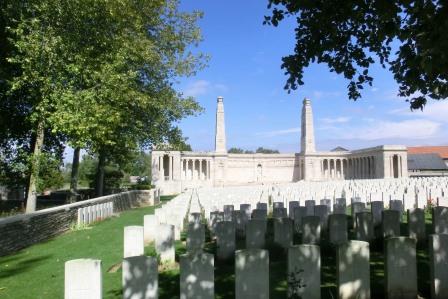
After our break, and postcards in hand, we made our way to the Vis en Artois British Cemetery. According to the information given by the Commonwealth War Graves Commission, the villages of Vis en Artois and Haucourt were taken by the Canadian Corps on August 27, 1918.  The cemetery began right after that date and was used by fighting units and ambulances until mid-October 1918.

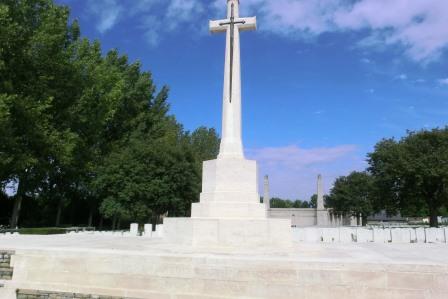
CIMG8325 Sep 5 2017 Vis en Artois British Cemetery Cross of Remembrance

Cross of Remembrance at Vis en Artois British Cemetery, with the Memorial behind the graves. (Photo credit: Daria Valkenburg)

CIMG8337 Sep 5 2017 Vis en Artois British Cemetery

Memorial at Vis en Artois British Cemetery. (Photo credit: Daria Valkenburg)

Originally, the cemetery had 430 graves, of which 297 were Canadian.  After WWI the cemetery grew by adding graves from battlefields and smaller cemeteries in the area, until today it has 2,369 burials from WWI, 1,458 of them unidentified.

….Kenneth Bell shares a grave with another WWI soldier!….

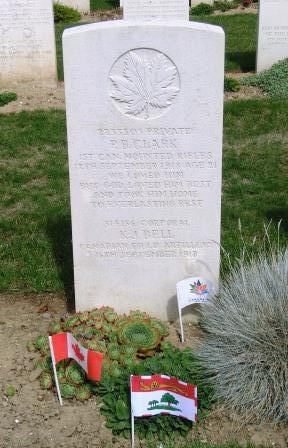
We found the grave of Kenneth Bell, but to our surprise he was not in a single grave.  He was buried with Private P. B. CLARK, who had died four days earlier than Bell.

CIMG8328 Sep 5 2017 grave of Cpl Kenneth Bel in Vis en Artois British Cemetery

Grave of Cpl Kenneth Bell, shared with Private P.B. Clark, at Vis en Artois British Cemetery. (Photo credit: Pieter Valkenburg)

Kenneth John BELL was born March 28, 1896 in Cape Traverse, the son of William Bell and Lucy Rogerson, and nephew of PEI Premier John Howatt Bell.  On September 16, 1918 he was hit by enemy shell fire, and was attended to by the medical officer of the brigade, but he died on the way to the dressing station. The location of the unit at the time of the casualty was Rumaucourt, 10.2 km from Harcourt.

It’s a shame as Bell, per his obituary, “had fought in the battles of the Somme, Vimy Ridge, Lens, Ypres, Passchendaele and many later battles and came out without a scratch”, only to die two months before the war’s end.  Unfortunately, we have not been able to find a photo or additional information on Corporal Bell.

CIMG8335 Sep 5 2017 Pieter by grave of Cpl Kenneth Bell in Vis en Artois British Cemetery

Pieter by the grave of Cpl Kenneth Bell, shared with Private P.B. Clark, at Vis en Artois British Cemetery. (Photo credit: Daria Valkenburg)

….Charles Lowther is buried 14 km from Kenneth Bell….

From Harcourt, we travelled 14 km (8.7 miles) further to Moeuvres Communal Cemetery Extension where Private Charles Lowther is buried.

CIMG8342 Sep 5 2017 Moeuvres Communal Cemetery Extension where Lowther is buried

Moeuvres Communal Cemetery Extension plaque. (Photo credit: Daria Valkenburg)

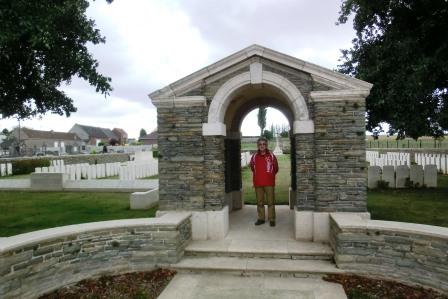
We soon learned that when we saw the word “Extension” by the name of a cemetery, it meant that the war graves were in a separate area, usually at the back, of a public cemetery.  In Moeuvres, the Extension has 565 Commonwealth burials and commemorations of WWI, with 263 unidentified graves.

CIMG8360 Sep 5 2017 Pieter at entrance to Moeuvres Communal Extension Cemetery

Pieter at the entrance to Moeuvres Communal Cemetery Extension. (Photo credit: Daria Valkenburg)

CIMG8343 Sep 5 2017 Pieter placing flags at Lowther grave at Moeuvres Communal Cemetery Extension

Pieter placing flags at the grave of Charles Lowther at Moeuvres Communal Cemetery Extension. You can see the cemetery extension is next to a farmer’s field. (Photo credit: Daria Valkenburg)

cimg8347-sep-5-2017-lowther-grave-at-moeuvres-communal-cemetery-extension.jpg

Grave of Charles Lowther at Moeuvres Communal Cemetery Extension. (Photo credit: Pieter Valkenburg)

Charles LOWTHER was born in North Carleton on September 27, 1896, the son of Henry and Bessie Lowther.  He died September 25, 1918 after being wounded by enemy shrapnel in a trench at Inchy-en-Artois, 2.1 km from Moeuvres.  He was evacuated by a unit of the 52nd division, who later reported him dead.

According to the war diary of the 25th Battalion, which Lowther was part of, for the 25th of September in Inchy-en-Artois:  “At about 6:00 am the enemy put down a heavy barrage on our lines and started to attack in force. Our S.O.S. was sent up and the field guns opened up immediately. We prevented the enemy from entering our trenches and in many places our men started over the top to meet the enemy, who was completely repulsed after some heavy fighting. The enemy continued to bombard our trenches the whole day, lifting fire towards the evening. At 11:00 pm the battalion was relieved by the 44th Canadian battalion. Casualties 6 O.R killed and 16 O.R. wounded…

O.R. refers to “Other Ranks”, ie not officers.  We looked to see if there were any other graves of men from the 25th Battalion but saw only one, that of an O. DAIGLE, who also died on September 25, 1918.

Unfortunately, as with Kenneth Bell, we have not been able to find a photo or additional information on Charles Lowther.

By this time it was 3:30 pm.  With the success we’d had so far today, Pieter wanted to find two more cemeteries, the Manitoba Cemetery in Caix and Grandcourt Cemetery in Grandcourt.  We should have quit while we were ahead, as by 7 pm we hadn’t found either cemetery and were getting very testy with each other. It was time to admit defeat for the day and go back to Arras for a well-deserved dinner and rest.

In the next blog entry we continue our search for the Manitoba and Grandcourt cemeteries. We need help to put a face to the name on these two graves.  Do you have information or photos for Kenneth Bell or Charles Lowther?  Comments or stories?  You can share them by emailing us at memorialtrail@gmail.com or by commenting on this blog.

© Daria Valkenburg

….Want to follow our research?….

If you are reading this posting, but aren’t following our research, you are welcome to do so.  Our blog address: https://onthewarmemorialtrail.com/

Front cover OnTheWarMememorialTrailinEurope4 countries, 6 weeks, 7,000 km – an unforgettable war memorial journey in Europe…. Daria’s book ‘No Soldier Buried Overseas Should Ever Be Forgotten‘ is available in print and e-book formats.  Net proceeds of book sales help support research costs and the cost of maintaining this blog. For more information see https://nosoldierforgotten.com/ 

You are also invited to subscribe to our YouTube Channel: On The War Memorial Trail With Pieter Valkenburg: https://www.youtube.com/channel/UCJ591TyjSheOR-Cb_Gs_5Kw

Never miss a posting!  Subscribe below to have each new story from the war memorial trail delivered to your inbox.