October 7, 2023. A few months ago, Edwin van der Wolf, one of the research volunteers at the Canadian War Cemetery in Holten, The Netherlands, asked for help in finding a photo of “…Sgt Clive Gerow, who unfortunately fell on April 10, 1945 near Deventer….”
We’d been to Deventer and the surrounding area with Edwin, so we were familiar with the area where Clive Gerow lost his life. Naturally, Pieter agreed to help with the photo search request.
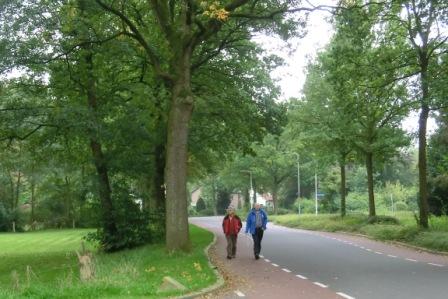
Pieter and Edwin van der Wolf (right) walked along the route near Schalkhaar that Canadian troops took before they liberated Deventer in April 1945. (Photo credit: Daria Valkenburg)
… The search for a photo of Clive was successful…
Edwin provided some basic information. Clive Elbert Steele GEROW was “…born on January 29, 1915 in Burk’s Falls, Ontario to John Gerow (who died in 1943) and Minnie Gerow, nee Magar. His mother died in 1920 when Clive was 5 years old. His sister was Thelma Beatrice Gerow (died 1941) and from his father’s second marriage he later had two half-sisters: Hope Francis and Laura May Gerow….”
In a sheer stroke of good fortune, a few days after Edwin’s initial request, Pieter found a photo on www.ancestry.ca, posted by Brynne Campbell. He contacted Brynne and explained about the photo search request, and provided a link to our On The War Memorial Trail Research blog. Brynne explained that “…Clive would have been my great-uncle…” Her grandmother, Hope Francis, is Clive’s half-sister.
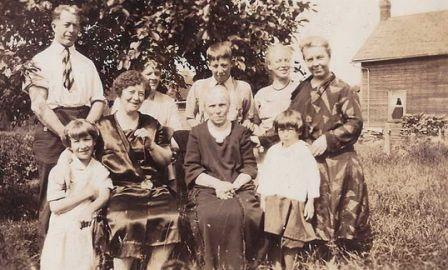
Family portrait, circa 1928. Standing, left to right: John Gerow, unknown, Clive Gerow, Elizabeth May Travis. Front, left to right: Thelma Gerow, Mrs Douglas, Charlotte E. Travis, Laura May Gerow, Edith Gerow. (Photo courtesy of the Gerow Family)
Edwin noted that “…Clive left school at the age of 17, having completed 11 years of education. After school he worked on his parents’ farm for 5 years and the last two and a half years, before enlisting in the army, as a mechanic at the Beaver House Lake Gold Mine…” near the Ontario town of Kirkland Lake, 285.41 km (177.35 miles) from his hometown.
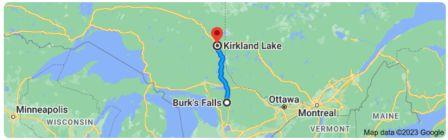
Map shows location of Burk’s Falls and Kirkland Lake. (Source: Google maps)
… Clive enlisted in 1939…
Clive enlisted with the Three Rivers Tank Regiment on November 2, 1939 in Trois-Rivières, Quebec. He would remain with this Regiment for much of his military service, with the Regiment undergoing several name changes. It was known as the 12th Armoured Regiment (Three Rivers Regiment) as of March 1, 1941. On May 15, 1942 it was designated the 12th Canadian Army Tank Regiment. On August 26, 1943, it became the 12th Canadian Armoured Regiment.
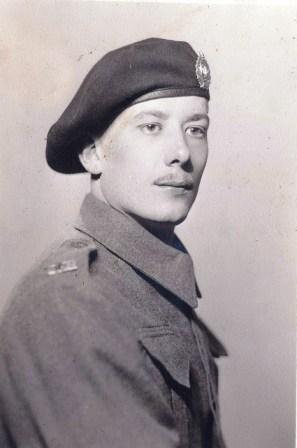
Clive Elbert Steele Gerow. (Photo courtesy of the Gerow Family)
In ‘War Chronicles 1939-1945 Three Rivers Regiment (Tank)’, author Charles Prieur noted that basic training began in Trois-Rivières before moving to Montreal, Quebec to “…Westmount’s M.A.A. (Montreal Athletic Association) Grounds on Montreal Island…” on March 26, 1940.
On March 28, 1940, “…Tank training begins without tanks. Drill features troops of men marching to semaphore signals. A Rypa simulator, with an electric motor, is also used to simulate a tank in motion. Courses multiply as able instructors are found with expertise in Vickers machine guns, radio transmission, electricity, mechanics, and Morse code…”
On June 23, 1940, the Regiment moved to Mount Bruno (23 km (14 mi) east of downtown Montreal) but quickly moved again, this time to Coteau Barracks in Trois-Rivières.
However, instead of the expected tank training, the Regiment was ordered “…to guard the 400 odd prisoners of war….” Troops also dealt with “…some 700 internees, in large part … refugees. Our Nazi prisoners consist almost exclusively of captured members of the Luftwaffe, merchant navy, submarine corps, and paratroop units…” Guard duty lasted until July 28, 1940, when “…No. 4 Company of the Veterans Home Guard… arrived to take over….”
On August 3, 1940, the Regiment was ordered to “…move to Camp Borden for actual tank training…” Clive was among those who were transferred to Borden, Ontario.
… Clive married shortly before going overseas…
On April 28, 1941, Clive married Elsie Mae Dickinson, who lived in Trois-Rivières. The couple were not together long as Clive and his Regiment were about to leave Canada for the United Kingdom.

Elsie Gerow (right) with Clive’s stepmother Edith Gerow (left). (Photo courtesy of the Gerow Family)
… Clive left Canada for service overseas…
Prieur noted that the Regiment left Camp Borden on June 17, 1941, expecting to “…detrain in Quebec City tomorrow –for a march through the outskirts of Limoilou, and arrive in Halifax on June 18…”
On June 19, 1941, the Regiment boarded the S.S. Windsor Castle. At midnight on June 21, 1941, the ship left Halifax for “…the United Kingdom, escorted by the battleship ‘Ramillies’, the battle cruiser ‘Repulse’ and six British destroyers….”
On June 30, 1941, “…at 0800 hrs, both the ‘Britannic’ and the ‘Windsor Castle’ drop anchor in the Clyde River near Gourock, Scotland…”
The next day, the Regiment left “… Gourock Station at 2000 hrs and travels through the night southwards to Lavington Down….” in Wiltshire, England. Preliminary training took up the next few months.
On October 7, 1941, Clive and his Regiment left for “…the Tank Firing Range at Linney Head, Wales…” for “…practice at the firing range…”
In January 1942 the Regiment moved to their winter quarters in Worthing, West Sussex, England. “…Except for ‘C’ Squadron in the Abbey, our billets here are clean modern cottages, with all conveniences — by far the best so far….” The Abbey was in nearby Sompting Abbott.
Clive was busy with training, receiving his Driver Operator Class ‘C’ qualification on March 1, 1942. From June 16 to July 2, 1942 Clive was attached to the Armoured Fighting Vehicle (AFV) Recovery Training Centre. Exercises and ongoing training with the Regiment continued.
On November 27, 1942 the Regiment moved to Brighton, England. Training began with Infantry Regiments, in preparation for battle.
Then from February 3, to March 31, 1943, he was sent for a Gunnery Instructor’s Course. Meanwhile the Regiment moved from Brighton back to Worthing.
On April 30, 1943, the Regiment moved “…to Hoddom Castle, in Annan, Scotland…” and issued Sherman tanks. “…These 30-tonners can reach a speed of 30 m.p.h, and are equipped with a confidence-building 75mm cannon and two Browning machine guns….”
… Clive left the United Kingdom for Sicily…
On June 15, 1943, the Regiment moved “…to the Port of Embarkation at Gourock on the Clyde in Scotland…” The following day the Regiment set sail for Sicily, Italy, “…crammed into 6 LSTs of the U.S. Navy. Its effective strength at this time is 37 officers and 550 non-commissioned officers and men, including 36 American and 18 British citizens….” An LST is a tank landing ship. (See https://en.wikipedia.org/wiki/Landing_Ship,_Tank)
During the month long journey from Scotland to Sicily, the convoy stopped at Gibraltar on June 30, 1943. “…At 1100 hrs, the cat is finally let out of the bag: the 1st Canadian Infantry Division and the 1st Canadian Tank Brigade are to join up with the Allied Forces. Indeed, we become an integral part of the famous Eighth Army under General Bernard Montgomery…”
From Gibraltar the convoy sailed along the north coast of Africa. On July 5, 1943, the convoy came under fire. “…At 1645 hrs, a huge explosion galvanizes the escorting destroyers into action. A Liberty ship has been torpedoed, catches fire, settles by the stern and sinks out of sight at 1700 hrs….”
… Clive participated in Operation Husky…
On July 10, 1943, they reached Pachino Bay in Sicily and ‘Operation Husky’ – the invasion of Sicily – began. “…The first Shermans of the Three Rivers Regiment rolled off L.S.T.s on the left flank of the 1st (Infantry) Brigade’s beach about 0900 hrs, and at 1015 hrs the unit reported one squadron ready for action…” (See https://www.canadahistoryproject.ca/1939-45/1939-45-10-operation-husky.html)
Over the next weeks, whatever brigade of the 1st Canadian Infantry Division was engaged, it was always with the support of the tanks of the Three Rivers Regiment.
On August 17, 1943 Prieur recorded that “… Sicily is finally cleared of the enemy…” Between September 12 and 24, 1943, “…the Three Rivers Regiment, now finally in reserve after its grueling solo support of the First Canadian Infantry Division and the 231st (Malta) Brigade throughout the Sicilian invasion, moves from Sicily and concentrates at Taranto, Italy….”
On October 5, 1943, “…the Three Rivers Regiment, which had moved overland from Foggia, arrived on the scene in time to bring its squadrons into action in support of the infantry brigades….” for the Battle of Termoli. (See https://www.canadiansoldiers.com/history/battlehonours/italiancampaign/termoli.htm)
On October 21, 1943, Clive was sent to No. 7 Casualty Clearing Centre and spent the next months in several hospitals and convalescent centres, and sent back to the United Kingdom. We could not find a record of why he was hospitalized for so long, but hospital records in Sicily indicate that there was a severe malaria epidemic.
Clive returned back to active duty on May 9, 1944, when he was transferred to No. 2 Canadian Armoured Corps Reinforcement Unit (CACRU), and sent for more training.
On September 3, 1944 Clive was transferred to No. 3 Canadian Armoured Corps Reinforcement Unit (CACRU). On September 8, 1944 Clive left the United Kingdom for northwest Europe. On October 8, 1944 he was transferred to the 27th Armoured Regiment (Sherbrooke Fusiliers Regiment), joining them near Maerle, Belgium.
Over the next months, Clive took part in the further advance through Belgium and The Netherlands, with the Regiment.
… Clive lost his life during the liberation of Deventer…
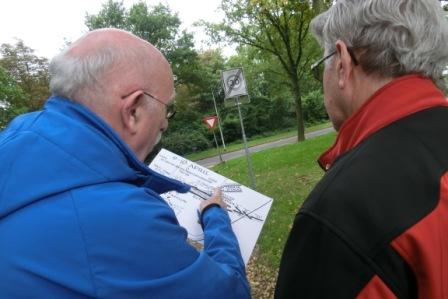
Edwin van der Wolf (left) and Pieter in Deventer, looking at a map of the attack that led to its liberation. (Photo credit: Daria Valkenburg)
On April 10, 1945, the Regiment was involved in the liberation of Deventer, a town lying on the right bank of the IJssel River. With the approaches protected by a maze of waterways, it was necessary to attack from the east.
The village of Schalkhaar was liberated without much difficulty, but three German tanks appeared on the morning of April 10 as the liberation of Deventer began. One tank was destroyed by ‘B’ Squadron of the 27th Armoured Regiment, while the other escaped. (See https://www.canadiansoldiers.com/history/battlehonours/northwesteurope/deventer.htm)
The war diary for April 10, 1945 provided a narrative of what happened. “…On our left flank ‘B’ Squadron west and enemy SPs were reported on our left flank. The ground was very open so a mad dash was made to the wood and protective positions were taken up to support SD&Gs who had ‘A’ Company across the canal at that point….” SP refers to self-propelled artillery. SD&G refers to the Stormont, Dundas and Glengarry Highlanders Regiment.
“….The SD&Gs worked straight north along the canal supported by 3 and 4 Tps while the NNSH went northwest supported by 1 and 2 Tps, finally reaching position, where they were stopped by a report of an SP…Sgt Gerow was killed by mortar fire and Lt Fraser took over No 2 Tp….” Tps refers to troops. NNSH refers to the North Nova Scotia Highlanders Regiment.
… Clive is buried in the Canadian War Cemetery in Holten…
Edwin explained that Clive “…was temporarily buried at the Roman Catholic Church in Schalkhaar before being reburied on April 9, 1946 in the Canadian War Cemetery in Holten….”
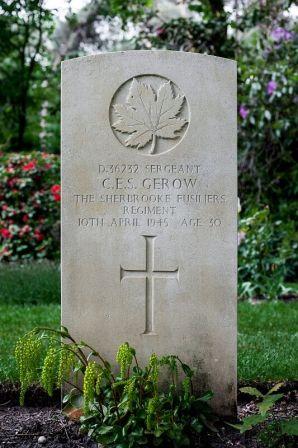
Grave of Clive Elbert Steele Gerow at the Canadian War Cemetery in Holten. (Photo source: Canadian Virtual War Memorial)
Thank you to Brynne Campbell for sharing photos of Clive Gerow. If you have a story to tell, please let Pieter know. You can email him at memorialtrail@gmail.com, or comment on the blog.
© Daria Valkenburg
…Want to follow our research?….
If you are reading this posting, but aren’t following the blog, you are welcome to do so. Our blog address: https://onthewarmemorialtrail.com/
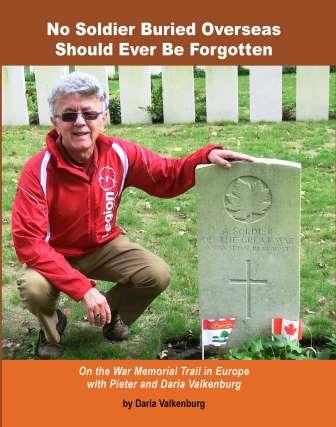 4 countries, 6 weeks, 7,000 km – an unforgettable war memorial journey in Europe…. Daria’s book ‘No Soldier Buried Overseas Should Ever Be Forgotten‘ is available in print and e-book formats. Net proceeds of book sales help support research costs and the cost of maintaining this blog. For more information on the book, please see https://nosoldierforgotten.com/
You are also invited to subscribe to our YouTube Channel: On The War Memorial Trail With Pieter Valkenburg: https://www.youtube.com/channel/UCJ591TyjSheOR-Cb_Gs_5Kw.
Never miss a posting! Subscribe below to have each new story from the war memorial trail delivered to your inbox.
 On The War Memorial Trail Research Project........ with Pieter and Daria Valkenburg