Celebration To Honour The Life Of WWII Pilot Elmer Muttart

100th Celebration - Elmer Bagnall Muttart-1

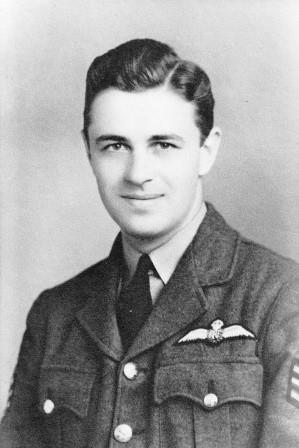
(Photo on left: from Canadian Virtual War Memorial at http://www.veterans.gc.ca)

March 14, 2018.  On March 8, 2018, at the Borden-Carleton Legion, a gathering of family and friends of WWII Pilot Elmer Bagnall MUTTART from Cape Traverse joined officials and non-profit historical organizations to honour his life.   This was the initiative of distant relative Lori (Muttart) Eggert.   After hearing about the Borden-Carleton Cenotaph Research Project and learning more about her relative, she saw the 100th anniversary of his birth as “an excellent opportunity to celebrate his life, his sacrifice, and raise some donations for the memorial planned in The Netherlands.”

CIMG9834 Mar 8 2018 Pieter and Lori Eggert

Pieter Valkenburg and Lori Eggert. (Photo credit: Daria Valkenburg)

Sponsored by the Cape Traverse Iceboat Committee, the event was embraced by us, the Borden-Carleton Legion, the Tryon & Area Historical Society, and the Lest We Forget Committee.  Period music was provided by Roger Sexton and George Ramsay.  Borden-Carleton Mayor Dean Sexton, and MLAs Jamie Fox and Dr. Peter Bevan-Baker gave words of remembrance.  Senator Mike Duffy was unable to attend, but sent a tribute of remembrance.  (Read the tributes by Mike Duffy:  Mike Duffy words of Remembrance: Mike Duffy words of Remembrance and Dr. Peter Bevan-Baker: Tribute by Dr Peter Bevan Baker: Tribute by Dr Peter Bevan Baker)

cimg9862-mar-10-2018-muttart-celebration-pieter-and-peter-bevan-baker.jpg

Pieter with MLA Dr. Peter Bevan-Baker. (Photo credit: Daria Valkenburg)

Jack Sorensen, Chair of Tryon & Area Historical Society noted that “One of the defining characters of a nation is the honor it bestows to those who have served in various ways to ensure peace in the country and the world beyond. Today, as a community in this great country of Canada, we carry out this tradition, by celebrating the life of a son, a brother in a family sense, a brother of a community which was his roots, and a Canadian Hero.”  (Read the full text of Jack Sorensen’s remarks: Remarks by Jack Sorensen TAHS)

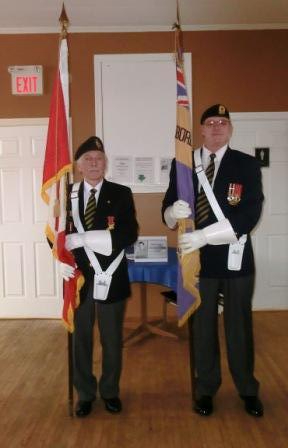
cimg9857-mar-10-2018-muttart-celebration-colour-party-george-palmer-and-carl-payne.jpg

Borden-Carleton Legion members George Palmer, left, and Carl Payne, right, provided the colour parade. (Photo credit: Daria Valkenburg)

In his remarks, Pieter paid tribute to Lori Eggert for organizing the event. “It’s so heartwarming when a family member of one of the soldiers takes such an interest.”  (Read the full text of Pieter’s remarks: Remarks by Pieter Valkenburg)

Pieter also read out a tribute from the Royal Netherlands Embassy in Ottawa. “Canadians were instrumental in our liberation and many gave their lives for our freedom.  Our gratitude for those courageous Canadian soldiers will never be forgotten.  They were our liberators.  Our heroes.  Forever.” (Read the tribute by the Dutch Embassy: Netherlands Embassy words of remembrance)

Lori Eggert, who had set up displays of Muttart, shared recollections on Elmer Muttart’s birth by his sister, Helen Coutts, of Toronto. “My brother was born one hundred years ago, on March 14th, 1918, during one of the stormiest March winters of a number of years.  There was no doctor at that time in Cape Traverse; the closest doctors were in Bedeque and Crapaud. The officiating doctor was Dr. Bowyer of Crapaud. Everybody loved him. My father drove in the sleigh to Crapaud to get him.  He drove there in the late afternoon and brought him back to our house, where he stayed for the night.”  (Read the full text of Helen Coutt’s remarks: 100 years ago by Helen Coutts)

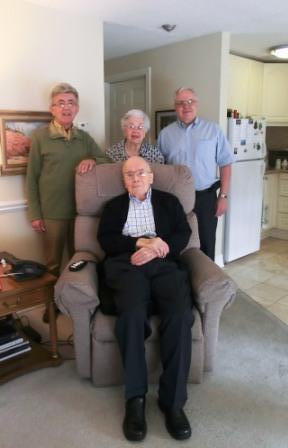
CIMG9479 Oct 25 2017 Pieter with Helen Elgin & Don Coutts in Toronto

Recently, we visited the Coutts family in Toronto. Standing, left to right: Pieter, Helen Coutts, Don Coutts. Seated: Elgin Coutts. (Photo credit: Daria Valkenburg)

CIMG9838 Mar 10 2018 Muttart Celebration display of Muttarts life

One of the displays made by Lori Eggert on the life of Elmer Muttart. (Photo credit: Daria Valkenburg)

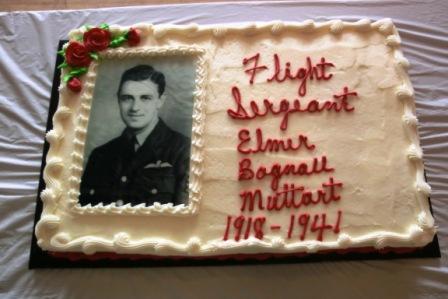
Of course, you can’t have a celebration without cake, and there was a beautiful one with a picture of Elmer Muttart embedded in the icing.

CIMG9849 Mar 10 2018 Muttart Celebration Cake

Cake to honour the life of Elmer Muttart. (Photo credit: Daria Valkenburg)

Donations were made to the Muttart Memorial Fund, a fundraising project towards the placement of a memorial plaque for Muttart and his crew at the site of the plane crash in Wons, The Netherlands.

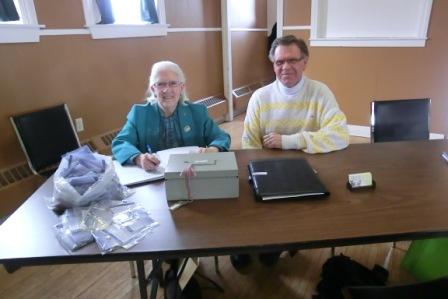
CIMG9843 Mar 10 2018 Muttart Celebration Arlen & Jack Sorensen of TAHS

Arlene and Jack Sorensen of the Tryon & Area Historical Society accepted donations to the “Muttart Memorial Fund”. (Photo credit: Daria Valkenburg)

UPDATE:  This project was completed in October 2019!

If you would like to donate, cheques may be written out to TAHS and mailed to Tryon & Area Historical Society (TAHS), PO Box 38, Crapaud PE C0A 1J0.  In the subject line, identify your cheque as being for the “Muttart Memorial Fund”.  A charitable donation receipt will be sent to all donors.

If you wish to donate and you live in Europe:  Bank transfers may be made to Stichting Missing Airmen Memorial Foundation, Bank Account # (IBAN) NL35ABNA0569579856, and state in the subject line “Attn D.S. Drijver for Halifax L9561”.

UPCOMING PRESENTATION: Pieter has been invited to speak about the Cenotaph Research Project at Central Trinity United Church in Breadalbane at 7 pm on Sunday, March 25, 2018.  Photos and information about soldiers welcome.  Members of the Tryon & Area Historical Association will be present to accept donations to the “Muttart Memorial Fund”.

The Cenotaph Research Project is far from over, and your input is welcome.  Please share your photos, comments, or stories by emailing us at memorialtrail@gmail.com or by commenting on this blog.

 © Daria Valkenburg

….Want to follow our research?….

If you are reading this posting, but aren’t following our research, you are welcome to do so.  Our blog address: https://onthewarmemorialtrail.com/
Front cover OnTheWarMememorialTrailinEurope4 countries, 6 weeks, 7,000 km – an unforgettable war memorial journey in Europe…. Daria’s book ‘No Soldier Buried Overseas Should Ever Be Forgotten‘ is available in print and e-book formats.  Net proceeds of book sales help support research costs and the cost of maintaining this blog. For more information see https://nosoldierforgotten.com/ 

You are also invited to subscribe to our YouTube Channel: On The War Memorial Trail With Pieter Valkenburg: https://www.youtube.com/channel/UCJ591TyjSheOR-Cb_Gs_5Kw

Never miss a posting! Subscribe below to have each new story from the war memorial trail delivered to your inbox.
Event To Honour The Life of Elmer Bagnall Muttart

March 2, 2018.  Lori (Muttart) Eggert, a relative of PEI WWII Pilot Elmer Bagnall MUTTART – whose story has been featured on this blog – is organizing an event to commemorate what would be the 100th birthday of Elmer Muttart, who died in 1941 after his plane was shot down in The Netherlands.

For those who may be interested in attending the event on March 10, 2018 in the Borden-Carleton Legion, here are the details that Lori has passed along:

100th Celebration - Elmer Bagnall Muttart-1

(Photo on left: from Canadian Virtual War Memorial at http://www.veterans.gc.ca)

I have organized the following event, in honour of the life of Flight Sergeant Elmer Bagnall Muttart, a distant relative of mine, on what would have been his 100th birthday.

The Legion is very supportive of this event and has encouraged its members to attend, in uniform if possible.  The Sergeant-At-Arms will march on the Legion Colours (flags) at 2 pm to commence the event, and off again at 5 pm to close the event.  The Cape Traverse Iceboat Committee is sponsoring the event, and there will be a huge cake with Elmer’s picture on it.  Hoping to display as many photos and articles about his life as I can find as I would like to celebrate his amazing accomplishments, not just his heroic sacrifice.

Please join us on Saturday March 10, 2018 (2:00 pm) at the Borden-Carleton Royal Canadian Legion Branch #10 to honour the life of a local son, brother and Canadian hero, born March 14, 1918 in Cape Traverse, PEI, on what would have been his 100th birthday.

Sadly, during WWII, at the age of 23, Elmer gave his life in a heroic act of bravery which spared his crew and many other lives. He is buried in Harlingen Cemetery in The Netherlands.

With the blessing of his surviving sister, Helen, and her family, we would like to celebrate the remarkable life of Elmer Bagnall Muttart, at an appropriate venue, the Royal Canadian Legion in Borden-Carleton. The Cenotaph outside bears his name and that of many other local heroes who made the ultimate sacrifice for their country.

For more on his tremendous act of heroism, please read a blog written by Pieter and Daria Valkenburg:  The story of WWII pilot Elmer Bagnall Muttart from Cape Traverse, who saved the Dutch village of Wons and his crew after being shot down in October 1941.
https://bordencarletonresearchproject.wordpress.com/2017/07/28/the-elmer-bagnall-muttart-story/comment-page-1/#comment-62

The non-profit Missing Airmen Memorial Foundation in The Netherlands and the non-profit Tryon & Area Historical Society (TAHS) here on Prince Edward Island have partnered to raise funds for a memorial plaque to be placed in Wons, The Netherlands, in October 2018. Those who wish to make a donation for the memorial plaque will receive a charitable receipt at this event from members of the TAHS.

Cake and refreshments to be shared.

All are welcome.

#CanadaRemembers

STORM DATE: Sunday March 11, 2018 at 2:00 pm

What a wonderful event!  Pieter and I hope to be home in time to attend and we look forward to meeting readers of this blog.

UPDATE:  This project was completed in October 2019!

Details for those wishing to donate to the project for a memorial plaque to be placed in Wons:  Cheques may be written out to TAHS and mailed to Tryon & Area Historical Society (TAHS), PO Box 38, Crapaud PE C0A 1J0.  In the subject line, identify your cheque as being for the “Muttart Memorial Fund”.  A charitable donation receipt will be sent to all donors.

If you wish to donate and you live in Europe:  Bank transfers may be made to Stichting Missing Airmen Memorial Foundation, Bank Account # (IBAN) NL35ABNA0569579856, and state in the subject line “Attn D.S. Drijver for Halifax L9561”.

The Cenotaph Research Project is far from over, and your input is welcome.  Please share your photos, comments, or stories by emailing us at  memorialtrail@gmail.com or by commenting on this blog.

Upcoming presentation:  Pieter will be speaking about the Cenotaph Research Project at Central Trinity United Church in Breadalbane on March 25, 2018, at 7:00 pm.  More details to come.

© Daria Valkenburg

….Want to follow our research?….

If you are reading this posting, but aren’t following our research, you are welcome to do so.  Our blog address: https://onthewarmemorialtrail.com/

Front cover OnTheWarMememorialTrailinEurope4 countries, 6 weeks, 7,000 km – an unforgettable war memorial journey in Europe…. Daria’s book ‘No Soldier Buried Overseas Should Ever Be Forgotten‘ is available in print and e-book formats.  Net proceeds of book sales help support research costs and the cost of maintaining this blog. For more information see https://nosoldierforgotten.com/ 

You are also invited to subscribe to our YouTube Channel: On The War Memorial Trail With Pieter Valkenburg: https://www.youtube.com/channel/UCJ591TyjSheOR-Cb_Gs_5Kw

Never miss a posting!  Subscribe below to have each new story from the war memorial trail delivered to your inbox.

On the War Memorial Trail ….. At The Politiek Farm In Wons

February 6, 2018. The basic story of PEI WWII pilot Elmer Bagnall MUTTART, whose name is listed on the Cenotaph outside the Borden-Carleton Legion, was told previously in this blog.  In the last blog entry, we visited Harlingen General Cemetery where Muttart is buried, and met with two volunteers from the Missing Airmen Memorial Foundation (See On the War Memorial Trail ….. At Harlingen General Cemetery).

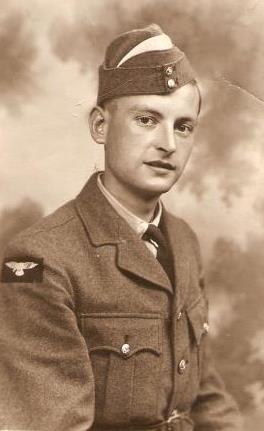
Elmer Bagnall Muttart (2)

Elmer Bagnall Muttart (Photo from Canadian Virtual War Memorial at http://www.veterans.gc.ca)

With the previous soldiers whose graves we had visited, the cemetery or memorial was the last stop on the war memorial trail for that person.  In the case of Muttart, the journey continued.  The Missing Airmen Memorial Foundation had received an invitation for us to visit the Politiek farm, the first farm outside of the village of Wons, where Halifax L9561 crashed after being shot down.  The farm is still owned by the Politiek family and we were welcomed by Johannis Politiek and his wife Jantina.  Johannis’ father Cor, who was 9 years old in 1941 when the plane crashed on his parents’ dairy farm, was also present and gave his recollection of that fateful evening.

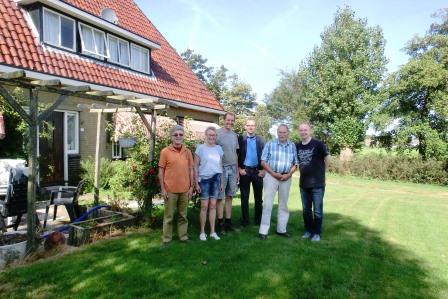
CIMG8032 Aug 28 2017 Politiek farm in Wons Pieter Jantina Johannes Alexander Cor Douwe

At the Politiek farm in Wons. From left to right: Pieter, Jantina Politiek, Johannis Politiek, Alexander Tuinhout, Cor Politiek, Douwe Drijver. (Photo credit: Daria Valkenburg)

Cor lived on the farm with his parents and siblings.  He was the youngest.  Everyone was in bed when they heard the commotion and saw that the plane was on fire as it was coming down, flying about 40 metres over the farmhouse roof.  Pieces of the plane were flying off until the plane crashed in the field a few hundred metres from the farmhouse, making a deep hole in the ground.  Due to the burning plane, no one could get to it until the next day, when the German authorities arrived.

When asked if anyone from the family had tried to approach the plane, Cor shook his head, explaining that the Dutch population were not allowed to approach, under threat of reprisals from their Nazi occupiers.

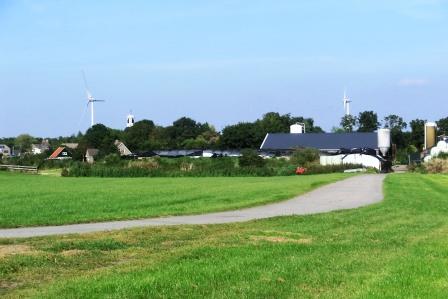
CIMG8038 Aug 28 2017 Politiek farm in Wons

Halifax L9561 crashed in the field to the right of the foreground of this photo. One can see the Politiek barn on the far right, and towards the far left one can see the houses and church steeple of the village of Wons. (Photo credit: Pieter Valkenburg)

Cor recalled that one of the survivors from the plane crash was on their farm, but unfortunately the Dutch Resistance had no means to safely evacuate anyone.  (Note: We do not know who this was.) Allied airmen had been instructed by the British government to surrender to the authorities, and that’s what they did.  As prisoners of war they were first brought to Leeuwarden, then to a prison in Amsterdam, and from there sent in groups to Frankfurt for interrogation before being transferred to the various prisoner of war camps.  Injured prisoners of war, such as John William DUFFIELD, were sent to the hospital in Leeuwarden, which was next to the German air base and quarters for German pilots.

scan0005 john duffield portrait

John William Duffield. (Photo courtesy of Lesley Newland)

In Duffield’s November 11, 2000 letter to Peter Hinchcliffe, who was researching German night fighters, he explained that “Muttart had arrived back at Middleton St. George after a conversion course at Linton on Ouse a few days prior to 12th October.  His crew were down for an operation to Bremen.  It was then found that three members of the crew were very inexperienced.  They were the W/OP (wireless operator), Engineer, and Rear Gunner. As a result Hunt (W/OP), Roberts (Engineer), and myself flew with the crew. Those we were replacing travelled as passengers for experience.  Trayler was second pilot and Alexander navigator.

We had just crossed the Dutch coast when there was a loud bang and the inner port engine caught fire.  My microphone was smashed.  Muttart gave orders to prepare to abandon.  Shortly after this I could hear nothing, but saw parachutes opening below.  I then decided I had better leave and as I could not make it up the fuselage decided to get out of the turret...

In a December 22, 2000 letter to Peter Hinchcliffe, Duffield continued with the events of that night, saying what he had learned many years afterward.  “The night of the 12th October was a complete shambles, flying to Germany with no one in the front turret.  I only found this out after the war at a reunion.  After we had been hit I opened the turret door and leaned out as far as I could but could see nothing.  I then assumed that we must have been directly over the fighter.  Had there been someone in the front turret this situation could have been avoided….”  We’ll never know if this is true, as it was wartime and anything could change in a second.

Duffield’s January 2, 1946 letter to Louis Muttart, father of Elmer Muttart, gave a secondhand account of what happened after Duffield lost contact with the cockpit when his microphone was destroyed, and then he lost consciousness after being injured when the plane was attacked on October 12, 1941.  “On my discharge from hospital I was unable to meet any others of the crew, but whilst on a ‘medical rehabilitation course’ some six months ago I met the wireless operator….”  The wireless operator was William Herbert HUNT.  All of the surviving crew had spent the remainder of the war in prisoner of war camps, and it was likely after returning to England that the crew were sent to the medical rehabilitation course that Duffield refers to.

Duffield continues his letter with what Hunt told him.  “Evidently he was the last man to leave the machine alive.  Before jumping he noticed that the machine was only 800 feet up.  Happy (Muttart’s nickname) was quite all right and said that he would stick to the aircraft and make a crash land.  True to the rules of air and sea, the skipper remained.  Happy, however, marvellous pilot that he was, was unable to pull the machine out of the dive and crashed with it.  He died instantly….

The crew members of Halifax L9561 were:

  • Pilot – F/S Elmer Bagnall MUTTART (age 23)
  • Co-Pilot – P/O Norman Frank TRAYLER (age 21)
  • Flight Engineer – Sgt David COTSELL (age 21)
  • Flight Engineer – Sgt Leslie Albert ROBERTS (age 25) (previously recorded as bomb aimer)
  • Navigator – Sgt Reginald William Purchase ALEXANDER (age 22)
  • Wireless Operator – Sgt William Herbert HUNT (age 22)
  • Gunner – Sgt George Henry PATTERSON (age 28)
  • Gunner – Sgt John William DUFFIELD (age 20)

Our thanks go to the families of Elmer Muttart and John Duffield for sharing the correspondence and allowing us to quote from the letters in this blog entry, and the previous one.  These first hand memories are so important in telling the stories of what happened during wartime.

Do you have a story or photos about Halifax L9561, its crew members, John Duffield, or Elmer Muttart?  You can share your comments and stories by emailing us at memorialtrail@gmail.com or by commenting on this blog.

UPDATE:  This project was completed in October 2019!

If you would like to make a donation in support of the commemoration plaque for Halifax L9561, which is being planned for placement in Wons, the information is below:

In Canada:  Cheques may be written out to TAHS and mailed to Tryon & Area Historical Society (TAHS), PO Box 38, Crapaud PE C0A 1J0.  In the subject line, identify your cheque as being for the “Muttart Memorial Fund”.  A charitable donation receipt will be sent to all donors.

In Europe: Bank transfers may be made to Stichting Missing Airmen Memorial Foundation, Bank Account # (IBAN) NL35ABNA0569579856, and state in the subject line “Attn D.S. Drijver for Halifax L9561”.

We’d now visited the graves of all the names listed on the Cenotaph outside the Borden-Carleton Legion who were buried in The Netherlands.  In our next blog entry, we visit a cemetery in Cologne, Germany and the grave of WWI soldier Lt. Henry Warburton STEWART.

© Daria Valkenburg

….Want to follow our research?….

If you are reading this posting, but aren’t following our research, you are welcome to do so.  Our blog address: https://onthewarmemorialtrail.com/

Front cover OnTheWarMememorialTrailinEurope4 countries, 6 weeks, 7,000 km – an unforgettable war memorial journey in Europe…. Daria’s book ‘No Soldier Buried Overseas Should Ever Be Forgotten‘ is available in print and e-book formats.  Net proceeds of book sales help support research costs and the cost of maintaining this blog. For more information see https://nosoldierforgotten.com/ 

You are also invited to subscribe to our YouTube Channel: On The War Memorial Trail With Pieter Valkenburg: https://www.youtube.com/channel/UCJ591TyjSheOR-Cb_Gs_5Kw

Never miss a posting!  Subscribe below to have each new story from the war memorial trail delivered to your inbox.

On the War Memorial Trail ….. At Harlingen General Cemetery

February 3, 2018.  In July 2017, the County Line Courier published a story about PEI Pilot Elmer Bagnall Muttart (See CLC July 19 p20 WWII Pilot Saved Dutch Village), whose name is listed on the Cenotaph outside the Borden-Carleton Legion. This blog had two previous entries about him.  (See The Elmer Bagnall Muttart Story and The Media Interview With CBC ).  This blog entry is about our visit to his grave at Harlingen General Cemetery in The Netherlands.

Elmer Bagnall Muttart (2)

Elmer Bagnall Muttart (Photo from Canadian Virtual War Memorial at http://www.veterans.gc.ca)

Elmer Bagnall MUTTART, born March 14, 1918 in Cape Traverse, son of Louis (Lewis) Muttart and Annie Bagnall, was an RCAF pilot assigned to the 10th Operational Training Unit in England in March 1941, where he trained to fly a Whitley, a twin-engine medium bomber.  On May 19, 1941 he was transferred to the 78th Squadron at the air base in Middleton St. George and had 20 successful flights in enemy territory as either co-pilot or pilot.  On September 24, 1941 he transferred to the 76th Squadron for retraining to fly the new four engine Halifax plane, a heavy bomber.

On October 12, 1941, with his regular navigator Reg ALEXANDER and six other crew members, Muttart began his 21st mission into enemy territory.  The crew members of Halifax L9561 were:

  • Pilot – F/S Elmer Bagnall MUTTART (age 23)
  • Co-Pilot – P/O Norman Frank TRAYLER (age 21)
  • Flight Engineer – Sgt David COTSELL (age 21)
  • Bomb Aimer – Sgt Leslie Albert ROBERTS (age 25)
  • Navigator – Sgt Reginald William Purchase ALEXANDER (age 22)
  • Wireless Operator – Sgt William Herbert HUNT (age 22)
  • Gunner – Sgt George Henry PATTERSON (age 28)
  • Gunner – Sgt John William DUFFIELD (age 20)

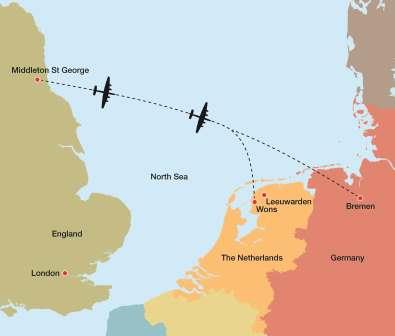
Flying Halifax L9561 as part of a group of 100 bombers, they left England at 7:30 pm and headed towards their target – a bombing raid on Bremen, Germany.  At 10:15 pm, Muttart’s plane was shot upon.  He managed to steer the plane south, passing over the town of Harlingen, where the plane was shot a second time.  Just past the village of Wons, the plane crashed, but not before all of the crew members, except for Muttart, had parachuted out.  The crew members, all British, spent the rest of the war in various prisoner of war camps.

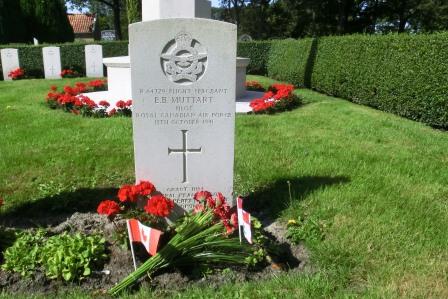
Muttart was buried in Harlingen General Cemetery, in the province of Friesland, on October 16, 1941 by the German military. This is a public cemetery with 67 Commonwealth burials from WW II, most of them airmen. 22 are unidentified. In addition, there are four unidentified war graves of other nationalities.

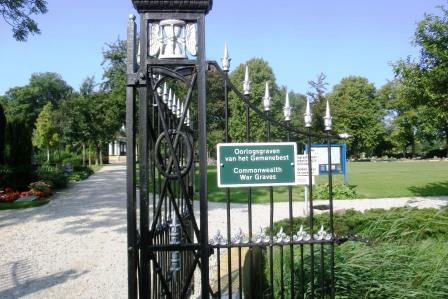
CIMG8076 Aug 28 2017 Harlingen Cemetery entrance gate

Entrance to Harlingen General Cemetery. (Photo credit: Daria Valkenburg)

When we went to pay our respects at Muttart’s grave with flags and a bouquet of flowers, we were joined by two members of the Missing Airmen Memorial Foundation, a non-profit organization dedicated to preserving the history of Allied planes shot down in The Netherlands during WW II.  The Foundation plans to honour the Halifax L9561 crew with a memorial plaque to be placed in Wons, near the site of the plane crash, and is raising funds for an event planned for October 2018.

We thought a Canadian contribution towards this would be a fitting tribute to honour Muttart, and the Tryon and Area Historical Association in Prince Edward Island agreed to help with a fundraising project, “Muttart Memorial Fund” for donations made within Canada.  Funds raised will be transferred to the Missing Airmen Memorial Foundation.

The Tryon & Area Historical Society is pleased to sponsor Pieter and Daria Valkenburg for carrying out the Elmer Bagnall Muttart Memorial Project. The Society will also administer the receiving of donations to go toward the cost of the Memorial. Registered Charity tax receipts will be issued…, says Jack Sorensen, Chair of the Tryon & Area Historical Society Inc.

Meeting with Alexander Tuinhout, Secretary for the Foundation, and Douwe Drijver, Treasurer for the Foundation, at Harlingen General Cemetery at Muttart’s grave was a fitting way to get acquainted as we begin to work on this joint project.

CIMG8019 Aug 28 2017 Harlingen Cemetery Pieter Alexander Douwe by Muttarts grave

Pieter on the left with Alexander Tuinhout, centre, and Douwe Drijver on the right, at Elmer Muttart’s grave in Harlingen General Cemetery. We had brought along a Canadian flag for the Foundation to use in their commemoration services. (Photo credit: Daria Valkenburg)

CIMG8014 Aug 28 2017 Harlingen Cemetery Muttarts grave

Grave of Elmer Bagnall Muttart in Harlingen General Cemetery. (Photo credit: Pieter Valkenburg)

One of the stories we had heard about Muttart’s burial is that he was buried with “full military honours” by the German military.  We had no idea if that was true, until we received a copy of a letter written by Gunner Sgt John William DUFFIELD, one of Muttart’s crew members.  Duffield was injured during the plane crash and ended up in a hospital.

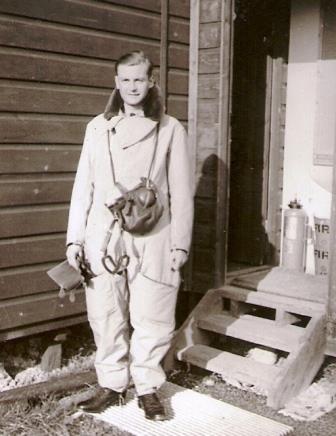
John Duffield in uniform

John Duffield in his flight suit. (Photo courtesy of Lesley Newland)

In a January 2, 1946 letter to Muttart’s father, Louis Muttart, Duffield wrote what happened:

Elmer, better known as ‘Happy’ on the squadron, was not my skipper, but for the fateful night of October 12th, I was loaned to his crew to fulfill my duties as a rear gunner.  He was my own skipper’s friend, and as he was such a good pilot, I was glad to be flying with him although it was only for the night.

We were on our way to Bremen and just over the Dutch coast when we were attacked from underneath.  I had my oxygen mask and microphone blown off my face and was hit on the left leg, hand, and body.  From this time onwards, I was out of communication with the crew.

We finally had two fighters attacking us and I managed to get one of them.  Our inner port engine caught fire, but by wonderful flying, Happy managed to keep the machine from spinning, but was unable to keep it from diving.  As a result he told us to jump from it.

Halifax_L9561_Wons-2

Estimated path taken by Halifax L9561 on October 12, 1941 after they were hit and diverted towards Wons. (Drawing courtesy of the Missing Airmen Memorial Foundation)

Duffield continued in his 1946 letter, “By this time I was paralyzed up the left side of my body and in trying to jump from the rear turret, my right leg became jammed.  It was only when I pulled my ‘chute that I freed myself.  I then became unconscious.

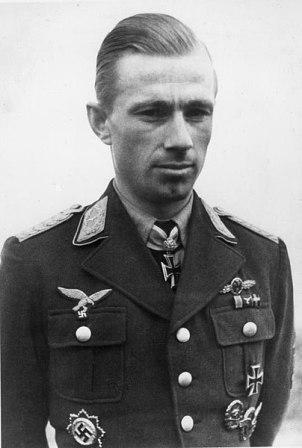
In a November 11, 2000 letter to Peter Hinchcliffe, who was researching German night fighters of WW II, Duffield wrote that “I came to lying on the ground, surrounded by German officers and Dutch civilians.  An ambulance soon arrived and I was on my way to hospital.  The following day, a tall, good looking German officer arrived and introduced himself as Helmut Lent.” The hospital was in nearby Leeuwarden.  Major Helmut LENT was the commander of 4./NJG 1 squadron, stationed at the airfield in  Leeuwarden.   A member of Lent’s squadron, Lt. Leopold FELLERER was responsible for shooting down the plane.

Duffield wrote about Lent in his 1946 letter to Muttart’s father, saying that Lent “later became the crack night fighter ace of the German Air Force.  He met his death in June 1944.  He asked me to send you his deepest sympathy for your son’s death.  Although he was our enemy, I can assure you that he meant it.  Happy was given a full military funeral and all arrangements were made by this pilot.  He bought a wreath for me on behalf of the crew in red, white, and blue flowers.

Alexander Tuinhout and Douwe Drijver told us that over 400 Allied planes crashed in Friesland and surrounding water, plus 150 German planes.  Most of the time, there were no survivors of plane crashes, making the 7 survivors of Halifax L9561 unusual.

In the next blog entry, we visit the Politiek farm in Wons, site of the plane crash, and speak with Cor Politiek, who was 9 years old in 1941 when the plane crashed on his parents’ dairy farm.

Do you have a story or photos about Halifax L9561, its crew members, John Duffield, or Elmer Muttart?  You can share your comments and stories by emailing us at memorialtrail@gmail.com  or by commenting on this blog.

UPDATE:  This project was completed in October 2019!

If you would like to make a donation in support of the commemoration plaque for Halifax L9561, the information follows below:

In Canada:  Cheques may be written out to TAHS and mailed to Tryon & Area Historical Society (TAHS), PO Box 38, Crapaud PE C0A 1J0.  In the subject line, identify your cheque as being for the “Muttart Memorial Fund”.  A charitable donation receipt will be sent to all donors.

In Europe: Bank transfers may be made to Stichting Missing Airmen Memorial Foundation, Bank Account # (IBAN) NL35ABNA0569579856, and state in the subject line “Attn D.S. Drijver for Halifax L9561”.

© Daria Valkenburg

….Want to follow our research?….

If you are reading this posting, but aren’t following our research, you are welcome to do so.  Our blog address: https://onthewarmemorialtrail.com/

Front cover OnTheWarMememorialTrailinEurope4 countries, 6 weeks, 7,000 km – an unforgettable war memorial journey in Europe…. Daria’s book ‘No Soldier Buried Overseas Should Ever Be Forgotten‘ is available in print and e-book formats.  Net proceeds of book sales help support research costs and the cost of maintaining this blog. For more information see https://nosoldierforgotten.com/ 

You are also invited to subscribe to our YouTube Channel: On The War Memorial Trail With Pieter Valkenburg: https://www.youtube.com/channel/UCJ591TyjSheOR-Cb_Gs_5Kw

Never miss a posting!  Subscribe below to have each new story from the war memorial trail delivered to your inbox.
On the War Memorial Trail ….. Candlelight Service At Holten Canadian War Cemetery

January 25, 2018.  When we visited the Royal Canadian Legion in The Netherlands and the Information Centre at Holten Canadian War Cemetery, we brought along flag pins, provided by Senator Mike Duffy of the Senate of Canada, to give to the schoolchildren who participate in the candlelight service at the Canadian war cemeteries on Christmas Eve.

So we were delighted that Edwin van der Wolf, one of the volunteers at Holten Canadian War Cemetery, shared photos of the 2017 Christmas Eve Ceremony.

DSC_6349

Edwin van der Wolf with schoolchildren from the town of Deventer, who are wearing Canadian flag pins, at Holten Canadian War Cemetery. (Photo courtesy of E. van der Wolf)

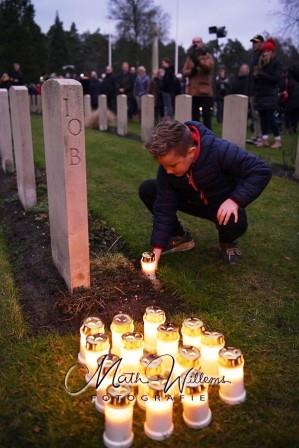
The candlelight ceremony began in 1991, with the participation of schoolchildren from the nearby town of Deventer, birthplace of Canada’s first Surveyor-General, Samuel Holland.  They light candles and place them on each grave in the cemetery at dusk.

DSC_6386-BorderMaker

Schoolchild places candle at one of the graves at Holten Canadian War Cemetery. (Photo credit: Math Willems)

Originally, the candlelight service began in Scandinavia by Mrs. Leena van Dam, who was born in Finland and wanted to show how grateful she was to live in a free country.  In Finland, it is traditional to place a burning candle on the graves of loved ones. Finnish candles can burn for ten hours and remain lit in all weather conditions, whether rain, wind, or snow.  Initially, Mrs. van Dam donated a five year supply of candles.  The Welcome Again Veterans Foundation, through the help of sponsors and donations, has continued funding the candles.

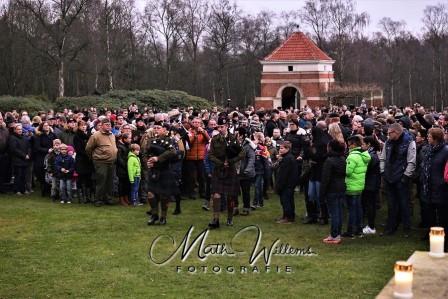
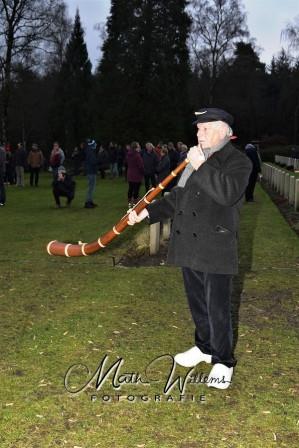
Close to 300 school children participate in this ceremony, which begins at 4:30 pm on Christmas Eve. Canadian and Dutch traditions are mixed as bagpipes are played and a Dutch horn is blown.

DSC_6364-BorderMaker

Bagpipers during the ceremony at Holten Canadian War Cemetery. (Photo credit: Math Willems)

DSC_6358-BorderMaker

The haunting sound of a Dutch horn is played during the ceremony. (Photo credit: Math Willems)

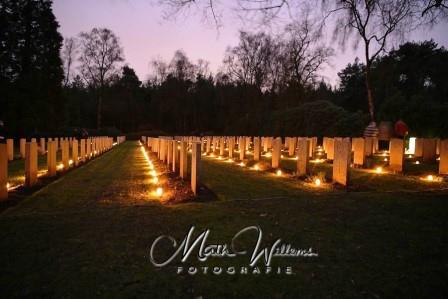
All evening, thousands of people from the area visit the cemetery and show their respects.  This candlelight ceremony is one of the many ways that the Dutch people remember the sacrifices of Canadian soldiers during WWII.

DSC_6414-BorderMaker

Candles at each grave at Holten Canadian War Cemetery on Christmas Eve. (Photo credit: Math Willems)

When we visited Holten Canadian War Cemetery our guide, Edwin van der Wolf, explained why he was a volunteer.  He told us that his grandfather lived in an area of Deventer that had been liberated by Canadian soldiers, and told his children and grandchildren the same story every Sunday.  Grandfather lived in a corner house on a street where he could see a hospital fence 100 metres away.  German soldiers were lying on the hospital roof and firing at Canadian soldiers as they climbed over the gate.  Some successfully climbed over the iron gate and were able to get in a crouching position and go past the line of fire.  As more Canadians advanced, the Germans retreated.

Hearing this story every week captured Edwin’s imagination.  The story, plus the fact that so many Canadians came from so far away to help liberate the Dutch made him feel a special bond with Canada.

Have you visited Holten Canadian War Cemetery and its Information Centre?  Have you seen one of the candlelight ceremonies?  You can share your comments and stories by emailing us at memorialtrail@gmail.com, comment on the blog, or tweet to @researchmemori1

© Daria Valkenburg

…Want to follow our research?….

If you are reading this posting, but aren’t following our research, you are welcome to do so.  Our blog address: https://onthewarmemorialtrail.com/

Front cover OnTheWarMememorialTrailinEurope4 countries, 6 weeks, 7,000 km – an unforgettable war memorial journey in Europe…. Daria’s book ‘No Soldier Buried Overseas Should Ever Be Forgotten‘ is available in print and e-book formats.  Net proceeds of book sales help support research costs and the cost of maintaining this blog. For more information see https://nosoldierforgotten.com/

You are also invited to subscribe to our YouTube Channel: On The War Memorial Trail With Pieter Valkenburg: https://www.youtube.com/channel/UCJ591TyjSheOR-Cb_Gs_5Kw

Never miss a posting!  Subscribe below to have each new story from the war memorial trail delivered to your inbox.

On the War Memorial Trail ….. At Holten Canadian War Cemetery

January 20, 2018.  After visiting the Information Centre at the Canadian War Cemetery in Holten, we went into the cemetery itself to lay flags at the graves of five known soldiers from PEI.  Two of them, William Douglas SHERREN and George Martin MCMAHON are listed on the Cenotaph outside the Borden-Carleton Legion.

We had wondered why the cemetery had more landscaping than most Commonwealth War Cemeteries and why it was not on one level, but terraced.  Edwin van der Wolf, our guide, explained that the cemetery originally was on flat ground.  The Canadian government acquired more land than was used in the belief that the war would last longer and go into Denmark, resulting in more casualties. Luckily, that didn’t happen, and meant that the excess land could be used for landscaping.

When the cemetery was first opened, metal crosses were used to mark each grave, and there is a display in front of the Information Centre that shows one.

CIMG9100 Sep 18 2017 display of original metal cross used in Holten Cemetery

Metal cross originally used to mark each grave in Holten Canadian War Cemetery. (Photo credit: Daria Valkenburg)

Originally, the Cross of Sacrifice in the cemetery was placed further back than in its present location.  Similar to the story we’d heard about the placement of a Cross of Sacrifice at Groesbeek Canadian War Cemetery, Edwin noted that he had heard that when Holten Cemetery began, Lt. General Guy Granville Simonds, Commander of the 2nd Canadian Army, “wanted the Cross of Sacrifice to be 60 metres high and lit up so that it could be seen across the German border as a reminder of who had conquered them.”  Whether this story is true or not, we don’t know.

CIMG9123 Sep 18 2017 Holten Cemetery Pieter & Edwin van der Wolf by cross of remembrance

Pieter with Edwin van der Wolf by the Cross of Sacrifice at Holten Canadian War Cemetery. (Photo credit: Daria Valkenburg)


IMG_20170918_133147255_HDR Sep 18 2017 landscaping at Holten Cemetery

Landscaped grounds of Holten Canadian War Cemetery. (Photo credit: Pieter Valkenburg)

The first grave where flags were placed was that of Captain William Douglas Sherren, born November 25, 1914 in Crapaud, son of William Douglas Sherren and Florence Amanda nee Carrier.  Married to Florence Mead Strickland, he was the father of two sons, Hubert and Harrison Blair.  An electrician before the war, Sherren enlisted on January 6, 1941 as a Lieutenant with the First Survey Regiment, Royal Canadian Artillery.  On March 29, 1944 he was promoted to Captain.

Wiliam Douglas Sherren

William Douglas Sherren. (Photo courtesy of Holten Canadian War Cemetery Information Centre)

On July 9, 1944, not long after D-Day, he arrived in France from England.  He was recognized by King George VI as a Member of the Military Division of the Most Excellent Order of the British Empire in March 1945, in recognition of gallant and distinguished service in North West Europe.

Unfortunately, on April 25, 1945, while in Germany, the vehicle he was travelling in struck a landmine. He was severely wounded and died on April 28, 1945.  Originally buried in Cloppenburg Hospital Cemetery in Lower Saxony, he was reburied in Holten Canadian War Cemetery in 1947, after the war ended.

IMG_20170918_134108826 Sep 18 2017 grave of WD Sherren Holten cemetery

Grave of Captain William Douglas Sherren at Holten Canadian War Cemetery. (Photo credit: Pieter Valkenburg)

The next set of flags were placed at the grave of Gunner George Martin McMahon, born January 14, 1913 in Emerald Junction, son of  Peter A McMahon and Catherine nee Monaghan.  Married to Margaret Kathleen Greenan, he was the father of 5 children. In addition, one child, Joseph Louis died in 1942 at the age of three months, and another child, Georgie, was born in November 1945 after McMahon’s death.  Prior to enlistment in Montreal with the Royal Canadian Artillery on December 7, 1943, he was a machinist with Canadian Vickers Ltd.  Fluent in both English and French, his army record noted he could play the violin.

OLYMPUS DIGITAL CAMERA

George Martin McMahon. (Photo courtesy “Around Kinkora Area” by G. K. Farmer)

McMahon left Canada for England in March 1945, and was sent to North West Europe in May 1945.  According to a letter to his widow, written by Colonel C. L. Laurin, McMahon was on “a short leave to Amsterdam in company of a comrade with the same regiment.  On the evening of the 10th of August 1945, at approximately 11:50 pm, they parted company…” 

McMahon’s friend returned to the Army leave hotel alone.  The following day, this soldier, made enquiries and was informed that the body of the deceased had been found in a canal….”  It was determined that he had accidentally drowned on August 11, 1945.   He was first buried in Hilversum Community Cemetery, and in 1946 was reburied in Holten Canadian War Cemetery.

IMG_20170918_134412720 Sep 18 2017 G McMahon grave Holten Cemetery

Grave of George Martin McMahon at Holten Canadian War Cemetery. (Photo credit: Pieter Valkenburg)

After visiting McMahon’s grave we went on to place flags at the graves of three more known soldiers from PEI: Carman GILLCASH, Frederick Charles CHEVERIE, and Daniel Peter MacKenzie.

Edwin van der Wolf told us that MacKenzie had been with the Carleton & York Regiment, which liberated the village of Posterenk.  This is where MacKenzie, plus 5 more from his unit, lost his life from sniper fire from Germans using the village’s windmill as a hideout.  For the past two years, on April 13, the people from the village commemorate the event around the old windmill.

Do you have more information or photos on these five soldiers from PEI?  Have you visited Holten Cemetery and its Information Centre?  Do you know of more soldiers from PEI buried in the Cemetery?  You can share your comments and stories by emailing us at memorialtrail@gmail.com or by commenting on this blog.

© Daria Valkenburg

….Want to follow our research?….

If you are reading this posting, but aren’t following our research, you are welcome to do so.  Our blog address: https://onthewarmemorialtrail.com/

Front cover OnTheWarMememorialTrailinEurope4 countries, 6 weeks, 7,000 km – an unforgettable war memorial journey in Europe…. Daria’s book ‘No Soldier Buried Overseas Should Ever Be Forgotten‘ is available in print and e-book formats.  Net proceeds of book sales help support research costs and the cost of maintaining this blog. For more information see https://nosoldierforgotten.com/ 

You are also invited to subscribe to our YouTube Channel: On The War Memorial Trail With Pieter Valkenburg: https://www.youtube.com/channel/UCJ591TyjSheOR-Cb_Gs_5Kw

Never miss a posting!  Subscribe below to have each new story from the war memorial trail delivered to your inbox.

On the War Memorial Trail ….. At The Information Centre at Holten Canadian War Cemetery

January 16, 2018.  After visiting the very large Canadian War Cemetery in Groesbeek we next went to visit a smaller Canadian War Cemetery in Holten.  This is the second largest WWII cemetery in The Netherlands.  The majority of those buried here died during the last stages of the war in Holland, during the advance of the Canadian 2nd Corps into northern Germany, and across the Ems in April and the first days of May 1945.

After the war ended, their remains were brought into this cemetery, which has 1,394 WWII burials, 1382 of them identified.  The burials are listed as the following: There are 1,394 burials: Navy 2, Army 1,378, Air Force 14, of which 1,355 are Canadian, 36 British, 2 Australian and 1 Belgian.

Five of the known burials are soldiers from Prince Edward Island, two of which are listed on the Cenotaph outside the Borden-Carleton Legion, and part of Pieter’s Cenotaph Research Project.  William Douglas SHERREN and George Martin MCMAHON are listed on the Cenotaph.  Carman GILLCASH, Frederick Charles CHEVERIE, and Daniel Peter MACKENZIE are the other three soldiers from Prince Edward Island.

This was a very different visit than when we were at the Canadian War Cemetery in Groesbeek, as there is a large information centre in Holten, where we met with Henk Vincent and Edwin Van der Wolf, two of the volunteers at the Centre.

CIMG9099 Sep 18 2017 Pieter outside Holten Info Centre

Pieter outside the Information Centre at Holten Cemetery in The Netherlands, with a bag of flag pins for schoolchildren who light candles at each grave at Christmas and flags for various ceremonies. (Photo credit: Daria Valkenburg)

The volunteers at Holten Cemetery have run a “Face to Every Name” project, in an attempt to receive a photo and learn more about every soldier buried there.  The original project began in 1995, during the 50th Anniversary of the Liberation of The Netherlands, with a group of friends who helped organize annual commemoration events.  They called themselves “Welcome Again Veterans”. 

While the organization that dealt with annual commemorations began in the 1950s, the new group started actively collecting photos, memoirs and books, and stories that had been donated over the years.

In 2005, as veterans arriving for liberation events began decreasing, the group started to think of a small museum as a repository for the information that had been collected.  By 2010, with funding secured from private donations, and Dutch municipal and provincial governments, plus the European Union, construction began, and the new Information Centre open in September 2011.  Unlike most Dutch construction, the Information Centre is constructed of wood, “just like in Canada”, according to Van der Wolf.

Today, the Information Centre receives 25,000 visitors per year, and we were eager to be two of them. Entrance is free, with donations helping to cover the operating costs of running this facility.

CIMG9104 Sep 18 2017 Henk Vincent Pieter Edwin van der Wolf in Holten Info Centre

Henk Vincent, left, and Edwin Van der Wolf, right, with Pieter in the centre, at the Information Centre at Holten Canadian War Cemetery. (Photo credit: Daria Valkenburg)

Highlights of some of the displays you can see and interact with are:

·         An Information wall with a map of northern and eastern Netherlands, showing where you can see where divisions entered the area, and liberation dates of different villages and towns, as well as a few important places where heavy fighting had taken place.  

·         The film hall, which lists the names of the 1,394 soldiers buried in Holten on its wall, then watch a 17 minute film about the cemetery.

 ·         Three information tables that use touch screen technology:

·         Information table 1 is a Database with basic data on all Canadian soldiers buried in The Netherlands. In addition, there are photos and biographies for many soldiers buried in Holten. 

·         Information table 2 is entitled ‘Meet a soldier, which features a more detailed life story for four fallen liberators using films with unique documents and photos.

 ·         Information table 3 showcases Interviews with witnesses of the liberation, plus three liberation stories, written during or directly after the liberation days.

 ·         Showcase wall, with a panorama photo of the entrance of the cemetery, and 8 showcases that highlight different themes. There are also 4 touch screens with films about the liberation of various villages and cities in northern and eastern Netherlands, a film about the Commonwealth War Graves Commission, and various photographs and films of commemorations at the cemetery over the years.

 ·         Four Documentaries:

1.      ‘Victory in The Netherlands’, an authentic film from 1945 on the liberation of northern and eastern Netherlands.

2.      The liberation of cities and villages in northern and eastern Netherlands from day to day.

3.      ‘Heroes Remember’, where Canadian veterans talk about their experiences of the liberation of The Netherlands.

4.        The May 4, 2015 ceremony at the cemetery.

 ·         Reading table, which includes memoirs and original newspaper articles about the liberation.

 ·         Cemetery Map

After touring the Information Centre, we continued on to the Cemetery itself, to lay flags at the graves of our five soldiers from PEI.

Have you visited Holten Cemetery and its Information Centre?  Do you know of more soldiers from PEI buried in the Cemetery?  You can share your comments and stories by emailing us at memorialtrail@gmail.com or by commenting on this blog.

© Daria Valkenburg

….Want to follow our research?….

If you are reading this posting, but aren’t following our research, you are welcome to do so.  Our blog address: https://onthewarmemorialtrail.com/

Front cover OnTheWarMememorialTrailinEurope4 countries, 6 weeks, 7,000 km – an unforgettable war memorial journey in Europe…. Daria’s book ‘No Soldier Buried Overseas Should Ever Be Forgotten‘ is available in print and e-book formats.  Net proceeds of book sales help support research costs and the cost of maintaining this blog. For more information see https://nosoldierforgotten.com/ 

You are also invited to subscribe to our YouTube Channel: On The War Memorial Trail With Pieter Valkenburg: https://www.youtube.com/channel/UCJ591TyjSheOR-Cb_Gs_5Kw

Never miss a posting!  Subscribe below to have each new story from the war memorial trail delivered to your inbox.

On the War Memorial Trail ….. The Liberation Route

January 6, 2018.  After flags were laid at the graves of the known soldiers from PEI at the Canadian War Cemetery in Groesbeek, we travelled along The Liberation Route with our friends Ad and Noor Scheepers.  History lives and breathes here, and if you are unaware of the past, you can take things at face value.

One example…I’m fascinated by windmills.  Not the ugly behemoths that we see now, but the older windmills that are still seen in Europe.  One of these is in Groesbeek, and is now a shop, and I wanted a photo of it.  Ad told us that during WWII the windmill had been used first as a reference point by the US 82nd Airborne Division and later as an observation point in 1944 in preparation for Operation Market Garden.  This was an Allied military operation, from September 17-25, 1944 that succeeded in liberating Nijmegen and Eindhoven, but failed in liberating the last bridge held in Arnhem, which would enable troops to the Rhine into Germany.  If you’ve seen the movie ‘A Bridge Too Far’ (See https://en.wikipedia.org/wiki/A_Bridge_Too_Far_(film)), then you may be familiar with what is discussed in this blog entry.

CIMG9038 Sep 16 2017 Windmill in Groesbeek that was a lookout post during WWII

Windmill in Groesbeek that was used as an observation post during WWII. (Photo credit: Pieter Valkenburg)

From Groesbeek, we followed the Liberation Route to Klein Amerika (Little America), a high spot near Groesbeek.  For some reason, Klein Amerika had this name long before WWII!  This was the area where parachutes and gliders landed in preparation for Operation Market Garden, to capture the bridges held by Germans during WWII.  In addition to the 505th of the US Army’s 82nd airborne division who landed here, the 1st Canadian Army guarded the area in the winter of 1944-1945.

CIMG9044 Sep 16 2017 Klein Amerika Monument 82nd Airborne Division and the 1st Canadian Army

Memorial at Klein Amerika honouring the 1st Canadian Army who guarded the area in the winter of 1944-45. (Photo credit: Daria Valkenburg)

Today, Klein Amerika has a memorial park, complete with jeeps and a replica of a Waco glider, and an information panel that plays newsreels about the events of the battle and its preparation.

CIMG9041 Sep 16 2017 Klein Amerika Ad & Pieter inspect jeep while Noor reads info panel

Ad Scheepers and Pieter inspect a jeep, while Noor watches one of the newsreels on the information panel at Klein Amerika. (Photo credit: Daria Valkenburg)

CIMG9042 Sep 16 2017 Klein Amerika Pieter & Ad in the replica Waco glider

Ad and Pieter in the Waco glider replica at Klein Amerika. (Photo credit: Daria Valkenburg)

Ad told us a story he’d heard about a commander of the British Airborne Division who landed in Klein Amerika and sneaked across the border to Germany.  He came back safely and when asked where he’d been, said he’d gone to Germany to be the first Brit to “piss on the Germans”.  We’ve not been able to confirm this story, but with the border so close by, it could be true.

We followed the Liberation Route across the border into Germany and then ended the tour at a café in Milligen, where the Rhine and Waal Rivers meet. It was fascinating to see how much shipping is done by boat here!

CIMG9059 Sep 16 2017 boat near De Gelderse Poort Cafe in Milligan where Rhine and Waal meet

Shipping traffic in Milligen, where the Rhine and Waal Rivers meet. (Photo credit: Daria Valkenburg)

Now that we had a better idea of what troops faced in trying to liberate this part of The Netherlands, we were even more honoured to be working on this cenotaph research project.  In our next blog entry, we visit another Canadian War Cemetery, this time in Holten.

Comments or stories?  You can share them by emailing us at memorialtrail@gmail.com or by commenting on this blog.

© Daria Valkenburg

….Want to follow our research?….

If you are reading this posting, but aren’t following our research, you are welcome to do so.  Our blog address: https://onthewarmemorialtrail.com/

Front cover OnTheWarMememorialTrailinEurope4 countries, 6 weeks, 7,000 km – an unforgettable war memorial journey in Europe…. Daria’s book ‘No Soldier Buried Overseas Should Ever Be Forgotten‘ is available in print and e-book formats.  Net proceeds of book sales help support research costs and the cost of maintaining this blog. For more information see https://nosoldierforgotten.com/ 

You are also invited to subscribe to our YouTube Channel: On The War Memorial Trail With Pieter Valkenburg: https://www.youtube.com/channel/UCJ591TyjSheOR-Cb_Gs_5Kw

Never miss a posting!  Subscribe below to have each new story from the war memorial trail delivered to your inbox.

On the War Memorial Trail ….. PEI Soldiers Buried In The Canadian War Cemetery in Groesbeek

December 30, 2017.  During our first visit to the Canadian War Cemetery in Groesbeek in The Netherlands, we were able to place flags at the graves of three PEI soldiers buried there.  In the last blog entry we told the story of George Preston SMITH of Kinkora, who was with the North Shore (New Brunswick) Regiment, and the accident in which he lost his life. (See On the War Memorial Trail ….. At The Canadian War Cemetery in Groesbeek)

Our thanks to Alice van Bekkum of the Faces to Graves Project, who shared an eye witness account that was recorded by Will Bird in his 1963 book about the North Shore (New Brunswick) Regiment. (See https://books.google.com/books/about North_Shore_New_Brunswick_Regiment.html?id=Iz7WAAAAMAAJ)

Will Bird account of what happened to George Preston Smith

Excerpt about George Preston Smith from Will Bird’s book about The North Shore (New Brunswick) Regiment.

Before returning to place flags at the rest of the known soldiers from PEI, we stopped by a memorial marking the route on February 8, 1945 where soldiers marched into Germany on their way from Groesbeek, as part of Operation Veritable.  This was the northern part of an Allied pincer movement that took place between February 8 and March 11, 1945 during the final stages of the Second World War.

The operation was conducted by Field Marshal Bernard Montgomery’s Anglo-Canadian 21st Army Group, primarily consisting of the First Canadian Army under Lieutenant-General Harry Crerar and the British XXX Corps under Lieutenant-General Brian Horrocks. Their objective was to clear German forces from the area between the Rhine and Maas rivers, east of the German/Dutch frontier, in the Rhineland.

CIMG8998 Sep 15 2017 Pieter by memorial showis where soldiers marched into Germany from Groesbeek operation veritable

Pieter at the memorial for Operation Veritable in Groesbeek. (Photo credit: Daria Valkenburg)

CIMG8996 Sep 15 2017 memorial shows where soldiers marched into Germany from Groesbeek operation veritable

Close-up view of the text on the memorial for Operation Veritable in Groesbeek. (Photo credit: Pieter Valkenburg)

On our second visit to the Canadian War Cemetery in Groesbeek we were joined by Pieter’s former colleague in the Dutch Foreign Service, Ad Scheepers, and his wife Noor, who live in Groesbeek.

CIMG9023 Sep 16 2017 Groesbeek Cemetery Ad & Noor Scheepers with Pieter by Gaudets grave

Ad and Noor Scheepers with Pieter by the grave of Cpl Arthur Gaudet. (Photo credit: Daria Valkenburg)

Ad was a fountain of information about the cemetery, and noted that it was along the Liberation Route, which one can take to visit the many monuments and memorials in this part of The Netherlands.  The cemetery, on a road called Zeven Heuvelenweg (Seven Hills Way), is the largest war cemetery of the Commonwealth Graves Commission in The Netherlands.

Most of the soldiers buried here fell during the fighting on the Lower Rhine between February 8 and March 26, 1945.  It’s called the Canadian War Cemetery and we’d always assumed all of the burials were Canadian, but it’s not true.  By number and nationality, the 2,617 soldiers buried here are from:

  • 2,399 from Canada
  • 267 from Great Britain
  • 3 from Belgium
  • 2 from Poland
  • 2 from Australia
  • 1 from New Zealand
  • 1 from Russia
  • 1 from Yugoslavia
  • 1 from The Netherlands

Inscribed on the Groesbeek Memorial in the cemetery are the names of 1,103 soldiers reported missing in action between August 1944 and May 1945. Only a few have been identified since the memorial was put up. Unfortunately, most are still listed as MIA (Missing In Action).

Ad told us he’d read that the Cross of Sacrifice in the cemetery was positioned where it was so it could be clearly seen from Germany, a stone’s throw away from the border.  It’s likely true, as one prerequisite that Canadian Officers had in selecting land for the cemetery was to have a view of Germany.

In a Dutch reference we read that construction on the cemetery began in 1945 by six Canadian soldiers. The location of the cemetery, on a hilltop, was chosen by Groesbeek Mayor Grotenhuis van Onstein for its view on the German border from the cemetery. The Cemetery was officially opened on May 4, 1947 by the Dutch Queen Wilhelmina. When the cemetery opened, the headstones were made from wood, as was the Cross of Sacrifice.  Later, the headstones were temporarily replaced by metal versions, and beginning in 1950 the headstones and Cross of Sacrifice were replaced by stone designs.

CIMG8945 Sep 15 2017 Groesbeek cemetery Pieter at Cross for remembrance

Pieter by the Cross of Sacrifice at the Canadian War Cemetery in Groesbeek. (Photo credit: Daria Valkenburg)

In alphabetical order, here are the known soldiers from PEI that are buried in the cemetery:

  • L/Cpl Ralph Schurman BOULTER, North Nova Scotia Highlanders, from West Point
  • Pte Lawrence BULGER, North Nova Scotia Highlanders, from Foxley River
  • Major John Weston CAMPBELL, North Nova Scotia Highlanders, from Clermont
  • Cpl Preston D. CAMPBELL, Algonquin Regiment, from Coleman
  • Rifleman William Alfred CANNON, Regina Rifle Regiment, from Pownal
  • Cpl Arthur GAUDET, Les Fusiliers Mont-Royal, from Mont Carmel
  • Sapper Joseph Edmond HENNEBERY, Corps of Royal Canadian Engineers, from Morrell
  • Cpl George Ivan MACKINNON, North Nova Scotia Highlanders, from Mt. Albion
  • Cpl Robert Bruce MACNEILLL, North Nova Scotia Highlanders, from Charlottetown
  • Pte Barney R. MCGUIGAN, North Shore (New Brunswick) Regiment, born in Souris
  • Cpl Stephen A. MCKINNON, Royal Hamilton Light Infantry, from St. Peter’s Bay
  • L/Cpl Edward Gabriel PERRY, Argyll & Sutherland Highlanders of Canada (Princess Louise), from St. Nicholas
  • Pte John Clifford ROGERS, North Shore (New Brunswick) Regiment, born in Hope River
  • Pte Ralph K. SILLIKER, Lake Superior Regiment, from O’Leary
  • Sgt Edison Alexander SMITH, North Nova Scotia Highlanders, from West Point
  • Pte George Preston SMITH, North Shore Regiment, from Kinkora
  • Pte William L. WEATHERBIE, Royal Regiment of Canada, from Charlottetown

Do you have photos or information on any of these soldiers?  If you know of other soldiers from PEI, please help the researchers at the Faces to Grave project by sharing that information. Photos and stories can be sent either through their website at http://facestograves.nl/index.html or by email to info@facestograves.nl.  Alternatively, you can contact us and we will forward your info for you.

Comments or stories?  You can share them by emailing us at memorialtrail@gmail.com, commenting on the blog, or tweet to @researchmemori1.    

© Daria Valkenburg

…Want to follow our research?…

If you are reading this posting, but aren’t following our research, you are welcome to do so.  Our blog address: https://onthewarmemorialtrail.com/

Front cover OnTheWarMememorialTrailinEurope4 countries, 6 weeks, 7,000 km – an unforgettable war memorial journey in Europe…. Daria’s book ‘No Soldier Buried Overseas Should Ever Be Forgotten‘ is available in print and e-book formats.  Net proceeds of book sales help support research costs and the cost of maintaining this blog. For more information see https://nosoldierforgotten.com/

Subscribe to our YouTube Channel: On The War Memorial Trail With Pieter Valkenburg: https://www.youtube.com/channel/UCJ591TyjSheOR-Cb_Gs_5Kw

Never miss a posting!  Subscribe below to have each new story from the war memorial trail delivered to your inbox.
On the War Memorial Trail ….. At The Canadian War Cemetery in Groesbeek

December 25, 2017.  During lunch with members of the Royal Canadian Legion in The Netherlands, we mentioned that we would be going to the Canadian War Cemetery in Groesbeek to lay flags at the graves of Prince Edward Island soldiers, and one from New Brunswick.  Although we had a list of 17 soldiers, only one was listed on the Cenotaph outside the Borden-Legion Carleton, George Preston SMITH of Kinkora, who was with the North Shore (New Brunswick) Regiment.

Placing flags at the grave of a soldier from New Brunswick was at the request of our friend, Brenda Graves of North Tryon, in memory of her uncle Frank Edward MCGOVERN. He also was from the North Shore (New Brunswick) Regiment, and died February 26, 1945 at the age of 19. Brenda, who is researching her family history, unfortunately has only a poor quality photo of her uncle.  Can anyone help put a face to this name?

Just outside the cemetery, by the parking lot, is a banner asking people for help in the Faces to Graves Foundation Groesbeek project.  The project was begun by members of the Royal Canadian Legion in The Netherlands to create a virtual memorial for all who are buried at the Groesbeek Canadian War Cemetery or listed on the Groesbeek Memorial.  2,338 soldiers are buried here.

CIMG8926 Sep 15 2017 faces to grave banner at Groesbeek cemetery

Faces to Graves Foundation banner. (Photo credit: Pieter Valkenburg)

Many of the war dead were brought to this cemetery from nearby Germany. Fallen Canadian soldiers from WWII, who were buried in German battlefields, were reinterred here (except for one who is buried in Reichswald Forest War Cemetery in Germany). General Harry Crerar, who commanded Canadian land forces in Europe, had ordered that Canadian dead were not to be buried on German soil.

CIMG8928 Sep 15 2017 Daria at Groesbeek cemetery

Daria at entrance to Groesbeek Canadian War Cemetery, with flowers to place at the grave of Frank Edward McGovern. (Photo credit: Pieter Valkenburg)

CIMG8937 Sep 15 2017 Groesbeek cemetery grave of Brendas uncle FE McGovern

Grave of Frank Edward McGovern at Groesbeek Canadian War Cemetery. (Photo credit: Daria Valkenburg)

George Preston Smith (2)

George Preston Smith. (Photo courtesy of Canadian Virtual War Memorial)

Private George Preston SMITH was born September 3, 1923 in Kinkora, the son of William Wilfred and Mabel Smith.  A store clerk before enlisting on April 1, 1943, he served in England, France, and Belgium, before meeting his death in Belgium in an unfortunate accident on November 12, 1944.  Smith was accidentally killed while trying to take his Stengun out of the back of a military truck. The gun was under a pile of greatcoats. He grabbed it by the muzzle and gave it a hard pull, causing the cocking piece to be pulled back far enough. When he let it go, the cocking piece went forward again with enough pressure to push a round into the chamber and fire it.

On November 15, 1944, he was buried in the Civil Cemetery in Malden, Belgium.  In 1946, his remains were exhumed and he was reburied in the Groesbeek Canadian War Cemetery.

CIMG8940 Sep 15 2017 Groesbeek cemetery Pieter at the grave of George Preston Smith

Pieter by the grave of Private George Preston Smith. (Photo credit: Daria Valkenburg)

After paying our respects to McGovern and Smith, Pieter placed flags on two more graves of PEI soldiers.  We had been invited by Alice van Bekkum, of the Faces to Graves Foundation, to participate in a special ceremony, along with members of the Royal Canadian Legion in The Netherlands.  Wish Of A Lifetime Canada (see https://wishofalifetime.ca/), an organization that fulfills seniors’ dreams and shares their stories to inspire those of all ages, had granted a wish that had a PEI connection.

Harriet Jenereaux, born in West Point, PEI, now living in Nova Scotia, wanted to see the grave of her father, Sgt Edison Alexander SMITH, who is buried in the cemetery in Groesbeek.  Harriet and her husband Keith were flown to The Netherlands, members of the Royal Canadian Legion provided a colour party, and Alice van Bekkum paid for a bugler to play The Last Post at the grave.   (See https://www.youtube.com/watch?v=BgXkld9BUIA)

CIMG8948 Sep 15 2017 Groesbeek cemetery bugler with Yvonne and Berry Swarthoff providing colour parade

Bugler with Royal Canadian Legion’s colour party of Yvonne and Berry Swarthoff at Groesbeek Canadian War Cemetery. (Photo credit: Daria Valkenburg)

Before Harriet arrived at the cemetery, Pieter made sure that Canadian and PEI flags were placed at her father’s grave, and that of her uncle, L/Cpl Ralph Schurman BOULTER, her mother’s brother.  Smith, aged 32, and Boulter, aged 28, were in the North Nova Scotia Highlanders, and were both killed in battle while crossing the Rhine on March 25, 1945.

CIMG8952 Sep 15 2017 Groesbeek cemetery Alice van Bekkum

Alice van Bekkum arranged for a photo of Smith to be placed by his grave. (Photo credit: Daria Valkenburg)

As Harriet neared her father’s grave, she called out to her husband Keith, “There’s Daddy!”  It was a poignant moment for us, the Dutch members of the Legion, an astonishing amount of reporters and press photographers, plus a representative of Phillips, the Dutch sponsor of Wish of a Lifetime.

CIMG8950 Sep 15 2017 Groesbeek cemetery Harriet Jenereux at her fathers grave

Harriet Jenereaux kneels at her father’s grave. (Photo credit: Daria Valkenburg)

After the ceremony and greeting Harriet, it was time for us to enjoy a cup of coffee and a piece of Dutch apple cake.  We’d return to place flags at the graves of the other 14 soldiers from PEI once all the commotion regarding Harriet’s visit had diminished.

Do you have relatives buried in Groesbeek Canadian War Cemetery?  If so, please consider participating in the Faces to Graves project by submitting photos and stories either through their website at http://facestograves.nl/index.html or by email to info@facestograves.nl.  Alternatively, you can contact us and we will forward your info for you.

Comments or stories?  You can share them by emailing us at memorialtrail@gmail.com, or commenting on the blog.

© Daria Valkenburg

…Want to follow our research?…

If you are reading this posting, but aren’t following our research, you are welcome to do so.  Our blog address: https://onthewarmemorialtrail.com/

Front cover OnTheWarMememorialTrailinEurope4 countries, 6 weeks, 7,000 km – an unforgettable war memorial journey in Europe…. Daria’s book ‘No Soldier Buried Overseas Should Ever Be Forgotten‘ is available in print and e-book formats.  Net proceeds of book sales help support research costs and the cost of maintaining this blog. For more information see https://nosoldierforgotten.com/

Subscribe to our YouTube Channel: On The War Memorial Trail With Pieter Valkenburg: https://www.youtube.com/channel/UCJ591TyjSheOR-Cb_Gs_5Kw.

Never miss a posting!  Subscribe below to have each new story from the war memorial trail delivered to your inbox.