On The War Memorial Trail…..The WWII Airman From Bras d’Or Who Was Aboard The Last Flight Of Halifax JD215

September 19, 2023. In November 2021, following a CTV Atlantic interview with Pieter, he received an email from Linda Hood Jobe.  “I read your story with interest. I have a great-uncle who died in the war…”  (See Forever grateful: Dutch Canadian tries to put faces to names of soldiers who fell liberating the Netherlands: https://atlantic.ctvnews.ca/forever-grateful-dutch-canadian-tries-to-put-faces-to-names-of-soldiers-who-fell-liberating-the-netherlands-1.5659567)

E5516B6AB48B433F86A9DE70197C45C3 Linda Jobe

Linda Hood Jobe on a trip to Isle of Skye (Isle of Raasay) in September 2019. (Photo courtesy of Linda Hood Jobe)

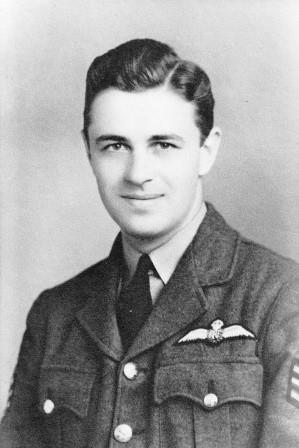
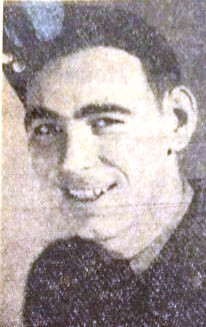
Linda’s great-uncle, William Andrew HOOD, of Little Bras D’or, Cape Breton Island, Nova Scotia, was in the Royal Canadian Air Force (RCAF), and lost his life on June 29, 1943 when the plane he was in was shot down over The Netherlands.  He’s buried in Eindhoven General Cemetery, The Netherlands.

…My father was only a baby when William died, but I know that his death affected my grandfather very much. He was greatly missed by his sisters and brothers…” Linda explained.

Born on May 22, 1921, William was the son of Wilson and Maria (nee Ross) Hood.  At the time of his enlistment on July 8, 1941 in Halifax, Nova Scotia, he was working for Lloyd Johnstone, a farmer in Bras d’Or.  His application to the RCAF was sent to No. 1 Manning Depot in Toronto, Ontario.

Among the special skills that would be useful to the RCAF, William noted that he could swim and skate.  He listed hockey, softball, and bowling as sports he participated in. 

…William enlisted in the RCAF with a preference for ground duty….

6A89D893483A45939CC3320E521725B3 newspaper clipping

William Andrew Hood. (Photo submitted by Linda Hood Jobe)

When asked for his preference in enlisting, he said it was for ground duty – not flying duty – but that did not happen.

William was transferred to the RCAF’s No. 4 Repair Depot in Dartmouth, Nova Scotia on July 20, 1941.  He was assigned to General Duties, which covered anything from guard duty to cleaning latrines.

On October 28, 1941, he was transferred to the No. 4 Repair Depot in Scoudouc, New Brunswick.  The Scoudouc airfield was a repair depot used to service aircraft employed on long range anti-submarine patrols, including Liberators or B-24s, American built four engine bombers.  It was used for aircraft testing and also served as an auxiliary landing field for #8 Service Flying School at Moncton.

…William trained as an air gunner….

In a June 23, 1942 interview at the No. 15 Recruiting Centre in Moncton, New Brunswick, William was assessed as “…frank and sincere…Good material for air gunner…” 

On August 30, 1942 he was sent to the No. 9 Bombing & Gunnery School in Mont Joli, Quebec, located about 322 km (200 miles) east of Quebec City.  In the 6 week course, William would have learned about the construction and fusing of bombs and the factors affecting bomb trajectories, how to take a gun apart and put it back together again, and participated in practice bombing exercises.

On December 19, 1942, William was awarded his Air Gunners Badge, and given 14 days embarkation leave.

…William left Canada for overseas service….

William left Canada on January 25, 1943, arriving in the United Kingdom on February 4, 1943, where he was assigned to No. 3 Personnel Reception Centre (PRC) in Bournemouth, England.  This was the arrival point for thousands of aircrew after training in Canada.

On March 3, 1943, William was sent for further training at the No. 7 Air Gunnery School (AGS) at Stormy Down, a Royal Air Force station near Pyle, Brigend in Wales.

On March 23, 1943, he was sent to No. 22 Operational Training Unit (OTU) at Wellesbourne for 10 weeks of further training as a member of a bomber crew.

On May 18, 1943 William was briefly sent to No. 1659 Heavy Conversion Unit at Topcliffe in Yorkshire. This was a 5 week course to familiarize crews with the four-engined Halifaxes or Lancasters on which they would be flying on operations when they were posted to a squadron. The May 18, 1943 war diary noted that “…ten crews from 427 Squadron and four from 22 OTU reported in for Conversion Training…

On June 10, 1943, having completed his training, William was posted to 419 Squadron, part of the No. 6 RCAF Group. He would not have participated in many operations as part of the Squadron before what would be his last flight – Halifax JD215.

…William was aboard the last flight of Halifax JD215….

Middleton St George to Colognemap from Wendy

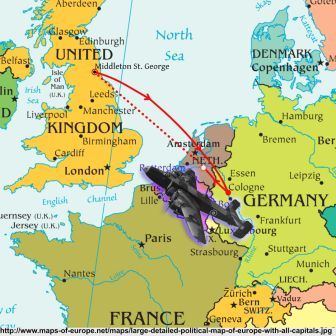
Map shows the plane’s path from England towards Cologne.  It was shot down over The Netherlands on its return to England.  (Map prepared by Wendy Nattress)

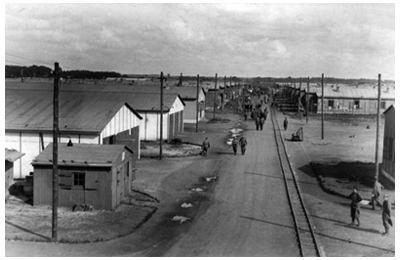
Just after 11:04 pm, on the evening of June 28, 1943, the crew of Halifax JD215 left Middleton St. George in England for a bombing raid over Cologne, Germany. 

Halifax_Bomber_2_ExCC

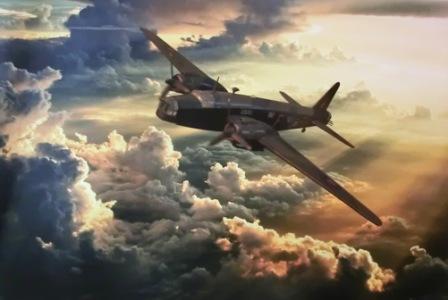
A Halifax Mark II bomber, similar to the one flown by Halifax JD215. (Photo credit: George Woodbine, Public domain, via Wikimedia Commons)

Halifax JD215 was among 608 Allied aircraft that participated in the raid over Cologne – 267 Lancasters, 169 Halifaxes, 85 Wellingtons, 75 Stirlings, and 12 Mosquitos.  Unfortunately, 25 planes never made it back to England.  According to a report on Canadian airmen lost in WWII in 1943, an “… intense Aurora Borealis display over the cloud base…” may have “…illuminated the bombers…” thereby contributing to the loss of aircraft by making them easier to spot.

Halifax JD215 successfully reached Cologne, but on its return to England, the plane was shot down over The Netherlands by Luftwaffe Major Günther Radusch in his German nightfighter.  It was just after 2:13 am.  Radusch claimed to have shot down 3 other Halifaxes that night.

… Halifax JD215 came down in a farmer’s field near Loon….

20230521_151545 Waalre Town Sign on bicycle path

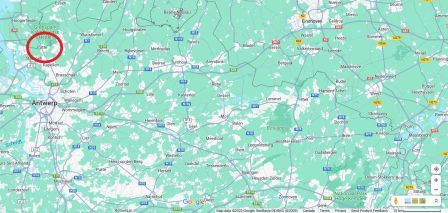
The plane came down over Waalre, located 5 km from Eindhoven. (Photo credit: Robert van der Ende)

The plane crashed near Loon in the municipality of Waalre, in a farmer’s field close to where a watermill, the Loondermolen, on the Dommel River, once stood.  Waalre is just 5 km from Eindhoven.  The mill was destroyed in 1940. (You can see a photo of the mill at https://www.molendatabase.org/molendb.php?step=details&nummer=5094)

20230522_124021Loondermolen in Waalre

The plane came down in a farmer’s field near Loon, near where a watermill, the Loondermolen, on the Dommel River, once stood. (Photo credit: Robert van der Ende)

A. Hendrikx, the mother of a friend of Robert van der Ende, remembers the crash. Born in December 1933, she lived in Waalre at the time, and told Robert that “… everybody had to take cover in shelters….

Robert explained that “…during the war there were of course much fewer buildings and since the plane was shot down at night, it must have given a frightening sound. Incidentally, another plane was shot down not much later. That plane ended up in Aalst (nowadays also the municipality of Waalre)….”  This was Lancaster ED979 of 619 Squadron, with a crew of 6 British and 1 Canadian.  The Canadian was one of the two Air Gunners, Flight Sgt John Harvey William WALKER of Sunny Brae, New Brunswick. All were killed.  This plane was also shot down by Major Radusch.

There were no survivors from Halifax JD215.  All 7 crew members are buried in The Netherlands, but in 3 different cemeteries.

…The crew of Halifax JD215….

  • Pilot – Flight Officer Harry Wilfred FOWLER of the RCAF – buried Mierlo War Cemetery. From St. Thomas, Ontario.
  • Flight Engineer – Sgt John Edwin DICKSON of the RAF – buried Eindhoven General Cemetery.
  • Navigator – Pilot Officer Warren Bretall MAYES of the RCAF – buried Canadian War Cemetery in Groesbeek. From Bellwood, Illinois, USA.
  • Bomb Aimer – Pilot Officer David Renwick AGNEW of the RCAF – buried Canadian War Cemetery in Groesbeek.  From Weyburn, Saskatchewan.
  • Wireless Operator/Air Gunner – Flight Lt Almer Clement RAINE of the RCAF – buried Eindhoven General Cemetery. From Brampton, Ontario.
  • Mid Upper Gunner – Sgt William Andrew HOOD of the RCAF – buried Eindhoven General Cemetery.  From Little Bras D’or, Nova Scotia.
  • Rear Gunner – Sgt William George OTTERHOLM of the RCAF – buried Canadian War Cemetery in Groesbeek. From Dixonville, Alberta.

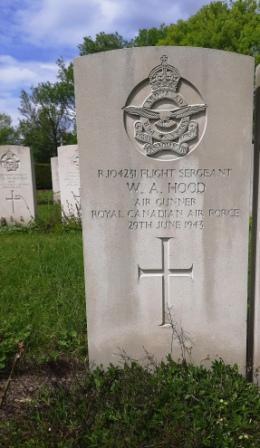
…William is buried in Eindhoven General Cemetery….

After Linda, Sgt Hood’s great-niece, contacted us, Robert van der Ende visited his grave at Eindhoven General Cemetery. 

20230520_140435_001 Grave of WA Hood

Grave of William Andrew Hood at Eindhoven General Cemetery.  (Photo credit: Robert van der Ende)

John Edwin DICKSON and Almer Clement RAINE were originally buried in Woensel Cemetery as unidentified airmen.  After their remains were identified, they were reburied in Eindhoven General Cemetery, but not beside William Andrew HOOD

Harry Wilfred FOWLER’s body was not found until 1949, during the excavation of the aircraft wreckage.  He is buried in Mierlo War Cemetery.

Warren Bretall MAYES, David Renwick AGNEW, and William George OTTERHOLM are buried in the Canadian War Cemetery in Groesbeek.

…A short video on The Last Flight Of Halifax JD215….

You can watch a short video summarizing the last flight of Halifax JD215:

Thank you to Linda Hood Jobe for telling us about her great-uncle. Thank you to Robert van der Ende for visiting the crash site and Eindhoven General Cemetery on our behalf.  Thank you to post-production editor Wendy Nattress, who made the The Last Flight Of Halifax JD215 (S4E2) YouTube video a reality, and for preparing the map showing the flight path for Halifax JD215.

If you have a story to tell, please let Pieter know. You can email him at memorialtrail@gmail.com, comment on the blog, or send a tweet to @researchmemori1.  

© Daria Valkenburg

…Want to follow our research?….

If you are reading this posting, but aren’t following the blog, you are welcome to do so.  Our blog address: https://onthewarmemorialtrail.com/
Front cover OnTheWarMememorialTrailinEurope4 countries, 6 weeks, 7,000 km – an unforgettable war memorial journey in Europe…. Daria’s book ‘No Soldier Buried Overseas Should Ever Be Forgotten‘ is available in print and e-book formats.  Net proceeds of book sales help support research costs and the cost of maintaining this blog. For more information see https://nosoldierforgotten.com/

Subscribe to our YouTube Channel: On The War Memorial Trail With Pieter Valkenburg: https://www.youtube.com/channel/UCJ591TyjSheOR-Cb_Gs_5Kw

Never miss a posting!  Subscribe below to have each new story from the war memorial trail delivered to your inbox.

On The War Memorial Trail….. “Archie Was A Good Guy”

September 12, 2023.  When Pieter begins researching a soldier whose name is on a photo wish list from one of the Canadian War Cemeteries in The Netherlands, he quite often finds current family members in various parts of Canada or the USA. 

A zigzag virtual search is not uncommon, but it’s rare that a search from one part of the country leads him right back to our own province of Prince Edward Island! But that’s what happened in the search for a photo of Archibald Phillip ‘Archie’ MCLEAN of Edmundston, New Brunswick!

The son of Allan John and Mary Rose ‘Minnie’ (nee Comfort) McLean, Archie was born August 5, 1920 in Edmundston.  When he enlisted in Edmundston on May 14, 1941 at the No. 7A District Field Office, he listed his occupation as paper maker with the Fraser Pulp Company in Edmundston, a pulp mill. (See https://en.wikipedia.org/wiki/Fraser_Papers – the Edmundston mill is still in operation, owned by Twin Rivers Paper Company.)

His enlistment form recorded that he had been serving in the 2nd Battalion Carleton & York Militia since July 1940.  It also noted that he enjoyed skating, and playing hockey and baseball.

Three of his brothers were also serving – and survived the war: Lawrence and Wilfred were in the Canadian Army.  Allan was in the Canadian Navy.  He also had five  sisters: Mae, Patricia, Emma, Theresa, and Hilda.

…The search for a photo of Archie led to two nephews….

The key to finding family came from two of the sisters.  Mae married Bertrand Clarence Michaud, and Pieter contacted her son Michael, who lives in Brunswick, Maine.   Michael didn’t have a photo but said his cousin, Donald Moore, who lives in Summerside, Prince Edward Island, and is himself a veteran, likely would.  Donald’s mother Theresa was another sister of Archie’s.

Pieter then contacted George Dalton, a veteran who lives in Summerside. Did he know him?  “…Yes…” George said.  “…He’s not been well, but someone from our group will contact him…

In the mysterious way that the Island works, it turned out that Pieter had previously met Donald Moore’s daughter, Tina Mundy!  It wasn’t very long before Tina’s daughter, Erin Mundy Montgomery, sent photos and information.  And a few days later, we met with Donald.

CIMG6452 Aug 29 2023 Pieter Don Moore Tina Mundy

Pieter with Donald Moore and Tina Mundy.  (Photo credit: Daria Valkenburg)

…Archie was a good guy…” Donald said.  “… I became 84 years old on July 23, and am the oldest of the cousins.  I spent 38 years in the military, with the RCAF, including a 4 year posting in France.  I made about 20 trips to Holland, but I never knew where Archie was buried…”  A planned trip to visit his grave in 2020 got cancelled due to Covid.

… Archie joined the Royal Canadian Engineers as a sapper….

On May 21, 1941, Archie was assigned to No. 71 Basic Training Centre in Edmundston.  After completing basic training, he was sent to the A5 Royal Canadian Engineers Training Centre in Petawawa, Ontario for training as a sapper on July 25, 1941. 

Archie McLean slightly corrected

Archibald Phillip ‘Archie’ McLean. (Photo courtesy of Donald Moore)

Life moved quickly for Archie, as on September 27, 1941 he was transferred to the 1st Field Squadron of the Royal Canadian Engineers.  On October 1, 1941, he passed the Standard Army Trade Test for Pioneer Class ‘C’.   This classification took into account a soldier’s civilian trade skills and experience and meant formal training might not be needed. 

…Archie left Canada for overseas service….

Shortly afterwards, on October 6, 1941, he left Canada, arriving in the United Kingdom on October 19, 1941.

On March 9, 1942, he was reassigned to the Engineer Reinforcement Unit (ERU) for a short period, then was transferred to No. 2 Canadian Construction Company of the Royal Canadian Engineers.  Archie was sent for a number of courses.  He completed a firefighting course on April 6, 1942, a Steel Square course on May 23, 1942, and received a qualification as a Carpenter ‘B’ on June 5, 1942. Around this period, No. 2 Construction Company was designated as No. 6 Canadian Construction Company.

Among the tasks that Archie would have participated in was the building of an RCAF bomber airport in Dunsfold, a task that was completed in a record-breaking 6 months. (See https://en.wikipedia.org/wiki/Dunsfold_Aerodrome)

Following the completion of the airport, the Company underwent training in bridge construction.  In January 1943, according to the Company’s Regimental history, ‘The Story of 2 Battalion R.C.E. 1940-1945’  “…we moved briefly into the Worthing area to construct pillboxes to a German design, for a tank outfit to shoot at…

After that they were tasked with renovations to an airport in Cornwall, in what was not a happy experience. “…After a battalion movement by train, we arrived at scintillating St Eval in the most fearfully depressing rain storm imaginable.  Day after day it lasted…”  Their assignment was “…to construct extensions to the existing standings and runways of the airport….” 

However, “… as soon as the cement had been poured, the rain would drum down, ignore tarpaulins and matting placed over the cement to protect it, and rot it, before it had a chance to set. Yard after yard of it had to be torn up and re-laid…”   (See https://en.wikipedia.org/wiki/RAF_St_Mawgan)

Renovations of the airport finally completed, the Company went to “…Bedford, for another spell of bridging…” so that heavy artillery could cross gaps in fields.

On June 1, 1944, Archie was transferred to No 1 Canadian Engineer Reinforcement Unit (CERU).  He briefly entered the world of show business between September 18, 1944 and October 10, 1944, when he was attached to ICA Shows when the Canadian Army Show came to England to perform for troops. He would have been involved in preparing stages and sets. (See https://www.silverhawkauthor.com/post/canadian-army-show-first-canadian-army-in-the-north-west-europe-campaign-of-1944-1945)

On November 18, 1944, Archie was transferred to the Canadian Infantry Corps (CIC) and assigned to No. 3 Canadian Infantry Training Regiment (CITR).

…Archie joined the Carleton & York Regiment in Italy….

Screenshot 2023-09-04 at 16-28-14 Map of Russi Italy

The Carleton & York Regiment was north of Rossi on February 13, 1945.  (Map source: http://www.gosur.com)

On January 4, 1945 Archie left the United Kingdom for Italy.  Then, on February 13, 1945 he was transferred to the Carleton & York Regiment, and reclassified from Pioneer ‘C’ to General Duty.   He joined them as the Regiment was north of Rossi, part of a group of reinforcements, at the tail end of the Italian Campaign. (See https://en.m.wikipedia.org/wiki/Italian_campaign_(World_War_II))

On March 16, 1945, he left Italy as part of Operation Goldflake, arriving in Marseilles, France two days later.  Operation Goldflake was the codename for moving troops from Italy to North-West Europe.  (See https://en.wikipedia.org/wiki/Operation_Goldflake)

The Carleton & York Regiment was now part of the 21st Army Group. From France, troops were moved up to the Belgian front, into The Netherlands, through the Reichswald Forest in Germany, and then back into The Netherlands.

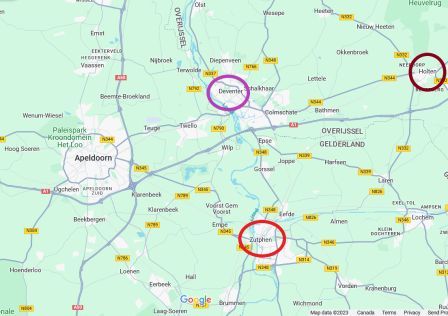
On April 12, 1945 the Regiment was part of Operation Cannonshot, which led to the crossing of the IJssel River between the villages of Gorssel and Wilp in the eastern part of The Netherlands. (See https://www.liberationroute.com/stories/190/operation-cannonshot)

According to the April 12, 1945 war diary entry of the Carleton & York Regiment, they “…moved across the Ijssel River at 14:30 hours….” to relieve the Seaforth Highlanders of Canada.

Map western holland showing Posterenk

On April 13, 1945, the war diary of the Carleton & York Regiment noted that troops were south of Deventer. “Weather – morning, dull and foggy, sunny in the afternoon, cold at night….

The objective was to clear Posterenk and move further up. Four Companies of the Carleton & York Regiment were engaged.  ‘D’ Company was to clear Posterenk, while the rest followed in support.  After Posterenk was cleared in the early afternoon, “…At 1538 hrs ‘B’ Company began to move up in carriers with one platoon of tanks in support…”  ‘D’ Company was then held up due to enemy fire.

… ‘B’ Company pushed through ‘D’ Company but were held up … by small arms and mortar fire…. At 1723 hrs ‘B’ Company moved forward again under heavy mortar fire, these mortars were engaged, also an enemy SP firing on ‘B’ Company from their left…” SP refers to self-propelled weapons.

It got worse. “… ‘B’ Company met with stiff enemy resistance….”  However, “…at 1925 hrs ‘B’ Company had cleared enemy and were moving forward slowly…” Then came a report of more problems. “… ‘B’ Company ….are now … meeting considerable enemy resistance…

…So far during B Company’s attack they have eight wounded and one killed, Lt. W.E. Brousseau being one of those wounded…

Both ‘B’ and ‘D’ Companies came under attack from high explosives. ‘D’ Company reported two wounded during the liberation of Posterenk.  One of these was Daniel ‘Dan’ Peter MACKENZIE. (See https://onthewarmemorialtrail.com/2023/06/29/on-the-war-memorial-trail-the-wwii-soldier-from-victoria-cross-fatally-wounded-during-the-liberation-of-posterenk/

Archie was among those wounded on April 13, 1945. While it’s possible that he was one of the two wounded from ‘D’ Company, he has never been mentioned as one of the soldiers that liberated Posterenk.  Therefore, we believe that he was one of the 8 soldiers wounded from ‘B’ Company.

The medical file stated that Archie received shrapnel wounds from a high explosive that penetrated his left chest.  He was taken to No 3. Casualty Clearing Centre, a Canadian military field hospital in Lochem, where he died in the very early hours of April 17, 1945.  He was 25 years old.

The records of his death go back and forth between April 16 and 17, but an ‘Amendment As To Date Of Casualty’ finally determined it was April 17, 1945.  That was the date that he was ‘struck off strength’ for his final pay, for the Estates Department, and on his New Brunswick Death Certificate.

…Archie is buried in the Canadian War Cemetery in Holten….

On April 17, 1945, Archie was temporarily buried in the Lochem Civil Cemetery, before being reburied in 1946 in the Canadian War Cemetery in Holten.   

IMG_1003 Sep 4 2023 Grave of Archie McLean with photo

Grave of Archibald Phillip ‘Archie’ McLean in Holten, The Netherlands.  (Photo credit: Henk Vincent)

Thank you to Erin Mundy Montgomery, Don Moore, and Tina Mundy for sharing photos and information on Archie McLean.  Thank you to George Dalton and Michael Michaud for help in finding family. Thank you to Barry Miller for helping with information on troop movements on April 13, 1945.  Thank you to Edwin van der Wolf and Henk Vincent, volunteer researchers for the Canadian War Cemetery in Holten and at the Information Centre Canadian Cemetery Holten, for placing Archie’s picture beside his grave and taking a photo for us.

If you have a story to tell, please let Pieter know. You can email him at memorialtrail@gmail.com, or comment on the blog.  

© Daria Valkenburg

…Want to follow our research?….

If you are reading this posting, but aren’t following the blog, you are welcome to do so.  Our blog address: https://onthewarmemorialtrail.com/

Front cover OnTheWarMememorialTrailinEurope4 countries, 6 weeks, 7,000 km – an unforgettable war memorial journey in Europe…. Daria’s book ‘No Soldier Buried Overseas Should Ever Be Forgotten‘ is available in print and e-book formats.  Net proceeds of book sales help support research costs and the cost of maintaining this blog. For more information see https://nosoldierforgotten.com/

Subscribe to our YouTube Channel: On The War Memorial Trail With Pieter Valkenburg: https://www.youtube.com/channel/UCJ591TyjSheOR-Cb_Gs_5Kw

Never miss a posting!  Subscribe below to have each new story from the war memorial trail delivered to your inbox.
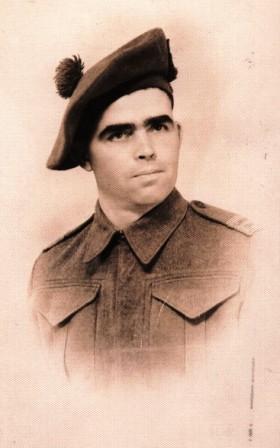
On The War Memorial Trail….. Honouring The Memories Of The North Novies Who Lost Their Lives During The Battle of Bienen

20210220_111030 Feb 20 2021 Pieter with photo wish lists

Pieter surrounded by some of the photo wish lists from the Canadian War Cemeteries in The Netherlands.  (Photo credit: Daria Valkenburg)

September 2, 2023. When Pieter decided to research the names of a number of soldiers from the North Nova Scotia Highlanders Regiment that lost their lives during the Battle of Bienen on March 25, 1945 last year, he undertook a mammoth challenge.

40 North Novies died in that battle, with 39 buried in the Canadian War Cemetery in Groesbeek, The Netherlands.  We told the stories of 13 of them this spring. Several of the names were on the cemetery’s photo wish list, and Pieter was successful in finding all the photos. 

The research took months and spanned the country, with help from other researchers, Legion branches, and the media in trying to track down families and photos.  We heard a lot of heartfelt stories about loss of a loved one and met – virtually – many wonderful people.

As summer days start turning into autumn and we begin to think ahead to Remembrance Week activities, it’s a good time to reflect on almost a year’s work of research to honour and remember these men.

…Battle of Bienen video on our YouTube Channel….

A short tribute to honour some of the soldiers from the North Nova Scotia Highlanders Regiment that lost their lives during the Battle of Bienen can be seen here:

….A monument in Bienen commemorates those who died in battle….

Screenshot 2023-09-02 at 08-56-31 Bienen · 46459 Rees Germany

Map shows route between Bienen and Groesbeek.  (Map source: Google maps)

In 2000 a monument to honour the Allied soldiers that lost their lives in the Battle of Bienen was placed in Bienen by surviving veterans. 

SONY DSC

Bienen Memorial. (Photo courtesy of Faces To Graves Foundation. Photo by Kim Huvenaars)

The English version of the German text reads as follows:

 ‘BIENEN TABLET
This tablet has been placed by a group of surviving Canadian veterans of the North Nova Scotia Highlanders, 3 Canadian Infantry Division, in proud and grateful memory of those forty members of their regiment who fell in battle at Bienen, Germany on Sunday, March 25, 1945 and in memory of those fellow combatants of 9 Canadian Infantry (Highland) Brigade and 51 British Highland Division who died in the same battle and in the same cause and as well, in respectful memory of those adversaries in the German army who died on that fateful day.

At the going down of the sun
And in the morning
We will remember them.

Erected at Bienen on the 55th Anniversary of the event in the year 2000.

….Stories about North Novies killed during the Battle of Bienen and buried in Groesbeek….

Did you miss the stories we told about 13 of these soldiers?

Thank you to all who provided photos and information that allowed these stories to be told this spring.  Each individual story identifies them. Thank you to post-production editor Wendy Nattress, who made the Battle of Bienen (S4E1) YouTube video a reality.

If you have a story to tell, please let Pieter know. You can email him at memorialtrail@gmail.com, comment on the blog, or send a tweet to @researchmemori1.  

© Daria Valkenburg

…Want to follow our research?….

If you are reading this posting, but aren’t following the blog, you are welcome to do so.  Our blog address: https://onthewarmemorialtrail.com/

Front cover OnTheWarMememorialTrailinEurope4 countries, 6 weeks, 7,000 km – an unforgettable war memorial journey in Europe…. Daria’s book ‘No Soldier Buried Overseas Should Ever Be Forgotten‘ is available in print and e-book formats.  Net proceeds of book sales help support research costs and the cost of maintaining this blog. For more information see https://nosoldierforgotten.com/

Subscribe to our YouTube Channel: On The War Memorial Trail With Pieter Valkenburg: https://www.youtube.com/channel/UCJ591TyjSheOR-Cb_Gs_5Kw

Never miss a posting!  Subscribe below to have each new story from the war memorial trail delivered to your inbox.

On The War Memorial Trail…..The WWII Trooper From Clementsvale Who Lost His Life During The Liberation Of The Netherlands

August 20, 2023. After seeing Pieter in a TV interview last fall, Debbie Cook contacted us. “I saw the episode on ATV/CTV … of what you are doing, and I say a huge ‘thank you’ to you both. I have 4 sons who are First Responders and I hold dear to my heart all those individuals in the Wars and all other First Responders who allow me to live free & happy as I have. My sons have a great-uncle who was killed overseas in WWII. His name was Harry Wright – do you have any information on him?…”  (Link to the interview that Debbie saw: https://atlantic.ctvnews.ca/maritime-man-appealing-to-public-for-help-identifying-lost-canadian-soldiers-1.6143236)

It was a wide-ranging question as there wasn’t a lot of detailed information, but after checking, we found a Harry WRIGHT from Nova Scotia who was a trooper in the Lord Strathcona’s Horse (Royal Canadians) Regiment.  He was buried in the Canadian War Cemetery in The Netherlands, and was on the cemetery’s photo wish list. 

We asked Debbie if this could be her Harry Wright.  “He was in the army and yes from Nova Scotia. Harry was the uncle of my ex-husband. I believe we have a photo….”  We had the right soldier and so the research began.

IMG_3767 Harry Wright

Harry Elwood Wright.  (Photo courtesy of the Wright Family)

…Harry was born in Clementsvale, Nova Scotia…

Born in Clementsvale, Nova Scotia on September 2, 1916, Harry Elwood WRIGHT was the son of John Everett and Florence May Wright. 

Screenshot 2023-08-15 at 18-36-53 Clementsvale

Map shows location of Clementsvale, Nova Scotia, where Harry was born, and the communities of Clementsport and Princedale. All three places are near Digby, Nova Scotia. (Map source: https://mapcarta.com/)

…Harry was an experienced mechanic….

When he enlisted at the No. 6 District Depot in Kentville, Nova Scotia on August 5, 1942, he had worked as a sawyer in a mill for 3 ½ years in Princedale, Nova Scotia, and drove a truck and worked in a garage for over 4 years. He was working for Mills Motors in Annapolis Royal as a mechanic and driver at the time of his enlistment.

His Personnel Selection Record noted that Harry was “…strong and robust…” with an “… aggressive, mature manner….”  Although he had only a Grade 7 education, he had “…superior learning ability and mechanical aptitude…”  The record went on to say that he had “…significant experience as truck driver and garage worker.  Is able to do many minor repairs and has good knowledge of related theory…

On August 15, 1942, Harry was sent to No. 60 Canadian Army Basic Training Centre (CABTC) in Yarmouth, Nova Scotia.

…Harry became a Canadian Armoured Corps Driver….

Once he completed his basic training, Harry was transferred to the A9- Canadian Armoured Corps (Advanced) Training Centre (CACATC) in Borden, Ontario on October 15, 1942.   He arrived there just a few weeks ahead of another soldier living in Nova Scotia – Ronald Sidney WATERHOUSE (See https://onthewarmemorialtrail.com/2021/11/03/on-the-war-memorial-trail-remembering-ww2-soldier-ronald-sidney-waterhouse/)

By November 16, 1942, Harry qualified as a Class III Driver Wheeled, which meant he was qualified to drive heavy trucks and armoured cars.  On December 12, 1942, he qualified as a Class II Driver Tracked, which meant he was trained to drive tracked vehicles, such as tanks. (See https://www.canadiansoldiers.com/vehicles/tanks/mainbattletanks.htm for an idea of the type of equipment Harry would have driven.)

…Harry left Canada for overseas service….

On March 9, 1943, he left Canada for the United Kingdom, arriving on March 17, 1943, where he was transferred to the No. 3 Canadian Armoured Corps Reinforcement Unit (CACRU).

Harry was sent for further training, successfully completing several courses for qualifying as a Driver Mechanic (MV) C and Driver Mechanic TK C. This meant that in addition to being a driver, Harry would also be responsible for minor vehicle repairs on vehicles in his unit.

On October 1, 1943, Harry was transferred to the 2nd Armoured Regiment – Lord Strathcona’s Horse (Royal Canadian).   With the Regiment, Harry’s training continued in England with Canadian built Ram tanks, in preparation for the Italian Campaign. (See https://en.m.wikipedia.org/wiki/Italian_campaign_(World_War_II))

…The Regiment moved to the Mediterranean for service in November 1943…. One of the Regiment’s most noteworthy battles in Italy was at the Melfa Crossing, where the reconnaissance troop established a bridgehead on the Melfa River and held it against determined German tank and infantry attacks until reinforcements could arrive….” (See https://www.canadiansoldiers.com/regiments/armoured/lordstrathconashorse.htm)

…Harry and his Regiment left Italy for northern Europe…

On February 19, 1945, the Regiment left Italy as part of Operation Goldflake, arriving in Marseilles, France two days later.  Operation Goldflake was the codename for moving troops from Italy to North-West Europe.  (See https://en.wikipedia.org/wiki/Operation_Goldflake)

The Regiment moved through France as far as Iseghem, Belgium.  The war diary summary for the month of March 1945 explained that it was “…quiet because of the lack of shells, exciting because we remained the entire month in the town of Iseghem, which was an entire change to our past Italian memories, which was not at all 100% pleasant…” 

During the month “…a great deal of maintenance was done on vehicles…” and soldiers had opportunities to take leave.  Harry was granted 9 days leave to the United Kingdom on March 28, 1945, returning back to his Regiment on April 7, 1945.

The stay in Iseghem was a prelude to what lay ahead.  “…The end of March found the Regiment preparing its tanks for a proposed move…”  By the time Harry returned from leave, the Regiment was in Malden, The Netherlands, south of Nijmegen.

On April 8, 1945, the war diary recorded that the Regiment “…passed through a part of Germany and back into Holland. Passed through flattened Cleve and Emmerich…

Screenshot 2023-08-19 at 09-35-12 Barneveld · Netherlands

Map shows movement of the Lord Strathcona’s Horse Regiment from Otterlo to Barneveld towards Nijkerk.  (Map source: Google maps)

Over the next few days, the Regiment encountered artillery fire as they moved to a staging area in Arnhem.  The April 15, 1945 war diary entry noted that the “… Regiment fought from Arnhem to Otterlo…

On April 16, 1945 the war diary reported that the Regiment was on the move.  “…Rolling was good to Barneveld area where ‘A’ Squadron ran into a bit of trouble…

The war diary entry for April 17, 1945 recorded that as they moved towards Nijkerk, their “…advance continued at a slower pace due to anti-tank guns, road blocks, and shelling…”  5 non-commissioned soldiers were reported killed in action.  Among those killed was Harry Wright.

…Harry is buried at the Canadian War Cemetery in Groesbeek….

Harry was temporarily buried in Barneveld before being reburied the following year in the Canadian War Cemetery in Groesbeek, The Netherlands.

IMG_2844 Grave of Harry Wright from Alice

Grave of Harry Elwood Wright at the Canadian War Cemetery in Groesbeek. (Photo courtesy of Faces To Graves Groesbeek)

Thank you to Debbie Cook for contacting us and ensuring that a photo of Harry Wright was provided.

If you have a story to tell, please let Pieter know. You can email him at memorialtrail@gmail.com, or comment on the blog.  

© Daria Valkenburg

…Want to follow our research?….

If you are reading this posting, but aren’t following our research, you are welcome to do so.  Our blog address: https://onthewarmemorialtrail.com/

Front cover OnTheWarMememorialTrailinEurope4 countries, 6 weeks, 7,000 km – an unforgettable war memorial journey in Europe…. Daria’s book ‘No Soldier Buried Overseas Should Ever Be Forgotten‘ is available in print and e-book formats.  Net proceeds of book sales help support research costs and the cost of maintaining this blog. For more information on the book, please see https://nosoldierforgotten.com/

Subscribe to our YouTube Channel: On The War Memorial Trail With Pieter Valkenburg: https://www.youtube.com/channel/UCJ591TyjSheOR-Cb_Gs_5Kw

Never miss a posting!  Subscribe below to have each new posting delivered to your inbox.

On The War Memorial Trail….. The WWII Soldier From Trail Who Played The Cornet

August 14, 2023.  When Pieter begins his research into a soldier, and then contacts possible family members, he never knows what to expect.  Sometimes, his outreach surprises family members as they might not know a lot about the soldier he inquires about. 

During the search for a photo of Theodor ‘Ted’ HENSCHEL, who was born in Winnipeg, Manitoba on September 19, 1914,  Pieter learned that Ted was living in Trail, British Columbia at the time of his enlistment on June 21, 1944 at the No. XI District Depot in Vancouver, British Columbia.

When Pieter was contacted Joy Roberts, daughter of Ted’s brother Emil, she wrote that “My father didn’t talk about his brother.  So I am a little confused.  Ted Henschel is listed on the Trail, BC war dead. My father and their father lived in Trail…”  But – the family did have photos of Ted!

Theodor Henschel

Theodor ‘Ted’ Henschel (Photo courtesy of the Henschel Family)

Ted’s parents had immigrated to Canada from Eastern Europe.  They lived in Winnipeg until Ted was a year old, then in Saskatchewan for 12 years, before moving to British Columbia. “…One brother, Fred, lived and passed away in Vancouver.  He changed his name at some point during the war, because of Henschel sounding German.  He changed it to Hansel and was the only child that immigrated with the parents (though I believe one other son died on the ship while crossing to America).  Fred was about twenty years older than my dad, Emil…” explained Joy.

Besides Fred and Emil, Ted had a brother Rudolf and a sister Annie. When Ted enlisted after being called up for service under the National Resources Mobilization Act (NRMA), he had been working for a decade as a machine operator for the Consolidated Mining and Smelting Company in Trail, British Columbia. In addition to English, it was recorded that he could speak German, and that he wore corrective lenses. (See https://en.wikipedia.org/wiki/National_Resources_Mobilization_Act)

…Ted began his basic training in Camrose….

Ted was sent to No. 131 Canadian Infantry Basic Training Centre (CIBTC) in Camrose, Alberta.

Ted identified A Company Sep 1944 Camrose

September 1944 group photo of No 131 CIBTC , taken at the Military Headquarters  in Camrose, Alberta.  Ted Henschel is in the middle row, second from right.  (Photo courtesy of the Henschel Family)

Ted was a cornet player and played in the platoon band.

Musicians Ted 3rd from right with arrow

Ted Henschel, third from right.  (Photo courtesy of the Henschel Family)

On September 16, 1944, having completed his basic training, Ted was transferred to the A-16 Advanced Canadian Infantry Training Centre (CITC) in Calgary, Alberta.

Ted remained in Calgary until December 9, 1944, when he was transferred to the No.1 Training Brigade in Debert, Nova Scotia for final training and preparation for overseas service.

…Ted left Canada for overseas service…

On Christmas Eve – December 24, 1944 – Ted left Canada for the United Kingdom.  Upon arrival in the United Kingdom on the last day of the year, he was assigned to No. 1 Canadian Infantry Training Regiment (CITR) for further training.

…Ted was sent to The Netherlands…

finalphasecanscottish

Ted Henschel joined the Canadian Scottish Regiment near Zwolle. (Map source: http://www.canadiansoldiers.com)

On March 23, 1945 he was in North West Europe with the X-4 reinforcement troops of the 21st Army Group. Then, on April 18, 1945, he was transferred to the Canadian Scottish Regiment, joining the unit in the area around Zwolle, The Netherlands.  The Regiment had established patrols around Zwolle over an area of 161 square kms (100 square miles), rounding up German stragglers.

…The Battle for Wagenborgen was fierce…

wagenborgen

The Canadian Scottish Regiment’s movements during the Battle for Wagenborgen.  (Map source: http://www.canadiansoldiers.com)

On April 19, 1945, the Regiment moved to a concentration area at Hoogezand, near Groningen. Allied troops next worked to clear the area around Groningen of enemy troops. Patrols reported that Wagenborgen was still held by Germans. 

…Roads leading in and out of Wagenborgen had been blocked, and covered by machine guns and anti-aircraft guns…. The terrain surrounding Wagenborgen was flat, unobstructed by dense foliage, and criss-crossed by numerous canals and drainage ditches which limited the avenues of approach for the attackers….”  (Excerpt from https://www.canadiansoldiers.com/history/battlehonours/northwesteurope/wagenborgen.htm)

On April 21, 1945,  an attack on Wagenborgen, located south of Delfzijl, began, in what turned out to be a terrible fight.  This was the preliminary battle before the Battle of Delfzijl Pocket. The Canadian Scottish Regiment began the attack with only ‘D’ Company, but very quickly realized that this was insufficient. There were many casualties.

However, a subsequent attack with three companies was successful and troops were able to repel counter-attacks. By the time it was over, Canadian Scottish casualties at Wagenborgen were 23 killed and 41 wounded.

…Ted lost his life during the Battle for Wagenborgen …

The war diary for the Canadian Scottish for Sunday, April 22, 1945 recorded that “… ‘A’, ‘B’, and ‘C’ Companies patrolled extensively to their fronts:  ‘A’ Company met small arms fire from the town of Wagenborgen…’B’ Company patrolled…also meeting small arms fire…. ‘C’ Company established 4 strong-points to their front on the dyke running southwest to northeast….

Ted was in ‘A’ Company, which late in the evening “pushed east towards the northern part of WAGENBORGEN with the 4.2’s firing on the Company’s left flank. ‘C’ Company sent one Platoon to secure the dyke…with the other two Platoons pushing towards the dyke ….

The after-action report for ‘A’ Company summarized what happened: “…At 2200 hours on the night of 22 April 45 A Company began their advance on the northern end of the village of WAGENBORGEN. Supporting fire commenced at 2230 and continued until 2245 during which time the Company advanced unmolested. At 2245 the assault commenced and for the first time enemy fire was apparent. The Company advanced through considerable shell –fire which caused several casualties…

By 11 pm, the war diary reported that “… ‘B’ Company’s attack was started on the southern part of WAGENBORGEN. …. ‘A’ Company secured the northern part of the village…

Sadly, at some point during the Battle for Wagenborgen on April 22, 1945, Ted lost his life. He likely hadn’t even had time to get to know the soldiers he was with, since he had only joined the Regiment a few days earlier.

…Ted is buried in the Canadian War Cemetery in Holten …

Ted was temporarily buried in Siddeburen before being reburied on February 15, 1946 in the Canadian War Cemetery in Holten, The Netherlands.

Foto graf Theodor Henschel, 21-1-013

Grave of Theodor ‘Ted’ Henschel in Holten, The Netherlands.  (Photo courtesy of the Information Centre Canadian Cemetery Holten)

…Ted is remembered on memorials in Trail and Wagenborgen …

As Joy wrote in her initial email, Ted is listed on the war memorial in Trail, British Columbia: see https://www.waymarking.com/waymarks/WMN9QE_Trail_Cenotaph_Trail_BC

He is also listed on the war memorial in Wagenborgen, which commemorates the residents of Wagenborgen who died in the Second World War, and 27 fallen Canadian soldiers – 23 of them from the Canadian Scottish Regiment.  See https://www.tracesofwar.com/sights/24193/War-Memorial-Wagenborgen.htm

Thank you to Joy Roberts, who wrote “Thank you very much for your work. Joy, Gail, and Dennis – Nieces and Nephew of Ted Henschel…” A big thank you to Judie Klassen, whose genealogy research helped to find family members of Ted Henschel.

If you have a story to tell, please let Pieter know. You can email him at memorialtrail@gmail.com, or comment on the blog.  

© Daria Valkenburg

…Want to follow our research?….

If you are reading this posting, but aren’t following our research, you are welcome to do so.  Our blog address: https://onthewarmemorialtrail.com/

Front cover OnTheWarMememorialTrailinEurope4 countries, 6 weeks, 7,000 km – an unforgettable war memorial journey in Europe…. Daria’s book ‘No Soldier Buried Overseas Should Ever Be Forgotten‘ is available in print and e-book formats.  Net proceeds of book sales help support research costs and the cost of maintaining this blog. For more information on the book, please see https://nosoldierforgotten.com/

Subscribe to our YouTube Channel: On The War Memorial Trail With Pieter Valkenburg: https://www.youtube.com/channel/UCJ591TyjSheOR-Cb_Gs_5Kw

Never miss a posting!  Subscribe below to have each new story from the war memorial trail delivered to your inbox.

On The War Memorial Trail….. Remembering WWII Soldier George Taylor

August 10, 2023. The search for a photo of a soldier often involves many people.  When Pieter begins an investigation, he looks for family members or organizations that might be able to help.  This can take him n a journey in which we are reminded of just how many people care about remembering those who’ve served.

The search for a photo of George TAYLOR of the Curve Lake First Nation began with an inquiry to Chief Keith Knott and Councillor Arnold Taylor.  Pieter’s request was sent to Mae Whetung-Derrick, who explained that she had been given Pieter’s name “.…by the Curve Lake First Nation, as I have done some research on Curve Lake veterans and created a slide show for the Remembrance Day luncheon that is held every year after the services (other than COVID years)….

After contacting Pieter, Mae spoke to Jocelyn Taylor Watson, “…the daughter of Benjamin Taylor, and the niece of Gunner Taylor. Benjamin also served in World War 2….

Pieter then spoke with Jocelyn who explained that her father, Benjamin, “…was the baby of the family, born two years after George.  He served during WWII but did not go overseas, and died in 2001 at the age of 78….

Shortly afterwards, Jocelyn’s daughter Autumn Watson got in contact. “…First, I would like to say Chi-Miigwetch (Thank-You) for reaching out to our Chief Keith Knott and Councillor Arnold Taylor, with respect to my great-uncle George Taylor. My mother (Jocelyn Taylor) had mentioned that you spoke with her. As a family we appreciate your dedication to breathing life and respect to our fallen soldiers!…

improved_photo(19) Taylor coloured

George Taylor.  (Photo submitted by Mae Whetung-Derrick, originally published in the Peterborough Examiner.  Photo restoration by Duane MacEwen.  Photo colourization by Pieter Valkenburg)

…George was a member of the Curve Lake First Nation…

curve lake first nation logoBorn April 28, 1920, George TAYLOR was the son of Lorenzo ‘Dow’ and Eva Taylor, members of the Curve Lake First Nation, a Mississauga Ojibway First Nation located in Peterborough County, Ontario.  (See https://curvelakefirstnation.ca/history/ and https://en.wikipedia.org/wiki/Curve_Lake_First_Nation)

When George enlisted in Peterborough, Ontario on July 9, 1941 with the No. 3 ‘A’ District Depot, it was noted that he could speak Chippewa (Anishinaabemowin), as well as being fluent in English.  (See http://www.native-languages.org/ojibwe.htm)

He had worked as a trapper and hunter since 1935, and also worked for a mixed farming operation. His sports interests included swimming, fishing, and playing softball.

…George trained as a gunner…

George began his basic training on July 12, 1941, at No. 32 Canadian Army Basic Training Centre (CABTC) in Peterborough.  He was then sent to No. 3 ‘A’ District Depot’s home base in Kingston, Ontario for additional training.

On August 27, 1941, he was transferred to the 3rd Field Battery, Royal Canadian Artillery for further training as a gunner in Gananoque, Ontario.

George was on the move again on December 1, 1941, this time to Sussex, New Brunswick, when he was attached to the 18th Field Regiment, Royal Canadian Artillery.  A few months later, on February 17, 1942, George was transferred to the 2nd Medium Regiment and sent to Petawawa, Ontario, in preparation for going overseas.

During his training as a gunner, George would have learned to use equipment such as 18/25 Pounders, 25 Pounders, and self-propelled 25 Pounder Sextons.  Gunners in a Medium Artillery Regiment would be trained in weapons such as 6-Inch Howitzers, 4.5-Inch Howitzers, or 5.5-Inch Howitzers.

…George left Canada for overseas service…

On March 20, 1942, George left Canada for the United Kingdom aboard the SS Aorangi, sailing from Halifax, Nova Scotia and arriving in Glasgow, Scotland 9 days later.

The Regiment was assigned to No. 3 Canadian Army Reinforcement Unit (CARU) for a month, while awaiting the arrival of their equipment.

From August 28 to 30, 1943, 2 Medium Regiment participated in Exercise Handspike, as training for the upcoming battles in Italy.

…George was in the Italian Campaign….

SS Argentina

Artist drawing of SS Argentina. (Photo source: By Boston Public Library Fred J Hoertz & Harry H Baumann – The Good Neighbor liners Argentina and Brazil, operated by Moore-McCormack Lines, sailing from New York to the East Coast of South America, CC BY 2.0, https://commons.wikimedia.org/w/index.php?curid=26243707)

On October 24, 1943, George was with his Regiment when they left Liverpool, England aboard USAT Argentina for Sicily, arriving on November 8, 1943, several months after Sicily had been deemed Allied territory in August 1943.  (See https://en.wikipedia.org/wiki/SS_Argentina_(1929))  Their first camp was based in Ionia.

For an idea of what weaponry George used and the conditions encountered, a short YouTube video about Royal Canadian Artillery members travelling to Italy to commemorate their time in Sicily may be of interest:

In March 1944, the Regiment was in Ortona, Italy, as part of the Allied Armies in Italy (AAI) for what became known as the Italian Campaign. (See https://en.m.wikipedia.org/wiki/Italian_campaign_(World_War_II)).  May 1944 found the Regiment in Cassino, Italy.  Over the next months the Regiment participated in fighting the Gustav, Hitler, and Gothic Line battles.

On June 21, 1944, George was hospitalized near Rome, Italy with prepatellar bursitis (inflammation of the bursa in front the kneecap), but discharged from hospital on July 4, 1944, when he returned to his Regiment.  (See https://en.wikipedia.org/wiki/Prepatellar_bursitis)

…George and his Regiment left Italy for northern Europe…

On March 11, 1945, the Regiment left Italy as part of Operation Goldflake, arriving in Marseilles, France two days later.  Operation Goldflake was the codename for moving troops from Italy to North-West Europe.  (See https://en.wikipedia.org/wiki/Operation_Goldflake)

Now part of the 21st Army Group, troops were moved from France up to the Belgian front, into The Netherlands, through the Reichswald Forest in Germany, and then back into The Netherlands.

The war ended in Europe on May 8, 1945, and the Regiment was in the Den Helder area of The Netherlands. The war diary for the Regiment noted that “…we were occupying our last gun position when hostilities ceased and almost immediately swung into a new role, that of disarming and despatching Germans back to their own country….

…George died accidentally while in The Netherlands…

In June 1945, the Regiment was based at Arnhem, The Netherlands.  The war diary entry for June 17, 1945 recorded that …Gunner Taylor…” of ‘Q’ Battery “… had taken sick and died of suffocation…”  A medical report noted that while asleep in his army tent, he had fallen ill and vomited.  Unfortunately, this had caused him to suffocate.  A military court of inquiry ruled his death accidental.

20211016_155710 Jocelyn Taylor at Groesbeek

Jocelyn Taylor Watson at the entrance to the Canadian War Cemetery in Groesbeek.  (Photo courtesy of the Taylor family)

George was buried at the Nijmegen Canadian Military Temporary Cemetery the following morning, on June 18, 1945. He was 25 years old.  Later he was reburied in the Canadian War Cemetery in Groesbeek, The Netherlands.

20211016_161144 Jocelyn Taylor, at Groesbeek

Jocelyn Taylor Watson at George Taylor’s grave. (Photo courtesy of the Taylor family)

Jocelyn visited the cemetery in 2021 with her daughter Autumn and son-in-law.  “…I sang at his grave and my daughter drummed…” Jocelyn explained during a phone call with Pieter. What a wonderful tribute to George!

Autumn wrote that they found the cemetery a “…beautiful resting place, but emotional to say the least”  Autumn also included a link to the Lakefield War Veterans, in which George is featured: https://lakefieldwarvets.ca/taylor-george/

…George’s father planted a pine tree…

Jocelyn told us that George is always remembered as her grandfather – George’s father Dow – planted a pine tree when George left to serve in the Canadian Army. Over 80 years later it is still standing, a living remembrance of this well-loved soldier.

Resized_20210606_195838_6246001 Pine tree re George Taylor

Pine tree planted by George’s father Dow. (Photo courtesy of the Taylor family)

Thank you to Jocelyn Taylor and Autumn Watson for sharing photos and information about George Taylor, and to Mae Whetung-Derrick for helping to find family.

If you have a story to tell, please let Pieter know. Email him at memorialtrail@gmail.com, comment on the blog, or tweet to @researchmemori1.

© Daria Valkenburg

…Want to follow our research?….

If you are reading this posting, but aren’t following our research, you are welcome to do so.  Our blog address: https://onthewarmemorialtrail.com/

Front cover OnTheWarMememorialTrailinEurope4 countries, 6 weeks, 7,000 km – an unforgettable war memorial journey in Europe…. Daria’s book ‘No Soldier Buried Overseas Should Ever Be Forgotten‘ is available in print and e-book formats.  For more information see https://nosoldierforgotten.com/

Subscribe to our YouTube Channel: On The War Memorial Trail With Pieter Valkenburg: https://www.youtube.com/channel/UCJ591TyjSheOR-Cb_Gs_5Kw.

Never miss a posting!  Subscribe below to have each new story from the war memorial trail delivered to your inbox.

On The War Memorial Trail….. The WWII Soldier Who Died While Reading A Dutch-English Dictionary

August 5, 2023.  When we planned a visit to the Canadian War Cemetery in Bergen Op Zoom, The Netherlands in October 2019, Pieter asked for a list of soldiers from Prince Edward Island from Caroline Raaijmakers of the Faces To Graves Bergen Op Zoom Project. (See https://onthewarmemorialtrail.com/2019/12/07/on-the-war-memorial-trail-our-2019-visit-to-the-canadian-war-cemetery-in-bergen-op-zoom/)

One of the soldiers whose grave we visited and placed flags at was that of Milton Evangeline LIVINGSTONE, born August 21, 1918 in Gladstone, Prince Edward Island, the only child of Joseph Henry and Agnes Lettie Livingstone of Murray Harbour, Prince Edward Island. 

Screenshot 2023-08-01 at 11-09-35 Murray River map satellite __ Canada Prince Edward Island

Map shows how close Gladstone, Murray Harbour, and Murray River are in Prince Edward Island. (Map source: https://satellites.pro)

… Milton made three attempts to actively serve…

After leaving school at the age of 17, Milton had various jobs, including on a farm, as a truck driver, and in a wholesale warehouse.  In 1940 he tried to enlist in the Canadian Army but was unsuccessful, as was his application to join the Royal Canadian Air Force.  Therefore, on April 6, 1942 he joined the 17th Armoured Regiment Reserve in Murray Harbour.  In the fall of 1942 he transferred to the Reserve in Charlottetown.

On March 2, 1943, he successfully enlisted with the No. 6 District Depot in Charlottetown.  By this time, he was married – to Mae Isabel Stymeist – and the father of Carol Christine, who had been born two months earlier, on December 31, 1942.

private livingstone Lincolns from Robert Catsburg

Milton Evangeline Livingstone. (Photo courtesy of Robert Catsburg, who had received it from the son of Marie van Elzakker-De Jong)

Milton was in Halifax, Nova Scotia he day after enlistment. The interviewer for his Personnel Selection Record noted that he “…seems to be a friendly and cheerful person….”  He “…plays softball, and reads a bit – mostly newspapers.  In his spare time he tinkers with machines…”  It was recommended that he be assigned to an infantry regiment.

On April 2, 1943, Milton was sent to No. 61 Canadian Army Basic Training Centre (CABTC) in New Glasgow, Nova Scotia.  His Personnel Selection Record was updated after he completed his basic training.  “…His progress was outstanding and he was therefore held over for two months as assistant instructor.  During this period he has done good and conscientious work and is recommended as capable and with NCO indications…”  (NCO refers to Non-Commissioned Officer.)

… Milton qualified as a Driver i/c and Driver Mechanic…

On August 6, 1943, Milton was transferred to No. 14 Infantry Training Centre (ITC) in Aldershot, Nova Scotia, remaining there until December 3, 1943 when he was sent to the S-5 Canadian Driving and Maintenance School (CD & M School) in Woodstock, Ontario, where he successfully completed a 6 week driving course to qualify as a Driver i/c Class III Wheeled Vehicles. (The term ‘Driver i/c’ refers to ‘Driver, internal combustion’.  Class III meant he was qualified to drive heavy trucks and armoured cars.)

After completing the driving course, Milton remained in Woodstock to take a Driver Mechanic I course, which he completed on March 15, 1944.  In addition to being a driver, he would also be responsible for minor vehicle repairs on vehicles in his unit.

… Milton left Canada for overseas service…

Milton returned to No. 14 Infantry Training Centre (ITC) in Aldershot on April 6, 1944 for final training and preparation before going overseas.

On May 1, 1944, he was on his way to the United Kingdom, arriving on May 7, 1944 and assigned to No 4 Canadian Infantry Reinforcement Unit (CIRU).  He was sent for more training, resulting in a reclassification to Driver Mechanic MV ‘C’ on June 8, 1944.

On September 10, 1944 Milton was sent to France with the X-4 reinforcement troops of No. 2 Canadian Base Reinforcement Group (CBRG), part of the 13th Battalion.  On September 23, 1944 he was transferred to ‘C’ Company of the Lincoln & Welland Regiment, joining them while the Regiment was in the area of Maldegem, Belgium. 

… Milton rejoined the Regiment after being released from the field hospital…

Milton was sent to a Field Hospital on September 25, 1944.  There was no record of casualties that day and he was not on the wounded list, so perhaps he had an accident.  On October 14, 1944 he returned to ‘C’ Company of the Lincoln & Welland Regiment, which was in the area of Middeldorp, Belgium.

By the beginning of November, the Regiment had entered The Netherlands, moving from Bergen Op Zoom and towards the capture of Steenbergen.

The Regiment’s war diary for November 4, 1944 reported that “…The Argyll & Sutherland Highlanders of Canada took over Steenbergen and reported the town clear…”  The Regiment was given a chance to take a well-deserved rest.

The last entry in Milton’s service record is on November 6, 1944 with the notation ‘Deceased. Believed Killed In Action’. However, the war diary for that day reported “… everything quiet…”  Similarly, no report of fighting was recorded in ‘History of the Lincoln and Welland Regiment’ by Robert Louis Rogers. 

The mystery of what happened to Milton was finally solved in an account in ‘Five Days In November –The Liberation of Welberg and Steenbergen in WWII’ by Robert Catsburg, and translated from the original Dutch by Ineke Hardy.

… An eyewitness account of what happened on November 6, 1944…

Robert Catsburg explained to us that the account of what happened that day came from Lies de Jong, one of the daughters of the De Jong family.

…On 6 November, a fatal accident took place at the home of the De Jong family on Oudlandsestraat. On their return, the De Jongs had found their house filled with Canadians of the Lincoln and Welland Regiment…  

 …The men were very well-behaved, and most of them slept in a small abandoned house at the back. During the day, they relaxed or carried out maintenance on the large tank parked beside the De Jong residence. A few men shared the house with the De Jongs…

…During the day, the officer slept in Grandpa’s box bed and at night, Grandpa took his place. The older De Jong daughters basked in the attention from the young soldiers. Daughter Marie had formed a friendship with one of them, Private Milton E. Livingstone…

…On 6 November, the two were sitting side by side at the table, looking up words in a dictionary in an effort to learn a little of each other’s language. A soldier of American origin (in the interview, Lies de Jong called him ‘the Texas man’) sat across from Marie and Milton, cleaning his weapon. Without warning, the weapon went off, and Milton Livingstone collapsed with a muffled groan. He was fatally injured….

…Marie watched in horror as her friend’s body was wrapped in a grey blanket, taken outside through the window, and removed by a truck. The chaplain of the regiment tried to counsel the family, but the language barrier defied his efforts. Marie kept the picture Milton Livingstone had given her until the day she died, in 2008…

… Milton’s cause of death was not investigated or recorded…

It’s not difficult to imagine the effect this incident had on Marie and her family. What is difficult to understand is why a soldier would be cleaning a loaded gun in the house of civilians with young daughters, and not outside. Even more difficult to understand is why no court of inquiry was made, or even a reference to what happened in the war diary, regimental history, or Milton’s service file. 

The war diaries for the Regiment recorded soldiers who were absent without leave, who had accidentally hurt themselves while on duty, who disobeyed officers.  Shooting of a soldier?  Nothing.

We have come across other accidental shootings over the years, which have been documented in the war diaries of other Regiments. It appears that the handling of this incident was not standard practice.

A note in the December 1944 war diary for the Lincoln & Welland Regiment suggested that such shootings were not unusual:  “…serious disciplinary action will be taken in the case of personnel who are injured as a result of our own or enemy weapons.  Carelessness in this respect is causing a great wastage of personnel…” 

… Milton is buried in the Canadian War Cemetery in Bergen Op Zoom…

CIMG3398 Oct 7 2019 Bergen Op Zoom Milton Livingstone

Pieter beside the grave of Milton Evangeline Livingstone. (Photo credit: Daria Valkenburg)

Milton was temporarily buried in Bergen Op Zoom before being reburied in the Canadian War Cemetery in Bergen Op Zoom in 1946. 

Thank you to Robert Catsburg for allowing us to quote from his book and for sharing the photo of Milton Livingstone.

Do you have a story to tell? Pieter encourages you to email him at memorialtrail@gmail.com, or comment on the blog.    

© Daria Valkenburg

…Want to follow our research?…

If you are reading this posting, but aren’t following our research, you are welcome to do so.  Our blog address: https://onthewarmemorialtrail.com/

Front cover OnTheWarMememorialTrailinEurope4 countries, 6 weeks, 7,000 km – an unforgettable war memorial journey in Europe…. Daria’s book ‘No Soldier Buried Overseas Should Ever Be Forgotten‘ is available in print and e-book formats.  Net proceeds of book sales help support research costs and the cost of maintaining this blog. For more information see https://nosoldierforgotten.com/

Subscribe to our YouTube Channel: On The War Memorial Trail With Pieter Valkenburg: https://www.youtube.com/channel/UCJ591TyjSheOR-Cb_Gs_5Kw

Never miss a posting!  Subscribe below to have each new story from the war memorial trail delivered to your inbox.
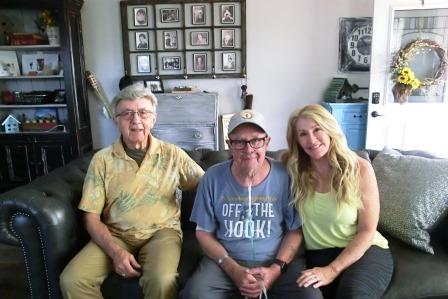
In Memoriam To Delbert Carr And Pam Alexander

In_memoriam

July 29, 2023. Over the past years, the On The War Memorial Trail Research Project has been telling stories of those who have served our country.  In the course of Pieter’s research, we’ve had the privilege of meeting many of the families who contributed photos and stories. 

When Pieter first began researching the names on the Cenotaph outside the Legion in Borden-Carleton, Prince Edward Island in 2015, two of the first stories were that of WWI soldier Vincent Earl CARR and WWII pilot Elmer Bagnall MUTTART.

…Delbert and Helen Carr provided the first photo for the Cenotaph Research Project…

We were very sorry to hear of the passing of Delbert Carr, nephew of WWI soldier Vincent Earl Carr.  (See https://www.saltwire.com/prince-edward-island/obituaries/delbert-louis-carr-90441/

CIMG3083 Aug 31 2019 Pieter with Helen & Delbert Carr

Pieter with Helen and Delbert (seated) Carr of Tryon. (Photo credit: Daria Valkenburg)

When Pieter began his research into the 48 names on the Cenotaph in Borden-Carleton, we carried a photo of the names with us in the hope that someone would recognize a name.  We had no luck until one day Helen Carr mentioned that her husband’s uncle, Vincent CARR, was listed on the memorial.  Did we want a photo of him?  With that photo, Pieter delved into Vincent Carr’s military records and learned that he died on October 30, 1917 during the Battle of Passchendaele

That was the first story we wrote about, which was published in the County Line Courier newspaper in October 2016. (See https://onthewarmemorialtrail.com/2017/07/28/the-cenotaph-research-project-begins/)

In 2017, we visited the grave where Vincent Carr is buried in Belgium (See https://onthewarmemorialtrail.com/2017/11/03/on-the-war-memorial-trail-of-passchendaele-and-surrounding-area/) and that visit led to a mystery that wasn’t solved until two years later. (See https://onthewarmemorialtrail.com/2019/09/01/the-three-ww1-soldiers-who-were-buried-together-at-passchendaele/)

…Pam Alexander was the daughter of Halifax L9561 navigator Reg Alexander…

The story of WWII pilot Elmer Bagnall MUTTART, who died after his plane was shot down over The Netherlands on October 12, 1941, has unfolded over several years, and began with this posting, one of the first stories on our blog: https://onthewarmemorialtrail.com/2017/07/28/the-elmer-bagnall-muttart-story/

Earlier this month, Don Coutts notified us that his mother Helen Coutts, Elmer’s sister, had passed away at the age of 101. (See https://www.humphreymiles.com/obituaries/Helen-Muttart-Coutts?obId=28481417)  An In Memoriam article was posted last week. (See https://onthewarmemorialtrail.com/2023/07/22/in-memorium-to-helen-nee-muttart-coutts/)

We were then saddened to learn that Pam Alexander, who was so much a part of this research file, had passed away in England on April 7, 2023.  It wasn’t until Pam’s husband published her obituary earlier in July that we knew of her passing.  (See https://www.theguardian.com/science/2023/jul/12/pam-alexander-obituary?CMP=share_btn_fb&fbclid=IwAR1twqhqrZC2cWxeDZShwYudyGpk1VcMnnG-HpYfzqJb-qiMFQB5L0rlDtw and https://en.m.wikipedia.org/wiki/Pam_Alexander)

When Pieter began researching Elmer’s story, he soon learned about Reg Alexander, the navigator on Elmer’s last flight, Halifax L9561.  This led him to the daughter of Reg, Pam Alexander, who he first got in contact with in October 2016.

Pam explained that “…My father did speak with Mr Muttart’s parents after the war but may not have given them all the details, which I only discovered when he was in his eighties. As children we had visited the Canadian War Memorial in Runnymede regularly in November in remembrance of my father’s pilot, who was known as ‘Happy’ Muttart….” 

She had visited Harlingen General Cemetery, where Elmer is buried, with her father.  “…The wreath my father placed said ‘From a grateful and admiring member of the crew and his family’…

Oct 12 2019 Pam Alexander Harlingen General Cemetery from Sikko Drijver

Pam Alexander (identified by red arrow) at Harlingen General Cemetery in Harlingen, The Netherlands, on October 12, 2019.  (Photo credit: Sikko Drijver)

Pam and her husband Roger Booker, and Pam’s sister Carolyn, attended the commemoration events and unveiling of the memorial panel in Won in October 2019, and so we had a chance to finally meet her in person. (See https://onthewarmemorialtrail.com/2019/11/18/on-the-war-memorial-trail-the-memorial-panel-in-wons-is-unveiled/)

Our deepest condolences go to the families of Delbert Carr and Pam Alexander. 

Do you have a story to tell? Pieter encourages you to email him at memorialtrail@gmail.com, comment on the blog, or tweet to @researchmemori1.    

© Daria Valkenburg

…Previous In Memoriams….

…Want to follow our research?…

Follow our blog

If you are reading this posting, but aren’t following our research, you are welcome to do so.  Our blog address: https://onthewarmemorialtrail.com/

Front cover OnTheWarMememorialTrailinEurope4 countries, 6 weeks, 7,000 km – an unforgettable war memorial journey in Europe…. Daria’s book ‘No Soldier Buried Overseas Should Ever Be Forgotten‘ is available in print and e-book formats.  Net proceeds of book sales help support research costs and the cost of maintaining this blog. For more information see https://nosoldierforgotten.com/

Subscribe to our YouTube Channel: On The War Memorial Trail With Pieter Valkenburg: https://www.youtube.com/channel/UCJ591TyjSheOR-Cb_Gs_5Kw

Never miss a posting!  Subscribe below to have each new story from the war memorial trail delivered to your inbox.

In Memoriam To Helen (nee Muttart) Coutts

In_memoriam

July 22, 2023. Over the past years, the On The War Memorial Trail Research Project has been telling stories of those who have served our country.  Along the way, we’ve also introduced you to many of the families who contributed photos and stories.

Last week, we received word from Don Coutts that his mother Helen Coutts, sister of WWII pilot Elmer Bagnall MUTTART, passed away at the age of 101. (See https://www.humphreymiles.com/obituaries/Helen-Muttart-Coutts?obId=28481417)

The story of Elmer Muttart, who died after his plane was shot down over The Netherlands on October 12, 1941, has unfolded over several years, and began with this posting, one of the first stories on our blog: https://onthewarmemorialtrail.com/2017/07/28/the-elmer-bagnall-muttart-story/

CIMG9481 Oct 25 2017 Pieter with Helen Elgin & Don Coutts in Toronto

Pieter (standing left) with Elgin Coutts (seated), Elgin’s wife Helen (centre) and son Donald (standing right) during a visit in 2017. (Photo credit: Daria Valkenburg)

We met Helen and Elgin Coutts and their son Don in 2017. A few years later, Helen’s husband Elgin passed away. (See https://onthewarmemorialtrail.com/2019/08/14/in-memoriam/)

On October 12, 2019, a memorial panel to honour Elmer Muttart and his Halifax L9561 crew was placed near the crash site in Wons, The Netherlands. (See https://onthewarmemorialtrail.com/2019/11/18/on-the-war-memorial-trail-the-memorial-panel-in-wons-is-unveiled/

Two short documentaries were made by us about the memorial panel and how it became a reality. (See https://onthewarmemorialtrail.com/2020/01/31/he-died-that-we-might-live-video-is-now-on-youtube/)

The group who came for the unveiling of the memorial panel also visited Elmer’s grave in Harlingen General Cemetery. (See https://onthewarmemorialtrail.com/2019/10/15/on-the-war-memorial-trail-the-visit-to-harlingen-general-cemetery/)

CIMG3431Oct 12 2019 Pieter Annie Lee Don Oranje Hotel Leeuwarden

Left to right: Pieter Valkenburg, Annie Lee MacDonald, Don Coutts with flower bouquets for the visit to Elmer Muttart’s grave. (Photo credit: Daria Valkenburg)

Among the remembrances were flower bouquets placed by us, family friends Annie Lee and Elmer MacDonald, and Don Coutts, Elmer’s nephew, on behalf of the Coutts family.  Don also placed small flags of Canada and Prince Edward Island by his uncle’s grave.

Thank you to Don Coutts for letting us know about his mother’s passing.  Our deepest condolences go to him and his wife Nora, and to his brother Peter and his wife Kathie, and their family.

Do you have a story to tell? Pieter encourages you to email him at memorialtrail@gmail.com, comment on the blog, or tweet to @researchmemori1.    

© Daria Valkenburg

…Want to follow our research?…

Follow our blog

If you are reading this posting, but aren’t following our research, you are welcome to do so.  Our blog address: https://onthewarmemorialtrail.com/

Front cover OnTheWarMememorialTrailinEurope4 countries, 6 weeks, 7,000 km – an unforgettable war memorial journey in Europe…. Daria’s book ‘No Soldier Buried Overseas Should Ever Be Forgotten‘ is available in print and e-book formats.  Net proceeds of book sales help support research costs and the cost of maintaining this blog. For more information see https://nosoldierforgotten.com/

Subscribe to our YouTube Channel: On The War Memorial Trail With Pieter Valkenburg: https://www.youtube.com/channel/UCJ591TyjSheOR-Cb_Gs_5Kw

Never miss a posting!  Subscribe below to have each new story from the war memorial trail delivered to your inbox.

On The War Memorial Trail…..The WWII Soldier From Disley Who Lost His Life While Swimming Across The Maas River

July 20, 2023. After Pieter was interviewed by Kevin Rollason of the ‘Winnipeg Free Press‘ in November 2022, we received an email from Mike Wilson about his great-uncle, Adam KLEIN.

Mike wrote that “….my mother Joyce recently read the ‘A Name Without A Face’ article in The Winnipeg Free Press and passed it on to me. Thank you for the important work that you are doing with this project….”  (See https://onthewarmemorialtrail.com/2022/11/09/on-the-war-memorial-trail-the-importance-of-remembrance/)

He went on to explain that “… my great-uncle on my mother’s side, Adam, served in the Second World War and is buried in the Bergen-op-Zoom Canadian War Cemetery in the Netherlands (Plot 8, Row G, Grave 4)…..Pte. Adam Klein was from Disley, Saskatchewan (near Regina Beach) and served with the Algonquin Regiment.  I have attached a picture of my Great Uncle Adam

Adam was born August 9, 1924 in Disley, Saskatchewan, the son of Joseph and Eva (nee Huber) Klein, who had immigrated to Canada from Czernowitz, Romania. (That area is now part of Ukraine. See https://en.wikipedia.org/wiki/Bukovina)

… Adam enlisted at the age of 19…

Uncle Adam Klein picture #2

Adam Klein. (Photo courtesy of the Klein Family)

When he enlisted with the 12th District Depot in Regina, Saskatchewan on October 6, 1943, at the age of 19, he was working for his father as a truck driver, who had a general hauling business in Regina Beach. 

The interviewer for his Personnel Selection Record recorded that Adam could “…speak some German…” and “…reads quite a lot of fiction. Plays baseball and rugby, likes most sports…. Likes comedy and western pictures….”   It was also noted that “…he is a proficient driver and licenced, so should prove suitable for Driver i/c…”  The term ‘Driver i/c’ refers to ‘Driver, internal combustion’, meaning someone qualified to drive a motor vehicle, but not a tracked vehicle, such as a tank.

On November 4, 1943, Adam was transferred to No. 122 Canadian Army Basic Training Centre (CABTC) in Prince Albert, Saskatchewan.  After completing his training there, his Personnel Selection Record was updated, noting that he was “… cooperative, has a good attitude, and appears to like Army life… He has a keen desire to drive in Army.  Brother overseas is a driver…”  This was Adam’s older brother August.

… Adam took courses to qualify as a Driver…

Adam was next sent to the A15 Canadian Infantry Training Camp (CITC) in Shilo, Manitoba.  From there, he went to the S-5 Canadian Driving and Maintenance School (CD & M School) in Woodstock, Ontario, on March 2, 1944, where he successfully completed a 6 week driving course to qualify as a Driver i/c Class III Wheeled Vehicles. This meant he was qualified to drive heavy trucks and armoured cars.

He remained in Woodstock for additional training, taking a Driver Mechanic W course, which he successfully completed on June 9, 1944.  This meant he was trained to drive tracked vehicles, such as tanks.

On June 10, 1944, Adam returned to A15 Canadian Infantry Training Camp (CITC) in Shilo, where an update to his Personnel Selection Record noted “…his suitability for overseas service…

Adam was now qualified as a Driver Mechanic Group C.  In addition to being a driver, he would also be responsible for minor vehicle repairs on vehicles in his unit.

… Adam left Canada a few days after his 20th birthday…

On August 4, 1944 Adam left Canada for the United Kingdom, arriving on August 11, 1944, and assigned to No 1 Canadian Infantry Reinforcement Unit (CIRU).  His stay in the United Kingdom was short, as on August 31, 1944 he was sent to France with the X-4 reinforcement troops of 11th Battalion.

On September 15, 1944 he was transferred to the Algonquin Regiment, which was in Belgium, having just fought in the Battle of the Leopold Canal. Reinforcements were badly needed. asualty figures for the Regiment during the fighting September on September 13 to 14, 1944 in the Belgian village of Moerkerke on the Leopold Canal were recorded as 168 killed, wounded or missing. (See https://www.canada.ca/en/department-national-defence/services/military-history/history-heritage/casualty-identification-military/battle-leopold-canal-september-13-14-1944.html)

Adam arrived at the Regiment on the same day as Bruce Wilbur CHURCHILL, whose story has been previously told on this blog.  (See https://onthewarmemorialtrail.com/2022/06/05/on-the-war-memorial-trail-the-ww2-soldier-who-lost-his-life-in-a-monastery-garden/)

The beginning of January 1945 found the Regiment in Meerle, Belgium.  Not long after the New Year the Regiment moved into the area around Drunen, The Netherlands.

… Adam was part of a patrol with ‘C’ Company…

The January 18, 1945 war diary for the Regiment recorded that after ‘C’ Company had been interviewed by a war correspondent for a radio station in Toronto, part of the evening was spent in “…carrying forward ammunition that will be used in the early morning when they will take part in a fire plan to cover a fighting patrol…”  Adam would be a member of this planned patrol.

On the morning of January 19, 1945, the war diary for the Regiment recorded that “….Weather: Dull, raw wind, hail and snow in AM...”  In spite of the poor weather, ‘C’ Company was sent on patrol, and the war diary recorded the patrol commander’s subsequent report.

Map showing where Adam Klein died

...At 0700 hours this morning, a fighting patrol of 23 men from 15 Platoon, commanded by W. A. Godefroy, crossed the north bank of the Maas, just west of the Heusden Canal….The patrol crossed the river and reached the top of the dyke without incident….

The patrol spread out. “…Cpl Carrier led his section to the left flank to a well developed trench system, which led to a pill box.  Hearing voices inside, he tossed in a hand grenade, which brought two Germans undamaged into the open….

Two men were assigned to guard them, while Cpl Kenneth John CARRIER and Adam Klein “…flushed out five more….and took them to the embarking point, only to find that owing to some error the remainder of the patrol had withdrawn with the two prisoners of war…

An explanation was given in an article in the January 26, 1945 edition of the ‘Maple Leaf’ newspaper. “…The boats had left. The corporal and the private hadn’t heard the whistled signal for withdrawal.…They stood alone in a snowstorm, in enemy territory, with the freezing river between them and our lines…

… German prisoners attacked Adam…

One of the five new prisoners was wounded and left behind.  “…Leaving Pte Klein with the four prisoners, the corporal ran along the beach, endeavouring to find a boat...”  He was unsuccessful.  Then, when he returned “…he found the four Germans had jumped Pte Klein and were pounding his head with a rock….

Cpl Carrier killed three of the prisoners but “…the fourth one managed to run away…” Later accounts stated that the fourth German was also killed by Carrier.

It wasn’t safe to remain in enemy territory.   Without a boat, their options were limited.  Therefore, they “…walked out onto the ruined bridge and swam for safety….

… A dangerous swim across the Maas River…

As they were halfway across, “…Pte Klein called out for help. Cpl Carrier, although he himself was almost exhausted, dragged his comrade to within a few yards of the shore….Only when further assistance arrived did he release his friend and swim the last few yards to safety…

The war diary entry explained that “… Cpl Carrier made the trip successfully, but Pte Klein was swept under as he was within an ace of being rescued by an ‘A’ Company man who dived in to help him…”  This was Pte Arnold Edward BOEHLER, who noticed “…two figures struggling frantically in the icy water about 10 yards from the shore...

… Adam died before reaching shore…

An account of Boehler’s actions noted that without hesitation, he “…rushed through a field of anti-personnel mines and, fully clothed, dove into the river…

The war diary entry explained that Boehler “…reached Klein and grabbed him by the shoulders, but unfortunately he got a cramp and was forced to relinquish his hold on the drowning man and it was only with great difficulty that he got back to shore himself...” The war diary entry differs from the account in a January 26, 1945 article in the Maple Leaf newspaper and in Boehler’s nomination for a military medal, both of which state that Boehler managed to drag Adam’s body to shore.

Adam’s body was recovered by Lt Godefroy, Lt Grandbois, and Pte Neely.  In ‘Warpath – The Story of the Algonquin Regiment 1939-1945’, the regimental history of the Algonquin Regiment written by Major G. L. Cassidy, it was stated that Adam did not drown but died from “…a heart attack brought on by the exertion and the cold…”  This was not in his service file, nor in the war diary.

The war diary recorded that on that same day as his death, Adam “…was given a military funeral in the afternoon, the pall bearers and firing party being composed of members of the patrol...”  He was buried just north of Drunen.       

While the war diary and the subsequent nominations for military medals for Cpl Carrier and Pte Boehler, the two soldiers that tried to rescue Adam, state that the incident happened on January 19, 1945, Adam’s military service file states he died on January 18, 1945. This date is repeated in ‘Warpath – The Story of the Algonquin Regiment 1939-1945’.  January 18, 1945 is also the date on his headstone.

… Adam is buried in the Canadian War Cemetery in Bergen Op Zoom…

After the war, Adam was reburied in the Canadian War Cemetery in Bergen Op Zoom, The Netherlands, which we visited in 2019.  The British War Cemetery is right next to it, which we mistakenly went to first.  A teacher with a group of students noticed our bag of flags and directed us to the right cemetery!

CIMG3382 Oct 7 2019 Bergen Op Zoom Pieter at Cdn War Cemetery

Pieter at the entrance to the Canadian War Cemetery in Bergen Op Zoom.  Our Sobey’s bag saved us from wandering around the wrong cemetery!  (Photo credit: Daria Valkenburg)

Grave of Adam Klein from findagrave

Grave of Adam Klein at the Canadian War Cemetery in Bergen Op Zoom. (Photo source: http://www.findagrave.com)

…Klein Island is named in honour of Adam…

On May 31, 1967, the Province of Saskatchewan’s Department of Natural Resources named Klein Island in honour of Adam.  (See https://geonames.nrcan.gc.ca/search-place-names/unique?id=HAETD)

Joyce Forshaw (nee Klein)

Joyce Forshaw (nee Klein), niece of Adam Klein. (Photo courtesy of Mike Wilson)

Mike Wilson wrote that “….Pte. Adam Klein was only 21 years old when he died, and he is still thought of, remembered and named often by his niece Joyce, who has proudly displayed Adam’s picture every November to honour him. It was during a quiet Remembrance Day visit with my mother … that we gathered information to send to you….

Thank you to Mike Wilson and Joyce Forshaw for contacting Pieter about Adam Klein. Adam lost his life in a part of The Netherlands that we are very familiar with, as so many of Pieter’s ancestors lived in this area.

Pieter reflected that “…the story of the liberation of The Netherlands is one my parents engrained in me, and I have never forgotten the sacrifices made by so many so that the Dutch people could live in peace and freedom…

Do you have a story to tell? Pieter encourages you to email him at memorialtrail@gmail.com, or comment on the blog.    

© Daria Valkenburg

…Want to follow our research?…

Follow our blog

If you are reading this posting, but aren’t following our research, you are welcome to do so.  Our blog address: https://onthewarmemorialtrail.com/

Front cover OnTheWarMememorialTrailinEurope4 countries, 6 weeks, 7,000 km – an unforgettable war memorial journey in Europe…. Daria’s book ‘No Soldier Buried Overseas Should Ever Be Forgotten‘ is available in print and e-book formats.  Net proceeds of book sales help support research costs and the cost of maintaining this blog. For more information see https://nosoldierforgotten.com/

Subscribe to our YouTube Channel: On The War Memorial Trail With Pieter Valkenburg: https://www.youtube.com/channel/UCJ591TyjSheOR-Cb_Gs_5Kw

Never miss a posting!  Subscribe below to have each new story from the war memorial trail delivered to your inbox.