On the War Memorial Trail …..Good News Bad News

July 12, 2018.  When doing research on something that happened a long time ago, one expects setbacks and successes.  Sometimes the setbacks are greater than the successes, and sometimes the other way around.

On July 30, this blog will be a year old, and the Cenotaph Research Project two years old.   A lot has happened since it began.  Many families have participated in this project, as have universities where some of the soldiers studied.  We thank them for their help in remembering their heroes.

We’re still missing a number of photos, as per the list provided in the previous blog entry.  (See Upcoming Presentation in Crapaud).  In some cases, we have not been able to find family members of the soldiers on the Cenotaph.  Occasionally we found family, only to be told they never heard of the person.  One woman was quite interested to hear about her WWI soldier relative, but after talking to her mother to see if any photo survived, reported back that the response was “it happened too long ago.”  That was the end of that story!

Most of the time, however, the family was aware of the person, but no photo survived, let alone other documents such as letters or postcards.  This happened to the family of another WWI soldier, who searched diligently for information and a photo, with no success.  We’ve now placed an ad in ‘Legion‘ magazine, in the hope that someone outside the island will be able to help.

In another instance, we were able to get a photo of one WWI soldier who died in Belgium, but a photo of his brother, who fought in France, has yet to be found.

So those are some of the setbacks regarding photos and personal stories.  Another recent setback was that we have learned from the Missing Airmen Memorial Foundation in The Netherlands that the memorial plaque in Wons, The Netherlands to honour WWII pilot Elmer Muttart and the crew of Halifax L9561, which was planned to be unveiled in October 2018 has been postponed to 2019.  While the postponement of this important ceremony is a disappointment, it’s an opportunity to continue raising funds for this project.

CIMG0984 Jul 9 2018 Pieter and Angela Walker of CBC Mainstreet

Pieter with Angela Walker of CBC’s Mainstreet in the CBC studio in Charlottetown. (Photo credit: Daria Valkenburg)

Ok, now for some positive news.  Angela Walker of CBC Mainstreet interviewed Pieter earlier this week.  If you missed the radio interview, here is the link:  https://www.cbc.ca/listen/shows/mainstreet-pei/segment/15556040 and the brief write-up on the CBC website:  Finding the heroic stories behind the names on a local cenotaph. Pieter Valkenburg is a Dutch Canadian who wanted to learn more about the names on the Borden-Carleton Cenotaph. So he started a research project to find the stories behind these fallen soldiers.’

Shane Ross posted a story on the CBC website based on what was discussed in the interview, and you can read that article here:  http://www.cbc.ca/news/canada/prince-edward-island/pei-pieter-valkenburg-soldiers-holland-netherlands-1.4740888

We are grateful to CBC PEI for taking an interest in the Cenotaph Research Project, and also to the County Line Courier newspaper, which has been publishing our stories since the project began.

A reminder that if you have a relative who was a WWII soldier and is buried in The Netherlands, please consider participating in a project to collect photos and stories for each soldier.  You can email your photos and info to Pieter at memorialtrail@gmail.com and he will forward the information on your behalf to the project team in The Netherlands.

© Daria Valkenburg

…Want to follow our research?….

If you are reading this posting, but aren’t following our research, you are welcome to do so.  Our blog address: https://onthewarmemorialtrail.com/

Front cover OnTheWarMememorialTrailinEurope4 countries, 6 weeks, 7,000 km – an unforgettable war memorial journey in Europe…. Daria’s book ‘No Soldier Buried Overseas Should Ever Be Forgotten‘ is available in print and e-book formats.  Net proceeds of book sales help support research costs and the cost of maintaining this blog. For more information see https://nosoldierforgotten.com/ 

You are also invited to subscribe to our YouTube Channel: On The War Memorial Trail With Pieter Valkenburg: https://www.youtube.com/channel/UCJ591TyjSheOR-Cb_Gs_5Kw

Never miss a posting! Subscribe below to have each new story from the war memorial trail delivered to your inbox.

Upcoming Presentation in Crapaud

July 9, 2018.  Everyone is invited to attend the upcoming presentation about the Cenotaph Research Project at St. John the Evangelist Anglican Church in Crapaud on Thursday, July 12, 2018.  Below, please see poster and a list of photos of soldiers we are still looking for.  Can you help???

Poster Cenotaph Research Project presentation

Names still without faces from WWI

  • James CAIRNS, born in Kinkora – UPDATE: PHOTO FOUND
  • Leigh Hunt CAMERON, born in Albany
  • James Lymon CAMERON, born in Victoria
  • William Galen CAMPBELL, born in Wellington
  • Bazil CORMIER, born in Tignish
  • Joseph Arthur DESROCHES, born in Miscouche – UPDATE: PHOTO FOUND
  • James Graham FARROW, born in Argyle Shore
  • Charles LOWTHER, born in North Carleton
  • Arthur Clinton ROBINSON, born in Tryon
  • Harry ROBINSON, born in Augustine Cove

Names still without faces from WWII

  • Leonard Stephen AVERY, born in Bedeque – UPDATE: PHOTO FOUND
  • John Daniel FERGUSON, born in Borden – UPDATE: PHOTO FOUND 
  • Ernest Ramey GALLANT, born in Borden
  • Singleton Charles JEFFERY, born in Bayfield, New Brunswick – UPDATE: PHOTO FOUND 

The Cenotaph also lists an F. ARSENAULT.  No information at all has been found for someone of this name from this area.

As a separate project, Pieter is helping researchers in The Netherlands who are looking for photos and information on Canadian soldiers buried in The Netherlands If you have a relative with a grave in The Netherlands and would like to participate, you can email your photos and info to Pieter at memorialtrail@gmail.com and he will forward the information on your behalf.  Or you can drop off your photos on Thursday and after being scanned they will be returned to you.

© Daria Valkenburg

…Want to follow our research?….

If you are reading this posting, but aren’t following our research, you are welcome to do so.  Our blog address: https://onthewarmemorialtrail.com/

Front cover OnTheWarMememorialTrailinEurope4 countries, 6 weeks, 7,000 km – an unforgettable war memorial journey in Europe…. Daria’s book ‘No Soldier Buried Overseas Should Ever Be Forgotten‘ is available in print and e-book formats.  Net proceeds of book sales help support research costs and the cost of maintaining this blog. For more information see https://nosoldierforgotten.com/ 

You are also invited to subscribe to our YouTube Channel: On The War Memorial Trail With Pieter Valkenburg: https://www.youtube.com/channel/UCJ591TyjSheOR-Cb_Gs_5Kw

Never miss a posting!  Subscribe below to have each new story from the war memorial trail delivered to your inbox.

On the War Memorial Trail …..WWI Soldier John Lyman Wood’s Connection With Acadia University

June 1, 2018.  In previous blog postings, we wrote about John Lyman WOOD, whose name is not only on the Cenotaph outside the Borden-Carleton Legion, but also is listed on the Vimy Memorial in France. (See Learning About The Two Names On The Vimy Memorial and Visiting The Canadian National Vimy Memorial)

Photo Lyman Wood

Photo: John Lyman Wood shortly after enlistment in October 1915. (Photo courtesy of Gene Rogerson collection)

Born in North Tryon on July 8, 1897, the son of George William Wood and Martha Heatly, he was raised on a farm, and was in second year engineering at Acadia University in Wolfville, Nova Scotia before enlisting in the Princess Patricia Canadian Light Infantry 4th University Company on October 12, 1915.  On November 28, 1915 he sailed from Halifax on the SS Lapland, arriving in Plymouth, England on December 7.

Upon arrival, he was sent to the 11th Reserve Battalion, stationed at St. Martin’s Plain near Folkestone, for infantry training for needed reinforcements to the Canadian Corps in the field.

Before WW1 began, Wood attended Horton Academy and Acadia University in Wolfville, Nova Scotia.   As part of his research, Pieter contacted Acadia University.  Wendy Robicheau, archivist at Acadia University, is researching WW1 soldiers who attended Acadia and posts information on a blog.  (See Acadia and the War: commemoration and dissemination blog: http://aboutacadiawar.blogspot.com/.)  Wendy explained that at Acadia University, Wood was known as ‘Lyman’, not ‘John’.

Wendy shared information from Acadia’s student newspaper, ‘The Acadia Athenaeum’, December 1915 issue. “The following men enlisted with the 4th Universities Company of the P.P.C.L.I.:–Lieut. Frank Higgins, ’14; Sergeant Murray Millet, ’16; Corporal Burton DeWolfe, ’16; Lance Corporal Don Chase Eng. ’16; Max Saunders, ’16; Charlie Fitch Eng, ’16; Harold Bishop, ex ’17; John MacNeill, ex ’18; Leyman Wood, ex ’18; John Mosher, ex ’18.”  P.P.C.L.I. refers to Princess Patricia Canadian Light Infantry. The dates after the men’s names refer to either the year of graduation or the year they should have graduated, if WW1 had not interrupted their education.

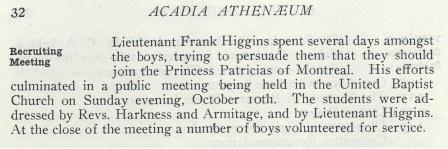
In her blog posting of June 23, 1917, (http://aboutacadiawar.blogspot.com/search?q=Higgins) , Wendy wrote that “It should be noted that Higgins played a role in recruiting several Acadia men to the P.P.C.L.I. His signature appears on the attestation papers of several students who enlisted in Wolfville.”  The following entry is from the November 1915 issue of the Acadia Athenaeum.

Recruit_Mtng_Ath_1915

Excerpt from November 1915 issue of Acadia Athenaeum of Acadia University.

Indeed, Higgins did sign the attestation papers for Wood as well, as Wendy explains in her blog posting of May 3, 2017 (http://aboutacadiawar.blogspot.com/2017/05/remembering-john-lyman-wood-died-100.html?q=Higgins): Private Wood attested in October 1915. He was a student with one year in Acadia’s O.T.C. The witness on his papers–Lieut. F.C. Higgins. Incidentally, Dr. C.E.A. deWitt, Class of ’04, signed his medical papers. DeWitt was the doctor at Camp Aldershot.

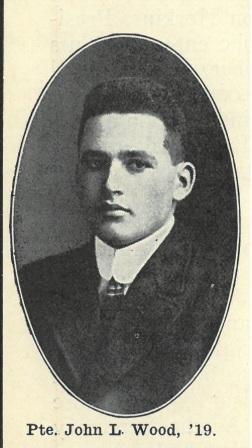
Wood_JL

Student photo from Acadia University, published in the June 1917 Acadia Athenaeum. This may have been his matriculation photo.

Wendy went on to explain that of the group of ten men mentioned in the December 1915 issue:  “Five will not survive. DeWolfe, Saunders, Fitch, and Wood all die in Europe. Bishop, severely wounded, is brought back to Nova Scotia, and dies in Halifax. Chase is taken POW at Mount Sorrell with other P.P.C.L.I. who are Acadia students, but not of the group listed above.

Wendy let us know about a book ‘As Ever’, written by John Grant, containing letters from his great-uncle Harold Fletcher Bishop, who signed up with John Lyman Wood, and was also a war casualty. (See  http://www.kingscountynews.ca/living/letters-from-auburn-soldier-in-first-world-war-inspire-book-71960/).  After contacting John Grant and asking about John Lyman Wood, he wrote back that he’d found a reference to Wood attending a dinner in Folkestone, England: “On or about January 16, 1916 the Acadia men organized a dinner at the Metropole Hotel where perhaps two dozen gathered for a meal, toasts, and to sing the Acadia songs around the piano.  I have included in my book two reports of evening that were published in the Acadia Atheneaum.  Pte. J.L. Wood, Class of ‘18” was mentioned. 

In an excerpt of one report of that evening, by Sgt F. Gregg, he explains that: “On the night in question the Acadians made their way, by bus and train, toward the Metropole hotel. Here the interior presented a happy contrast to the bleak, darkened, town without. Upon being ushered into the sanctum reserved for us we were surprised to see fellows, many of whom we thought still to be in the Blue Nose province.

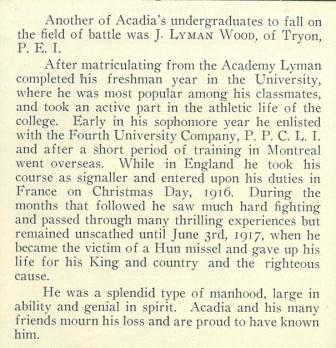
This was the only reunion dinner that Wood attended. On January 21, 1916 he was in hospital with appendicitis, then gastritis, and measles.  He was discharged on April 15, 1916, to the 39th Battalion. On December 22, 1916, he arrived in France as part of the Second Infantry Battalion, which was part of the 1st Canadian Infantry Brigade during the Battle of Vimy Ridge.   He survived that battle, but his luck ran out on May 3, 1917, when he was killed in action during the Battle of Arras, in the third battle of the Scarpe near Fresnoy.  Wood’s body was never recovered, his only memorial in Europe being his name inscribed on the Vimy Ridge Memorial, which we visited last fall.  Wood’s obituary was published in the June 1917 issue of the Acadia Athenaeum, with an unfortunate typo for the month of his death.

wood obituary

Excerpt from June 1917 issue of Acadia Athenaeum of Acadia University. Note that the date of death is incorrect. Wood died on May 3, 1917.

A big thank you to Wendy Robicheau for sharing the information about Wood from Acadia University, to Gene Rogerson for providing a photo of Wood, and to John Grant for letting us know about the Acadia reunion dinner.  Can you add anything more to Wood’s story?  Email us at memorialtrail@gmail.com, comment on the blog, or send a tweet to @researchmemori1. Comments or stories?  You can share them by email or by commenting on this blog.

UPCOMING PRESENTATION: Pieter has been invited to speak about the Cenotaph Research Project at St John The Evangelist Anglican Church in Crapaud at 7 pm on Thursday, July 12, 2018.  Location: 391 Nelson St, Trans Canada Hwy Rte, Crapaud, PE C0A 1J0.  Photos and information about soldiers welcome.

© Daria Valkenburg

…Want to follow our research?….

If you are reading this posting, but aren’t following our research, you are welcome to do so.  Our blog address: https://onthewarmemorialtrail.com/

Front cover OnTheWarMememorialTrailinEurope4 countries, 6 weeks, 7,000 km – an unforgettable war memorial journey in Europe…. Daria’s book ‘No Soldier Buried Overseas Should Ever Be Forgotten‘ is available in print and e-book formats.  Net proceeds of book sales help support research costs and the cost of maintaining this blog. For more information see https://nosoldierforgotten.com/ 

You are also invited to subscribe to our YouTube Channel: On The War Memorial Trail With Pieter Valkenburg: https://www.youtube.com/channel/UCJ591TyjSheOR-Cb_Gs_5Kw

Never miss a posting!  Subscribe below to have each new story from the war memorial trail delivered to your inbox.

On the War Memorial Trail …..WWI Soldier Arthur Collett’s Bible

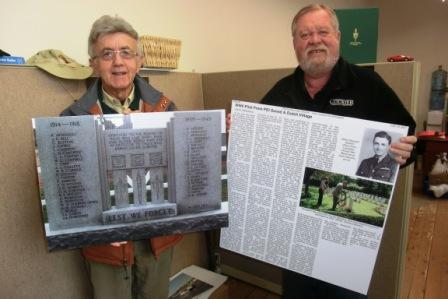
April 2, 2018.  On March 25, Pieter was invited to give a presentation about the Cenotaph Research Project at Central Trinity United Church in Breadalbane.  In addition to preparing a slideshow of interesting photos to complement the talk about the research on the soldiers listed on the cenotaph outside the Borden-Carleton Legion, we had posters made of the Cenotaph photo and two of the articles published in the County Line Courier.  These posters were put on display, and will be used in future presentations.

Pieter Valkenburg and Mike Smith with Cenotaph poster and Muttart poster

Pieter on the left with County Line Publisher Mike Smith. (Photo credit: Daria Valkenburg)

We received a very warm welcome from everyone, and enjoyed the delicious potluck dinner that preceded the talk.  The presentation was well received, with a lively question and answer session after the presentation.  Jack and Arlene Sorensen of the Tryon & Area Historical Society attended, and accepted donations to the “Muttart Memorial Fund”.

Pieter Valkenburg at the podium in Breadalbane

Pieter at the podium at Central Trinity United Church in Breadalbane. (Photo credit: Daria Valkenburg)

One of the people who attended the presentation was Joyce Loo of Springfied.  When an article about Arthur Leigh COLLETT ran in the County Line Courier last fall, Joyce contacted us with additional information.   (See the same article published in Summerside Citizen (Sside Citizen Nov 15 2017 p15 Cemetery in a potato field in France) and our earlier blog entry: Grandcourt Road Cemetery in Farmers Fields)

Mrs. Loo, nee Haslam, wrote us that: “I am very interested in your article in the County Line Courier about Arthur Collett. He taught my mother in Springfield School. He boarded with Louis Haslam and family. I now live in that house and found his Greek Bible in the attic. My mother liked him very much as a teacher and she knew he had died in France.

Until receiving this email, Pieter had not found any information that Arthur Collett had taught on PEI before completing his education at King’s College in Nova Scotia and receiving his Rhodes scholarship to Oxford.  After contacting King’s College, Pieter received a reply and information from the University Librarian, Jennifer Adams.

From the information from March-April 1913 issue of ‘The Record’, a student magazine that later become the yearbook for King’s College, we learned that “in 1906, on taking a County Scholarship, he entered Prince of Wales College in Charlottetown….. During the years 1906-1908, Mr. Collett was enrolled in H Company of the 82nd Regiment Abegweit Light Infantry….Mr. Collett left Prince of Wales College in 1908, and took up teaching before entering King’s in 1909.”  Mrs. Loo was correct!

In her email, Ms. Adams noted that “In his last year at King’s, Collett was selected as a Rhodes Scholar and was also the Senior Student, equivalent to being head of the student body.”

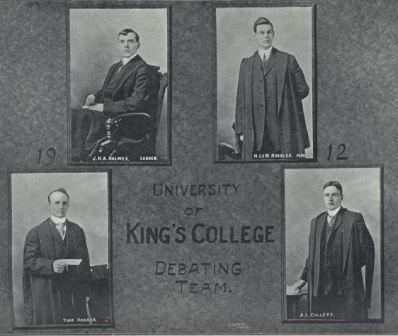
While at King’s College, Collett had the nickname “Deak” and was briefly on the debating team.

Collett, Arthur Leigh - UKC Debating Team 1912

Arthur Collett on bottom far right in this 1912 photo of King’s College Debating Team. (Photo credit: courtesy of King’s College collection)

Joyce Loo brought the bible she had mentioned in her email, and we were able to see that it was a Greek-Latin bible, most likely part of the literary studies that Collett was enrolled in while at Oxford.  His graduation write-up at King’s College, in “The Record, Encaenia” for 1913 noted that “Throughout his College course, “Deak” has displayed a decided thirst for English, being both a prolific contributor to Haliburton Society and a valued member of the RECORD staff….

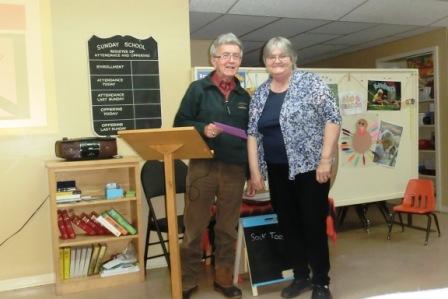
Pieter Valkenburg with Judy and Joyce Loo with Colletts bible

Joyce Loo (centre) with daughter Judy Loo on left and Pieter Valkenburg on right and Collett’s bible. (Photo credit: Daria Valkenburg)

Spine of Colletts bible

Spine of Collett’s bible. (Photo credit: Daria Valkenburg)

How wonderful it was to meet Joyce Loo and have this opportunity to learn more about WW1 soldier Arthur Leigh Collett!  As we learn more about the soldiers on the Cenotaph from families, books, and letters, we can keep adding to their stories.  This was but one example!  Our heartfelt thanks to Jennifer Adams of University of King’s College for providing the additional information on Arthur Leigh Collett’s life as a student.

All too soon, the first presentation about the Cenotaph Research Project was over, and Pieter was thanked by the event organizer, Evelyn Stewart.

Pieter Valkenburg with Evelyn Stewart after the presentation in Breadalbane

Pieter with Evelyn Stewart of the Cavendish-Breadalbane Fellowship Group. (Photo credit: Daria Valkenburg)

If you have a photo, or information, of Collett’s time at Prince of Wales College, his involvement in H Company of the 82nd Regiment Abegweit Light Infantry, or his brief teaching career, please let us know.

Photos are still needed for many of the names on the Cenotaph outside the Borden-Carleton Legion, so please dig out those old albums and take a look. Please share your photos, comments, or stories by emailing us at memorialtrail@gmail.com or by commenting on this blog.

Would you like to have Pieter speak about the Cenotaph Research Project at an upcoming event? If you are interested, email at memorialtrail@gmail.com.

UPDATE:  This project was completed in October 2019!

Donations are still being collected towards the ‘Muttart Memorial Fund’ for a memorial panel in Wons, The Netherlands.  If you would like to donate, cheques may be written out to TAHS and mailed to Tryon & Area Historical Society (TAHS), PO Box 38, Crapaud PE C0A 1J0.  In the subject line, identify your cheque as being for the “Muttart Memorial Fund”.  A charitable donation receipt will be sent to all donors. 

If you wish to donate and you live in Europe:  Bank transfers may be made to Stichting Missing Airmen Memorial Foundation, Bank Account # (IBAN) NL35ABNA0569579856, and state in the subject line “Attn D.S. Drijver for Halifax L9561”.

© Daria Valkenburg

….Want to follow our research?….

If you are reading this posting, but aren’t following our research, you are welcome to do so.  Our blog address: https://onthewarmemorialtrail.com/

Front cover OnTheWarMememorialTrailinEurope4 countries, 6 weeks, 7,000 km – an unforgettable war memorial journey in Europe…. Daria’s book ‘No Soldier Buried Overseas Should Ever Be Forgotten‘ is available in print and e-book formats.  Net proceeds of book sales help support research costs and the cost of maintaining this blog. For more information see https://nosoldierforgotten.com/ 

You are also invited to subscribe to our YouTube Channel: On The War Memorial Trail With Pieter Valkenburg: https://www.youtube.com/channel/UCJ591TyjSheOR-Cb_Gs_5Kw

Never miss a posting!  Subscribe below to have each new story from the war memorial trail delivered to your inbox.

On the War Memorial Trail …..Another Photo For WWII Soldier George Preston Smith

March 21, 2018.  In two previous blog entries the story of George Preston Smith was shared. SMITH, of Kinkora, was with the North Shore (New Brunswick) Regiment, and lost his life in a freak accident in Belgium during WWII when his gun went off while he was trying to pull it out from under a pile of coats stashed in the back of a military truck.  (See On the War Memorial Trail ….. At The Canadian War Cemetery in Groesbeek and On the War Memorial Trail ….. PEI Soldiers Buried In The Canadian War Cemetery in Groesbeek)

After reading an article mentioning Smith, “On the War Memorial Trail ….. PEI Soldiers Buried In The Canadian War Cemetery in Groesbeek”, published in the County Line Courier, one reader, who asked to remain anonymous, shared a photo of George Preston Smith with Alice van Bekkum of the Faces To Graves Foundation Groesbeek in The Netherlands and also with Pieter as part of the Cenotaph Research Project.

George Preston Smith

George Preston Smith (Photo courtesy of Smith’s family)

This generous gesture is giving this soldier an additional layer to his personality, as can be seen from this undated photo.  If you have a story about George Preston Smith or more photos, please let us know.

Smith is buried at Canadian War Cemetery in Groesbeek.  If you have photos or information on any other WWII soldiers who are buried in The Netherlands, please help the researchers at the Faces to Graves project by sharing that information. Photos and stories can be sent to memorialtrail@gmail.com and we’ll forward on your behalf.

In looking at missing faces for the Borden-Carleton Cenotaph Research Project, which this blog documents, we are still seeking photos for the following:

Names still without faces from WWI

  • James CAIRNS, born in Kinkora – UPDATE: PHOTO FOUND!
  • Leigh Hunt CAMERON, born in Albany
  • James Lymon CAMERON, born in Victoria
  • William Galen CAMPBELL, born in Wellington
  • Bazil CORMIER, born in Tignish
  • Joseph Arthur DESROCHES, born in Miscouche  – UPDATE: PHOTO FOUND!
  • James Graham FARROW, birthplace unknown
  • Charles LOWTHER, born in North Carleton
  • Arthur Clinton ROBINSON, born in Tryon
  • Harry ROBINSON, born in Augustine Cove – UPDATE: PHOTO FOUND!

 Names still without faces from WWII

  • Leonard Stephen AVERY, born in Bedeque – UPDATE: PHOTO FOUND!
  • John Daniel FERGUSON, born in Borden – UPDATE: PHOTO FOUND!
  • Ernest Ramey GALLANT, born in Borden
  • Singleton Charles JEFFREY, born in Bayfield, New Brunswick – UPDATE: PHOTO FOUND!

Please check your old photo albums and see if you might not have one of these men in them!  Our goal is to find a photo for them all!  Please share your comments and stories by emailing us at memorialtrail@gmail.com or by commenting on this blog.

UPDATE:  This project was completed in October 2019!

UPCOMING PRESENTATION: Pieter has been invited to speak about the Cenotaph Research Project at Central Trinity United Church in Breadalbane at 7 pm on Sunday, March 25, 2018.  Photos and information about soldiers welcome.  Members of the Tryon & Area Historical Association will be present to accept donations to the “Muttart Memorial Fund”.

© Daria Valkenburg

….Want to follow our research?….

If you are reading this posting, but aren’t following our research, you are welcome to do so.  Our blog address: https://onthewarmemorialtrail.com/

Front cover OnTheWarMememorialTrailinEurope4 countries, 6 weeks, 7,000 km – an unforgettable war memorial journey in Europe…. Daria’s book ‘No Soldier Buried Overseas Should Ever Be Forgotten‘ is available in print and e-book formats.  Net proceeds of book sales help support research costs and the cost of maintaining this blog. For more information see https://nosoldierforgotten.com/ 

You are also invited to subscribe to our YouTube Channel: On The War Memorial Trail With Pieter Valkenburg: https://www.youtube.com/channel/UCJ591TyjSheOR-Cb_Gs_5Kw

Never miss a posting!  Subscribe below to have each new story from the war memorial trail delivered to your inbox.

On the War Memorial Trail ….. In Cologne

February 26, 2018.  After visiting the graves of all the names listed on the Cenotaph outside the Borden-Carleton Legion who were buried or listed on monuments in France, Belgium, and The Netherlands, we had one visit and one country left for this trip… to the Cologne Southern Cemetery, located in the Südfriedhof Cemetery in Cologne, Germany, and the grave of WWI soldier Lt. Henry Warburton STEWART.

This trip almost proved to be my undoing.  After a long drive to Cologne, we finally found the cemetery, located at an intersection of tram lines in a busy part of Cologne.  Pieter was in a rush to get moving after the long car ride, and sprinted ahead to find the Commonwealth War Graves Cemetery.

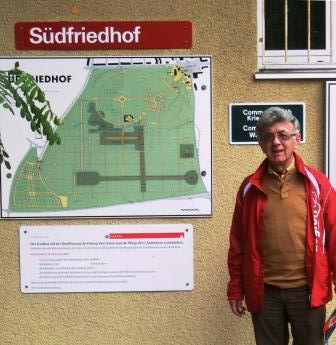
Südfriedhof Cemetery is a very large public cemetery, the largest we’ve ever been in, with many paths and turns.  Only one small sign at the entrance indicates that there is a Commonwealth War Graves Cemetery located here.  Once inside the cemetery, we soon learned that there are no directional markers to it.

CIMG9274 Sep 24 2017 Cologne Pieter at entrance to Sudfriedhof cemetery

Sign at the entrance to Südfriedhof Cemetery with a map of the cemetery, and a very small sign behind Pieter’s head giving an indication that there is also a Commonwealth War Graves Cemetery located here. (Photo credit: Daria Valkenburg)

With Pieter long gone, I slowly hobbled my way on the gravel paths, trying to figure out where to go.  Most cemeteries are in clear lines, but this one was like a maze.  It was beautifully maintained, but quite dark and to my mind, a bit depressing.  As it was a Sunday, there were many people in the cemetery.  When we’d been in cemeteries in South America, many were like parks, with wide paths, park benches, and children laughing and playing.  People sat on benches and visited with each other. Outside the entrance, there were kiosks selling ice cream, balloons, and flowers.  Not this cemetery.  It was quiet and people talked very softly to each other.  Occasionally I saw people tending the graves of their family members.

It was very humid, and as I made my way, hoping not to get lost, I could feel my hair curling and frizzing.  My arthritic hip was aching and walking with a cane on gravel meant moving even more slowly than usual.  After close to a km of walking, I finally saw what I believed to be a sign to the Commonwealth War Graves Cemetery.  The sign said “Graves of the Victims of the War from 1914-1918”.

CIMG9284 Sep 24 2017 Cologne sign at Sudfriedhof cemetery directing one to the victims of WW1

Sign pointing to the graves of WWI victims. (Photo credit: Daria Valkenburg)

I took that path and came into an area of the cemetery surrounded by hedges, making a rather dark cemetery look even drearier.  To my surprise, however, the WW1 victims were German soldiers who had died during the war.  It took me a long time afterwards to realize that to their families, they were just as much victims as Allied soldiers.

Only one young man was in this part of the cemetery, planting flowers by a grave.  I hesitantly asked if he knew where the Commonwealth War Graves Cemetery was.  He looked at me for quite a few minutes and at first I thought he wasn’t going to answer, but then figured out that he was as surprised to find me in that part of the cemetery as I was.  “Just follow the path and you will come to the gate for the English soldiers” he said.  We wished each other a good day and I kept on.

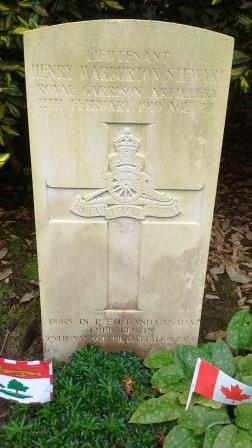
Finally, I found the gate to the Cologne Southern Cemetery and discovered it was the back door gate, not the entrance.  Pieter was waiting by the grave of Henry Warburton Stewart, and had already put down the flags and written in the cemetery register.  He’d forgotten who had the camera, otherwise he probably would have already gone back to the car!

IMG_20170924_113711423 Sep 24 2017 grave of Henry Warburton Stewart at Cologne Southern Cemetery

Grave of Henry Warburton Stewart at Cologne Southern Cemetery. (Photo credit: Pieter Valkenburg)

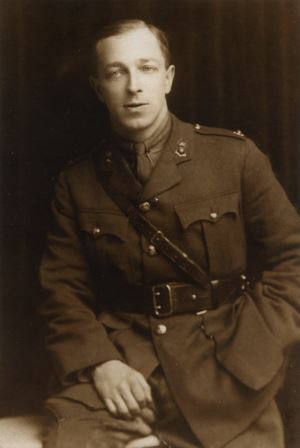
The story of Henry Warburton Stewart is a sad one, as he survived WW1, only to die of pneumonia after contracting Spanish flu in Germany, far away from his comrades.  Born in Strathgartney on April 15, 1884, the son of Robert Bruce Stewart and Ann, nee Warburton, he was a civil engineer when he enlisted as a private with the 29th Battalion (Tobin’s Tigers) in Vancouver on November 30, 1914.

Henry Warburton Stewart

Henry Warburton Stewart. (Photo courtesy B. Stewart family collection)

After serving in the trenches of France for two years, he was discharged with excellent recommendations by the Canadian Army on March 9, 1917 in England and commissioned as a Lieutenant in the Imperial Army’s 77th Siege Battery Royal Garrison Artillery.  Since we have not been able to get access to the war diaries of this unit, we presume that he was sent to Germany as part of the post-occupation forces and there fell ill, dying on February 11, 1919 at No. 2 Canadian Field Hospital in Bonn.  He was buried with military honours at Poppelsdorf Cemetery in Bonn.

In 1922, it was decided that the graves of Commonwealth soldiers who had died in Germany should be brought together in one of four cemeteries within Germany.  Stewart was reburied in Cologne Southern Cemetery.

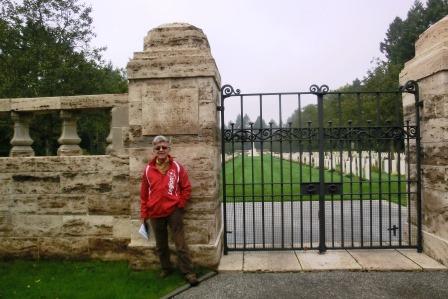
CIMG9281 Sep 24 2017 Cologne Pieter at entrance to Cologne Southern Cemetery in Sudfriedhof cemetery

Pieter at the entrance to Cologne Southern Cemetery, located in Südfriedhof Public Cemetery in Cologne. (Photo credit: Daria Valkenburg)

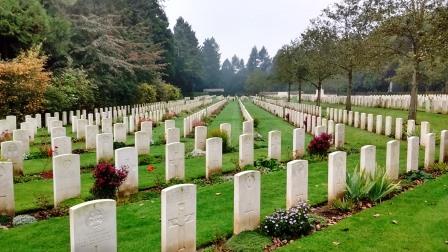
Unlike the portion of the cemetery where the German soldiers rest, Cologne Southern Cemetery is open and airy.

IMG_20170924_114611116_HDR Sep 24 2017 View of graves in Cologne Southern Cemetery

Commonwealth war graves in Cologne Southern Cemetery. (Photo credit: Pieter Valkenburg)

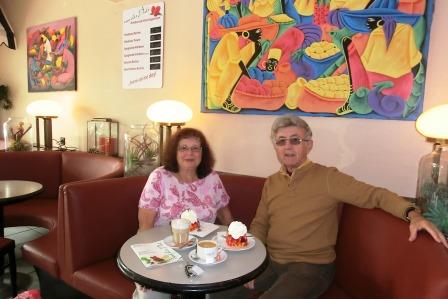
After paying our respects to Lt. Stewart, we slowly made our way back towards the car.  Pieter noticed a pastry shop across the road and suggested we mark the end of our war memorial tour with a piece of cake and a cup of coffee.

CIMG9286 Sep 24 2017 Cologne time for a fruit tart and coffee at Van der Put cafe after Sudfriedhof cemetery

Coffee break at Van der Put café in Cologne.

So, after four European countries and 7,000 km on the rental car, the research now continues on Canadian soil.  We had an amazing adventure and met many wonderful people dedicated to helping to remember the wartime sacrifices of Canadian and other Allied soldiers.  We are humbled and grateful to play a small part in this.

Unfortunately, we know little about Stewart’s service in the Imperial Army as those records are not digitized and are at The British National Archives.  If anyone has more information, please let us know.  As well, photos are still needed for many of the names on the Cenotaph outside the Borden-Carleton Legion.   Please share your photos, comments, or stories by emailing us at memorialtrail@gmail.com or by commenting on this blog.

© Daria Valkenburg

….Want to follow our research?….

If you are reading this posting, but aren’t following our research, you are welcome to do so.  Our blog address: https://onthewarmemorialtrail.com/

Front cover OnTheWarMememorialTrailinEurope4 countries, 6 weeks, 7,000 km – an unforgettable war memorial journey in Europe…. Daria’s book ‘No Soldier Buried Overseas Should Ever Be Forgotten‘ is available in print and e-book formats.  Net proceeds of book sales help support research costs and the cost of maintaining this blog. For more information see https://nosoldierforgotten.com/ 

You are also invited to subscribe to our YouTube Channel: On The War Memorial Trail With Pieter Valkenburg: https://www.youtube.com/channel/UCJ591TyjSheOR-Cb_Gs_5Kw

Never miss a posting!  Subscribe below to have each new story from the war memorial trail delivered to your inbox.

On The War Memorial Trail….Sharing Information at In Flanders Field Museum in Ypres

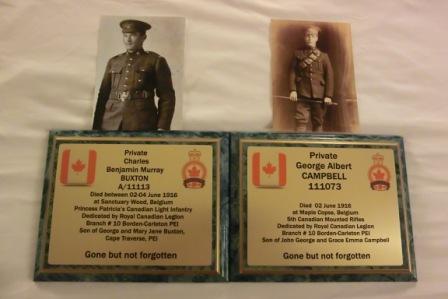
December 12, 2017.  Our last war memorial trail stop in Belgium was in Ypres, at the In Flanders Field Museum, which is dedicated to preserving the story of World War I in the West Flanders region.  Pieter had arranged to donate photos, information, and the memorial plaques about Charles ‘Charlie’ Benjamin Murray BUXTON and George ‘Albert’ CAMPBELL to their Knowledge Centre.

CIMG8886 Sep 10 2017 photos and plaques of Buxton & Campbell

Photos and plaques of WWI soldiers Buxton and Campbell. (Photo credit: Pieter Valkenburg)

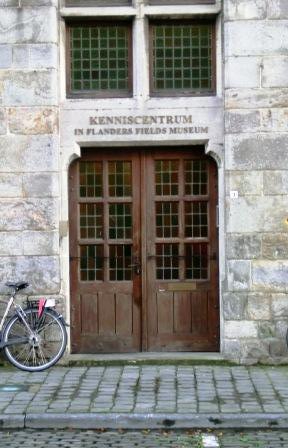
cimg8901-sep-11-2017-entrance-to-archives-of-in-flanders-field-museum-in-ypres.jpg

Entrance to the Knowledge Centre of the In Flanders Field Museum (Photo credit: Daria Valkenburg)

Pieter met with the Registrar, Frederik Vandewiere, who seemed very happy to receive information on two Canadian soldiers, and gave Pieter a book about the museum and the work it does in preserving the past.

CIMG8906 Sep 11 2017 Pieter with plaques given to Frederik Vandewiere of In Flanders Field Museum in Ypres

Pieter donates plaques and photos to Frederik Vandewiere, Registrar at the In Flanders Field Museum’s Knowledge Centre. (Photo credit: Daria Valkenburg)

Besides collecting information on soldiers and battles, photos, and other artifacts, the Museum also has a collection of WWI related art.  Considering the war memorial trail we’ve been following, one very poignant one recorded sentiments that were very telling.

CIMG8903 Sep 11 2017 Picture seen at In Flanders Field Museum in Ypres

Poignant artwork seen at the In Flanders Field Knowledge Centre. (Photo credit: Daria Valkenburg)

This ended our war memorial tour in Belgium.  We were eager to continue on to The Netherlands, where our first stop would be in Harlingen to visit the grave of WWII pilot Elmer Bagnall MUTTART, whose story has been told previously on this blog. (See The Elmer Bagnall Muttart Story).  Comments or stories?  You can share them by emailing us at  memorialtrail@gmail.com or by commenting on this blog.

© Daria Valkenburg

….Want to follow our research?….

If you are reading this posting, but aren’t following our research, you are welcome to do so.  Our blog address: https://onthewarmemorialtrail.com/

Front cover OnTheWarMememorialTrailinEurope4 countries, 6 weeks, 7,000 km – an unforgettable war memorial journey in Europe…. Daria’s book ‘No Soldier Buried Overseas Should Ever Be Forgotten‘ is available in print and e-book formats.  Net proceeds of book sales help support research costs and the cost of maintaining this blog. For more information see https://nosoldierforgotten.com/ 

You are also invited to subscribe to our YouTube Channel: On The War Memorial Trail With Pieter Valkenburg: https://www.youtube.com/channel/UCJ591TyjSheOR-Cb_Gs_5Kw

Never miss a posting!  Subscribe below to have each new story from the war memorial trail delivered to your inbox.

On The War Memorial Trail In the Passchendaele Area

December 9, 2017.  After we finished placing flags in Belgium in memory of those names on the Cenotaph outside the Borden-Carleton Legion, we decided to visit some of the memorials in the Passchendaele area.  Anyone who has been here knows that it’s impossible to see everything in such a short time, but we did our best to see as many as we could.

After we left Maple Copse Cemetery, where it’s possible the George Albert Campbell is buried, we went to the 85th Canadian Infantry Battalion – Nova Scotia Highlanders Monument in Zonnebeke.  It was a small monument, located in a farmer’s field.  It was impossible to drive right up to it, so Pieter parked the car and went there alone.

cimg8866-sep-10-2017-info-sign-about-85th-nova-scotia-highlanders-monument.jpg

Information sign about the 85th Canadian Infantry Battalion – Nova Scotia Highlanders Monument in Zonnebeke. (Photo credit: Pieter Valkenburg)

The monument is in memory of the 85th Canadian Nova Scotia Battalion, which suffered heavy losses during the battle of Passchendaele at the end of October 1917.  One side of the monument has a black bronze plaque with the inscription: “85th Canadian Infantry Battalion (Nova Scotia Highlanders) BEF. This plaque was erected by the Battalion in memory of their valiant comrades who gave their lives in action before Passchendaele at Decline Copse and Vienna Cottage on 28 to 31 October 1917.” Below the inscription are listed the names of the 12 officers and 132 other ranks who died in these actions.

CIMG8868 Sep 10 2017 85th Nova Scotia Highlanders monument

85th Canadian Infantry Battalion – Nova Scotia Highlanders Monument in Zonnebeke. (Photo credit: Pieter Valkenburg)

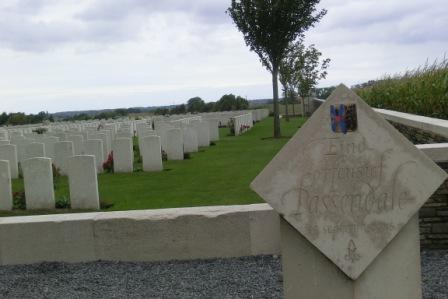
From the photo above, you can notice that the sky was dark.  After a day of sunshine, it had started to rain.  But, since we weren’t made of sugar, we kept going.  Our destination was Kitchener’s Wood in Langemark, but along the way we saw a sign marking the location of the final battle of Passchendaele, right beside the Passchendaele New British Cemetery in Zonnebeke.  Of course we stopped to visit.

CIMG8869 Sep 10 2017 Sign marking final battle of Passchendaele beside New British Cemetery in Zonnebeke

Sign on the wall of the Passchendaele New British Cemetery in Zonnebeke says “end of the Passchendaele offensive 25 September 1918. (Photo credit: Daria Valkenburg)

CIMG8872 Sep 10 2017 New British Cemetery in Zonnebeke

Entrance to Passchendaele New British Cemetery in Zonnebeke. (Photo credit: Daria Valkenburg)

650 Canadians are buried in this cemetery, including Alexander Wuttenee DECOTEAU, Canada’s first Aboriginal-Canadian police officer.  A Cree born on the Red Pheasant Reserve in Saskatchewan in 1887, he enlisted in 1916 and was killed by a sniper during the Battle of Passchendaele on October 30, 1917, the same day and battle in which Vincent CARR, who is listed on the Cenotaph outside the Borden-Carleton Legion, lost his life.  After reading about Private Decoteau, we went and put a Canadian flag by his grave.

CIMG8874 Sep 10 2017 Pieter by grave of Alexander Decoteau New British Cemetery in Zonnebeke

Pieter by the grave of Private Alexander Decoteau in Passchendaele New British Cemetery in Zonnebeke. (Photo credit: Daria Valkenburg)

Our last war memorial trail stop for the day was at Kitchener’s Wood Memorial in Langemark-Poelkapelle.  This was harder to find than we expected, as the car’s GPS directed us to an empty field! A farm with what looked to be a house was across the field and we had a discussion whether to give up or knock on the door and ask directions.

Now, if you are a long-suffering wife, you know who was ready to give up rather than ask directions.  Yep, the guy who could speak the language sat in the car, while the Canadian with poor Dutch skills went and knocked on the door.  It was clear that the door was beside the kitchen as through the window I could see a group of young men around a large table, and one young man washing dishes by the sink.  The man washing dishes opened the door, and to my great relief very quickly found out he spoke as much Dutch as me.  It turned out that he and his companions were all from Poland, near where my maternal grandmother was born!

Obviously we weren’t the first to get tricked by the GPS system as he was familiar with the Kitchener’s Wood Memorial and explained that there was an error in the navigation system.  The memorial was 500 metres down the road right beside a house, on the side of the road opposite to where the GPS directed us to.

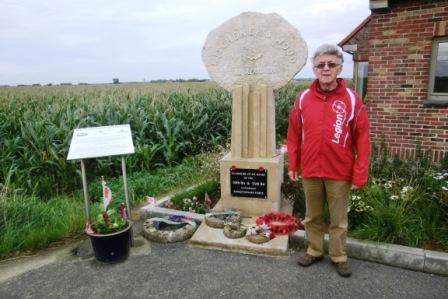
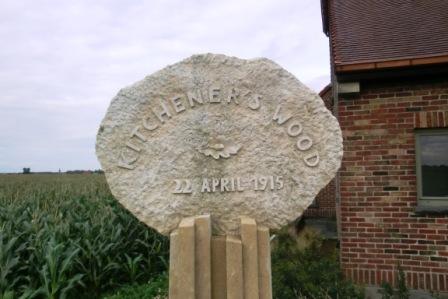
With the right directions, we found the memorial by a farmhouse.  The memorial was erected in memory of the soldiers of the 10th Canadian Battalion and the 16th Canadian Scottish Battalion, who were killed during a night attack at Kitchener’s Wood on April 22, 1915 during the first lethal chemical gas attack by the Germans.

CIMG8883 Sep 10 2017 Pieter by Kitcheners Wood Memorial

Pieter by Kitchener’s Wood Memorial. (Photo credit; Daria Valkenburg)

French troops had fallen back, leaving a 6 km gap to the left of the Canadian sector.  During the night of April 22 into 23, the 10th Canadian and the 15th Canadian Scottish Battalion counter-attacked and captured a German held position at Kitchener’s Wood.  This prevented a German breakthrough to Ypres and beyond.

CIMG8880 Sep 10 2017 Kitcheners Wood Memorial close up of acorn

On a polished stone base is a roughly worked stone representing the mutilated oaks of the forest, with the inscription: “Kitchener’s Wood, 22 April 1915″ encircling an oak leaf with an acorn. (Photo credit: Daria Valkenburg)

This ended our war memorial tour in Belgium for this trip, and we went back to the hotel to relax.  One more stop in Belgium, at the In Flanders Museum in Ypres, and then on to The Netherlands where we will be visiting the graves of WWII soldiers.

Comments or stories?  You can share them by emailing us at memorialtrail@gmail.com or by commenting on this blog.

© Daria Valkenburg

….Want to follow our research?….

If you are reading this posting, but aren’t following our research, you are welcome to do so.  Our blog address: https://onthewarmemorialtrail.com/

Front cover OnTheWarMememorialTrailinEurope4 countries, 6 weeks, 7,000 km – an unforgettable war memorial journey in Europe…. Daria’s book ‘No Soldier Buried Overseas Should Ever Be Forgotten‘ is available in print and e-book formats.  Net proceeds of book sales help support research costs and the cost of maintaining this blog. For more information see https://nosoldierforgotten.com/ 

You are also invited to subscribe to our YouTube Channel: On The War Memorial Trail With Pieter Valkenburg: https://www.youtube.com/channel/UCJ591TyjSheOR-Cb_Gs_5Kw

Never miss a posting!  Subscribe below to have each new story from the war memorial trail delivered to your inbox.

On The War Memorial Trail….Two Campbell Brothers in WWI

December 8, 2017. After visiting the Sanctuary Wood Cemetery, we stopped at the Battle of Mount Sorrel Monument, honouring the 15th Canadian Infantry at Observatory Ridge.  We had noticed this monument only because of a torn Canadian flag beside it!  We learned that the plaque was unveiled on October 22, 2011 before Canadian and Belgian dignitaries by members of the 15th Battalion Memorial Project.

IMG_20170910_133239840_HDR Sep 10 2017 Batttle of Mount Sorrel Monument

Battle of Mount Sorrel Monument, honouring the 15th Canadian Infantry at Observatory Ridge. (Photo credit: Pieter Valkenburg)

While no one on the Cenotaph outside the Borden-Carleton Legion was in the 15th Canadian Infantry, these soldiers were in the thick of things during the Battle of Mount Sorrel, in which George Albert Campbell and Charles Benjamin Murray Buxton lost their lives.

Buxton’s story was told in previous blog entries, and this blog entry is to tell what little we know about George ‘Albert’ CAMPBELL and how he lost his life.

george-albert-campbell-from-gerald-tingley.jpg

Private George Albert Campbell. (Photo courtesy of Gerald Tingley family collection)

Albert was born on July 8, 1895 in Wellington, PEI, the son of John George Campbell and Grace Emma, nee Barlow.  A fisherman and farmer before enlisting on April 6, 1915 with the 6th Canadian Mounted Rifles, he later transferred to the 5th Canadian Mounted Rifles.

During the Battle of Mount Sorrel, the 5th Canadian Mounted Rifles were in a supporting position, occupying the strongpoint, dugouts, and trenches in Maple Copse and Zillebeke area, as noted in ‘With The Patricia’s In Flanders 1914-1918 Then & Now’ by Stephen K. Newman.

Newman goes on to explain in his book that “….the 5th Canadian Mounted Rifles in Maple Copse held on despite heavy shelling that flattened the entire wood and made their old trenches untenable.  They waited for the reinforcements from 2nd Canadian Mounted Rifles and the 9th Brigade.  The two eighteen pounder sacrifice guns of the 5th Battery Canadian Field Artillery hidden in the southern part of Sanctuary Wood did their job to the last man and were overrun.  The German success depended on their bulling through the Patricia line and moving the 5th Canadian Mounted Rifles out of Maple Copse….

Albert was in the midst of this battle, as a member of the 5th Canadian Mounted Rifles.  According to the Canadian War Graves Register Circumstances of Death, he was killed in action in the vicinity of Maple Copse.

The War Diary of the unit for June 2, 1916 notes: “A red letter day in the history of the battalion ever to be remembered by those who lived through it. The battalion went into the line in the night of the 31st of May /1st of June occupying a position in Brigade support at Maple Copse.

 ‘A’ company and two platoons of ‘B’ company at Maple Copse. Nothing of importance occurred until the morning of the 2nd of June when at about at 8.30 a.m., the enemy began a very heavy bombardment of the frontline and all the ground at Maple Copse and vicinity. Heavy bombardments continued till noon on the 3rd and continued again after 6 p.m

Unfortunately, Albert has no known grave, and his name is therefore listed on the Menin Gate Memorial.  It’s quite likely, however, that he might be buried in Maple Copse Cemetery in an unknown grave.

CIMG8858 Sep 10 2017 Maple Copse Cemetery

Entrance to Maple Copse Cemetery. (Photo credit: Pieter Valkenburg)

Maple Copse was the name used by the British Army for a small plantation east of Zillebeke and just west of Sanctuary Wood.  It was used by medical staff as a dressing station, and burials took place here both before and after the Battle of Mount Sorrel.

The cemetery was destroyed by shellfire during the Battle of Mount Sorrel and when fighting resumed afterwards, with the gravestones destroyed and ending up in the rubble.  Of 256 named graves that were known to exist, only 26 could be definitely located.  Perhaps Albert is in one of these.  Of the 256 graves, 114 had soldiers from the United Kingdom and 142 from Canada.

Like he did with Buxton at the Sanctuary Wood Cemetery, Pieter put Canadian flags on 4 unknown graves from a Canadian Regiment, and then placed a PEI flag on one of these in memory of George ‘Albert’ Campbell.

CIMG8864 Sep 10 2017 Pieter by grave of unknown soldier at Maple Copse Cemetery

Pieter by the grave of an unknown soldier from a Canadian regiment at Maple Copse Cemetery. (Photo credit: Daria Valkenburg)

With the advances in DNA research, perhaps one day there will be the possibility to find out who the unknown soldiers are in Maple Copse and Sanctuary Wood cemeteries.  Wouldn’t that be a genealogical project to get involved with?

Unfortunately, we have very little information about his life prior to enlistment, but are grateful for the photo of Albert sent by a distant relative, Gerald Tingley.  If anyone has more information or photos, please help us honour Albert’s memory by sharing them.  (For previous blog entries that have mentioned Albert, see A Daytime Visit To Menin Gate Memorial in Ypres and A Visit To Sanctuary Wood.)

There are two Campbells on the Cenotaph outside the Borden-Carleton Legion, one who died and one who survived, but with injuries.  George ‘Albert’ Campbell had a younger brother, William Galen CAMPBELL, born June 16, 1897 in Wellington, who enlisted on April 22, 1916 with the 5th Siege Battery as a gunner, shortly before his older brother died.  He later transferred to the 8th Siege Battery of the 3rd Brigade Canadian Garrison Artillery, and was poisoned by a mustard gas shell, during action near Lievin (Pas de Calais) in France on May 28, 1918.

The war diary of the 8th Siege Battery tersely noted what happened to the unit:

27 May 1918: Intense gas bombardment on Lievin and many gas shells fell around Thelus and vicinity.

28 May 1918: Twenty nine other ranks of Lievin section admitted to hospital, gassed.

29 May 1918: Capt. Cunningham, Lt Messeray and 39 other ranks of Lievin section to hospital, gassed.

Unlike his brother Albert, William Galen survived and married Ida May McNally on January 5, 1919.  On April 14, 1919 he was discharged from military service.  He passed away on April 24, 1954 in Charlottetown and is buried in the cemetery at the Free Church of Scotland in Cape Traverse.  We have no photo or further information on William Galen Campbell.

william-g-campbell-gravestone-free-church-of-scotland-cape-traverse.jpg

Grave of William Galen Campbell in the cemetery of the Free Church of Scotland in Cape Traverse. (Photo credit: Pieter Valkenburg)

While our visit to Maple Copse Cemetery ended our Belgian visit to graves and memorials for the names on the Cenotaph outside the Borden-Carleton Legion, we were interested in visiting some of the other memorials in the area.  So, in the next blog entry, we will continue on the war memorial trail in Belgium.

Comments or stories?  You can share them by emailing us at memorialtrail@gmail.com or by commenting on this blog.

© Daria Valkenburg

….Want to follow our research?….

If you are reading this posting, but aren’t following our research, you are welcome to do so.  Our blog address: https://onthewarmemorialtrail.com/
Front cover OnTheWarMememorialTrailinEurope4 countries, 6 weeks, 7,000 km – an unforgettable war memorial journey in Europe…. Daria’s book ‘No Soldier Buried Overseas Should Ever Be Forgotten‘ is available in print and e-book formats.  Net proceeds of book sales help support research costs and the cost of maintaining this blog. For more information see https://nosoldierforgotten.com/ 

You are also invited to subscribe to our YouTube Channel: On The War Memorial Trail With Pieter Valkenburg: https://www.youtube.com/channel/UCJ591TyjSheOR-Cb_Gs_5Kw

Never miss a posting!  Subscribe below to have each new story from the war memorial trail delivered to your inbox.

On The War Memorial Trail….A Visit To Sanctuary Wood Cemetery

November 24, 2017. After the stirring Last Post Ceremony at the Menin Gate Memorial the evening before, we continued our war memorial tour of the Flanders area.  Our first stop was Sanctuary Wood Cemetery in Zillebeke, near the Sanctuary Wood Memorial we had previously visited.  This is where Charles ‘Charlie’ Benjamin Murray BUXTON died and is likely buried in this cemetery in an unknown grave.

CIMG8837 Sep 10 2017 Sanctuary Wood Cemetery

Maple trees line the road to Sanctuary Wood Cemetery in Zillebeke. (Photo credit: Daria Valkenburg)

Previous blog entries gave details about Buxton’s life and career. (See Who Can Put A Face To Charles Benjamin Murray Buxton? and  A Daytime Visit To Menin Gate Memorial in Ypres and The Princess Patricia’s Light Infantry Memorial and A Visit To Sanctuary Wood)

cropped picture of Charles Buxton

Charles Benjamin Murray Buxton. (Photo courtesy of John Marchbank family collection)

While serving in the No. 2 company of the Princess Patricia Canadian Light Infantry (PPCLI) during the Battle of Mount Sorrel on June 2, 1916, he was wounded and reported missing.  When no sign of him was found by June 4, 1916, he was declared as being killed in action.

The war diary of the unit for June 2, 1916 explains what happened on that day:

General Action: Mount Sorrel.  Enemy attacked soon after 1 pm after four hours of intensive bombardment on PPCLI and 8th Brigade front.  On the Regiment’s right the garrison (No. 1) was annihilated and ‘the Loop’ overrun, but the support line held in Warrington Avenue and Gourock Road (No. 3), Lovers Walk and Maple Copse (No. 4).    On the left No. 2 held the Appendix and beat off a bombing attack, ultimately withdrawing at night.  The crisis had passed by 5 pm, but the bombardment continued through the night.

In the book ‘With The Patricia’s In Flanders 1914-1918 Then & Now’ by Stephen K. Newman, it was noted that Initially No. 2 Company in the left front position was on the periphery of the destruction.  Much of this was due to the closeness of the trenches in the Appendix and the German shells over ranging by twenty yards.  Only the right hand platoon bore the brunt of the fire.

A personal account quoted in the book goes on to say that as of 2:30 am on June 3, No. 2 Company withdrew from their front line trench…. We could get no word from Headquarters and with no sign of reinforcements, the young Lieutenant who had crawled all the way on his hands and knees to relieve our wounded Captain decided we better retire.  By this time we had piled up about 20 more casualties, some severely wounded and these had to be carried out if they were to have a chance to live.  There were about 45 of us left untouched in the company and as almost all the wounded had at least to be supported, if we took them out, there would not be enough left to hold the trench, so it was decided to leave.”

map around Ypres area

Map of area, showing where Buxton and Campbell lost their lives. (Map courtesy of John Stephens, author of ‘Travel Tips for Canadians: Visiting The Great War Sites of Flanders and Vimy Ridge’)

It’s not known at what point during that terrible day that Buxton was hit, but from the accounts it seems clear that in the chaos his body was never initially recovered, and anything that might have identified went missing.   With no known grave to pay tribute to, we found four unknown graves from the Canadian Regiment to put Canadian flags on, and on one we also placed a Prince Edward Island flag in memory of Charles Buxton.

cimg8842-sep-10-2017-sanctuary-wood-cemetery.jpg

Pieter placed flags by an unknown grave of the Canadian Regiment in Sanctuary Wood Cemetery. (Photo credit: Daria Valkenburg)

After fortifying ourselves with a warm drink at the Hill 62 Sanctuary Wood Restaurant, where Pieter inspected a British cannon, we decided to continue on to Maple Copse Cemetery, where George ‘Albert’ CAMPBELL lost his life.

CIMG8847 Sep 10 2017 Pieter at Hill 62 Sanctuary Wood Restaurant by British cannon

Pieter by a WWI era British cannon outside the Hill 62 Sanctuary Wood restaurant and museum. (Photo credit: Daria Valkenburg)

Comments or stories?  You can share them by emailing us at memorialtrail@gmail.com or by commenting on this blog.

© Daria Valkenburg

….Want to follow our research?….

If you are reading this posting, but aren’t following our research, you are welcome to do so.  Our blog address: https://onthewarmemorialtrail.com/

Front cover OnTheWarMememorialTrailinEurope4 countries, 6 weeks, 7,000 km – an unforgettable war memorial journey in Europe…. Daria’s book ‘No Soldier Buried Overseas Should Ever Be Forgotten‘ is available in print and e-book formats.  Net proceeds of book sales help support research costs and the cost of maintaining this blog. For more information see https://nosoldierforgotten.com/ 

You are also invited to subscribe to our YouTube Channel: On The War Memorial Trail With Pieter Valkenburg: https://www.youtube.com/channel/UCJ591TyjSheOR-Cb_Gs_5Kw

Never miss a posting!  Subscribe below to have each new story from the war memorial trail delivered to your inbox.