On The War Memorial Trail….The Last Post Ceremony At The Menin Gate Memorial In Ypres

November 23, 2017.  In the morning we’d visited the Menin Gate Memorial in Ypres and found the listings for two men whose names are on the Cenotaph outside the Borden-Carleton Legion: Charles Benjamin BUXTON and George ‘Albert’ CAMPBELL (See A Daytime Visit To Menin Gate Memorial in Ypres).

We returned in the evening for The Last Post Ceremony, which occurs at 8 pm every day at Menin Gate Memorial, rain or shine.  It began on July 2, 1928, after the Memorial opened in 1927, as a way for the citizens of Ypres to express their gratitude towards those who had died in defence of Belgium’s freedom.

The only time the ceremony was not held in Ypres was during the German occupation during World War II.  Instead, a daily ceremony was held at Brookwood Military Cemetery, in Surrey, England.  On September 6, 1944, the evening that Polish forces liberated Ypres in the Second World War, the ceremony at Menin Gate resumed, even though heavy fighting was still taking place in other parts of Ypres.

Bands and choirs from around the world apply to participate in the ceremonies. On the evening we attended the ceremony, the St. Cecilia Helden band from The Netherlands was there.  It was very apt since Pieter is from The Netherlands, and that was going to be the next country on our war memorial trail.

CIMG8802 Sep 9 2017 Daria with two members of St Cecilia Helden band before Last Post Ceremony at Menin Gate

Daria with two members of the St. Cecilia Helden band from The Netherlands. (Photo credit: Mieke de Bie)

We quickly saw that if we wanted to get a spot with easy visibility of the ceremony that we would have to line up at least 1 ½ hours early!  We did and so were lucky to have a front line view, and watched the band march through Menin Gate Memorial to stand on the outside of the Memorial.

CIMG8804 Sep 9 2017 Last Post Ceremony Menin Gate st Ceclia Helden Band

St. Cecilia Helden band marched through Menin Gate before the ceremony began. (Photo credit: Daria Valkenburg)

Police cars soon barricaded the road on either side of the Menin Gate Memorial so no traffic could get by.

Just before 8 pm three buglers from the local fire brigade arrived and played ‘The Last Post’. 

CIMG8815 Sep 9 2017 Last Post Ceremony Menin Gate buglers from local fire brigade play The Last Post

Buglers from the local fire brigade in Ypres play ‘The Last Post’ at 8 pm. (Photo credit: Daria Valkenburg)

‘The Last Post’ was followed by the Exhortation, where a dignitary said the words we are all familiar with from Remembrance Day ceremonies in Canada.  Taken from the 4th verse of Laurence Binyon’s poem ‘For The Fallen’, first published on September 21, 1914, he recited, in English:

“They shall grow not old, as we that are left grow old:
Age shall not weary them, nor the years condemn.
At the going down of the sun and in the morning,
We will remember them.”

This was followed by a minute of silence, and then wreaths were laid by various groups while the St. Cecelia Helden band played.  We were sorry we hadn’t thought of asking to lay a wreath as a way to further commemorate Campbell and Buxton.  Following the wreath laying the final bugle call, ‘Réveille’, was played and the ceremony was over.

We were lucky to be right at the spot where the fire brigade walked past, and they graciously posed for a photo.  Of course, we gave them Canadian flag pins, and to our surprise we received a Menin Gate Memorial pin in exchange.

CIMG8833 Sep 9 2017 Last Post Ceremony Menin Gate

Buglers from the local Fire Brigade in Ypres. (Photo credit: Daria Valkenburg)

This was a beautiful ceremony, with respectful visitors from many countries.  Behind us was a family from Poland, a poignant reminder of the Polish allies who liberated Ypres during WWII.

We returned to our hotel in a thoughtful mood, after the day of visiting memorials and cemeteries.  We still had a few places in Flanders to visit before going on to The Netherlands, but that would have to wait for another day.

Comments or stories?  You can share them by emailing us at memorialtrail@gmail.com or by commenting on this blog.

© Daria Valkenburg

….Want to follow our research?….

If you are reading this posting, but aren’t following our research, you are welcome to do so.  Our blog address: https://onthewarmemorialtrail.com/
Front cover OnTheWarMememorialTrailinEurope4 countries, 6 weeks, 7,000 km – an unforgettable war memorial journey in Europe…. Daria’s book ‘No Soldier Buried Overseas Should Ever Be Forgotten‘ is available in print and e-book formats.  Net proceeds of book sales help support research costs and the cost of maintaining this blog. For more information see https://nosoldierforgotten.com/ 

You are also invited to subscribe to our YouTube Channel: On The War Memorial Trail With Pieter Valkenburg: https://www.youtube.com/channel/UCJ591TyjSheOR-Cb_Gs_5Kw

Never miss a posting!  Subscribe below to have each new story from the war memorial trail delivered to your inbox.

On The War Memorial Trail….A Visit To Sanctuary Wood

November 19, 2017.  After visiting the Princess Patricia’s Light Infantry Memorial in Zonnebeke, Belgium, we went to Sanctuary Wood in Zillebeke to the Hill 62 Monument overlooking Mount Sorrel.  This memorial commemorates Canadian forces who served in Ypres Salient, especially during the Battle of Mount Sorrel in June 1916.

CIMG8771 Sep 9 2017 Sign to Sanctuary Wood

Sign at the entrance to Hill 62 (Sanctuary Wood) Memorial. (Photo credit: Daria Valkenburg)

The road leading to the memorial, Canadalaan (literally Canada Avenue, but also known colloquially as Maple Avenue), once formed part of the Canadian front line.  After the war, the avenue was planted with maple trees as a mark of respect for the Canadian sacrifice.

Two of the men listed on the Cenotaph outside the Borden-Carleton Legion lost their lives here, during the Battle of Mount Sorrel: Charles ‘Charlie’ Benjamin BUXTON of the Princess Patricia’s Light Infantry, and George ‘Albert’ CAMPBELL of the 5th Canadian Mounted Rifles.  Both men have no known grave and are listed on the Menin Gate Memorial in Ypres. (See A Daytime Visit To Menin Gate Memorial in Ypres )

Before going to Sanctuary Wood Cemetery and Maple Copse Cemetery, places where perhaps our two soldiers are lying in an unmarked grave, we wanted to know more about what exactly happened here during the defence of Ypres in 1916.  The first thing that struck is was how close Ypres was.  We could see it clearly from the memorial!

CIMG8775 Sep 9 2017 Sanctuary Wood Ypres can be seen from Hill 62

The spires of buildings in Ypres can be clearly seen from Sanctuary Wood. (Photo credit: Daria Valkenburg)

Sanctuary Wood, also known as Hill 62, was the place where Canadian troops fought as a national unit for the first time.  During the battle, which was fought between June 2 and June 4, 1916, 8,430 soldiers were killed, wounded, or missing.

We were curious why it was called Hill 62, and a bit bemused to realize it was called that because the hill was 62 metres above sea level!

Hill 62 and nearby Mount Sorrel were the only places of a higher elevation that were not controlled by the Germans….and they wanted it.  Canadian troops were almost alone in defending this territory, having only the support of British artillery.  The rest of the British troops were preparing for the Battle on the Somme in July 1916.

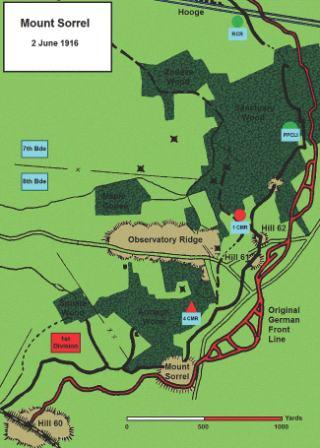
So what happened?  On June 2, 1916, the Germans attacked the Canadian positions with artillery and the detonation of 4 large mines under Mount Sorrel.  You can imagine the deadly effect this had in the trenches.

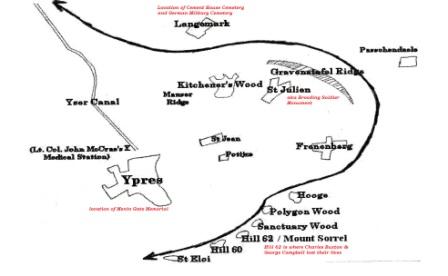
As per the map of the battle, Buxton’s unit (PPCLI) was at Sanctuary Wood, and suffered 400 losses.  Campbell’s unit was a support brigade at Maple Copse, and by the end of the day 59 were killed, 272 wounded, and 50 missing. Buxton and Campbell were among the casualties.

battle of mount sorrel map

Map of Battle of Mount Sorrel on June 2, 1916. (Credit: http://www.canadiansoldiers.com)

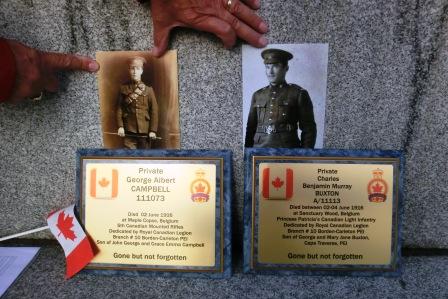
It only seemed right to place the photos and plaques we had of these men, which we’d taken to Menin Gate earlier in the day, here at Sanctuary Wood Memorial.

CIMG8897 Sep 11 2017 Photos & Plaques of Buxton & Campbell at Sanctuary Wood

Plaques and photos for George Albert Campbell and Charles Benjamin Buxton. (Photo credit: Daria Valkenburg)

CIMG8894 Sep 11 2017 Pieter at Sanctuary Wood with photos and plaques of Buxton & Campbell

Pieter holds the photos and plaques of Buxton and Campbell at the Sanctuary Wood Memorial. (Photo credit: Daria Valkenburg)

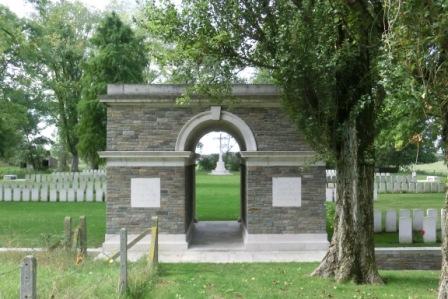
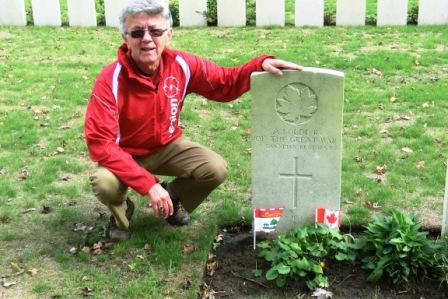
We decided we had to visit both Sanctuary Wood Cemetery and Maple Copse Cemetery and learn exactly what happened to each man, but that would have to wait for another day.  It was getting late, and we wanted to get to Ypres for the Last Post ceremony at Menin Gate.

Comments or stories?  You can share them by emailing us at memorialtrail@gmail.com or by commenting on this blog.

© Daria Valkenburg

….Want to follow our research?….

If you are reading this posting, but aren’t following our research, you are welcome to do so.  Our blog address: https://onthewarmemorialtrail.com/

Front cover OnTheWarMememorialTrailinEurope4 countries, 6 weeks, 7,000 km – an unforgettable war memorial journey in Europe…. Daria’s book ‘No Soldier Buried Overseas Should Ever Be Forgotten‘ is available in print and e-book formats.  Net proceeds of book sales help support research costs and the cost of maintaining this blog. For more information see https://nosoldierforgotten.com/ 

You are also invited to subscribe to our YouTube Channel: On The War Memorial Trail With Pieter Valkenburg: https://www.youtube.com/channel/UCJ591TyjSheOR-Cb_Gs_5Kw

Never miss a posting!  Subscribe below to have each new story from the war memorial trail delivered to your inbox.

On The War Memorial Trail….The Princess Patricia’s Light Infantry Memorial

November 18, 2017.  On July 30 of this year we posted a blog entry on WWI soldier Charles Benjamin Murray BUXTON, known as Charlie, and asked for a photo and information on him. (See Who Can Put A Face To Charles Benjamin Murray Buxton?)  As well, the request was included in an article in the County Line Courier that was published on August 9.  (See CLC p30 Aug 9 2017 Face for Arsenault)

We included an excerpt from an August 13, 1915 letter written to Charlie Buxton’s aunt, Minnie Marchbank of Alma, letting her know that her son George was all right.  It was through the Marchbank connection that we were able to find a photo, actually two!

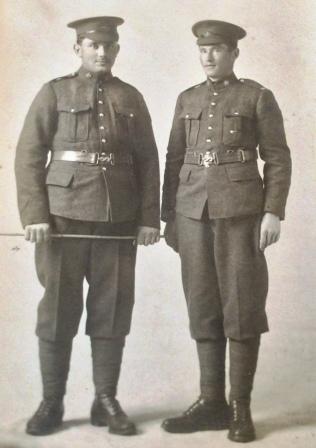
George Marchbank survived the war, and his son John of Nanton, Alberta, a veteran of the Korean War, had a photo of his father and Buxton, which he shared.

IMG_0185 photo of george marchbank and charles buxton

George Marchbank on the left, and Charles Buxton on the right. (Photo courtesy of John Marchbank family collection)

John Marchbank

Royal Canadian Legion member John Marchbank, son of George Marchbank, the cousin of Charles Buxton. (Photo courtesy of John Marchbank family collection)

The second photo of Charlie came from a period just before the war interrupted his career as a school inspector in West Prince.  Through the newspaper archives, Pieter found a 1954 reference to a display of hockey photos found at Myricks store in Alberton.  One of the photos was of the 1915 Alberton Regal Hockey Team… and one of the players in the photo was C. B. Buxton!

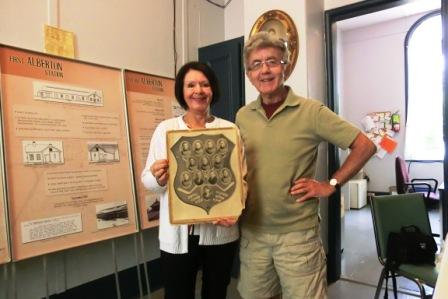
It appeared that while inspecting schools, Charlie stayed with his aunt Minnie, and found time to play on the Alberton Regal Hockey Team.  A call to the Alberton Museum verified that they had the team photo.  We immediately made a trip to Alberton and met with Arlene Morrison, Museum Manager, who explained that the 1915 photo was donated by Eileen Oulton.

CIMG7941 Aug 11 2017 Arlene Morrison and Pieter with 1915 hockey photo

Arlene Morrison and Pieter Valkenburg at Alberton Museum with the 1915 Alberton Regal Hockey Team Photo. (Photo courtesy of Eileen Oulton Collection)

OLYMPUS DIGITAL CAMERA

Inset from the team photo of Charles Benjamin Buxton, who played centre for the 1915 Alberton Regal Hockey Team. (Photo courtesy of Eileen Oulton Collection)

As Charlie was with the Princess Patricia’s Light Infantry, our next stop on the war memorial trail in Belgium was the Princess Patricia’s Light Infantry Memorial in Zonnebeke. The Princess Pats were the first Canadian troops to arrive in Belgium, and fought in most of the battles in Belgium between 1915 and 1918.

The memorial is right beside a corn field, on land donated by Jules van Ackere in 1958, right at the edge of the road.

CIMG8789 Sep 9 2017 Pieter at PPLI memorial in Zonnebeke

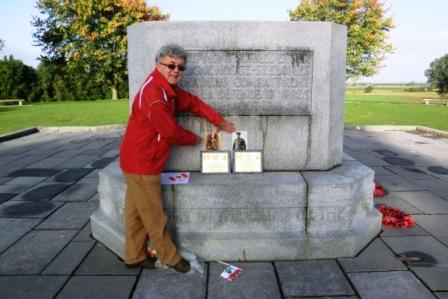
Pieter at the Princess Patricia’s Light Infantry Memorial in Zonnebeke. You can see the maple tree behind the memorial. (Photo credit: Daria Valkenburg)

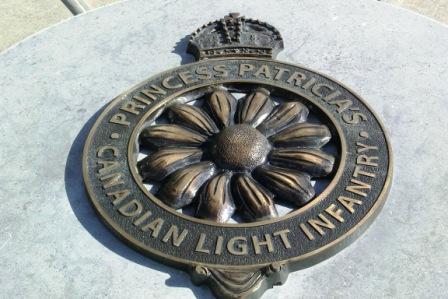
The memorial was redone in 2015 and has a centennial plaque plus a bronze Marguerite daisy insignia, indicative of the cap badge worn by the troop during 1915.  As well, a Canadian Sugar maple tree was planted.

CIMG8784 Sep 9 2017 insignia of PPLI with bronze marguerite flower

Bronze Marguerite daisy insignia on the memorial. (Photo credit: Daria Valkenburg)

The memorial, which is much smaller than Pieter expected, commemorates the Battle of Frezenberg on May 8, 1915, marking the area they successfully defended, the Bellewaarde Ridge.  By the end of the battle, out of a complement of 546, only 4 officers and 150 men had survived.

Charlie Buxton was not in this battle. He enlisted on April 10, 1915 in the 1st University Company, which was formed to reinforce the Patricia Patricia’s Light Infantry, and sailed to England, then travelled on to France.  On July 17, 1915 he was taken on strength by the Patricia Patricia’s Light Infantry in France.

Charlie died in June 1916 in Sanctuary Wood, during the Battle of Mount Sorrel, our next stop on the war memorial trail.

Comments or stories?  You can share them by emailing us at memorialtrail@gmail.com or by commenting on this blog.

© Daria Valkenburg

….Want to follow our research?….

If you are reading this posting, but aren’t following our research, you are welcome to do so.  Our blog address: https://onthewarmemorialtrail.com/

Front cover OnTheWarMememorialTrailinEurope4 countries, 6 weeks, 7,000 km – an unforgettable war memorial journey in Europe…. Daria’s book ‘No Soldier Buried Overseas Should Ever Be Forgotten‘ is available in print and e-book formats.  Net proceeds of book sales help support research costs and the cost of maintaining this blog. For more information see https://nosoldierforgotten.com/ 

You are also invited to subscribe to our YouTube Channel: On The War Memorial Trail With Pieter Valkenburg: https://www.youtube.com/channel/UCJ591TyjSheOR-Cb_Gs_5Kw

Never miss a posting!  Subscribe below to have each new story from the war memorial trail delivered to your inbox.
On The War Memorial Trail….A Visit To Tyne Cot Cemetery

November 10, 2017.  While we were in Zonnebeke, we made a stop on the war memorial trail at Tyne Cot Cemetery.  In France, unless it was a big cemetery or memorial, like Vimy Ridge or Beau Hamel, there were few visitors.  In Belgium, to our surprise, members of car and motorcycle clubs visited the various cemeteries and memorials as part of their touring schedules.  During our visit to Tyne Cot Cemetery, a club for a car named Burton stopped on their own war memorial rally tour.

The Burton is a Dutch sports car based on French 2CV technology. The Burton is an open, nostalgic-looking sports car built on the chassis of the 2CV with a modern fibreglass body and built from a kit. Of course, car-mad Pieter couldn’t resist taking a few photos as he made his way from the parking lot to the cemetery.

IMG_20170909_151921275 Sep 9 2017 Burton car in Tyne Cot cemetery parking lot

Burton sports car in the parking lot of Tyne Cot Cemetery in Zonnebeke. (Photo credit: Pieter Valkenburg)

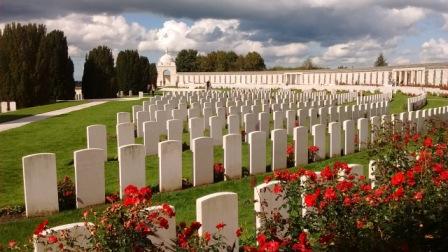
Tyne Cot Cemetery is the largest Commonwealth War Cemetery in the world, with 11,956 graves, of which 1,011 are Canadian.  Most were killed during the Battle of Passchendaele.  In addition, 34,957 soldiers with no known grave, who died after August 15, 1917, have their names engraved on the cemetery walls.  Those soldiers with no known grave who died before August 15, 1917 are listed on the Menin Gate Memorial (See A Daytime Visit To Menin Gate Memorial in Ypres).

IMG_20170909_153120338 Sep 9 2017 Tyne Cot Cemetery graves with wall of those with no known grave

Names of soldiers with no known grave, who died after August 15, 1917 are engraved on the walls of Tyne Cot Cemetery. (Photo credit: Pieter Valkenburg)

Surprisingly, with the large number of war dead in Tyne Cot, no one from the Cenotaph outside the Borden-Carleton Legion is buried or commemorated there.  But if you are on a war memorial trail, it would be a shame to miss seeing the largest cemetery.

IMG_20170909_153208728 Sep 9 2017 Tyne Cot Cemetery graves

Tyne Cot Cemetery in Zonnebeke. (Photo credit: Pieter Valkenburg)

As we made our way to the cemetery and the visitors centre, we passed by a grassy area of plastic poppies with messages from the public in Britain. This was an initiative of the Royal British Legion’s Passchendaele 100 Memorial, who collected the poppies and brought them to the cemetery.  Some of the messages commemorated a loved one, others were very general in nature.  It certainly made for a colourful display!

IMG_20170909_152308460 Sep 9 2017 plastic poppies in field in Tyne Cot cemetery in Zonnebeke

Plastic poppies with messages from the British public on display at Tyne Cot Cemetery. (Photo credit: Pieter Valkenburg)

We learned that a Victoria Cross recipient from the 27th (City of Winnipeg) Battalion is buried here, James Peter ROBERTSON, a private who was killed on November 6, 1917 during the final phase of the Battle of Passchendaele.  When his platoon was blocked by barbed wire and a German machine gun, he dashed to an opening in the enemy position, and rushed the gun, killing four German soldiers and turning the machine gun on the rest of the Germans.  This allowed the platoon to continue towards its objective.  Afterwards, when two Canadian snipers were wounded in front of their trench, he went out and carried one in, while under fire.  Unfortunately, he was killed as he returned with the second man.  With Daria being from Winnipeg, Pieter of course visited the grave of this soldier and placed flags.

IMG_20170909_152917733 Sep 9 2017 grave opf JP Robertson in Tyne Cot cemetery

Grave of Victoria Cross recipient James Peter Robertson, buried at Tyne Cot Cemetery in Zonnebeke. (Photo credit: Pieter Valkenburg)

 We are continually humbled by the depth of sacrifice from the soldiers.  Like in northern France, you can’t go very far before you encounter another cemetery or memorial.  As we continued on the War Memorial Trail, we thought of the two other soldiers from the Cenotaph project who died in this area, George Campbell and Charles Buxton, and whose names are on the Menin Gate Memorial.

As Buxton was with the Princess Patricia’s Light Infantry, our next stop was the Princess Patricia’s Light Infantry Memorial in Zonnebeke.  Comments or stories?  You can share them by emailing us at memorialtrail@gmail.com or by commenting on this blog.

© Daria Valkenburg

….Want to follow our research?….

If you are reading this posting, but aren’t following our research, you are welcome to do so.  Our blog address: https://onthewarmemorialtrail.com/

Front cover OnTheWarMememorialTrailinEurope4 countries, 6 weeks, 7,000 km – an unforgettable war memorial journey in Europe…. Daria’s book ‘No Soldier Buried Overseas Should Ever Be Forgotten‘ is available in print and e-book formats.  Net proceeds of book sales help support research costs and the cost of maintaining this blog. For more information see https://nosoldierforgotten.com/ 

You are also invited to subscribe to our YouTube Channel: On The War Memorial Trail With Pieter Valkenburg: https://www.youtube.com/channel/UCJ591TyjSheOR-Cb_Gs_5Kw

Never miss a posting!  Subscribe below to have each new story from the war memorial trail delivered to your inbox.
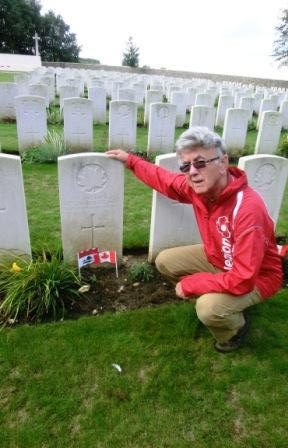
On The War Memorial Trail….Visiting More Memorials In The Passchendaele Area

November 7, 2017.  After visiting Cement House Cemetery and the grave of Vincent Carr, and the St. Julien Monument to commemorate the position where Canadians were during the first poison gas attack, we stopped at the German Military Cemetery in Langemark.  Its official name is “Deutscher Studentenfriedhof”, one of four German cemeteries in the Flanders region of Belgium.   ‘Studentenfriedhof’ means ‘the students’ cemetery’ and is called that due to the large number of young volunteer soldiers who are buried here.

This is the only German cemetery that seems to get visitors at all, especially non-Germans.  It’s an impressive but depressing cemetery.

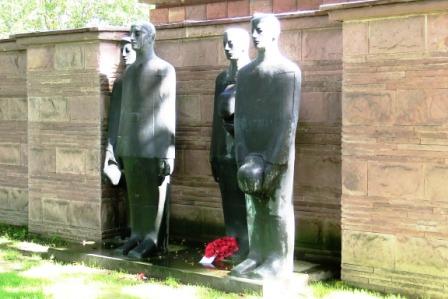
CIMG8740 Sep 9 2017 Statue at German War Cemetery in Langemark

Bronze sculpture by Emil Krieger of four soldiers in mourning. (Photo credit: Daria Valkenburg)

The cemetery has 44,061 burials.  25,000 of these were unknown and buried in a large communal grave.

CIMG8742 Sep 9 2017 German War Cemetery in Langemark

Memorial says “In this cemetery rest 44,061 German soldiers from the war of 1914-1918”. (Photo credit: Daria Valkenburg)

Over the decades, researchers have identified 17,000, whose names are now on bronze plaques positioned around three sides of the cemetery.

CIMG8745 Sep 9 2017 German War Cemetery in Langemark

Bronze plaques with the names of identified German soldiers. (Photo credit: Daria Valkenburg)

After this rather chilling stop, we continued on to the Passchendaele Canadian Memorial, located on Canadalaan (Canada Lane) in Zonnebeke.

CIMG8746 Sep 9 2017 Canadalaan location of Passchendaele Memorial in Zonnebeke

Canadalaan was named in honour of Canada’s role in the Battle of Passchendaele. (Photo credit: Pieter Valkenburg)

It was here that we were reminded of the madness of the Battle of Passchendaele. British and Australian soldiers had tried, from July until early October 1917, rather unsuccessfully, to capture the German-occupied Belgian coast.  They made only minimal advances and the commander of the British forces, Sir Douglas Haig, ordered the Canadian Corps to take their place and capture Passchendaele.

20,000 Canadian soldiers arrived in the midst of heavy rainfall and waist-deep mud, and no one seemed to have enough sense or authority to force a rethink to the plan to begin an assault at that time of year.  The only voice of sanity was Canadian-born Lt. Gen. Sir Arthur Currie, who took the time to inspect the battlefield and, after doing so, protested that the planned attack would cost 16,000 Canadian casualties.  No one listened to him.

So, on October 26, 1917, Canadian troops began a series of attacks in the area.  On October 30, 1917, with the help of two British divisions, they began the assault on the village of Passchendaele, inching their way from shell-crater to shell-crater, under heavy fire.  The landscape was already destroyed by shelling and heavy rain.  Roads, trees, and most buildings were gone.  It was in the midst of this that Vincent Carr from North Tryon died, instantly killed by a high explosive shell.

Troops reached the outskirts of Passchendaele during a terrible rainstorm, and held on for five days, waist-deep in mud and exposed to German shelling. Reinforcements arrived on November 6, and by November 10 Canadian troops occupied the village, thus ending the battle.  Almost 12,000 Canadians were wounded, and over 4,000 died.

CIMG8750 Sep 9 2017 Pieter at Passchendaele Memorial in Zonnebeke

Pieter at the Passchendaele Canadian Memorial in Zonnebeke. (Photo credit: Daria Valkenburg)

The Passchendaele Canadian Memorial has the following inscription on one side, on a granite block, saying:

“The Canadian Corps in Oct-Nov 1917 advanced across this valley – then a treacherous morass – captured and held the Passchendaele ridge.”

IMG_20170909_141204168_HDR Sep 9 2017 Passchendaele Memorial in Zonnebeke

The Passchendaele Canadian Memorial has maple leaves carved in the form of a wreath on the front and back. (Photo credit: Pieter Valkenburg)

The Battle of Passchendaele, which lasted 100 days, had more than Canadian casualties.  275,000 British and Commonwealth soldiers were killed and wounded, among them the Canadian casualties already mentioned.  220,000 German soldiers were also killed and wounded.

Beside the Passchendaele Canadian Memorial is the Memorial Museum Passchendaele 1917 in Zonnebeke, which concentrates on the Battle of Passchendaele itself.  They have begun a Passchendaele Archives Project of trying to put faces and stories to those who died between July 12 and November 15, 1917 during the battle.  If you have a relative, and a photo, please consider supporting this project. You can email them at archives@passchendaele.be or visit their website at www.passchendaele.be for more information.  They will send you a form to fill out: Passchendaele Archives Questionnaire.

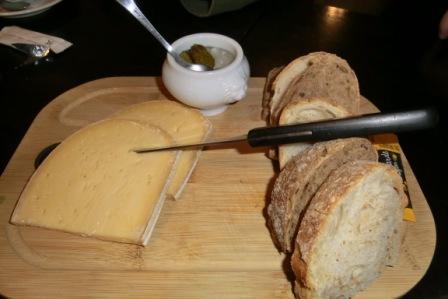
After these two visits, Pieter was finally persuaded to go for a snack before continuing on with the war memorial tour.  Across from the Memorial Museum Passchendaele 1917 was a lovely restaurant, Brasserie De Volksbond, where Pieter and I shared Belgian bread and Passendale cheese.

CIMG8762 Sep 9 2017 Passendale cheese at Brasserie de Volksbund in Zonnebeke

How could we resist having Passendale cheese for lunch? (Photo credit: Daria Valkenburg)

Yes, while we Canadians know Passchendaele for the battle, it’s better known for its Passchendaele beer and Passendale cheese.

CIMG8753 Sep 9 2017 Passchendaele beer sign at Brasserie de Volksbund in Zonnebeke

Pieter didn’t get a chance to sample the Passchendaele beer! (Photo credit: Daria Valkenburg)

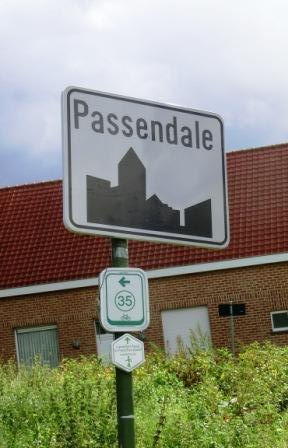
If you are wondering about the spelling difference, the Belgians have a much simpler spelling of their village and region!

CIMG8747 Sep 9 2017 sign for Passchendaele

Passchendaele = Passendale. (Photo credit: Pieter Valkenburg)

Our next stop on the War Memorial Trail, after a much needed lunch break, was Tyne Cot British Cemetery, which was also in Zonnebeke.  Comments or stories?  You can share them by emailing us at memorialtrail@gmail.com or  by commenting on this blog.

© Daria Valkenburg

….Want to follow our research?….

If you are reading this posting, but aren’t following our research, you are welcome to do so.  Our blog address: https://onthewarmemorialtrail.com/

Front cover OnTheWarMememorialTrailinEurope4 countries, 6 weeks, 7,000 km – an unforgettable war memorial journey in Europe…. Daria’s book ‘No Soldier Buried Overseas Should Ever Be Forgotten‘ is available in print and e-book formats.  Net proceeds of book sales help support research costs and the cost of maintaining this blog. For more information see https://nosoldierforgotten.com/ 

You are also invited to subscribe to our YouTube Channel: On The War Memorial Trail With Pieter Valkenburg: https://www.youtube.com/channel/UCJ591TyjSheOR-Cb_Gs_5Kw

Never miss a posting!  Subscribe below to have each new story from the war memorial trail delivered to your inbox.
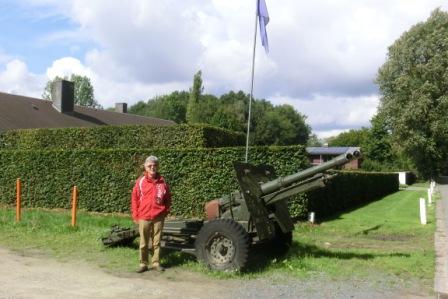
On The War Memorial Trail…We Visit Passchendaele and Surrounding Area

November 2, 2017.  After hearing so much about Passchendaele and the terrible 100 days of fighting over a mere 8 km of territory in 1917, we had to go and see the area for ourselves.  245,000 allied soldiers alone were casualties, not to mention Belgian citizens and German soldiers. We kept thinking, “How could it be worth such a heavy sacrifice?”

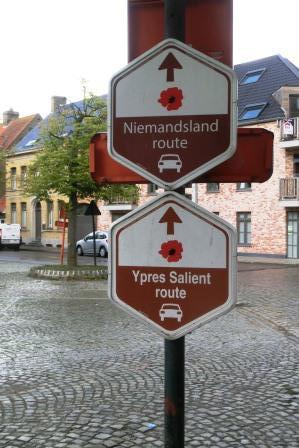
We followed two routes in this area, the Ypres Salient Route, and No Man’s Land Route (Niemandsland Route in Flemish).

CIMG8738 Sep 9 2017 sign saying Ypres Salient Route

Signs along the road marked the routes you could follow on the war memorial trail in Belgium. (Photo credit: Pieter Valkenburg)

One soldier on the Cenotaph outside the Borden-Carleton Legion, Vincent CARR, died on October 30, 1917 during the Battle of Passchendaele.  His story was told earlier in this blog.  (See links to The Cenotaph Research Project Begins and The WWI Names On The Cenotaph).  He’s buried at Cement House Cemetery in Langemark, and our first stop on the war memorial trail in the Passchendaele area was there.

CIMG8723 Sep 9 2017 Pieter at Cement House Cemetery with flags

Pieter at the entrance to Cement House Cemetery. (Photo credit: Daria Valkenburg)

Cement House was the military name given to a fortified farm building on the Langemark-Boesinghe (now called Boezinghe) road.  There are 3,952 WWI Commonwealth graves, 2,225 of them unidentified.  There are an additional 22 WWII graves, 5 of which are unidentified.

After placing the flags on Carr’s grave, we saw that the graves on either side of him were Canadians from the same Canadian Motor Machine Gun Brigade unit as Carr, and that they died on the same day.  It seemed only right to take a photo of all three graves and pay tribute to R. BELLAS, our Vincent CARR, and J. B. WILLSON.

IMG_20170909_131617502 Graves of Bellas Carr Willson in Cement House Cemetery

The graves of R. Bellas, V. Carr, and J. B. Willson in Cement House Cemetery. (Photo credit: Pieter Valkenburg)

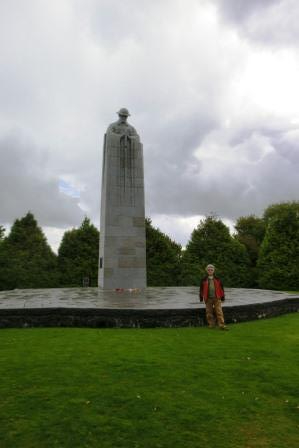
After leaving Cement House Cemetery, we stopped at the St. Julien Memorial (Sint Juliaan in Flemish), a Canadian War Memorial commemorating the Canadian First Division’s participation in the Second Battle of Ypres in World War I.  This was a nasty battle where the troops faced the first poison gas attacks along the Western Front on April 22, 1915.  The memorial is commonly known as the Brooding Soldier, the name given to the statue sculpted by Frederick Chapman Clemesha, an architect from Regina who was also a WWI veteran.

Unfortunately, the heavens opened as we arrived in the parking lot.  We waited a few minutes in the hope that the rain would stop, but no luck.  There was a big tour bus beside us and no one got out of it either.  After ten minutes the bus left (guess they had to stay on schedule).  At that point Pieter said, rain or not, he was going to the memorial.  Only his cousin François was willing to join him!  Mieke and I stayed in the car.

cimg8733-sep-9-2017-pieter-by-brooding-soldier-monument-st-juliaan-memorial-in-langemark.jpg

St. Julien Memorial in Langemark. (Photo credit: François Breugelmans)

The sculpture is a stone tower, topped by the head and shoulders of a soldier, whose head is bowed.  The soldier is in the pose of a serviceman standing with ‘reversed arms’ – resting his hands on the rifle butt and the rifle pointing with its barrel to the ground. This pose is a gesture of mourning and respect for the fallen.

The memorial is inscribed as follows: THIS COLUMN MARKS THE BATTLEFIELD WHERE 18,000 CANADIANS ON THE BRITISH LEFT WITHSTOOD THE FIRST GERMAN GAS ATTACKS THE 22ND-24TH OF APRIL 1915. 2,000 FELL AND HERE LIE BURIED.

The location of the statue is where the Canadian position was when they were attacked by gas.  None of the troops had gas masks.  They tried to protect themselves as best they good, and some pressed handkerchiefs soaked with urine around their mouths.  As we now know, this did little good.

A few minutes after the Pieter and François came back into the car and we pulled away from the parking lot, it stopped raining and the sun came out.  It was like a message had been received!

Although it was after 2 pm, and three of us were hungry and tired, we had a few more stops before Pieter would allow us to have a rest and lunch!  We grumbled that he had forgotten we were volunteers on this journey, not military recruits!  Our war memorial route continues in the next blog entry.

As yet, we have not been able to find any information on Vincent Carr’s wife, Bessie Carr, who came from Summerside, and died in 1918, a year after her husband.  Can you help?  If you are related to R. Bellas or J. B. Willson, we’d like to hear from you as well.  Comments or stories?  You can share them by emailing us at memorialtrail@gmail.com or by commenting on this blog.

© Daria Valkenburg

….Want to follow our research?….

If you are reading this posting, but aren’t following our research, you are welcome to do so.  Our blog address: https://onthewarmemorialtrail.com/

Front cover OnTheWarMememorialTrailinEurope4 countries, 6 weeks, 7,000 km – an unforgettable war memorial journey in Europe…. Daria’s book ‘No Soldier Buried Overseas Should Ever Be Forgotten‘ is available in print and e-book formats.  Net proceeds of book sales help support research costs and the cost of maintaining this blog. For more information see https://nosoldierforgotten.com/ 

You are also invited to subscribe to our YouTube Channel: On The War Memorial Trail With Pieter Valkenburg: https://www.youtube.com/channel/UCJ591TyjSheOR-Cb_Gs_5Kw

Never miss a posting!  Subscribe below to have each new story from the war memorial trail delivered to your inbox.
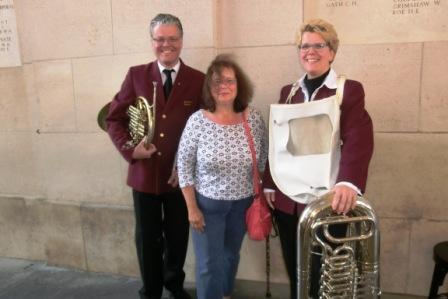
On The War Memorial Trail….Visiting Lt. John McCrae’s Field Hospital Bunker Outside Ypres

October 29, 2017. Lt. John McCrae (November 30, 1872 – January 28, 1918) is famous as the author of the poem we recite every Remembrance Day, “In Flanders Fields”.  So it was an honour to visit the place where he wrote the poem and have a look at the horrendous conditions in which, as a military surgeon, he had to work in his field hospital bunker (dressing station).

The Canadian government has a memorial to John McCrae that features “In Flanders Fields” at the site of this field hospital bunker located beside the Commonwealth War Graves Commission’s Essex Farm Cemetery. The Belgian government calls this site the “John McCrae Memorial Site”.

IMG_20170909_123444276 Sep 9 2017 John McCrae Memorial

John McCrae Memorial with the poem “In Flanders Fields” in his handwriting at the far right. (Photo credit: Pieter Valkenburg)

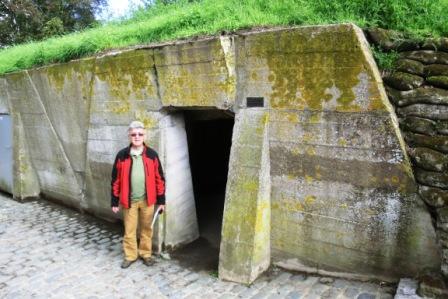
During the Second Battle of Ypres, fought from 22 April – 25 May 1915 for control of Ypres, Dr McCrae treated the wounded from a hastily dug, 8 foot by 8 foot bunker dug in the back of the dyke along the Yser Canal in Boezinge, about 2 miles north of Ypres.

CIMG8720 Sep 9 2017 John McCrae Memorial Site Pieter outside field hosptial bunker

Pieter at the entrance to the field bunker hospital where Lt. John McCrae worked as a military surgeon during the Second Battle of Ypres. Note that it was built into the dyke. (Photo credit: Daria Valkenburg)

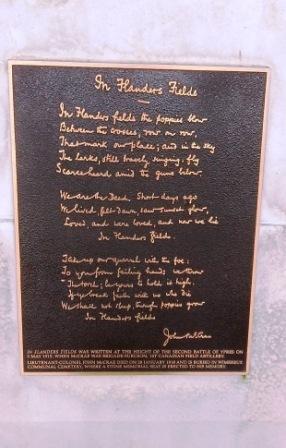
After his friend, Lt. Alexis Helmer, was killed in the battle, legend has it that McCrae wrote the poem, ‘In Flanders Fields’, on May 3, 1915 as he sat upon the back of a medical field ambulance near this bunker at Essex Farm.

IMG_20170909_123455044 Sep 9 2017 John McCrae poem In Flanders Fields

The poem “In Flanders Fields” in his handwriting on the John McCrae Memorial. (Photo credit: Pieter Valkenburg)

In June 1915, McCrae was sent to set up No. 3 Canadian General Hospital at Dannes-Camiers near Boulogne-sur-Mer in northern France.  It was there that he died of pneumonia on January 28, 1918.  We wonder if he was aware that over a hundred years after he wrote the poem, the poppy and his poem remain a symbol of remembrance to the fallen.

We were deeply touched by the visit to the field hospital bunker, and weren’t surprised in the least when it started to rain.  It seemed as though rain was part of the memorial.  No one from the Cenotaph outside the Borden-Carleton Legion was buried at Essex Farm Cemetery, so we went on to Cement House Cemetery, which will feature in the next blog entry.

Have you been to the John McCrae Memorial Site?  Comments or stories?  You can share them by emailing us at memorialtrail@gmail.com or by commenting on this blog.

© Daria Valkenburg

….Want to follow our research?….

If you are reading this posting, but aren’t following our research, you are welcome to do so.  Our blog address: https://onthewarmemorialtrail.com/

Front cover OnTheWarMememorialTrailinEurope4 countries, 6 weeks, 7,000 km – an unforgettable war memorial journey in Europe…. Daria’s book ‘No Soldier Buried Overseas Should Ever Be Forgotten‘ is available in print and e-book formats.  Net proceeds of book sales help support research costs and the cost of maintaining this blog. For more information see https://nosoldierforgotten.com/ 

You are also invited to subscribe to our YouTube Channel: On The War Memorial Trail With Pieter Valkenburg: https://www.youtube.com/channel/UCJ591TyjSheOR-Cb_Gs_5Kw

Never miss a posting!  Subscribe below to have each new story from the war memorial trail delivered to your inbox.
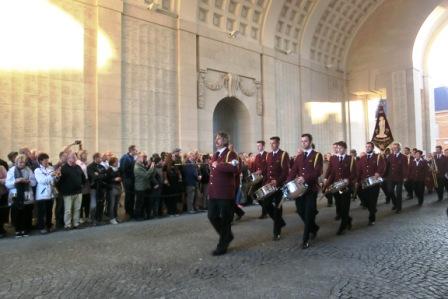
On The War Memorial Trail….A Daytime Visit To Menin Gate Memorial in Ypres

October 26, 2017.  Menin Gate (Menenpoort in Flemish) is a large archway, with a bridge over a moat that surrounds the city of Ypres. Between October 1914 and September 1918 hundreds of thousands of Commonwealth soldiers marched through it on their way to the battlefields.  300,000 of them died, and 90,000 have no known grave.

Ypres was at the centre of a road network and essential for the Germans to capture in order to take the English Channel ports through which British support came into France during World War I. For the Allies, Ypres was important as it became the last major Belgian town that remained out of German control.

Five major battles occurred around Ypres. During the First Battle of Ypres the German army’s advance to the east of the city was stopped.  Eventually, however, the Germans surrounded the city on three sides, bombarding it throughout much of the war. The Second Battle of Ypres was the second German attempt to take the city in April 1915. The third battle, which we know as the Battle of Passchendaele, occurred over five months in 1917. The fourth and fifth battles occurred during 1918.

Today, Menin Gate is a memorial to 54,616 Commonwealth soldiers who died before August 16, 1917 and have no known grave, about 6,983 of them Canadians.

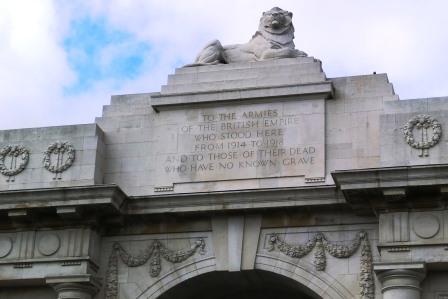
CIMG8681 Sep 9 2017 Ypres Menin Gate Memorial

Menin Gate Memorial in Ypres. (Photo credit: Daria Valkenburg)

Two of those Canadians are listed on the Cenotaph outside the Borden-Carleton Legion: Charles Benjamin Murray BUXTON and George ‘Albert’ CAMPBELL.  So, of course, we went to find their names on the Menin Gate Memorial.

CIMG8683 Sep 9 2017 Ypres Inscription at entrance to Menin Gate Memorial

Inscription on the Menin Gate Memorial. (Photo credit: Daria Valkenburg)

Inside the archway is a Hall of Memory, with stairwells on either side of the archway, and panels listing the names of each of these soldiers.  One wall by the stairwall lists the names of Canadian soldiers, and we first found Charles Buxton, listed under the names of those from the Princess Patricia Canadian Light Infantry.  Pieter stood by the wall listing his name and held up Buxton’s photo and a plaque that he’d asked Kevin Peddle of Prince County Trophy and Awards in Summerside to make for him.

CIMG8688 Sep 9 2017 Ypres Pieter with plaque and photo of Buxton at Menin Gate Memorial

Pieter at Menin Gate Memorial, holding up a photo of Charles Buxton and a memorial plaque. (Photo credit: Daria Valkenburg)

OLYMPUS DIGITAL CAMERA

Memorial Plaque for Charles Buxton that Pieter had made. (Photo credit: Pieter Valkenburg)

Buxton - Cropped

Charles Buxton. (Photo: courtesy of John Marchbank Collection)

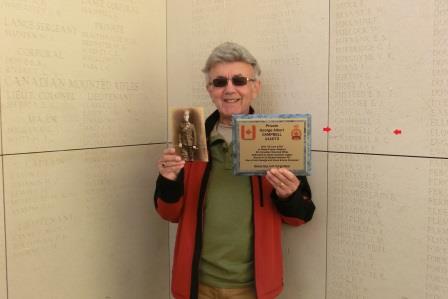
We then searched for the listing for George Albert Campbell under the Canadian Mounted Rifles, and repeated the procedure, holding up a picture of Campbell and a memorial plaque.

CIMG8703 Sep 9 2017 Ypres Pieter with plaque and photo of Campbell by name on Menin Gate

Pieter at Menin Gate Memorial, holding up a photo of George Albert Campbell and a memorial plaque. (Photo credit: Daria Valkenburg)

OLYMPUS DIGITAL CAMERA

Memorial Plaque for George Albert Campbell that Pieter had made. (Photo credit: Pieter Valkenburg)

George Albert Campbell - Cropped

George Albert Campbell. (Photo: courtesy of Gerald Tingley Collection)

If you were paying attention at the beginning of this entry, you read that 90,000 WWI Commonwealth soldiers have no known grave, but only 54,616 are listed on Menin Gate. Why?  When the memorial was completed, it was too small to contain all the names of the missing and unidentified soldiers, as had originally been planned. An arbitrary cut-off point of August 15, 1917 was chosen and the names of 34,984 British soldiers missing after this date were inscribed on the Tyne Cot Memorial to the Missing instead. The names of missing and unidentified soldiers from New Zealand and Newfoundland are listed on separate memorials.

With advances in DNA and stories about finding skeletons in various graves in fields, we wondered what happened if a soldier was identified.  Any remains are reburied in a cemetery, and if the soldier can be identified the name is removed from the Menin Gate Memorial.

We were glad we had the opportunity to visit Menin Gate Memorial in the morning, before it got busy and before the Last Post Ceremony in the evening, which we would come back to attend.

We also wanted to visit Maple Copse Cemetery, where Campbell is believed to be buried, and Sanctuary Wood, where Buxton lost his life during a battle, and have a chance to tell their stories in the spot where they were last.

First, though, we decided to visit areas in and around Passchendaele, beginning with Lt.  John McCrae’s field hospital bunker, the subject of the next blog entry. Comments or stories?  You can share them by emailing us at memorialtrail@gmail.com or by commenting on this blog.

© Daria Valkenburg

….Want to follow our research?….

If you are reading this posting, but aren’t following our research, you are welcome to do so.  Our blog address: https://onthewarmemorialtrail.com/

Front cover OnTheWarMememorialTrailinEurope4 countries, 6 weeks, 7,000 km – an unforgettable war memorial journey in Europe…. Daria’s book ‘No Soldier Buried Overseas Should Ever Be Forgotten‘ is available in print and e-book formats.  Net proceeds of book sales help support research costs and the cost of maintaining this blog. For more information see https://nosoldierforgotten.com/ 

You are also invited to subscribe to our YouTube Channel: On The War Memorial Trail With Pieter Valkenburg: https://www.youtube.com/channel/UCJ591TyjSheOR-Cb_Gs_5Kw

Never miss a posting!  Subscribe below to have each new story from the war memorial trail delivered to your inbox.

On The War Memorial Trail….A Visit To Chester Farm Military Cemetery

October 22, 2017.  After we paid our respects to Arthur Robinson at La Laiterie Military Cemetery in Belgium, we made our way to Chester Farm Military Cemetery, 5 km south of Ypres, where another WWI soldier, James Lymon CAMERON, is buried.  The cemetery, one of three in the area, is in a farming area.

CIMG8660 Sep 9 2017 Directional sign to Chester Farm Military Cemetery

Directional sign to Chester Farm Cemetery. Note the John Deere dealership. We are in a farming area, only 5 km south of Ypres. (Photo credit: Pieter Valkenburg)

Chester Farm was the name given to a farm about 1 km south of Blauwepoort Farm, on the road from Zillebeke to Voormezeele.  The names of these two places may be almost unpronounceable, but we encountered them over and over again as scenes of many fierce battles.

CIMG8662 Sep 9 2017 Chester Farm Military Cemetery stone marker

Stone marker on gate of Chester Farm Military Cemetery. (Photo credit: Daria Valkenburg)

The cemetery opened in March 1915 and has 420 Commonwealth burials, 7 of them unidentified.  It’s in a beautiful location, surrounded by cows.  It seems fitting for an Islander to be in such a rural location.

CIMG8671 Sep 9 2017 Chester Farm Military Cemetery with cows in backgroung flags by Camerons grave

Chester Farm Military Cemetery, surrounded by cows. Pieter had already placed flags on the grave of James Lymon Cameron. (Photo credit: Daria Valkenburg)

Private James Lymon Cameron was born December 30, 1892 in Victoria, Prince Edward Island, the son of Edward H. Cameron, a carpenter, and Susan Estelle Harrington of Hampton.  The family was Roman Catholic and worshipped at the church in Kelly’s Cross.

With such a background on the island, it was a mystery to us why no one seemed to know the family, until Pieter’s research revealed that the family must have moved around quite a bit for Edward’s work.  In a 1900 US census, the family was living in South Bend City, in the state of Washington, and James Lymon’s sister Ethel was recorded as having been born in New Hampshire in 1889.  He had an older sister Lucy who was born on Prince Edward Island, but was not listed in the 1900 census, suggesting that she was no longer alive, and a younger brother Otto, who was born on Prince Edward Island.

In a 1921 census from Vancouver, another younger brother, Edward, is recorded as having been born in the USA around 1906.  Ethel is living with her parents and brother.  She is recorded as married with the last name Gilbert, but her husband is not with her.

At the time that James Lymon enlisted on March 18, 1915 with the 47th Battalion (BC) CEF, the family was living in Vancouver, and he was employed as a marine oiler.  By October 1915 he was on his way to Europe, and transferred twice, first to the 30th Reserve Battalion, and then to the 7th Canadian Infantry Battalion (1st British Columbia).

On July 24, 1916, he was killed by enemy shell fire at ‘The Bluff’ at Ypres Salient during The Battle of The Bluff near St. Eloi.  The Bluff is a mound near St Eloi, south-east of Ypres, which was created from a spoil heap during the digging of the Ypres–Comines Canal before the war.

CIMG8666 Sep 9 2017 Chester Farm Military Cemetery Pieter by grave of James Lymon Cameron

Pieter by the grave of James Lymon Cameron at Chester Farm Military Cemetery. (Photo credit: Daria Valkenburg)

The war diary of the 7th Canadian Infantry Battalion for July 2, 1916, explained what happened in three terse lines:  “Bombardment of Front Line. Headquarters Shelled. Our retaliation effective.

Unfortunately, this is all we know about James Lymon Cameron.  We don’t even know what he looked like.  If you can add any further information or provide a photo, please let us know.

In the next blog entry we visit Menin Gate in Ypres. Comments or stories?  You can share them by emailing us at memorialtrail@gmail.com or by commenting on this blog.

© Daria Valkenburg

….Want to follow our research?….

If you are reading this posting, but aren’t following our research, you are welcome to do so.  Our blog address: https://onthewarmemorialtrail.com/

Front cover OnTheWarMememorialTrailinEurope4 countries, 6 weeks, 7,000 km – an unforgettable war memorial journey in Europe…. Daria’s book ‘No Soldier Buried Overseas Should Ever Be Forgotten‘ is available in print and e-book formats.  Net proceeds of book sales help support research costs and the cost of maintaining this blog. For more information see https://nosoldierforgotten.com/ 

You are also invited to subscribe to our YouTube Channel: On The War Memorial Trail With Pieter Valkenburg: https://www.youtube.com/channel/UCJ591TyjSheOR-Cb_Gs_5Kw

Never miss a posting!  Subscribe below to have each new story from the war memorial trail delivered to your inbox.

On the War Memorial Trail in Belgium and a Visit to La Laiterie Military Cemetery

October 16, 2017.  After leaving France and arriving in De Panne, Belgium, on the North Sea coast, we were joined by Pieter’s cousin François Breugelmans and his wife Mieke de Bie, who live in Antwerp.  It gave us a chance to visit as well as continue the war memorial trail.

For most of our time in Belgium we had a break from driving, as François took over that task.  This was great as many of the roads in the area are very narrow, more suited to one way traffic, not two way traffic.

CIMG8641 sep 9 2017 Francois on a narrow road

A typical road in Belgium! (Photo credit: Pieter Valkenburg)

The thing that struck us the most was that all of the cemeteries and memorials we had to visit in Belgium were not far from Ypres.  Our first cemetery in Belgium was La Laiterie Military Cemetery, where Arthur Clinton ROBINSON is buried.  Named after a dairy farm, the cemetery is right on a busy road, next to a cement business.  It’s very well kept and has 751 Commonwealth WW1 graves, 180 of them unidentified.

CIMG8659 Sep 9 2017 Daria and Mieke outside La Laiterie Military Cemetery

Daria Valkenburg and Mieke de Bie outside La Laiterie Military Cemetery. (Photo credit: François Breugelmans)

CIMG8647 Sep 9 2017 At Robinsons grave in La Laiterie Cemetery see cement factory

Placing the flags at the grave of Arthur Clinton Robinson in La Laiterie Military Cemetery. Note the cement factory beside the cemetery. (Photo credit: Daria Valkenburg)

When we began this project, we thought it would be easy to get a photo and information on Private Robinson as we knew his nephew John Robinson and John’s wife Hazel had done extensive genealogical research.  Unfortunately, John and Hazel had been unable to find any photos and very little information.  Arthur Clinton Robinson was born July 20, 1896 in Tryon, the son of Albert James Robinson and Flora P. Scruton, a nurse from New Hampshire who died on June 23, 1901 from tuberculosis.

A farmer before the war, Arthur Clinton Robinson enlisted in the 26th (New Brunswick) Battalion on November 20, 1914, and was in Europe by spring of the following year.  On March 27, 1916 he was killed in action when shell fire hit the trenches southeast of Kemmel, which itself is only10 km south west of Ypres.

CIMG8649 Sep 9 2017 grave of Arthur Clinton Robinson in La Laiterie cemetery

Grave of Arthur Clinton Robinson at La Laiterie Military Cemetery. (Photo credit: Pieter Valkenburg)

In 1917, after Arthur Clinton’s death, his father Albert remarried, to Mary Mooney, and they had a family of their own.  John Robinson is descended from this second marriage and thought that it was likely that no one kept anything from the previous family, since no one was alive by the time of the remarriage.

Pieter wrote in the guest register this time, and then we left to find Chester Farm Cemetery, our next destination.

CIMG8656 Sep 9 2017 Pieter writes in guest register at La Laiterie Cemetery Francois and Mieke in back

Pieter writes in the Guest Register at La Laiterie Military Cemetery while his cousins examine the cemetery register. (Photo credit: Daria Valkenburg)

In the next blog entry we continue our war memorial tour in the area around Ypres, Belgium. If you have a photo or info on Arthur Clinton Robinson, please let us know.  Comments or stories?  You can share them by emailing us at memorialtrail@gmail.com, comment on the blog, or tweet to @researchmemori1.

© Daria Valkenburg

…Want to follow our research?…

If you are reading this posting, but aren’t following our research, you are welcome to do so.  Our blog address: https://onthewarmemorialtrail.com/

Front cover OnTheWarMememorialTrailinEurope4 countries, 6 weeks, 7,000 km – an unforgettable war memorial journey in Europe…. Daria’s book ‘No Soldier Buried Overseas Should Ever Be Forgotten‘ is available in print and e-book formats.  Net proceeds of book sales help support research costs and the cost of maintaining this blog. For more information see https://nosoldierforgotten.com/

Subscribe to our YouTube Channel: On The War Memorial Trail With Pieter Valkenburg: https://www.youtube.com/channel/UCJ591TyjSheOR-Cb_Gs_5Kw

Never miss a posting!  Subscribe below to have each new story from the war memorial trail delivered to your inbox.