On The War Memorial Trail…..The Bulger Brothers – Part 2:  The WWII Stretcher Bearer From Foxley River Killed During The Battle of Bienen

August 19, 2024. During WWII, the Bulger family of Foxley River, Prince Edward Island, suffered a double tragedy, losing two sons:  Harold ‘Hal’ Gabriel BULGER, who is buried in the Canadian War Cemetery in Adegem, Belgium, and Lawrence William BULGER, who is buried in the Canadian War Cemetery in Groesbeek, The Netherlands.

We were aware of Lawrence Bulger from last year’s series on soldiers from the North Nova Scotia Highlanders who lost their lives during the Battle of Bienen on March 25, 1945. Since his name was not on a photo wish list, we didn’t research his story at that time. The date of the Battle of Bienen was significant to Pieter as he was “…exactly one year old when this battle occurred….” and it’s why he made such an effort to research so many of the North Novies that died that day.

….Another story in the Battle of Bienen series….

This year, when we decided to tell the story of one more soldier killed during the Battle of Bienen, we asked Edison Smith for help in contacting a family member for Lawrence Bulger.  Edison’s grandfather, Edison Alexander SMITH, and great-uncle Ralph Schurman BOULTER, both lost their lives in the Battle of Bienen.  Edison put us in contact with Bev Jeffery, niece of the Bulger brothers.

In Part 1 of this two-part series, Hal’s story was told.  (See https://onthewarmemorialtrail.com/2024/08/05/on-the-war-memorial-trail-the-bulger-brothers-part-i-the-wwii-soldier-from-foxley-river-killed-during-the-battle-of-moerbrugge/).  Now, in Part 2, we tell Lawrence’s story.

To learn more about the Bulger brothers, we were delighted to meet with Bev, the family’s historian, who explained that her “mother was Harold and Lawrence’s sister Agatha….

CIMG6828 May 27 2024 Bev Jeffery & Pieter Mill River Resort

Pieter with Bev Jeffery at Mill River Resort in Mill River, Prince Edward Island.  (Photo credit: Daria Valkenburg)

Born May 31, 1924 in Portage, Prince Edward Island, Lawrence was the son of Gabriel and Anne ‘Annie’ Marion (nee Milligan) Bulger of Foxley River, Prince Edward Island.  One of 16 children, Lawrence had two brothers and thirteen sisters. 

Lawrence Bulger with Guitar

Lawrence Bulger with his guitar at home on Prince Edward Island. (Photo courtesy of Bev Jeffery)

…Lawrence enlisted at the age of 17 ….

Before enlisting at the No. 6 District Depot in Charlottetown, Prince Edward Island, on March 10, 1942, Lawrence had worked on his family’s farm. He’d also worked at J.N. Kenny Contractors, a building contracting firm in Halifax, Nova Scotia until December 24, 1941.  He was only 17 when he enlisted, but tried to get around that by adding a year to his birth year, saying he was born in 1923. 

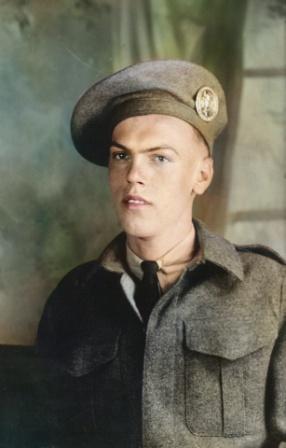
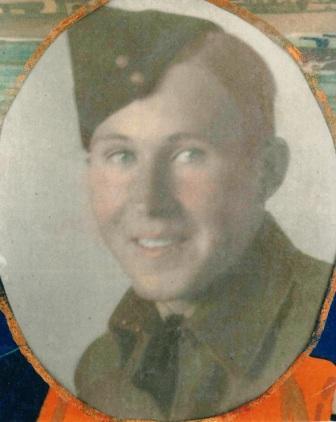
Lawrence Bulger colourized by RU

Lawrence Bulger, shortly after enlisting in 1942.  (Photo courtesy of Bev Jeffery.  Photo colourization by Pieter Valkenburg)

After completing his basic training at No. 62 Canadian Army (Basic) Training Centre (CABTC) in Charlottetown, Lawrence was transferred to the Princess Louise Fusiliers (Motor), an infantry regiment, in Halifax, Nova Scotia on July 14, 1942.   

Then, on November 21, 1942, his real age was discovered and he was sent to No. 6 District Depot in Halifax while a decision was made about his future in the army.  Lawrence was described as a “…quiet but friendly man...” who was “…accustomed to hard work…” It was also noted that he “…cannot drive a car….” and “…hasn’t had any trades experience of any kind…”  It was recommended that he be given infantry training.

On November 30, 1942, Lawrence was transferred to the Anti-Aircraft Artillery Formation Camp in Bedford, Nova Scotia.  He remained there until September 1, 1943, when he was sent to No. 61 Canadian Army (Basic) Training Centre (CABTC) in New Glasgow, Nova Scotia.  It was the second time he had to go through basic training.

…Lawrence was transferred from the Infantry to the Medical Corps ….

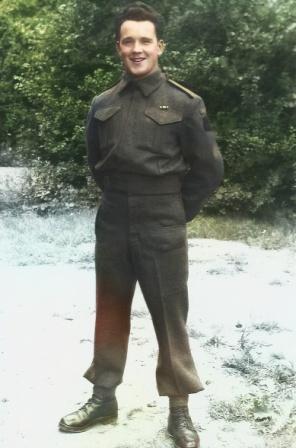
lawrence bulger Sep 1943 colourized

Lawrence Bulger in the fall of 1943.  (Photo courtesy of Bev Jeffery.  Photo colourization by Pieter Valkenburg)

On September 17, 1943, he was reallocated to the Royal Canadian Army Medical Corps (RCAMC) and, once his basic training was complete, was transferred to A22 Canadian Army Medical Corps Training Centre in Camp Borden, Ontario on October 6, 1943.  While at Camp Borden, Lawrence received advanced training to prepare him as a stretcher bearer, with three key responsibilities when dealing with the wounded in a war zone: stop the bleeding, treat for shock, and evacuate. 

In an interview on October 26, 1943, it was noted that Lawrence was “…very disappointed about reallocation to RCAMC, as he was enthusiastic about the Infantry.  A sturdy active chap….

…Lawrence married Violet May Bedgood ….

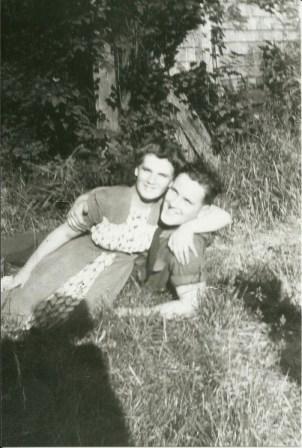
Violet(Bedgood) & Lawrence Bulger 1943 001

Violet May Bedgood and Lawrence Bulger in 1943.  (Photo courtesy of Bev Jeffery)

Just before his transfer to Camp Borden, Lawrence married Violet May Bedgood in Halifax, Nova Scotia on October 2, 1943, a few days after receiving permission to do so.  According to his application for permission to marry, they had known each other for a year.

Lawrence completed his advanced training in Camp Borden and was deemed ready for overseas service. He was granted special embarkation leave from December 15 to 23, 1943, the last extended period of time to visit with his wife and family.

On January 19, 1944, he was sent to No. 1 Training Brigade in Debert, Nova Scotia, for further training and in preparation for overseas service. 

….Lawrence left Canada for overseas service….

On March 6, 1944, Lawrence left Canada, arriving in the United Kingdom on March 13, 1944, where he was assigned to 1 Canadian General Reinforcement Unit (CGRU).  He was sent for further training while in the United Kingdom and worked as an orderly at No. 18 Canadian General Hospital.

Bev Jeffery had written that Violet was “…pregnant when Lawrence shipped out….” On May 16, 1944, their son Lawrence ‘Larry’ William was born in Halifax, Nova Scotia – a child that Lawrence would never meet in person.

Lawrence was transferred from RCAMC to No. 1 Canadian Infantry Training Regiment (CITR) on December 14, 1944.  As part of the Canadian Infantry Corps, he would be putting his training as a stretcher bearer to use in an infantry regiment in an active war zone.

….Lawrence was transferred to the North Nova Scotia Highlanders….

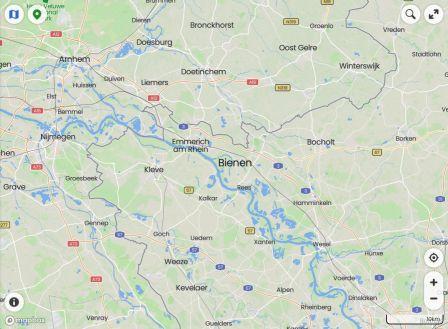
Screenshot 2022-11-07 at 10-07-46 Bienen

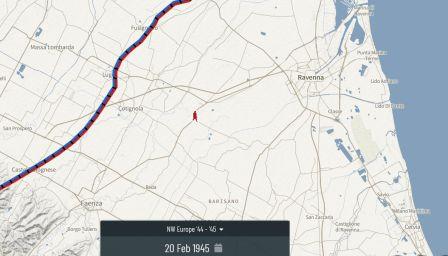
The North Nova Scotia Highlanders made their way from Xanten towards Bienen in Germany in March 1945.  (Map source: Mapcarta)

On February 17, 1945, Lawrence was sent by plane to northwest Europe as part of the CIC-X4 reinforcement troops, and then was assigned to the North Nova Scotia Highlanders on March 11, 1945, joining the Regiment as they left Xanten, Germany for the Reichwald forest.

The Regiment was in the midst of preparations for Operation Plunder, which began March 21, and involved Allied troops crossing the Rhine River to the north of the Ruhr industrial region in western Germany. With aerial and military support, this took place on the night of March 23, 1945 near Rees, a town situated on the right bank of the Rhine River, approximately 20 km (12.4 miles) east of Kleve. (See https://en.wikipedia.org/wiki/Operation_Plunder)

…Lawrence lost his life in the Battle of Bienen ….

On the next afternoon, March 24, 1945, Allied troops encountered fierce German resistance near the village of Bienen. They got as far as Bienen, when troop movement stopped due to blown bridges across the Rhine in that area.

In ‘No Retreating Footsteps’ by Will Bird, he noted that the 7th Argyll and Sutherland Highlanders had made “… three attempts …. to capture the village, but they were turned back by very heavy machine gun fire from the front of the village, supported by heavy mortar fire…

On March 25, 1945, the North Nova Scotia Highlanders reached Bienen, Germany for the climax of 9 Canadian Infantry Brigade’s role in Operation Plunder. The Regiment was tasked with passing through the 7th Argyll and Sutherland Highlanders who had been stopped in front of Bienen during the night. 

Bienen was a difficult challenge as the road through it was the only access point.  In ‘No Retreating Footsteps’ author Will Bird explained that it was “… an isthmus of solid land about half a mile wide with one road, the main Rees-Emmerich highway, which passed through Bienen exactly at the narrowest point…

Aerial Bienen post-war

Post-war aerial of Bienen (view to the southeast towards Rees). The aerial clearly demonstrates the tactical importance of Bienen, laying astride the narrow neck of land. The main road from Rees to Emmerich (nowadays Emmericher Strasse) runs straight through Bienen. (Photo source: http://www.WW2Talk.com and identified as ‘Courtesy Becker’)

March 25, 1945 was Palm Sunday – one week before Easter. The battle began in the morning and didn’t end until late that evening.  Right from the start, troops were pinned down, …suffering heavy casualties…” per the Regiment’s war diary for that day.  Worse, in terms of communications, “….contact between platoons was next to impossible because of the murderous fire and heavy mortaring….” 

The one day battle proved devastating in terms of casualties, both dead and wounded, as they fought in a deadly battle on open ground.  Among the casualties was 20 year old Lawrence William Bulger.  He was one of several stretcher bearers who lost their lives that day, killed by machine gun fire while attending to the wounded on the battlefield.

….Lawrence is buried in Groesbeek….

Like Clifford BATEMAN, John Joseph BOHON, Ralph Schurman BOULTER, Charles ‘Marshall’ CARSON, Harry William DOUCETTE, Marven Glenroy HARVEY, Kitchener ‘Kitty’ LANGILLE, Marvin William MCGREGOR, Austin Havelock MUNROE, Wilfred ‘Willy’ Joseph POWER, Louis Allan SEXTON, and John Lewis WALLACE, Lawrence was temporarily buried in the military cemetery in Rees, Germany. According to his military file, he was buried on April 5, 1945. The following year he was reburied in the Canadian War Cemetery in Groesbeek, The Netherlands.

In October 2019, Pieter and I visited the cemetery and placed Canadian and Prince Edward Island flags by Lawrence’s grave.  (See https://onthewarmemorialtrail.com/2019/12/04/on-the-war-memorial-trail-our-2019-visit-to-the-canadian-war-cemetery-in-groesbeek/)

CIMG3356 Oct 5 2019 Groesbeek Lawrence Bulger from Daria

Grave of Lawrence William Bulger in the Canadian War Cemetery in Groesbeek, The Netherlands.  (Photo credit: Daria Valkenburg)

….Lawrence and his brother Hal are remembered on the Ellerslie Monument….

CIMG6817 May 27 2024 Pieter by Ellerslie Monument - Bulgers

Pieter points to the names of Lawrence and Hal Bulger on the Ellerslie Monument.  (Photo credit: Daria Valkenburg)

In May 2024 we visited the Ellerslie Monument in Ellerslie, Prince Edward Island, just 13.4 km (8.3 miles) from Foxley River, where the names of Lawrence and his brother Hal, who lost his life on September 10, 1944 during the Battle of Moerbrugge in Belgium, are commemorated.  

This concludes the 2 part series on the Bulger Brothers. Thank you to Bev Jeffery for submitting photos and information on her Uncle Lawrence, and to Edison Smith for contacting the Jeffery family.

Do you have photos or information to share? Email Pieter at memorialtrail@gmail.com, comment on the blog, or tweet to @researchmemori1.

© Daria Valkenburg

….Previous stories about North Novies killed during the Battle of Bienen and buried in Groesbeek….

….Want to follow our research?….

If you are reading this posting, but aren’t following our research, you are welcome to do so.  Our blog address: https://onthewarmemorialtrail.com/

Front cover OnTheWarMememorialTrailinEurope4 countries, 6 weeks, 7,000 km – an unforgettable war memorial journey in Europe…. Daria’s book ‘No Soldier Buried Overseas Should Ever Be Forgotten‘ is available in print and e-book formats.  Net proceeds of book sales help support research costs and the cost of maintaining this blog. For more information see https://nosoldierforgotten.com/ 

You are also invited to subscribe to our YouTube Channel: On The War Memorial Trail With Pieter Valkenburg: https://www.youtube.com/channel/UCJ591TyjSheOR-Cb_Gs_5Kw

Never miss a posting!  Subscribe below to have each new story from the war memorial trail delivered to your inbox.

On The War Memorial Trail….. The WWII Soldier From Hallowel Grant Who Lost His Life During The Battle For The North Shore Of The Scheldt

July 24, 2024.  On November 7, 2022, Pieter was interviewed by Ceilidh Millar of CTV Atlantic News At 5 about the search for 4 soldiers of the North Nova Scotia Highlanders Regiment who died during the Battle of Bienen on March 25, 1945.  (You can read the article and watch the video.  See P.E.I. man identifying Canadian soldiers in the Netherlands | CTV News https://atlantic.ctvnews.ca/maritime-man-appealing-to-public-for-help-identifying-lost-canadian-soldiers-1.6143236)

Following the broadcast, several people got in contact to help with the photo search request, and to let him know about other soldiers buried in The Netherlands or Belgium. Among these was Martin Sullivan, who emailed Pieter, saying “My uncle Edward died October 20, 1944 near Brasschaet. Buried in Bergen Op Zoom.  He was in the Algonquin Regiment, C Company. Thank you to the Dutch people for taking care of Pte E. D. Chisholm’s grave and doing this research….

It took a while, but we eventually had a chance to meet Martin and look at the treasure trove of information and photos he had about his uncle, Edward ‘Ed’ Dalton CHISHOLM.

20230918_150701 Sep 18 2023 Pieter with Martin Sullivan in Cap Pele

Pieter with Martin Sullivan. (Photo credit: Daria Valkenburg)

Born November 5, 1924 in Hallowell Grant, Antigonish County, Nova Scotia, Ed was the son of Willliam John and Annie Jane Chisholm. He had 7 brothers and 5 sisters. Martin explained that his mother Josephine was one of Ed’s older sisters.

Ed Chisholm with siblings

A young Edward Chisholm and his older brother John William Chisholm identified in ‘Limbs’ by Lewis B. Chisholm.  (Photo courtesy of Martin Sullivan)

… Ed first enlisted in the Royal Canadian Naval Volunteer Reserve…

After leaving school at age 15, Ed worked on his parents’ farm, and then on a dairy farm, before going on to work as a stevedore for Scotia Stevedore Company in Halifax, Nova Scotia.  (A stevedore works at a dock to load and unload cargo from ships.)  

On March 22, 1943, at the age of 17, Ed left his employer and enlisted in the Royal Canadian Naval Volunteer Reserve as an ordinary seaman.  However, he was discharged as ‘medically unfit’ on May 12, 1943 due to being colour-blind. 

… Ed enlisted in the Canadian Army in 1944…

Ed Chisholm from Martin Sullivan

Edward ‘Ed’ Dalton Chisholm. (Photo courtesy of Martin Sullivan)

Ed returned to work as a stevedore in Halifax, this time with Cunard White Star Ltd, until January 4, 1944, when he enlisted at the No. 6 District Depot of the Canadian Army in Halifax, Nova Scotia.

His Personnel Selection Record noted that red-haired Ed had “…considerable experience in hockey and other sports. Attends dances ….” and reads “….popular fiction magazines and follows the news…”  His height of 6 feet 1 inch (1.85 metres) was remarked upon, and he was described as having “…a fine physique and a steady, calm, well balanced spirit…General characteristics point to suitability for vigorous activity along general combatant lines….

On January 14, 1944, Ed was sent to No. 60 Canadian Infantry Basic Training Centre (CIBTC) in Yarmouth, Nova Scotia.  After completing his basic training, Ed was transferred to A14 Canadian Infantry Training Centre (CITC) in Aldershot, Nova Scotia on March 12, 1944.

Next, Ed was attached to S-5 Canadian Driving and Maintenance School (CD & M School) in Woodstock, Ontario on May 5, 1944, for a Driver Course. He successfully completed this on June 29, 1944 and was qualified as a Driver i/c Class III (W).  (The term ‘Driver i/c’ refers to ‘Driver, internal combustion’.  Class III meant he was qualified to drive heavy trucks and armoured cars. ‘W’ refers to ‘Wheeled’.)

He was reassigned back to A14 CITC in Aldershot in preparation for overseas service, and granted two weeks embarkation leave, from July 7 to 20, 1944, the last chance he had to see his family.

… Ed left Canada for overseas service in August 1944…

On August 4, 1944, Ed left Canada for the United Kingdom.  Upon arriving on August 10, 1944 he was assigned to No. 4 Canadian Infantry Reinforcement Unit (CIRU).

On September 2, 1944 he was sent to France with the X-L infantry reinforcement troops of the 21st Army Group.

… Ed joined the Algonquin Regiment in Belgium…

Screenshot 2024-07-20 at 12-30-12 Sijsele · 8340 Damme Belgium

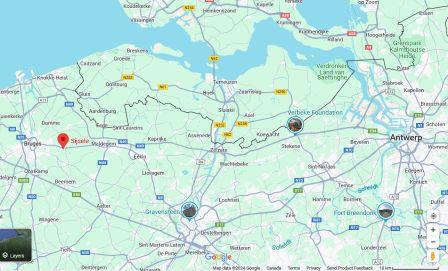
Edward ‘Ed’ Dalton Chisholm joined the Algonquin Regiment in Sijsele, Belgium, as they travelled eastward. (Map source: Google maps)

On September 15, 1944 he was assigned to the Algonquin Regiment, joining them in Sijsele, Belgium, located not far from the Dutch border.  The Regiment had suffered heavy losses during the battles to capture the canals around Moerkerke and needed reinforcements as they slowly advanced towards the Scheldt and the need to liberate the port of Antwerp.

By October 18, 1944, the Regiment was near Westmaele, north-east of Antwerp.  In ‘Warpath The Story of the Algonquin Regiment 1939-1945’, author Major G. L. Cassidy wrote that “… on October 19th, a battalion reconnaissance party went north to Camp de Brasschaet for a look at the terrain where the next day’s battle was to be fought…..” This was the Battle for the North Shore of the Scheldt.

The Algonquin Regiment war diary for October 19, 1944 stated that “…at 13:15 hours, the battalion left on its journey north, arriving at our destination, a badly bombed sanitarium, about 16:30 hours.  Here the men were briefed on the forthcoming operation and after digging in, settled down to spend another quiet night…

The ‘Warpath’ entry for that day stated that when the orders were issued on the evening of October 19, the “…divisional plan was to advance and capture the town of Esschen, moving along two centre lines in two brigade groups…

….The Battle for the North Shore Of The Scheldt was fatal for Ed….

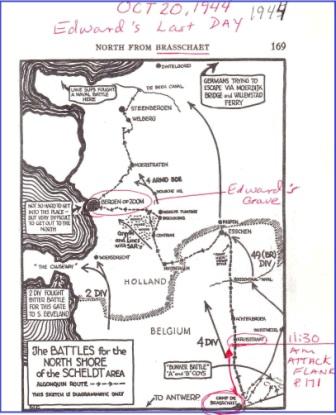
The Battle for the North Shore of the Scheldt began on October 20, 1944 at 7:30 am, with “… ‘B’ Company leading, ‘A’ Company on the right, and ‘D’ Company on the left...” according to the Algonquin Regiment’s war diary for that day.

Ed Chisholm was in ‘C’ Company, which didn’t go into position until later in the morning, as noted in the war diary.  “…At 11:30 hours, ‘C’ Company was placed under command of 28 Canadian Armoured Regiment, and with ‘C’ Squadron of that unit, made a flanking attack and captured the cross roads.  During this operation, one ‘C’ Company man was killed, and one tank was knocked out with one man killed and one officer wounded. Twenty one prisoners of war were captured….

The ‘C’ Company man killed was Ed, as was confirmed in ‘Warpath’. “… ‘C’ Company suffered only one fatal casualty, Pte E.D. Chisholm….”  He was 19 years old, only two weeks away from his 20th birthday.

Martin Sullivan had been given an eyewitness account by Stanley Cameron with a bit more information on what happened to his Uncle Edward. Stanley, from Grande Prairie, Alberta, was with the Royal Canadian Engineers 2nd Division.  “…When a German 30 mm cannon took out the tank, Edward was hit by tank shrapnel and was pushed into a ditch until taken to hospital.  He died in a field hospital, with a priest who gave him his last confession…” 

Map page 169 Warpath - Algonquin Regt Oct 20 1944 Chisholm_Page_3

Notes made by Martin Sullivan about Ed Chisholm’s last battle. (Map source: ‘Warpath The Story of the Algonquin Regiment 1939-1945’)

….Ed is buried in Bergen Op Zoom….

Screenshot 2023-09-17 at 21-00-01 kalmthout belgie at DuckDuckGo

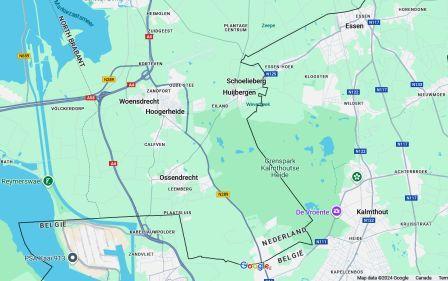
Edward ‘Ed’ Dalton Chisholm was temporarily buried in Kalmthout, Belgium. (Map source: DuckDuckGo)

On October 21, 1944, Ed was temporarily buried “…in a field opposite the house of Joseph Goosenaerts…” in the village of Kalmthout, Belgium, before being reburied in the Canadian War Cemetery in Bergen Op Zoom, The Netherlands.

grave Chisholm from Find A Grave

Grave of Edward ‘Ed’ Dalton Chisholm in the Canadian War Cemetery in Bergen Op Zoom, The Netherlands. (Photo courtesy of Find A Grave)

….A family was left to grieve their son….

Martin wrote in his copy of ‘Warpath’ that when his grandmother (Momma) learned about her son’s death, she “…went to church and Edward appeared in her hands to tell her he was in heaven…”  When asked if this anecdote could be shared, Martin agreed.

Martin explained that upon hearing such devastating news about their son “….our grandfather Billy John Chisholm (PaPa) went to the woods to cry, and then hitched up the team of horses to take Momma to church in town….

His grandmother’s faith helped her to cope with the loss of a beloved son.  “…After several days of living in town and going to church all day, PaPa and the children were worried that their Momma would never be coming home. Momma prayed for her son to the Blessed Virgin and St. Joseph. Then one day they smiled down on her. Her prayers were answered.  There in her open hands was Edward’s face saying ‘Thank you Momma, I’m in heaven and you don’t have to worry about me anymore’. Her boy’s soul had been received into heaven and Momma went home to take care of the remaining twelve children. Thanks be to God….” 

Thank you to Martin Sullivan for sharing photos and information.  Do you have photos or information to share? Email Pieter at memorialtrail@gmail.com, comment on the blog, or tweet to @researchmemori1.

© Daria Valkenburg

….Want to follow our research?….

If you are reading this posting, but aren’t following our research, you are welcome to do so.  Our blog address: https://onthewarmemorialtrail.com/

Front cover OnTheWarMememorialTrailinEurope4 countries, 6 weeks, 7,000 km – an unforgettable war memorial journey in Europe…. Daria’s book ‘No Soldier Buried Overseas Should Ever Be Forgotten‘ is available in print and e-book formats.  Net proceeds of book sales help support research costs and the cost of maintaining this blog. For more information see https://nosoldierforgotten.com/ 

You are also invited to subscribe to our YouTube Channel: On The War Memorial Trail With Pieter Valkenburg: https://www.youtube.com/channel/UCJ591TyjSheOR-Cb_Gs_5Kw

Never miss a posting!  Subscribe below to have each new story from the war memorial trail delivered to your inbox.

On The War Memorial Trail…… The WWII Soldier From Donaldston Who Died In A Vehicle Accident In The Netherlands

July 13, 2024.  In the 11 part Atlantic Canada Remembers series that ran in 2021, photos submitted about Atlantic Canadian soldiers buried overseas were featured. Pieter ensured that photos of soldiers who are buried in The Netherlands were forwarded to the appropriate cemetery for their digital archives. 

In Part 2 of the Atlantic Canada Remembers series, Helen O’Connell submitted a photo of her uncle, Francis ‘Frank’ Ivan DOUGAN.  She wrote that he “….was born in November 12, 1919 to Florence and John Dougan from Donaldston, Prince Edward Island.  He was the 2nd of 12 boys born in that family – no girls.  Frank left school at age of 15 and went to work to help his family.  He worked in Debert, Nova Scotia as a labourer and mechanic.  In 1941, he and 3 of his brothers enlisted….”  (See https://onthewarmemorialtrail.com/2021/01/13/on-the-war-memorial-trail-atlantic-canada-remembers-part-2/)

Screenshot 2024-07-03 at 11-24-35 Donaldston · Prince Edward Island C0A 1T0

Donaldston is located in central Prince Edward Island. (Map source: Google maps)

…..Frank enlisted under the NRMA in 1941….

Frank originally enlisted under the National Resources Mobilization Act (NRMA) in Charlottetown, Prince Edward Island on October 2, 1941 and underwent basic training at No. 62 Canadian Army Basic Training Centre (CABTC). (See https://en.wikipedia.org/wiki/National_Resources_Mobilization_Act)

After completing his basic training, Frank was sent for 62 days of advanced training at No. A19 Canadian Army Service Corps Training Centre (CASCTC) at Camp Borden in Borden, Ontario.  

From there, he was transferred to the 6th Division Ammunition Company of the Royal Canadian Army Service Corps (RCASC) in Valcartier, Quebec on April 7, 1942.

Frank would remain with the Royal Canadian Army Service Corps (RCASC), an administrative and transport corps of the Canadian Army.  Their role was to provide support to Canadian soldiers wherever they went, moving supplies from the rear areas to the front-lines. They delivered all rations, ammunition, petroleum products, and all other essentials, using vehicles ranging from three- to ten-ton trucks, and forty-ton tank transporters. (For more information, see https://en.wikipedia.org/wiki/Royal_Canadian_Army_Service_Corps)

….Frank enlisted for active service…..

Francis Ivan Dougan

Francis ‘Frank’ Ivan Dougan. (Photo courtesy of Helen O’Connell)

On June 1, 1942, Frank transferred from the non-active militia to active service in the Canadian Army, remaining with the 6th Division Ammunition Company in Valcartier.   

On July 7, 1942, Frank was sent to the Canadian Army Trades School in Hamilton, Ontario for a Motor Mechanics Course, which lasted 6 months. On January 20, 1943, Frank was attached to the Headquarters of the 6th Division Ammunition Company at Hastings Military Park in Vancouver, British Columbia.

On March 9, 1943, he was sent to the Headquarters of the 6th Division Company in Victoria, British Columbia.  Then, on September 2, 1943, he was transferred to the 28th Transport Company in Duncan, British Columbia, but sent on assignment with the Royal Rifles of Canada to Wainwright, Alberta, where he remained until October 19, 1943, when he returned to Duncan. 

Frank next was transferred to No. XI District Depot in Vancouver, British Columbia on February 4, 1944 for a short period before being sent, on February 16, 1944, to No. 1 Training Brigade in Debert, Nova Scotia, in preparation for overseas service. 

….Frank left Canada for overseas service….

On April 11, 1944, Frank left Canada, arriving in the United Kingdom on April 19, 1944, where he was assigned to the Canadian Army Service Corps Reinforcement Unit (CASCRU).

Frank was transferred to the 12th Battalion of the Royal Canadian Army Service Corps (RCASC), part of the 10th Canadian Infantry Brigade (CIB) on May 1, 1944, qualifying as a Driver i/c on May 8, 1944.  (The term ‘Driver i/c’ refers to ‘Driver, internal combustion’.) 

Helen had written that while overseas Frank “… worked as a driver in the war, mainly in the UK….”  This turned out to be incorrect, as Frank was in the United Kingdom for only a few short months – until July 25, 1944, when he, and the 10th Canadian Infantry Brigade (CIB), arrived in France as part of the 21st Army Group.  He was with the Brigade until after WWII officially ended.

….Frank remained in Europe after the war ended….

On July 6, 1945, as a driver, Frank was assigned to the 4th Armoured Division Transport Company of the Royal Canadian Army Service Corps (RCASC), joining them in Almelo, The Netherlands.  He remained with the 4th Armoured Division until November 10, 1945, when he was reassigned to the 2/9 Canadian Infantry Brigade (CIB).

On April 7, 1946, Frank was transferred to the 48th Canadian General Transport Company of the Royal Canadian Army Service Corps (RCASC), part of the Canadian Army Occupation Force (CAOF) in Germany. 

….Frank lost his life in a vehicle accident….

Helen wrote that “….after the war Frank decided to work in peacekeeping as a Canadian soldier in Oldenburg, Germany.  On May 16, 1946, he was involved in road accident and was killed.  He was buried in Holland and was awarded the France and Germany Star 1939-1945….

According to his service file, Frank died in a hospital in Nijmegen following a road accident during very bad weather in Nijmegen, while he was on his way from Grave, The Netherlands to Oldenburg, Germany. Mechanical failure in the steering mechanism led to the accident.  Frank was a passenger in the rear of the vehicle along with 2 others, plus the driver. 

There were two fatalities: Frank Dougan and another soldier who was also in the rear, Charles Ernest Edwin CRIDLAND, who had been born in England, but was from Vancouver, British Columbia.

….Frank is buried in Holten….

2227155_1 Grave of Frank Ivan Dougan CVWM

Grave of Francis ‘Frank’ Ivan Dougan in the Canadian War Cemetery in Holten, The Netherlands. (Photo courtesy of Canadian Virtual War Memorial)

Frank was initially buried in the Canadian Cemetery in Groesbeek, near Nijmegen, before being reburied, on July 16 1946, in the Canadian War Cemetery in Holten, The Netherlands.

Helen was able to visit The Netherlands and the Canadian War Cemetery in Holten.  “…My husband and I were very fortunate to visit his grave in 2016.  I was so proud and honoured to be there.  I will not forget.  This graveyard seemed almost like a sacred place for these solders who gave their life for us and since my visit I really appreciate that….

In 1948, Frank’s grave was adopted by a family from Delden – jeweller Jan A. Zengerink and his wife Ria.  An English translation of the letter that they wrote to Frank’s family informing them of the grave adoption was forwarded to Frank’s mother by the Department of Defence.

Thank you to Helen O’Connell for submitting a photo and information on her uncle. Do you have photos or information to share? Email Pieter at memorialtrail@gmail.com, or comment on the blog.

© Daria Valkenburg

…..The Atlantic Canada Remembers series….

Missed the Atlantic Canada Remembers series? See:

….Want to follow our research?….

If you are reading this posting, but aren’t following our research, you are welcome to do so.  Our blog address: https://onthewarmemorialtrail.com/

Front cover OnTheWarMememorialTrailinEurope4 countries, 6 weeks, 7,000 km – an unforgettable war memorial journey in Europe…. Daria’s book ‘No Soldier Buried Overseas Should Ever Be Forgotten‘ is available in print and e-book formats.  Net proceeds of book sales help support research costs and the cost of maintaining this blog. For more information see https://nosoldierforgotten.com/ 

You are also invited to subscribe to our YouTube Channel: On The War Memorial Trail With Pieter Valkenburg: https://www.youtube.com/channel/UCJ591TyjSheOR-Cb_Gs_5Kw

Never miss a posting!  Subscribe below to have each new story from the war memorial trail delivered to your inbox.

On The War Memorial Trail…… The WWII Soldier From St. Nicholas Who Lost His Life During The Battle of Hochwald Gap

July 6, 2024.  Back in 2015, Pieter received a photo of WWII soldier Edward Gabriel PERRY, whose name was on a photo wish list from the Canadian War Cemetery in Groesbeek, The Netherlands. 

Edward was born in St. Nicholas, a small community west of Summerside, Prince Edward Island, on October 6, 1924, the son of John F. and Zelia Perry. He was one of 11 children, with 5 brothers, three of whom also served overseas during WWII, and 5 sisters.

….Edward enlisted at age 18….

PERRY Edward Gabriel

Edward Gabriel Perry.

When he enlisted at the No. 6 District Depot in Charlottetown, Prince Edward Island, on February 25, 1943, he was only 18 years old, too young to be sent into an active combat zone.  At the time, he stated that he grew up on a farm, but had spent the past two months working as a carpenter for Fred Cameron of Saint John, New Brunswick, who had a lumber business.

Edward’s Personnel Selection Record noted that he “…plays hockey…” and that his “…chief diversion is reading….”  It went on to describe him as “…reserved, determined…” and concluded that he would “…make an efficient soldier…

From Charlottetown, Edward was sent to Halifax, Nova Scotia, and from there to No. 61 Canadian Army (Basic) Training Centre (CABTC) in New Glasgow, Nova Scotia on March 13, 1943. 

After completing his basic training, Edward was sent to the A1 Canadian Artillery Training Centre in Petawawa, Ontario on May 12, 1943 to be trained as a gunner. 

On June 14, 1943, he was assigned to the 23rd Anti-Aircraft Regiment of the 50th Anti-Aircraft Battery of the Royal Canadian Artillery.  Edward’s new assignment was coastal defence in Sydney, Nova Scotia.  During WWII, Sydney was the second-most-important port for convoy formation after Halifax.

He remained in Sydney until March 23, 1944 when he was transferred to No. 1 Transit Camp in Windsor, Nova Scotia, in preparation for overseas service. Then, on May 15, 1944, he was reallocated to the Training Brigade Group in Debert, Nova Scotia for further training.

….Edward left Canada for overseas service….

On July 19, 1944 Edward left Canada, arriving in the United Kingdom on July 27, 1944, where he was assigned to No. 3 Canadian Infantry Reinforcement Unit (CIRU).

A month later, on August 29, 1944, he was sent to France, and then transferred to the Argyll & Sutherland Highlanders (Princess Louise’s), part of the 21st Army Group, on September 2, 1944. On December 10, 1944, he was promoted to Lance Corporal.

….The Battle of Hochward Gap was deadly….

ASH Can map1

Map shows plan for the Battle of Hochwald Gap.  Note: Kanten on map should read Xanten.  (Map source: ‘The Argyll & Sutherland Highlanders of Canada (Princess Louise’s) 1928-1953, edited by Lt-Col H. M. Jackson)

The end of February 1945 saw the Regiment in Germany for the Battle of Hochwald Gap, part of Operation Blockbuster, the final push towards the Rhine River, along with several other Canadian Regiments.  This offensive began on February 28, 1945 to clear the Germans from the Reichswald, a heavily forested area between the Maas and the Rhine Rivers, driving them back over the Rhine, taking the fight well into German territory for a full-scale invasion of Berlin.  (For more information, see https://canadianbattlefieldtours.ca/operation-blockbuster/ and https://civilianmilitaryintelligencegroup.com/10742/the-battle-of-hochwald-gap-one-of-the-largest-armor-engagements-you-probably-have-never-heard-of)

Troops faced a battlefield that was cold, wet, and muddy, and a ferocious fight by desperate Germans who recognized that they were about to lose the war. On March 1, 1945, Edward was badly wounded during the battle, and brought to a field hospital just after 6 pm “…in very poor condition…” and given “…1 pint of plasma….” 

He was sent on an urgent basis to No. 3 Casualty Clearing Centre, arriving at 9 pm. The medical report noted that he had “…shell fragment wounds with compound fracture of the right femur, injury of the femoral vessels, and multiple lacerations of both legs, and a penetrating wound to the abdomen…”  Edward was rushed into surgery, but died at 5:15 am on March 2, 1945. 

….Edward is buried in the Canadian War Cemetery in Groesbeek….

CIMG3330 Oct 5 2019 grave Groesbeek Edward Perry from daria

Grave of Edward Gabriel Perry in the Canadian War Cemetery in Groesbeek, The Netherlands. (Photo credit: Daria Valkenburg)

Edward was initially buried in the Canadian Military Cemetery in Bedburg, Germany, before being reburied in the Canadian War Cemetery in Groesbeek, The Netherlands. 

Do you have photos or information to share? Email Pieter at memorialtrail@gmail.com, or comment on the blog.

© Daria Valkenburg

 ….Previous postings about soldiers who died during the Battle of Hochwald Gap….

….Want to follow our research?….

If you are reading this posting, but aren’t following our research, you are welcome to do so.  Our blog address: https://onthewarmemorialtrail.com/

Front cover OnTheWarMememorialTrailinEurope4 countries, 6 weeks, 7,000 km – an unforgettable war memorial journey in Europe…. Daria’s book ‘No Soldier Buried Overseas Should Ever Be Forgotten‘ is available in print and e-book formats.  Net proceeds of book sales help support research costs and the cost of maintaining this blog. For more information see https://nosoldierforgotten.com/ 

You are also invited to subscribe to our YouTube Channel: On The War Memorial Trail With Pieter Valkenburg: https://www.youtube.com/channel/UCJ591TyjSheOR-Cb_Gs_5Kw

Never miss a posting!  Subscribe below to have each new story from the war memorial trail delivered to your inbox.

On The War Memorial Trail…..The WWII Soldier From Mount Carmel Killed During The Liberation Of Posterenk

June 30, 2024.  In 2017, Pieter and I visited the village of Posterenk in The Netherlands with Edwin van der Wolf, one of the research volunteers at the Canadian War Cemetery in Holten.

CIMG9302 Sep 25 2017 Posterenk Windmill

Windmill in Posterenk, which has a memorial stone inscribed on the wall.  (Photo credit: Daria Valkenburg)

CIMG9300 Sep 25 2017 Sign Posterenk freed by CYR Apr 13 1945

Translation of memorial stone on the windmill: Posterenk freed by the Carleton & York Regiment of Canada on April 13, 1945. (Photo credit: Daria Valkenburg)

….The Island connection to Posterenk…..

Edwin wanted us to visit the village because it had an Island connection.  François ‘Frank’ GALLANT, son of Antoine and Eleanor (nee Poirier) Gallant of Mount Carmel, Prince Edward Island,  died there on April 13, 1945, while serving with the Carleton & York Regiment.

CIMG9296 Sep 25 2017 Edwin and Pieter by Posterenk windmill

Edwin van der Wolf (left) and Pieter in Posterenk.  (Photo credit: Daria Valkenburg)

The village had a list of 6 soldiers to commemorate from the Carleton & York Regiment, who had all been buried in the area.  Unfortunately, not all soldiers who died are included on this list, but Edwin worked towards including two more, who were not buried near Posterenk, but “were temporarily buried in Lochem because they had previously died in a Canadian hospital there…” 

In total, out of the 8 soldiers, three were from Prince Edward Island!  The stories of Daniel Peter MACKENZIE and James ‘Frank’ MOSSEY were previously told.  In this posting, we feature the story of Frank GALLANT, the reason we were in Posterenk back in 2017!

Gallant Frank

François ‘Frank’ Gallant.  (Photo courtesy of the Information Centre Canadian Cemetery Holten)

….Three Gallant brothers served…..

Born November 24, 1914, Frank originally enlisted under the National Resources Mobilization Act (NRMA) in Charlottetown, Prince Edward Island on August 13, 1942 and underwent basic training at No. 62 Canadian Army Basic Training Centre (CABTC), which he completed on October 12, 1942. (See https://en.wikipedia.org/wiki/National_Resources_Mobilization_Act)

His Personnel Information Record noted that he could speak both French and English, and came from a rural farming background, which likely accounted for him having only a Grade 4 education.  In addition to farming, Frank had experience in carpentry work, and had worked in a lumber mill.  He could drive a vehicle, and played baseball and hockey. Two of his brothers, Georges and Simon, were also in the army. 

With his basic training successfully completed, Frank was transferred to A5 Canadian Engineer Training Camp (CETC) in Petawawa, Ontario for advanced training on October 13, 1942.  Upon completion of that training, he remained in Petawawa for an additional two months, doing general repair work. 

On January 28, 1943, Frank was transferred to No. 2 Engineer Services and Works Company (ES&W Company) of the Royal Canadian Engineers, where his task was to fire and repair boilers at No. 2 District Depot in Toronto, Ontario. He was with ‘D’ Wing, a ‘supernumerary to establishment’ reserve unit, while a decision about the direction his army career was to take was made.

Frank had expressed interest in being considered in the Tradesman category as a fireman or maintenance man, but it was determined that since his occupation background was “… erratic….” with no “…special training…” and he was considered very fit, in the “…A-1 category…”, he should be reallocated to “…Infantry (Non-Tradesman)” and receive infantry training. 

Frank received special leave to return home to Prince Edward Island to help with the family’s farm operation on August 29, 1943, after which he returned to Toronto on November 1, 1943.

….Frank transferred to the Infantry…..

As a result of the assessment that he be assigned to an Infantry Unit, Frank was transferred to the 1st Battalion Victoria Rifles of Canada on November 10, 1943 and sent the following day to Stratford, Ontario to be re-mustered as a rifleman.

Frank remained in Stratford for training until February 18, 1944, when he was sent to Niagara-on-the-Lake, Ontario. 

On August 24, 1944, Frank transferred from the non-active militia to active service in the Canadian Army, remaining with the 1st Battalion Victoria Rifles of Canada in Niagara-on-the-Lake.

….Frank left Canada for overseas service…..

On November 21, 1944, Frank left for Great Britain with the 1st Battalion, to provide reinforcements to the Canadian Army in the field.  Upon arrival on November 28, 1944, he was assigned to No. 3 Canadian Infantry Training Regiment (CITR).

He continued receiving further training until January 23, 1945, when he left the United Kingdom for Italy, as part of the X-4 Reinforcements, arriving on February 7, 1945.  On February 13, 1945 he was transferred to the Carleton & York Regiment, joining them north of Rossi (Russi), part of a group of reinforcements, at the tail end of the Italian Campaign. (See https://en.m.wikipedia.org/wiki/Italian_campaign_(World_War_II))

He joined the Carleton & York Regiment at the same time as Archibald Phillip ‘Archie’ MCLEAN of Edmundston, New Brunswick.  Archie’s story was previously told on this blog.  (See https://onthewarmemorialtrail.com/2023/09/13/on-the-war-memorial-trail-archie-was-a-good-guy/)

Screenshot 2023-09-04 at 16-28-14 Map of Russi Italy

The Carleton & York Regiment was north of Russi on February 13, 1945.  (Map source: http://www.gosur.com)

On March 17, 1945, he left Italy as part of Operation Goldflake, arriving in Marseilles, France three days later.  Operation Goldflake was the codename for moving troops from Italy to North-West Europe.  (See https://en.wikipedia.org/wiki/Operation_Goldflake)

The Carleton & York Regiment was now part of the 21st Army Group. From France, troops were moved up to the Belgian front, into The Netherlands, through the Reichswald Forest in Germany, and then back into The Netherlands.

The Liberation of Posterenk…

On April 12, 1945 the Regiment was part of Operation Cannonshot, which led to the crossing of the IJssel River between the villages of Gorssel and Wilp in the eastern part of The Netherlands. (See https://www.liberationroute.com/stories/190/operation-cannonshot)

Map western holland showing Posterenk

According to the April 12, 1945 war diary entry of the Carleton & York Regiment, they “…moved across the Ijssel River at 14:30 hours….” to relieve the Seaforth Highlanders of Canada.

On April 13, 1945, the war diary entry noted that “…‘D’ Company’s objective is Posterenk…The Regiment didn’t expect much opposition, but they “met with stiff resistance just after starting at 11:25 hrs…

In ‘Invicta – The Carleton and York Regiment in the Second World War’ author Robert Tooley explained that “…on the CYR front D Company was to lead off towards its first objective, the village of Posterenk: the opposition was expected to be light, and the company was instructed to continue to move forward until strong opposition was encountered.  The battalion now had in support a troop of M10 SP anti-tank guns, a troop of tanks, a platoon of medium machine guns, and a platoon of 4.2 inch mortars. D Company pushed off at 10:50 am….. Contrary to expectations, D Company met stiff resistance and suffered several casualties from small arms fire….”   

At some point during that day, Frank lost his life. 

…Frank is buried in Holten…

Frank was one of 6 soldiers initially buried along the main road to Posterenk, a village near Zutphen, before being reburied in the Canadian War Cemetery in Holten.

Posterenk list of 6 CYR members

The 6 soldiers buried near Posterenk.

CIMG3198 Oct 3 2019 Holten Frank Gallant

Grave of François ‘Frank’ Gallant at the Canadian War Cemetery in Holten.  (Photo credit: Daria Valkenburg)

…Frank is remembered on the war memorial in Wellington…

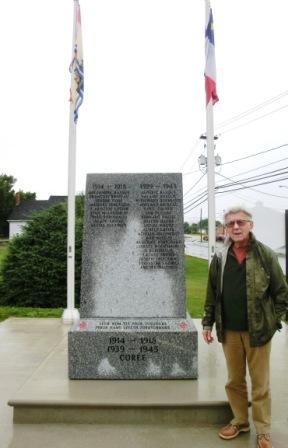
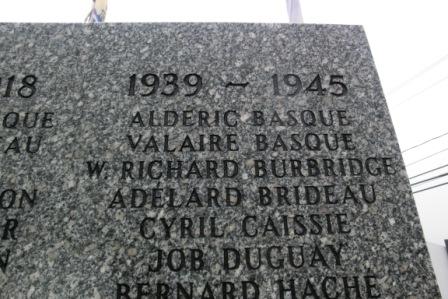
In May 2024, we visited the war memorial in Wellington, Prince Edward Island, where Frank’s name is listed.

CIMG6840 May 27 2024 Wellington Monument - Francis Gallant - photo by Pieter

François ‘Frank’ Gallant is remembered on the war memorial in Wellington, Prince Edward Island.  (Photo credit: Pieter Valkenburg)

…Previous stories about soldiers commemorated in Posterenk….

Do you have photos or information to share? Email Pieter at memorialtrail@gmail.com, comment on the blog, or tweet to @researchmemori1.

© Daria Valkenburg

….Want to follow our research?….

If you are reading this posting, but aren’t following our research, you are welcome to do so.  Our blog address: https://onthewarmemorialtrail.com/

Front cover OnTheWarMememorialTrailinEurope4 countries, 6 weeks, 7,000 km – an unforgettable war memorial journey in Europe…. Daria’s book ‘No Soldier Buried Overseas Should Ever Be Forgotten‘ is available in print and e-book formats.  Net proceeds of book sales help support research costs and the cost of maintaining this blog. For more information see https://nosoldierforgotten.com/ 

You are also invited to subscribe to our YouTube Channel: On The War Memorial Trail With Pieter Valkenburg: https://www.youtube.com/channel/UCJ591TyjSheOR-Cb_Gs_5Kw

Never miss a posting!  Subscribe below to have each new story from the war memorial trail delivered to your inbox.

On The War Memorial Trail….. The WWII Lumberjack From Belledune Killed By Stray Mortar Fire In The Nijmegen Salient

June 24, 2024.  It’s surprising how often a chance meeting will lead to a photo.  In September 2023, while staying at a hotel in Ottawa, Ontario, we were approached by a fellow guest, Victor Richard, who had seen us coming out of our car the day before and had noticed the Prince Edward Island licence plate.  The following day, when he saw us in the lobby, he explained that he was from New Brunswick, the province next to ours. 

….The road to a soldier’s photo can be circuitous….

Victor showed an interest in the On The War Memorial Trail research project.  Pieter asked for his help in finding a photo of a particular soldier, and after we all returned back home, Victor put us in contact with Jean Gaudet.  In the meantime, Pieter had found a photo of the soldier online, as it had recently been posted on the Canadian Virtual War Memorial by Captain (Retired) Etienne L.L. Gaudet. 

Jean knew Captain Gaudet well and very quickly Pieter was put in contact with Etienne, who works diligently in ‘…promoting the memory of soldiers in New Brunswick…’ – as Jean put it.  During the Covid period, Etienne had visited 244 cemeteries, documenting the graves of soldiers across New Brunswick. (See https://www.cbc.ca/news/canada/new-brunswick/nb-veteran-journey-cemeteries-1.6237590)

After learning about the On The War Memorial Trail research project, Etienne emailed Pieter. “God bless you for the work you are doing. I certainly share your passion in ensuring none of these heroes are ever forgotten. I have worked very hard to build the Canadian Virtual War Memorial especially for those soldiers buried in New Brunswick who lacked pictures on the site.

I am now the person responsible for Veterans in Memramcook, which involves organizing our Remembrance Day ceremony and all other things related to honouring those that have served from …Memramcook….

Etienne ended by making an offer to help.  “…Please don’t hesitate to write if I can assist you in any way…

Etienne and Pieter 2

Pieter with Etienne Gaudet.  (Photo credit: Daria Valkenburg)

….An offer to help led to a photo….

Pieter soon asked for Etienne’s assistance with a photo search, asking if he would be willing to contact the family of an Acadian soldier, Edgar M. GUITARD.  “….He lost his life in The Netherlands on the 15th of January 1945. He had 6 brothers and 4 sisters. This morning I called the daughter of his youngest sister Emelia, Nicole Lagace, but she said that she had never heard of Nicole Lagace or Emelia Guitard. I have a feeling that she thought that I was a scammer and did not trust me….. Would you be able to help?….

Pieter hoped that a French-speaking voice on the phone might reassure Nicole Lagace, but Etienne decided to pay a visit in person the following morning.  That evening he reported back. “I was able to speak with Nicole in person. She has a photo of Edgar in her albums, but didn’t have time today to go through them. She apologized for her reaction to your phone call and stated that she has been scammed before and is incredibly careful now….” 

A few days later…success!  Etienne reported that he’d “…received the photo from Nicole Guitard Lagace, who confirms that the gentleman in the photo is her uncle, Edgar M. Guitard.…I do hope his memory can live forever although he died way too young. It was an honour to assist you and help preserve his memory in perpetuity. We will remember them….

Nicole also contacted Pieter, explaining that “…the photo donated by me belonged to my mom.  Thank you very much….” 

….Edgar was born in Belledune….

Screenshot 2024-06-21 at 12-03-44 belledune new brunswick - Google Search

Map shows location of Belledune, New Brunswick, located on Chaleur Bay.  (Map source: Google maps)

Edgar was born on September 17, 1917 in Belledune, New Brunswick, a port village on Chaleur Bay, the son of Jean ‘Mickey’ and Bridgitte Guitard.  One of 11 children, Edgar grew up on his parents’ farm. 

When he enlisted at District Depot No. 5 in Rimouski, Quebec on April 8, 1941, he stated that he had served in the Active Militia since January 1941 – with No. 71 Centre Militaire out of Edmundston, New Brunswick.  He also stated that he was a fisherman during the spring and summer, and had worked as a lumberjack since 1930 for Fraser Brothers, out of Causapscal, Quebec.  Edgar enjoyed snowshoeing and fishing.

His Soldiers Qualification Card noted that he was illiterate, due to not having attended school, and was French speaking.

colourized improved_photo(37)

Edgar M. Guitard. (Photo courtesy of Nicole Lagace.  Photo colourization by Pieter Valkenburg)

Based on his extensive experience as a lumberjack with Fraser Brothers, Edgar was transferred to No. 12 Company of the Canadian Forestry Corps (CFC) in Valcartier, Quebec on April 12, 1941.

Unlike other members of the Canadian Army, members of the Canadian Forestry Corps were not expected to be in combat.  Their role was to help the British with their need for timber.  As stated in an article on http://www.canadiansoldiers.com/corpsbranches/forestrycorps.htm  “wood was needed for living quarters, messes, and recreation facilities, as well as crates for vital supplies such as food, ammunition and even vehicles, and for the creation of explosives, stocks for weapons, the construction of ships, aircraft and factory facilities….

Canada agreed to send workers and equipment to Great Britain, with the Corps Headquarters based in Scotland.  The British designated the areas of work, and the final disposal of the lumber created, but all military operations were under the control of Canadian Military Headquarters in London, England.

Although the men serving in the Canadian Forestry Corps were not in a combat role, they were provided with very rudimentary basic training in using firearms, only because of the impending threat of German invasion.

….Edgar left Canada for overseas service….

After about 6 weeks of basic training, Edgar left Halifax, Nova Scotia for the United Kingdom on June 18, 1941, arriving in Gourock, Scotland on July 2, 1941. He remained with No. 12 Company until September 29, 1943, when he was transferred to No. 11 Company, and then on March 19, 1944 to No. 5 Company. 

The work done by the Canadian Forestry Corps (CFC) included building barracks, roads, bridges, and setting up power plants. They also helped with snow clearance on the highland roads in Scotland. Each company of the CFC had two sections, one cutting in the bush and bringing out the timber, and the other sawing it into lumber at the company mill.

For an idea of the hard work done by the Corps, take a look at this very short British Pathé video Canadian Forestry Corps In Britain (1941)….

It was work that Edgar thrived at, but things were about to change.  By the spring of 1943, a desperate need for more soldiers in the Canadian Army caused several hundred soldiers to be redeployed.  Edgar was able to remain in the United Kingdom until after D-Day on June 6, 1944.

….Edgar was sent to France….

The above referenced Canadian Soldiers article explained that “…..after the landings in Normandy in June 1944, ten companies eventually moved to the Continent to continue operations there; 77 square timber rafts and 54 round timber rafts had been created in Southampton to move timber across the English Channel with them. By the end of August 1944, operations had commenced on the continent….

No. 5 Company was one of these ten companies, now part of the 21st Army Group.  On July 26, 1944, Edgar left for France with No. 5 Company, arriving a day later.

Edgar remained with the No. 5 Company until November 25, 1944, when he was transferred to the X-4 Reinforcement List of the 10th Battalion of the Canadian Infantry Corps.  The lumberjack was now a soldier, even though his training had not prepared him for combat.

….Edgar’s transfer to Le Régiment de la Chaudière was his last….

On January 13, 1945, Edgar was transferred to Le Régiment de la Chaudière and allotted to ‘A’ Company.  The Regiment had wintered in the Nijmegen Salient, while preparing for the upcoming fight in the Rhineland in February 1945.  They were based on the Holthurnsche estate in The Netherlands, near the German border, between the cities of Berg en Dal and Nijmegen.

While on the estate, Edgar was one of two casualties hit by stray mortar fire.  The Regiment’s War diary entry for January 14, 1945, written at 10:30 am….  “…La cie A:  2 casualties par l’action des mortiers allemands….” (English translation: ‘A’ Company: 2 casualties by the action of German mortars.)  He died the following day, aged 27.

Map Jan 14 1945 position of Regt

Location of Le Régiment de la Chaudière on January 14, 1945, near the Dutch/German border. (Map source: Project ’44)

Today the area where the Regiment overwintered is the Hotel Holthurnsche Hof.

footer banner_holthurnsche_hof

Hotel Holthurnsche Hof is now where Le Régiment de la Chaudière was located in mid-January 1945. (Photo source:  http://realhealth.nl/hotel-holthurnsche-hof/)

..…Edgar is buried in Groesbeek …..

Edgar was initially buried in a temporary Canadian cemetery in Nijmegen on January 16, 1945, before being reburied in the Canadian War Cemetery in Groesbeek, The Netherlands on August 7, 1945.

grave stone Edward Guitard from Find A Grave

Grave of Edgar M. Guitard in the Canadian War Cemetery in Groesbeek, The Netherlands.  (Photo source: Find A Grave)

Thank you to Etienne Gaudet for going above and beyond to meet a family member of Edgar Guitard, and to Nicole Lagace for submitting a photo of her uncle. Many thanks also to Victor Richard and Jean Gaudet for connecting the dots that led to us meeting Etienne! Do you have photos or information to share? Email Pieter at memorialtrail@gmail.com, comment on the blog, or tweet to @researchmemori1.

© Daria Valkenburg

….Want to follow our research?….

If you are reading this posting, but aren’t following our research, you are welcome to do so.  Our blog address: https://onthewarmemorialtrail.com/

Front cover OnTheWarMememorialTrailinEurope4 countries, 6 weeks, 7,000 km – an unforgettable war memorial journey in Europe…. Daria’s book ‘No Soldier Buried Overseas Should Ever Be Forgotten‘ is available in print and e-book formats.  Net proceeds of book sales help support research costs and the cost of maintaining this blog. For more information see https://nosoldierforgotten.com/ 

You are also invited to subscribe to our YouTube Channel: On The War Memorial Trail With Pieter Valkenburg: https://www.youtube.com/channel/UCJ591TyjSheOR-Cb_Gs_5Kw

Never miss a posting!  Subscribe below to have each new story from the war memorial trail delivered to your inbox.

On The War Memorial Trail….. The WWII Soldier From Central Blissville Killed Along The Goch-Calcar Road

June 9, 2024. Most of the time, Pieter has good success in finding photos of soldiers named on photo wish lists from the three Canadian War Cemeteries in The Netherlands.  This past winter, however, he ran into one frustration after another.  In most cases, while family of soldiers were found, no one had photos. A few times, family members were found, but did not respond to inquiries. 

..…An old TV program inspired one photo search …..

Pieter was getting a bit discouraged.  It didn’t help that I was not well for much of the winter and spent most of the time reading and watching comedies on TV.  Since we’d been doing research on airmen who had been POWs I began watching Hogan’s Heroes, a comedy about POWs assigned to form a special operations unit in a POW camp run by the Luftwaffe to help prisoners escape and to perform acts of sabotage against the German war effort. A very funny satire and I’m sure that laughing over the antics these men got up to helped me recover more quickly. 

So, when Pieter began looking at his photo wish lists again, he asked if I had any thoughts on which soldier to research.  I didn’t until I noticed a soldier named Carter, who came from a place named Central Blissville.  That’s the guy, I told Pieter.  When he asked why, I told him there was a character on the show named Sgt Carter and who could resist a place named Blissville? Pieter shook his head, but went with my suggestion and within a day had a photo!

Before telling the story of the Canadian soldier named Carter, take a look at this excerpt from Hogan’s Heroes, featuring the fictional American soldier named Carter, portrayed by Larry Hovis, impersonating the German commandant of the POW camp… 

..…The non-fictional Private Carter enlisted in 1941…..

Donald Roy Carter from facebook page Jeremy Carter

Donald Roy Carter.  (Source: Jeremy Carter)

The non-fictional Donald Roy CARTER was born August 4, 1923 in Central Blissville, Sunbury County, New Brunswick, son of Roy William and Josephine ‘Ina’ Helen Carter.  However, when he enlisted at the No. 7 District Depot in Fredericton, New Brunswick, on May 3, 1941, he stated that his birthdate was May 27, 1922.  Since a soldier in active service needed to be 19 years old, Donald fudged his date of birth.

On May 22, 1941, Donald was sent to No. 70 Canadian Army (Basic) Training Camp (CABTC) in Fredericton, New Brunswick for basic training. After completing his basic training, he was transferred to the A22 Canadian Army Medical Corps Training Centre at Camp Borden in Ontario.  Here Donald received advanced training to prepare him as a stretcher bearer, with three key responsibilities when dealing with the wounded in a war zone: stop the bleeding, treat for shock, and evacuate. 

….Donald left Canada for overseas service….

On September 6, 1941, Donald was given embarkation leave of just over a week, and then he found himself on his way to the United Kingdom on October 9, 1941. Upon arrival in Greenock, Scotland on October 19, 1941, he was assigned to No. 1 General Holding Unit.

A Holding Unit was a reinforcement pool where soldiers brought over from Canada received additional training.

On December 13, 1941, Donald was transferred to the 11th Field Ambulance, Royal Canadian Army Medical Corps (RCAMC). A field ambulance was a mobile medical unit which was usually found serving with an infantry division during WWII.

….Donald survived Operation Jubilee – the Dieppe Raid….

Allied Forces had plans for an amphibious attack on the German-controlled port of Dieppe in Normandy, France in 1942, in what would become known as Operation Jubilee, also called the Dieppe Raid.  (See https://en.wikipedia.org/wiki/Dieppe_Raid)

Loading-wounded-on-landing-craft.-Source-Global-News-768x447

Royal Canadian Army Medical Corps personnel treating casualties during rehearsal in England for raid on Dieppe. (Photo Source: Global News)

As part of the preparations, the 11th Field Ambulance underwent training on the Isle of Wight. An exercise on June 4, 1942 included practice in moving casualties from an assault landing craft to an advanced dressing station. They also practiced opposed and unopposed beach landings. Two final, large, exercises took place along the Dorset Coast on June 11-12, 1942 and June 22-24, 1942.

On August 18, 1942, Donald was among the members of the 11th Field Ambulance that assembled at Newhaven, with one bearer section (1 Medical Officer and 18 other ranks) detached to the Royal Regiment of Canada at Portsmouth. They all sailed toward Dieppe at about 9:30 pm. 

Unfortunately, Operation Jubilee was a disaster, particularly for the Canadian soldiers, and the medical unit attached to the Royal Regiment of Canada. 3,623 of the 6,086 Allied forces who landed were killed, wounded, or taken prisoner of war. This included 5,000 Canadians, who suffered a 68 percent casualty rate, with 3,367 killed, wounded, or taken prisoner.

Donald, however, survived and safely returned to the United Kingdom on August 19, 1942, where he remained until shortly after D-Day.

….Donald returned to Normandy in July 1944….

On July 3, 1944, Donald and the 11th Field Ambulance, now part of the 21st Army Group, returned to Normandy, France as the Battle of Normandy continued following the advances made on D-Day on June 6, 1944. 

As the 2nd Canadian Corps advanced in July, the 11th Field Ambulance moved along with them, as part of the 2nd Canadian Infantry Division (along with other medical units).  11th Field Ambulance was tasked with providing support to the 4th Canadian Brigade. During battle on July 18-19, 1944 they treated casualties, before making preparations to move forward on July 20, 1944 for Operation Spring at Verrieres Ridge on July 25, 1944.

normandymapspring

Map shows troop locations for Operation Spring.  (Map source: http://www.canadiansoldiers.com)

Donald survived the fight along the Verrieres Ridge, most likely because the 11th Field Ambulance was not at the front, but was held in reserve in Caen for the 2nd Canadian Motor Ambulance Convoy. (See https://www.canadiansoldiers.com/history/battlehonours/northwesteurope/verrieresridge.htm)

Then, during Operation Totalize on August 7-11, 1944, an offensive designed to break through the German defences south of Caen and toward Falaise, the 11th Field Ambulance was under command of the 2nd Canadian Armoured Brigade.  (See https://en.wikipedia.org/wiki/Operation_Totalize)

….Donald had limited participation in the Battle of the Scheldt….

scheldt2

Map shows location of South Beveland, The Netherlands.  (Map source: http://www.canadiansoldiers.com)

As the Allied forces moved from Normandy into Belgium, and then into The Netherlands for the Battle of the Scheldt,  three Field Ambulances of the 2nd Canadian Division were used in Operation Vitality, the battles for South Beveland for a month from October 2, 1944. 

Each Field Ambulance unit operated an advanced dressing station and a casualty collection post. 11th Field Ambulance evacuated casualties directly to No. 6 Canadian General Hospital in Antwerp, Belgium. (See https://en.wikipedia.org/wiki/Battle_of_the_Scheldt and https://www.oorlogzeeland.nl/index.php/slag-om-de-schelde/scheldeslag-information-in-english)

However, Donald missed much of the action as he was not on active service between October 16 and November 12, 1944.  This effectively ended his time with the 11th Field Ambulance.

….Donald was transferred into the Infantry….

On November 24, 1944 Donald was transferred to the Canadian Infantry Corps, as part of the X4 Reinforcement for the 13th Battalion.  Then, on December 4, 1944 he was assigned to the Essex Scottish Regiment, joining them in Mook, The Netherlands.

On February 16, 1945, the Essex Scottish Regiment left The Netherlands and crossed the border into Germany, at Kleve.  The following day, the war diary reported that the battalion “…moved off to an assembly area between Kleve and Calcar….” in preparation for an attack on the Goch-Calcar Road, which was subsequently delayed until February 19, 1945.

….Heavy fighting along the Goch-Calcar Road proved deadly….

Victory-37 Map Moyland Wood and the Goch Calcar Rd

Moyland Wood and the Goch-Calcar Road, 16-21 February 1945 (Map source: HyperWar: The Victory Campaign [Chapter 18] ibiblio.org)

The war diary for February 19, 1945 noted that the attack on the Goch-Calcar Road resulted in the Regiment fighting “….under a heavy hail of shrapnel and small arms fire. Casualties were fairly heavy….Communications were difficult. Vehicles became bogged in the soft mud, casualties were difficult to evacuate, and guns and ammunition could not get up where they were required….

The battle raged on into the night and then after midnight communications were lost.  The war diary entry for February 20, 1945 continued with an account of the battle.  “… The early hours of the morning were grim ones. Isolated company groups fought on, short of ammunition, burdened with casualties which could not be easily evacuated, and lacking the support of the anti-tank weapons with which to deal with the Mark IV tanks the enemy had marshalled for his counter-attack….

The casualties for the battle numbered “…13 officers and 235 other ranks…” of which about 50 were fatalities.  Among those killed on February 20, 1945 was Private Donald Roy Carter, who lost his life at the age of 21.

 ..…Donald is buried in Groesbeek …..

Donald was temporarily buried near Calcar, Germany, before being reburied the following year in the Canadian War Cemetery in Groesbeek, The Netherlands.
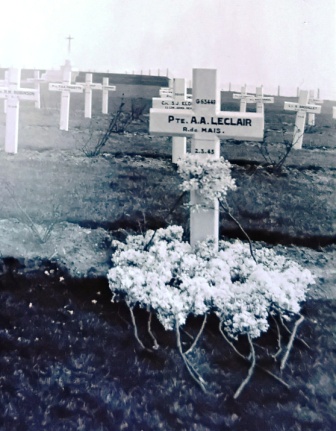
grave stone donald carter from find a grave

Grave of Donald Roy Carter in the Canadian War Cemetery in Groesbeek, The Netherlands.  (Photo source: http://www.findagrave.com)

Do you have photos or information to share? Email Pieter at memorialtrail@gmail.com, or comment on the blog.

© Daria Valkenburg

….Want to follow our research?….

If you are reading this posting, but aren’t following our research, you are welcome to do so.  Our blog address: https://onthewarmemorialtrail.com/
Front cover OnTheWarMememorialTrailinEurope4 countries, 6 weeks, 7,000 km – an unforgettable war memorial journey in Europe…. Daria’s book ‘No Soldier Buried Overseas Should Ever Be Forgotten‘ is available in print and e-book formats.  Net proceeds of book sales help support research costs and the cost of maintaining this blog. For more information see https://nosoldierforgotten.com/ 

You are also invited to subscribe to our YouTube Channel: On The War Memorial Trail With Pieter Valkenburg: https://www.youtube.com/channel/UCJ591TyjSheOR-Cb_Gs_5Kw

Never miss a posting!  Subscribe below to have each new story from the war memorial trail delivered to your inbox.

On The War Memorial Trail….. Commemorating The 80th Anniversary Of D-Day

Screenshot 2024-05-28 at 10-34-30 D-Day 80th Anniversary Banner Decoration - 1.2m

June 1, 2024.  June 6, 2024 marks the 80th anniversary of Operation Overlord (the larger Normandy invasion) and Operation Neptune (the English Channel-crossing portion of Operation Overlord) – what we refer to as D-Day.

….What does D-Day mean?….

Did you know that the ‘D’ in D-Day was a military codeword referring to ‘Departure Day’?  U.S. General Dwight D. Eisenhower, Supreme Commander of the Allied Expeditionary Force in Europe,  noted, through his executive assistant, Brigadier General Robert Schultz: “Be advised that any amphibious operation has a ‘departed date;’ therefore the shortened term ‘D-Day’ is used….

While there were several other D-Days during the war, the invasion of Normandy was the biggest and most well-known. 

…..D-Day was an international effort….

Most people consider D-Day to have been solely a joint British, Canadian, and American effort.  However, it’s important to recognize that over 2 million troops from over 12 countries were in Britain in preparation for the invasion. While Allied forces consisted mainly of American, British, and Canadian troops, smaller contingents included Australian, Belgian, Czech, Dutch, French, Greek, New Zealand, Norwegian, Rhodesian, and Polish naval, air, or ground support!

Dday Invasion-map

D-Day invasion map. The Canadians landed on Juno Beach in Normandy, France. (Map source: https://www.ddaylepe.org.uk/index.php/overlord-neptune/)

On the morning of D-Day, ground troops landed across five assault beaches –Juno, Sword, Gold, Utah, and Omaha.  Canadian soldiers landed at Juno on the outskirts of Bernières.  British forces landed at Sword and Gold, while the Americans landed at Utah and Omaha.

Want to know a bit more about D-Day?  See https://news.sky.com/story/eleven-things-you-might-not-know-about-d-day-13132330  My favourite tidbit is how Hitler slept through the D-Day landings.  Even after he woke up in the late morning he believed it was just a diversionary tactic – and so no reserve troops were immediately sent to Normandy!

….11 servicemen who survived D-Day have been featured on this blog….

Over the past years, we have featured stories of 11 servicemen who were present in Normandy on June 6, 1944. All survived D-Day, but only 1 survived WWII and returned home – Airman Lorne MACFARLANE flew a night mission that coincided with the early morning hours of D-Day and realized afterwards what a lucky escape he and his crew had.  “Our mission was completed.   As we crossed the Channel on the way back, we could see through breaks in the cloud, the wakes of hundreds of ships…” heading towards the French coast.  You can read Lorne’s story here:  https://onthewarmemorialtrail.com/2021/10/20/on-the-war-memorial-trail-the-ww2-pilot-from-pei-who-flew-40-missions-overseas-and-returned-home/

The other 10 are buried in a Canadian War Cemetery in France, The Netherlands, or Belgium.  These men are:

….The actions of D-Day helped shorten WWII….

For a very brief overview of the significance of D-Day, watch this 3 minute CTV video prepared for the 75th anniversary:

….Upcoming Event at the Borden-Carleton Legion….

To commemorate the 80th anniversary of D-Day, the Borden-Carleton Legion will have a wreath laying ceremony by the Cenotaph at 3:00 pm on June 6, 2024.  Pieter and I will be there. All are welcome to attend in honour of those who fought on that day.  The wreath laying ceremony will be followed by a light lunch of hamburgers and hot dogs.

Do you have photos or information to share? Email Pieter at memorialtrail@gmail.com, comment on the blog, or tweet to @researchmemori1.

© Daria Valkenburg

….Want to follow our research?….

If you are reading this posting, but aren’t following our research, you are welcome to do so.  Our blog address: https://onthewarmemorialtrail.com/

Front cover OnTheWarMememorialTrailinEurope4 countries, 6 weeks, 7,000 km – an unforgettable war memorial journey in Europe…. Daria’s book ‘No Soldier Buried Overseas Should Ever Be Forgotten‘ is available in print and e-book formats.  Net proceeds of book sales help support research costs and the cost of maintaining this blog. For more information see https://nosoldierforgotten.com/ 

You are also invited to subscribe to our YouTube Channel: On The War Memorial Trail With Pieter Valkenburg: https://www.youtube.com/channel/UCJ591TyjSheOR-Cb_Gs_5Kw

Never miss a posting!  Subscribe below to have each new story from the war memorial trail delivered to your inbox.

On The War Memorial Trail….. The WWII Signalman From Charlottetown Whose Jeep Ran Over A Mine 6 Days Before The War Ended

May 29, 2024.  This is the 10th year that Pieter has been helping researchers at the Canadian War Cemetery in Holten, The Netherlands to find photos of soldiers buried there.  He began with a list of soldiers who were from Prince Edward Island. It wasn’t until a year later that newspaper articles were published with stories related to Pieter’s research, and three years before this blog began in 2017.   Since then, the scope of his ‘little research project’ has expanded several times to include soldiers from across Canada and several cemeteries.

Back in 2014, Pieter was initially sent a list of 9 names, one of which was Maurice James HUGHES, who was born December 19, 1919 in Charlottetown, Prince Edward Island, the son of James M. and Nora (nee Gallant) Hughes.  

In the search for a photo of Maurice, Pieter ran into one stumbling block after another. He’d found family members, but none ever responded to inquiries.  Then, in the fall of 2019, we met with Ray Arsenault, a member of the Royal Canadian Legion in Charlottetown, who brought a scrapbook he’d received from a friend, Kaye Collins, which contained photos and articles about soldiers from the newspaper.  In a moment of serendipity that happens all too rarely, there was a photo of Maurice! 

CIMG3147 Sep 13 2019 Pieter with Ray Arsenault

Pieter with Ray Arsenault and the scrapbook in which a photo of Maurice James Hughes was found. (Photo credit: Daria Valkenburg)

CIMG3149 Sep 13 2019 Cover of Ray Arsenault notebook

The scrapbook collated by Kaye Collins that contained a picture of Maurice James Hughes. (Photo credit: Daria Valkenburg)

Maurice James Hughes newspaper article from Ray Arsenault

Picture of Maurice James Hughes found in the scrapbook collated by Kaye Collins.

…In 2023 a family member contacted us….

Four years after receiving the photo from Ray Arsenault, Pieter received an email from Lisa Hughes Bell: “… I recently read an article about you, regarding a face for every grave. My Great-Uncle was buried at the Holten Cemetery …. His name was Maurice J. Hughes from Charlottetown….” 

Lisa included a similar photo to what we’d already received.  After acknowledging her email, we received another email.  “…I really don’t know much about Maurice, but am really excited about doing research to find out as much as I can. My Grandfather (Maurice’s brother Frank) was in the Navy and really didn’t talk much about the war. We always knew that he never got over losing his big brother.…” 

As so often happens when family learns that a soldier died so close to the end of WWII, Lisa noted that “…there has always been a sadness in our family about Maurice because he died May 2, 1945, so close to coming home….”  She ended by saying that the family “….would be pleased if you did a story on Maurice…”  Since Maurice’s story had not yet been told on this blog, we decided to do so.

….Maurice was a signalman….

According to a May 10, 1945 obituary in The Guardian, he had been “…a popular member of the Maritime Electric’s staff…” as an assistant fireman before enlisting for active service as a signalman with the No. 6 District Signals, Royal Canadian Corps of Signals (RCCS) in Charlottetown on October 28, 1939. 

A signalman was a specialist responsible for military communications, doing works such as radio or telephone operators, laying cables for communications, and relaying messages for field commanders at the front line.

Before joining the active service, Maurice had joined the No. 6 District Signals militia on May 17, 1937 in Charlottetown. 

After completing his basic training, Maurice was sent to Halifax, Nova Scotia.  Then, on June 16, 1940, he was transferred to No. 3 Canadian Infantry Division, Signals.

On July 5, 1940, he reported for duty at Barriefield Camp in Kingston, Ontario. This was the home of the Royal Canadian Corps of Signals.  NOTE: As of 1966, Barriefield Camp was renamed Canadian Forces Base Kingston (CFB Kingston).

Next, Maurice was sent to Sussex Camp, New Brunswick for training as a linesman on October 15, 1940, and qualified as a Tradesman Group C Linesman on February 25, 1941.

Then, in preparation for overseas service, Maurice was assigned to No. 1 Training Brigade in Debert, Nova Scotia on July 5, 1941.

…Maurice left Canada for overseas service – including D-Day….

On July 19, 1941, Maurice and his Regiment left Canada from Halifax, Nova Scotia, arriving in Avonmouth in the United Kingdom on July 31, 1941.  His training continued, as extensive preparations began for Operation Overlord (the larger Normandy invasion) and Operation Neptune (the English Channel-crossing portion of Operation Overlord) on June 6, 1944 – what we know today as D-Day.

Assigned to the 3rd Canadian Infantry Division, the role of the Signal Corps was to ensure smooth communications on that fateful day. (See https://www.veterans.gc.ca/en/remembrance/history/second-world-war/normandy-1944)

Dday Invasion-map

D-Day invasion map. The Canadians landed on Juno Beach in Normandy, France. (Map source: https://www.ddaylepe.org.uk/index.php/overlord-neptune/)

…Maurice was recommended for a Military Medal for an incident that happened on D-Day….

No mention was made of what Maurice encountered during the day, but just before midnight on June 6, 1944, Maurice and two other signalmen, E. W. MARTIN and J. D. MCPHEE, were near Banville, when they encountered German soldiers.  Lt. (later Captain) J. W. GROSS reported that as the 3 men were ….returning from 7 Canadian Infantry Brigade Headquarters to 12 Canadian Field Regiment with a line, they were 1 ½ miles from our exchange and making a crossing at a crossroads…

They’d encountered sniper fire all night, so Martin was in a ditch, covering the other two with a Bren gun.  Suddenly, “… a German soldier walked out from a side road….” and surrendered.  Unfortunately, a German officer also stepped out and began shooting at Maurice and McPhee, which ended when Martin opened fire.

Then, “....a German Major came up….” and told them that his whole company, part of the 11th Grenadier Regiment, wanted to surrender.   As the Germans “.…came up they handed over their arms and were searched by the three linesmen…”  Within 15 minutes they had 60 prisoners of war.

This was not the end!   “… About 20 minutes later two Canadian officers came upon the scene and joined the three linesmen…” as the contingent, except for Maurice, moved toward Banville.

Maurice “... stayed at the cross roads and 30 more surrendered to him. He moved them along the road and joined the party….” 

After the prisoners of war were taken to the POW cage on the beach, the linesmen continued their work and finished laying the line!

The three linesmen were recommended for a Military Medal for their actions, but sadly, their bravery and actions in having so many Germans surrender to them was not rewarded.  The recommendation for a Military Medal was not approved. 

….A Canadian Army Newsreel film was taken in The Netherlands….

Following upon the success of D-Day, Maurice and his Regiment were involved in the Allied advance through Northwest Europe.  In The Netherlands, a Canadian Army Newsreel briefly filmed members of the Royal Canadian Corps of Signals (RCCS). Film Source: Library and Archives Canada.  Take a look:

….The Regiment moved into Germany on April 26, 1945….

Screenshot 2024-05-26 at 10-13-08 winschoten - Google Search

Map shows location of Winschoten, The Netherlands, as well as Weener and Leer in Germany.  (Map source: http://www.google.ca)

In the last week of April 1945, the Regiment prepared to leave The Netherlands. The after-action report on communications in the Regiment’s War Diary noted that after leaving Winschoten, The Netherlands, the “…Divisional Headquarters moved onto Germany on 26 April 1945…” and re-established “…preparatory for the operation to capture Leer….” on April 28, 1945.

In order to have communications available, a “…cable was taken across the River Ems at Weener, one circuit to connect 7 Canadian Infantry Brigade, which was on the opposite side of the river, and one circuit was extended to the bridge site on the river Leda, ready to be extended when 9 Canadian Infantry Brigade crossed into Leer. A line was laid to 16 Field Company RCE and extended on to a point on the Ems where the rafts were being assembled...

….Maurice lost his life near Leer, Germany….

Lt. Colonel George Clarence LEECH, the Commanding Officer of Maurice’s unit, had recorded in his personal notes that Maurice, whose nickname was ‘Maw’, was very well liked and had not only participated in D-Day, but had been in the front line from then until his death on May 2, 1945 when the jeep he was riding in was hit by a mine.

On May 9, 1945, Lt. Colonel LEECH wrote a letter of condolence to Maurice’s mother, saying that “….Cpl Hughes was killed while riding in a jeep with Sgt Nixon on May 2nd when it ran into an enemy mine and blew up.  He did not suffer at all as death was instantaneous….”  Sgt E. C. ‘Nick’ NIXON was seriously wounded, but survived.

Lt. Colonel Leech went on to note that “…Maurice was one of my finest Corporals.  Since enlisting in 1939, he has given everything for the cause which we have been fighting for have at lost won…” Germany had signed an unconditional surrender, ending the war in Europe, on May 8, 1945, just a few days after Maurice lost his life.

.…Maurice is buried in Holten ….

Initial burial in Ihrhove The Coordinate Translator

Map shows location of Ihrhove, Germany, where Maurice James Hughes was initially buried.  (Map source: Google)

Maurice was originally buried in a temporary Canadian Military Cemetery in Ihrhove, Germany.  In his letter, Lt Colonel Leech wrote that the “…burial service was conducted by Father McCarney…” and that “….most of the men of his section attended his funeral…

On March 12, 1946, Maurice was reburied in the Canadian War Cemetery in Holten, The Netherlands.

Hughes MJ Maurice James F26373

Grave of Maurice James Hughes in the Canadian War Cemetery in Holten, The Netherlands.  (Photo courtesy of the Canadian Virtual War Memorial)

After the war ended, many Dutch people adopted a soldier’s grave, as a way to give thanks for the sacrifices made by Allied soldiers.  Maurice’s grave was adopted by Mr. J. Schut from Deventer.  In a January 14, 1949 letter to the Department of Defence, he stated that he was 38 years old and asked that his letter be sent to Maurice’s family so they would know that Maurice would not be forgotten.  An abridged English translation of his letter was forwarded to Maurice’s father on February 28, 1949. 

Thank you to Ray Arsenault for providing a photo from the scrapbook collated by Kaye Collins, and to Lisa Hughes Bell for sharing how the family felt about the loss of Maurice. Do you have photos or information to share? Email Pieter at memorialtrail@gmail.com, comment on the blog, or tweet to @researchmemori1.

© Daria Valkenburg

….Want to follow our research?….

If you are reading this posting, but aren’t following our research, you are welcome to do so.  Our blog address: https://onthewarmemorialtrail.com/

Front cover OnTheWarMememorialTrailinEurope4 countries, 6 weeks, 7,000 km – an unforgettable war memorial journey in Europe…. Daria’s book ‘No Soldier Buried Overseas Should Ever Be Forgotten‘ is available in print and e-book formats.  Net proceeds of book sales help support research costs and the cost of maintaining this blog. For more information see https://nosoldierforgotten.com/ 

You are also invited to subscribe to our YouTube Channel: On The War Memorial Trail With Pieter Valkenburg: https://www.youtube.com/channel/UCJ591TyjSheOR-Cb_Gs_5Kw

Never miss a posting! Subscribe below to have each new story from the war memorial trail delivered to your inbox.

On The War Memorial Trail…..The WWII Soldier From Stellarton With A Street Named In His Honour

Lt. Percy Dexter Higgins

Percy Dexter Higgins.  (Photo courtesy of the Higgins Family)

May 6, 2024. In a January 2021 posting in the Atlantic Canada Remembers series, we wrote about Percy ‘Dexter’ HIGGINS of Stellarton, Nova Scotia, who was serving with the North Nova Scotia Highlanders when he lost his life during the Battle of Warnsveld in The Netherlands on April 4, 1945. (See https://onthewarmemorialtrail.com/2021/01/16/on-the-war-memorial-trail-atlantic-canada-remembers-part-3/)

Screenshot 2024-04-24 at 10-46-59 warnsveld - Google Search

Map shows location of Warnsveld, The Netherlands.  (Map source: Google)

Warnsveld is located in the eastern part of The Netherlands about 2 km (1.2 miles) from Zutphen.  Not long after the article was posted, we received an email from Warnsveld resident Harm Kuijper, advising that there was a proposal to name a street after Dexter, near where he lost his life. 

Harm asked if we would contact Dexter’s family about this initiative, which we did.  Donald Higgins had submitted a photo of his uncle, Percy ‘Dexter’ HIGGINS, writing that “…My father’s brother, Lt. Percy Dexter Higgins, is buried in Holten Cemetery. He served with North Nova Scotia Highlanders R.C.I.C. (from N.S.)…

…A street in The Netherlands was named for Dexter in 2024 …..

On April 5, 2024, Harm contacted us again, this time to let us know that Higginsstraat (Higgins Street) had been unveiled the day before.  “Higginsstraat was officially unveiled yesterday…..” he wrote.  “…. We had the Canadian ambassador visiting, who was able to attend our first two commemorations. Then unfortunately he had to return to The Hague due to commitments. Sergeant Nicole Mitchell then revealed the street name together with the Mayor of Zutphen….

Harm also included a link to a Dutch language article from ‘Achterhoek Nieuws’:  https://www.contactzutphen.nl/nieuws/algemeen/482711/onthulling-straatnaambord-markeert-herdenking-bij-het-witte-k

An English translation of the article is below:

Screenshot 2024-04-15 at 11-39-35 Onthulling straatnaambord markeert herdenking bij het Witte Kruisje

Unveiling of the street sign honouring Lieutenant Percy Dexter Higgins. Photo: Henk Derksen.  Left to right: Barry and Yvonne Swarthoff from RCL Branch 5, Harm Kuijper, Sgt Nicole Mitchell of the Canadian Army, Zutphen mayor Wimar Jaeger, Wim Poppink from RCL Branch 5.

Unveiling of the street name sign marks the commemoration at the Witte Kruisje 

ZUTPHEN – Every year the commemoration is held at the Witte Kruisje (White Cross) in Leesten in honour of the Canadian corporal A.P. Periard, who was killed on April 4, 1945. This year the commemoration took on a special character due to the presence of the Canadian ambassador, relatives of Private Harry Gervais, and the unveiling of a street sign in honour of Lieutenant Percy Dexter Higgins. 

For this special occasion, the 48th Highlanders Pipes And Drums and the Royal Canadian Legion Branch 005 were also present. The commemoration at the Witte Kruisje was led by group 6 of the Lea Dasbergschool, where Mrs. Ineke Hissink welcomed those present. Mayor Wimar Jaeger addressed those present and laid a flower arrangement, followed by the ambassador and other attendees. 

After two minutes of silence, the Wilhelmus (Dutch National Anthem) and the Canadian National anthem were played and sung. Students from the Lea Dasbergschool recited poems and placed their flower arrangements. 

Afterwards, the students returned to school, while the other guests moved to the Canadian monument on Kerkhofweg. This monument contains the names of 35 Canadian and one English soldier who died during the liberation of Warnsveld and Zutphen. Harm Kuijper, the Canadian ambassador (Hugh Adsett), Mayor Jaeger, and Scott Gravel spoke at this monument. Flowers were laid and after a moment of silence the national anthems were played and sung. 

Finally, all those present returned to Leesten, where Mayor Jaeger, together with Sergeant Nicole Mitchell, unveiled the street sign in honour of Lieutenant Percy Dexter Higgins, who was killed on the grounds of the Groot Graffel (now GGnet)….

Private Harry Louis GERVAIS, son of Moise and Hattie-Mae Gervais, of La Passe, Ontario, died April 4, 1945 while serving with the Stormont, Dundas and Glengarry Highlanders, aged 19, and is also buried in the Canadian War Cemetery in Holten, The Netherlands.

..…Who was Percy ‘Dexter’ Higgins? …..

Born October 4, 1921 in Stellarton, Nova Scotia, Dexter was the son of Percy Dowell and Evangeline Higgins. On June 28, 1938, Dexter joined ‘C’ Company of the Pictou Highlanders Militia in Stellarton, giving his year of birth as 1919, to make him two years older.  In reality, he was still in high school.

On October 12, 1939 he signed up for active service with ‘C’ Company of the Pictou Highlanders in Stellarton, this time using his actual birth year.  At this point in time Dexter was working as a grocery clerk for Blair Brothers, a retail store in Stellarton. 

Dexter was transferred to Amherst, Nova Scotia and the North Nova Scotia Highlanders, 3rd Division, on October 26, 1940.   In an interview for his Occupational History Form, it was recorded that in addition to being fluent in English, he was able to read French.

….Dexter left Canada for overseas service….

On July 7, 1941, Dexter was sent to Debert, Nova Scotia, in preparation for overseas service.  Dexter and his fellow North Novies boarded the ‘Orion’ on Halifax, Nova Scotia on July 19, 1941, arriving in Avonmouth, United Kingdom on July 31, 1941.

Dexter qualified as a Clerk Group C on June 24, 1942 and was promoted to Lance Corporal from Private on May 27, 1943.

On November 1, 1943, Dexter received permission to marry Elizabeth Mary Minihane, of Cowfold, Sussex, England.  They married in West Grinstead not long afterwards.

Dexter was then attached, for all purposes, to No. 1 Canadian Officers Cadet Training Unit (OCTU) School on December 15, 1943. His daughter Carol Anne was born on March 30, 1944, just ahead of his transfer to No. 4 Canadian Infantry Reinforcement Unit (CIRU) on April 4, 1944.

On May 1, 1944, Dexter was selected for officers training and sent to No. 1 Pre-Officers Cadet Training Unit School, receiving a commission as Lieutenant on November 16, 1944. 

He next was sent to the Canadian Military Headquarters (CMHQ) course on January 28, 1945, which he completed on March 12, 1945.  A few days later, on March 16, 1945, Dexter was transferred to the X-4 Reinforcement List of the Canadian Infantry Corps.

The next day, March 17, 1945, he left for North West Europe, arriving the following day.  On March 27, 1945, he returned to the North Nova Scotia Highlanders, and assigned to ‘B’ Company the following day.  He joined the North Novies in Rees, Germany, as one of the reinforcements following the losses of 39 men during the Battle of Bienen two days earlier. (For links to previous stories told about North Novies killed during this battle, see https://onthewarmemorialtrail.com/2023/09/02/on-the-war-memorial-trail-honouring-the-memories-of-the-north-novies-who-lost-their-lives-during-the-battle-of-bienen/)

Dexter’s lack of actual combat experience would soon prove deadly, as the battle-hardened North Novies moved towards German/Netherlands border and into The Netherlands for the upcoming Battle of Warnsveld.       

..…Dexter died during the night of April 4-5, 1945 …..

Dexter lost his life during the Battle of Warnsveld which began late in the day on April 4, 1945. Three accounts state he died on April 4, 1945, while his service file states April 5, 1945.  The discrepancy between the accounts and the service file is likely because April 5 is when his body was retrieved.

An account of the events is in Will R. Bird’s ‘No Retreating Footsteps… the story of the North Novas’: “…. April 4th was bright and sunny…The Brigadier arrived and the Novas’ next objective was the town of Warnsveld…. The troops were carried in vehicles to a debussing point in the woods…… there was a delay as a huge crater in the road had to be filled by the Sappers before the ‘Wasps’ could get over. Then the tanks had not arrived and the company could not get forward until 1730 hours. ‘A’ Company started to hit snipers in concealed positions and progress was slow as each house had to be searched in turn….

Bird’s account mentions what happened next. “….There was considerable shooting going on in various spots and ‘B’ Company sent a platoon to make sure of an area between them and ‘A’ Company.  Lt Higgins was in command. There was open ground to be crossed with a fence running at an angle. Three attempts to get over were driven back by machine gun fire.  Lt Higgins then tried to lead a rush up by the cover of the fence and was killed as he jumped over on the other side….

..…The war diary for the North Novies also states Dexter died April 4, 1945 …..

The war diary entry for April 4, 1945 for the North Nova Scotia Highlanders also states that Lt Higgins died on April 4, 1945.  “…The Brigadier came to see the Commanding Officer at 1150 hours and gave to the North Nova Scotia Highlanders as their next objective, the town of Warnsveld, code name DAFFODIL….

As reported in Will Bird’s account, the actual battle began at 5:30 pm.  Over the course of the evening, one platoon of ‘B’ Company “…had been sent to clear the area between them and ‘A’ Company and while doing so they came under Machine Gun fire and Lt. P. Higgins was killed. The troops ‘A’ Company were meeting were 16 years old, who were fighting fanatically and surprisingly well with very little support outside of machine guns and bazookas…

‘A’ Company reached its position by 11:00 pm, and reported that “…they sent back 18 prisoners of war, all young fanatics….

The fight continued into the night.  Shortly after midnight, the war diary entry for April 5, 1945 noted that “…at this point of the attack ‘A’ Company became involved in a fierce fight for a hospital in the woods…The Germans were well dug in and held a fairly strong position…..By 0300 hours ‘A’ Company reported the hospital and woods cleared…” 

..…A former Warnsveld resident related an eyewitness account that also stated Dexter had died April 4, 1945…..

After the original posting about Percy ‘Dexter’ Higgins in 2021, we also received an email from retired United Church Minister, Reverend Henk Dykman, who grew up in the Warnsveld area, and now lives in Ontario.  The North Nova Scotia Regiment “….had on the 4th of April 1945 its worst day of all of their campaign in The Netherlands…

Henk then explained that he had been told a slightly different account of how Dexter had died than was in Will Bird’s book, while at a reunion of North Nova Scotia Highlanders in Guelph, Ontario in the 1990s. “….The official records of the North Novas do not mention it, but he died in front of the large main building of Het Groot Graffel, a psychiatric hospital. The actual date was April 4 around 10:00 pm but we hang on to April 5, when his body was recovered…

Henk recalled being approached by veteran Vincent HULL.  “ ‘I heard you mentioning Dexter Higgins to someone. I was in his platoon and with him when he died’ Hull said….

Henk asked for more information as Dexter had died a bit less than one kilometre (0.6 mile) north of the teacherage where Henk’s father was principal at the elementary school and where Henk grew up.

….Vincent grabbed a piece of paper and drew a little map. I recognized right away what he was drawing. ‘We came from the north over a low sandhill to a highway and ducked into a dry ditch. On the other side of the road was a wood with here and there some buildings. We could see them well because of the floodlights which were bounced off low clouds and gave a diffused shine. On several roofs were red crosses. It was obviously a hospital.’ ”  This most likely is the hospital mentioned in the war diary.

Henk recalled Vincent’s words.  “…. ‘We better radio the company to give our position, I said to Dexter.’  Dexter decided to investigate further, however, saying “ ‘Well, it’s quiet now, there is a road over there, let’s move on’….

Vincent then explained how Dexter lost his life. “…We went to a wide lane towards the biggest building, Dexter in front. He had not gone far on that lane when a machine gun opened up from a small window in the roof and shot him. A sergeant and a corporal were wounded as we ran back to the ditch as fast as we could. Everything was quiet again and after we bandaged the wounded we decided to stay where we were. It was before midnight and we did not move till dawn. We saw quite a few German soldiers retreating, but they did not see us. At dawn we saw our comrades from ‘A’ Company moving from one building to another so we got up and went again towards that big one….” 

….So that was Vincent’s story and the details fitted my memories about where it was very well….” Henk wrote.  “….Dexter was the only Canadian killed at that hospital. So now he will be honoured with a street name at a new subdivision south of the hospital….

..…Dexter is buried in Holten …..

Dexter was originally buried in the Civilian Cemetery in Warnsveld, before being reburied in the Canadian War Cemetery in Holten. 

Grave of Percy Dexter Higgins CVWM

Grave of Percy ‘Dexter’ Higgins in the Canadian War Cemetery in Holten, The Netherlands.  (Photo courtesy of the Canadian Virtual War Memorial)

An error was made in recording the date of Dexter’s death as April 7, 1945 on the Canadian Virtual War Memorial and on his gravestone.  The family was provided with the service file records should they wish to ask the Commonwealth War Graves Commission for a correction to be made on his gravestone, and for a correction to be made on the Canadian Virtual War Memorial. 

Thank you to Donald Higgins for providing a photo, to Harm Kuijper for letting us know about the street naming ceremony, and to Henk Dykman for relating the story he’d heard about how Lt Higgins died. Do you have photos or information to share? Email Pieter at memorialtrail@gmail.com, comment on the blog, or tweet to @researchmemori1.

© Daria Valkenburg

….Want to follow our research?….

If you are reading this posting, but aren’t following our research, you are welcome to do so.  Our blog address: https://onthewarmemorialtrail.com/

Front cover OnTheWarMememorialTrailinEurope4 countries, 6 weeks, 7,000 km – an unforgettable war memorial journey in Europe…. Daria’s book ‘No Soldier Buried Overseas Should Ever Be Forgotten‘ is available in print and e-book formats.  Net proceeds of book sales help support research costs and the cost of maintaining this blog. For more information see https://nosoldierforgotten.com/ 

You are also invited to subscribe to our YouTube Channel: On The War Memorial Trail With Pieter Valkenburg: https://www.youtube.com/channel/UCJ591TyjSheOR-Cb_Gs_5Kw

Never miss a posting!  Subscribe below to have each new story from the war memorial trail delivered to your inbox.