On The War Memorial Trail….A Visit To Sleen General Cemetery

June 15, 2025.  On April 26, 2025 we travelled to Schoonebeek in the province of Drenthe, The Netherlands, to meet Yannic Wethly, one of the volunteers at the Air Research Drenthe Foundation (Stichting Luchtoorlog Onderzoek Drenthe).  This non-profit organization researches WWII air crashes in the province and places information panels near the crash sites.

We’d been involved with a similar organization in the province of Friesland, Missing Airmen Memorial Foundation, to honour the crew of the last flight of Halifax L9561 in which the pilot, Elmer Bagnall MUTTART of Cape Traverse, Prince Edward Island, lost his life. This led to a memorial panel being placed outside the village of Wons on October 12, 2019. (See https://onthewarmemorialtrail.com/2019/11/18/on-the-war-memorial-trail-the-memorial-panel-in-wons-is-unveiled/)

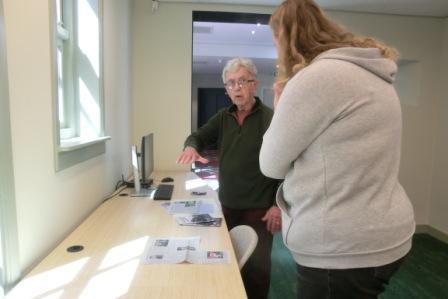
Yannic had gotten in contact about the last flight of Halifax DT630, in which the pilot, Jack Douglas MACKENZIE of Winnipeg, Manitoba, and three other crew members, lost their lives.  We’ve stayed in touch, and were happy to meet Yannic in person at an excellent exhibition that the organization held in Schoonebeek, entitled ‘The Last Flight – The airwar around Schoonebeek’.

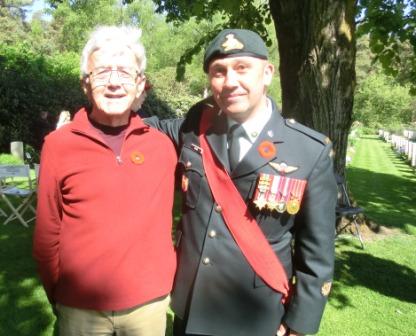
Pieter and Daria with Yannic Wethly of the Air Research Drenthe Foundation.  (Photo courtesy of Valkenburg Family)

After touring the exhibit, we were joined by Yannic’s father, and in the end we were in Schoonebeek for 2 hours!

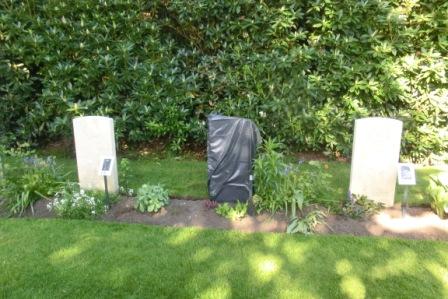
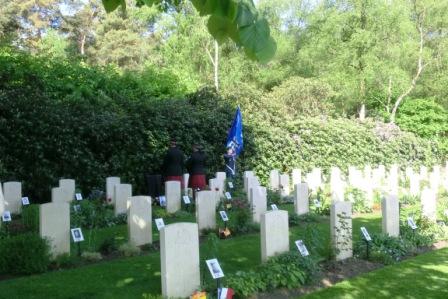
….Our first flags were placed at 4 graves in Sleen General Cemetery…

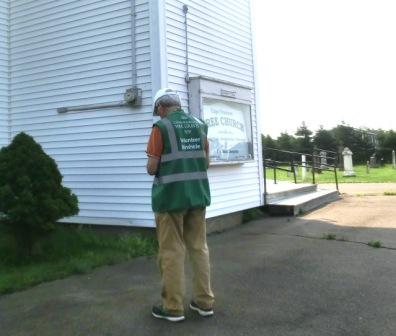
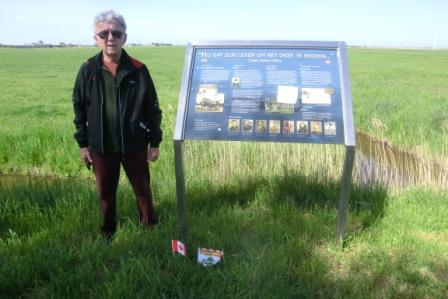
The village of Sleen was not far away from Schoonebeek.  (Photo credit: Daria Valkenburg)

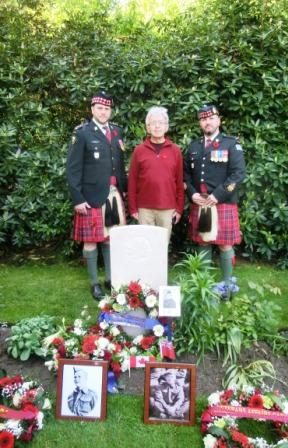
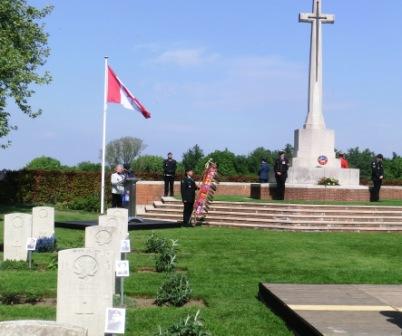
From Schoonebeek we went to Sleen General Cemetery to honour the 4 airmen who lost their lives on February 3, 1943 during the last flight of Halifax DT630 (call sign VR-T), one of 8 heavy Halifax bombers sent on a night raid to Hamburg, Germany. 

The cemetery was outside the village of Sleen, and off of a narrow lane, with a farmer’s field on the other side of the cemetery.

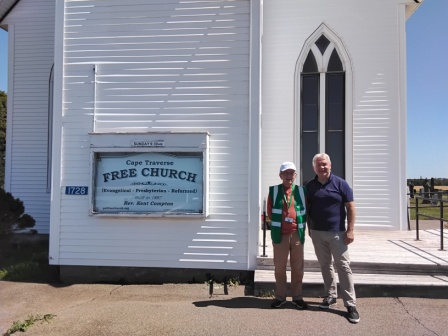
Sign directing us to Sleen General Cemetery. (Photo credit: Daria Valkenburg)

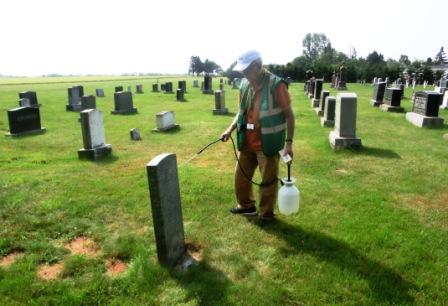
We didn’t know what to expect once we turned into the tree-lined entrance to the cemetery. It was much larger than we thought, and very well-maintained. 

The tree-lined entrance from the road into Sleen General Cemetery provided an aura of serenity. (Photo credit: Daria Valkenburg)

Out of a crew of 7, four men, all with the Royal Canadian Air Force (RCAF), died and are buried in Sleen:

  • Pilot P/O Jack Douglas MACKENZIE of Winnipeg, Manitoba
  • Flight Engineer Sgt. William Peter DUTHIE of Winnipeg, Manitoba
  • Air Gunner W/O II Raymond Hepton HILL of Montreal, Quebec
  • Air Gunner W/O II Lennox Alwin GONNETT of Westmount, Quebec

You can read Jack Douglas MacKenzie’s story at https://onthewarmemorialtrail.com/2023/02/19/on-the-war-memorial-trail-the-wwii-pilot-killed-at-the-controls-of-his-halifax-bomber/

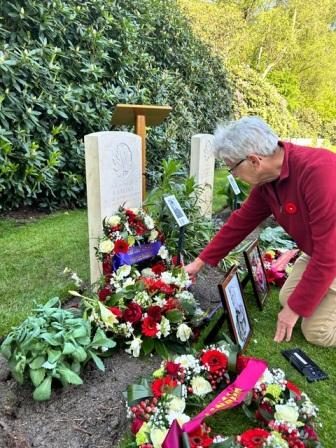
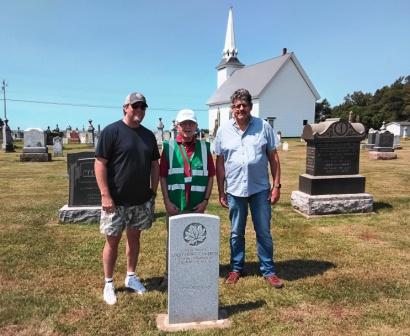
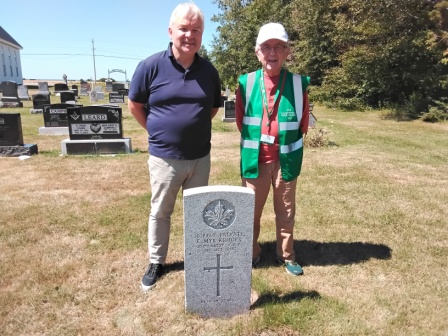
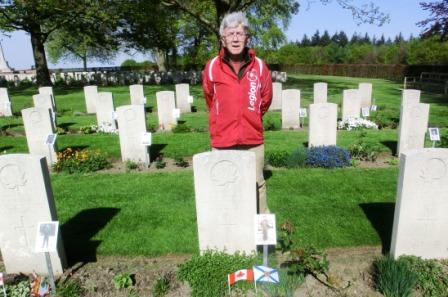
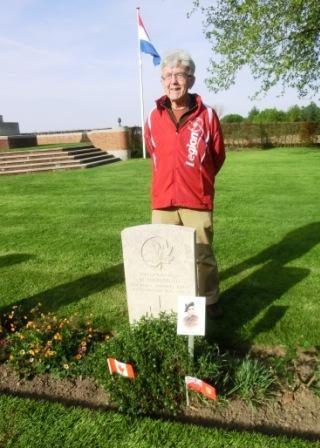
After placing Canadian and provincial flags, Pieter paid his respects by the graves of the 4 airmen.  (Photo credit: Daria Valkenburg)

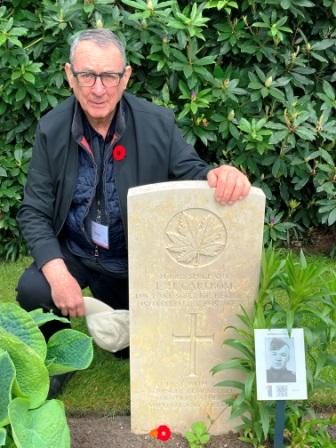
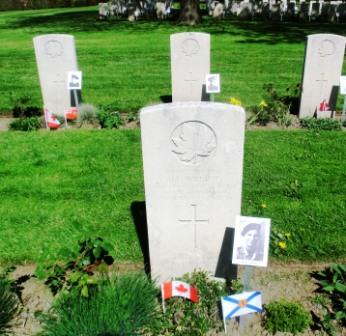
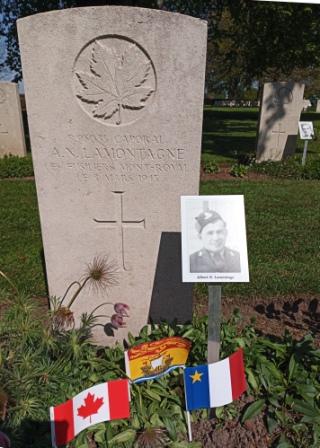
Canadian flags were placed at all four graves.  Manitoba flags were placed at the graves of Jack Douglas MacKenzie and William Peter Duthie.  Quebec flags were placed at the graves of Raymond Hepton Hill and Lennox Alwin Gonnett.

Pieter by Jack MacKenzie’s grave in Sleen General Cemetery. (Photo credit: Daria Valkenburg)

The three surviving crew members – 2 from the RCAF and 1 from the Royal Air Force (RAF) – spent the remainder of the war years in prisoner of war camps:

  • Navigator Sgt. William Nelson GARNETT, RCAF
  • Bomb Aimer Sgt. Eric Raymond MARQUAND, RCAF
  • Rear Air Gunner F/Sgt. Alexander Henry MILTON, RAF

Sleen General Cemetery was the first of 14 cemeteries that we visited during our trip, and the first 4 graves, out of a total of 383 graves, at which Pieter placed flags. All of the flags placed on our war memorial tour had been donated, as mentioned in an earlier posting. (See https://onthewarmemorialtrail.com/2025/06/04/on-the-war-memorial-trail-flags-and-pins-received-for-our-2025-european-war-memorial-tour/)

Thank you to the following for the donation of flags placed at the graves in Sleen General Cemetery:

  • Mario Henry and his brother Etienne Henry, who donated the Quebec flags
  • Wayne Ewasko, MLA for Lac Du Bonnet, Manitoba, Interim Leader of the Official Opposition, Province of Manitoba, who donated the Manitoba flags
  • Alan Waddell, Constituent Assistant, on behalf of Heath MacDonald, MP (Member of Parliament) for Malpeque, PEI, who donated the Canadian flags

Over the next several postings, we’ll continue to share the highlights of our adventures on the 2025 European War Memorial Tour.  Next up on our journey of remembrance is the Canadian War Cemetery in Groesbeek, where Pieter placed flags at 120 graves.

Now that we’re back home, the research work continues for Pieter.  If you have photos or information to share about soldiers buried in The Netherlands or Belgium, please email him at memorialtrail@gmail.com, or comment on the blog.    

© Daria Valkenburg

….Want to follow our research?…

If you are reading this posting, but aren’t following our research, you are welcome to do so.  Our blog address: https://onthewarmemorialtrail.com/
4 countries, 6 weeks, 7,000 km – an unforgettable war memorial journey in Europe…. Daria’s book ‘No Soldier Buried Overseas Should Ever Be Forgotten‘ is available in print and e-book formats.  Net proceeds of book sales help support research costs and the cost of maintaining this blog. For more information see https://nosoldierforgotten.com/

Subscribe to our YouTube Channel: On The War Memorial Trail With Pieter Valkenburg: https://www.youtube.com/channel/UCJ591TyjSheOR-Cb_Gs_5Kw

Never miss a posting!  Subscribe below to have each new story from the war memorial trail delivered to your inbox.

On The War Memorial Trail…Holten Rolled Out A Warm Welcome

June 12, 2025. During the first part of our 2025 European War Memorial Tour we stayed in the village of Holten, just a few kms from the Canadian War Cemetery outside the village.  We’d been in Holten several times over the years, but this year we saw Canadian flags everywhere – on roundabouts, streets, houses, and businesses – all commemorating 80 years of freedom.  Who knew that orange and red looked so good together?  It quickly became our favourite colour combination!

Pieter by a roundabout in the village of Holten, The Netherlands. (Photo credit: Daria Valkenburg)

Houses in the village of Holten were bedecked with streamers and Canadian flags. (Photo credit: Daria Valkenburg)

Several signs along the street commemorated 80 years of freedom and showed Canadian and Dutch flags. (Photo credit: Daria Valkenburg)

It was a heartwarming welcome to the many Canadian visitors who made their way to the village enroute to the Canadian War Cemetery in Holten. We were just two of those visitors.

….The author and translators of ‘Holten Heroes’ finally meet in person!….

While we were in Holten, we had the opportunity to finally meet in person with Jan Braakman, whose book we had translated into English during the Covid years when we were all housebound. ‘Holten Heroes: Stories from a Canadian Field of Honour’ was translated by us from the original Dutch book ‘Holtense Canadezen’ that Jan wrote. (See https://onthewarmemorialtrail.com/2023/11/01/new-book-about-soldiers-buried-in-the-canadian-war-cemetery-in-holten-the-netherlands/)

Of course, we made sure to take a photo of the three of us with both versions of the book!

Pieter and Daria with Jan Braakman, and the English and Dutch versions of Jan’s book. (Photo credit: Trudy van ‘t Hoff)

The translators with the English language edition of ‘Holten Heroes’.  (Photo courtesy of Valkenburg family)

….We met 3 students from Rijssen….

Left to right:  Jan Braakman, Roselle de Jong, Manon ten Hove, Lieke Brinks, Jorina Lensink (teacher), Pieter Valkenburg, Henk Vincent. (Photo credit: Daria Valkenburg)

Pieter was invited by Henk Vincent, one of the volunteers at the Canadian War Cemetery in Holten, to meet with 3 high school students from Jacobus Fruytier Scholengemeenschap in Rijssen, plus their teacher, Jorina Lensink.  Roselle de Jong, Manon ten Hove, and Lieke Brinks are 16 years old and had done research on Canadian soldiers.  Ms Lensink explained that the research of soldiers was part of their history exams.

All of the soldiers researched are buried in the Canadian War Cemetery in Holten.  I asked how they chose a soldier, and learned that the names had been given to them by Henk.  Pieter briefly looked at their papers and said they had done a fantastic job of research.

Roselle had studied Victor Lloyd CARPENTER of Fort Frances, Ontario, who died April 27, 1945, aged 22, while serving with the South Alberta Regiment. 

Manon had studied Neil Patrick O’Connor STEWART of St. Paul, Alberta, who died April 8, 1945, aged 20, while serving with the South Saskatchewan Regiment.

Lieke had studied two soldiers:  Clarence Warren LORENSEN, who died April 2, 1945, while serving with the South Alberta Regiment, and Lyle Lewis CRAIG of Paddockwood, Saskatchewan, who died April 19, 1945, while also serving with the South Alberta Regiment. 

Over the next several postings, we’ll continue to share the highlights of our adventures on the 2025 European War Memorial Trail….including the various cemeteries we visited along our journey of remembrance.

Meanwhile, now that we’re back home, the research work continues for Pieter.  If you have photos or information to share about soldiers buried in The Netherlands or Belgium, please email him at memorialtrail@gmail.com, or comment on the blog.    

© Daria Valkenburg

….Want to follow our research?…

If you are reading this posting, but aren’t following our research, you are welcome to do so.  Our blog address: https://onthewarmemorialtrail.com/

4 countries, 6 weeks, 7,000 km – an unforgettable war memorial journey in Europe…. Daria’s book ‘No Soldier Buried Overseas Should Ever Be Forgotten‘ is available in print and e-book formats.  Net proceeds of book sales help support research costs and the cost of maintaining this blog. For more information see https://nosoldierforgotten.com/

Subscribe to our YouTube Channel: On The War Memorial Trail With Pieter Valkenburg: https://www.youtube.com/channel/UCJ591TyjSheOR-Cb_Gs_5Kw

Never miss a posting!  Subscribe below to have each new story from the war memorial trail delivered to your inbox.
On The War Memorial Trail…..The Inclusion Of Acadian Flags On The 2025 European War Memorial Tour Received Publicity

June 8, 2025.  In planning for the 2025 European War Memorial Tour, we were very grateful for help we received in getting flags and pins to take with us.  The many donors were identified and thanked in the previous posting.  (See https://onthewarmemorialtrail.com/2025/06/04/on-the-war-memorial-trail-flags-and-pins-received-for-our-2025-european-war-memorial-tour/)

Simone Comeau, of Nova Scotia, is the niece of Pte Joseph ‘Ambroise’ COMEAU, an Acadian soldier, whose story was told several years ago on this blog.  (See https://onthewarmemorialtrail.com/2021/05/17/on-the-war-memorial-trail-a-tragic-drowning-on-the-leda-river-in-germany-part-3/) She ensured that we received Acadian flags from La Société acadienne de Clare when she learned about the planned tour! 

When she told us that French language media in Nova Scotia was interested in interviewing her about sending us Acadian flags and in learning more about her uncle, we asked if the media could include the names of 4 Acadian soldiers from Nova Scotia whose photos Pieter has yet to find. 

Simone was subsequently interviewed this past winter on the radio by Colette Deveau of Radio-Canada’s La Mouvée, and in ‘Le Courier’ newspaper by Richard Landry.  Both interviews included the names of the 4 soldiers for which photos are still missing.

….Simone Comeau was interviewed by Richard Landry for the ‘Le Courier’ newspaper…

The following is a translation into English (by me) of an article in French by Richard Landry published in the February 21, 2025 edition of ‘Le Courier’: https://lecourrier.com/nos-communautes/nos-communautes-clare/2025/02/21/ambroise-comeau-parmi-55-soldats-acadiens-honores-avec-un-drapeau-acadien-aux-pays-bas/.  The article includes the backstory of how we met Simone, while researching her uncle’s story, as well as the donation of Acadian flags for the 2025 European War Memorial Tour.

 “…Ambroise Comeau among 55 Acadian soldiers honoured with an Acadian flag in the Netherlands

Simone proudly shows off a photo of her uncle Ambroise Comeau’s grave in the Netherlands. Credit: Richard Landry

SAULNIERVILLE – Simone Comeau of Meteghan, niece of Ambroise Comeau (born in Saulnierville), who lost his life defending Holland during the Second World War, has just paid a special tribute to her uncle. For the first time, Acadian soldiers from the Maritimes buried in Holten, Netherlands, will have an Acadian flag placed on their graves, thanks to Simone’s efforts.  (NOTE: Acadian soldiers buried in Groesbeek, Bergen Op Zoom, and Adegem (Belgium) also received flags.) 

Pieter Valkenburg, originally from Holland, lives in Prince Edward Island with his Canadian wife, Daria. He became Canadian and is a former Dutch diplomat. The couple has been working for some time on a research project called On The War Memorial Trail, which aims to find information about Maritime soldiers who served in the liberation of Holland during the Second World War. (NOTE: The research project also features soldiers from other Canadian provinces.)

Private Ambroise Comeau died during World War II in Germany. Credit: Photo from the Simone Comeau collection

Among all the soldiers killed there, they discovered 55 Acadian soldiers from the region who died there during this war, including Ambroise Comeau from Saulnierville, who died during the war in Germany at the age of 21 in 1945.  

Ambroise’s niece, Simone Comeau, of Meteghan, a retired teacher and school principal, conducted extensive research on her uncle after discovering that the Valkenburgs were looking for information. It all began four years ago. She has since accumulated a large file on her uncle. 

The Valkenburgs regularly visit the graves of Maritime soldiers in Holland. This year, on the occasion of the 80th anniversary of the end of the Second World War, they will return there in April. In the past, they have placed Canadian and provincial flags on the graves of all Maritime soldiers. This year, for the first time, they will also place an Acadian flag on the 55 graves of Acadian soldiers. 

Pieter asked Simone to find small Acadian flags to place on the graves of these Acadian soldiers. This will be the first time that the Acadian flag will be placed alongside the provincial and Canadian flags on the graves of Acadians who gave their lives defending Holland. 

Simone enlisted the help of Nathalie Robichaud, executive director of the Société acadienne de Clare, to find the 55 flags. Nathalie managed to locate them and donated them to the cause. Coincidentally, Natalie is Ambroise’s great-niece. 

There are photos of 51 of the 55 Acadian soldiers from the Maritimes in the small museums located at the entrance to the cemeteries with details available on each deceased soldier. We are looking for information and especially photos of the four missing persons. They are: Herbert A. BOUDREAU of Ward’s Brook (died October 28, 1944 while serving with the Royal Hamilton Light Infantry and buried in the cemetery at Bergen Op Zoom, Netherlands), Theodore J. GALLANT of Sydney Mines (died October 20, 1944 while serving with the Argyll and Sutherland Highlanders and buried in the cemetery at Bergen Op Zoom), Sherman William BOUTILIER of Sheet Harbour (died February 19, 1945 while serving with the North Nova Scotia Highlanders and buried in the cemetery at Groesbeek, Netherlands) and Albert G. LERUE of Halifax (died March 7, 1945 while serving with the Algonquin Regiment and buried in the cemetery at Groesbeek). 

Anyone who can offer photos or information about them is asked to email to memorialtrail@gmail.com. 

As for Ambroise Comeau, he was a carpenter during his short career. A funeral service was held in early June 1945 at Sacré-Cœur Church in Saulnierville. He was the son of the late Gus and Jessie Comeau. A military parade took place from his parents’ home to the church before the mass celebrated by Father Castonguay.

The grave of Ambroise Comeau with the cemetery caretaker in Holten, the Netherlands, and Pieter Valkenburg, right. Credit: Photo from the Simone Comeau collection (Note: The man in the photo with Pieter isn’t the cemetery caretaker but Edwin van der Wolf, one of the researchers for Holten.)

His grave in Holten reads: F.602531, J.A. Comeau, The North Nova Scotia Highlanders, April 28, 1945 (in French). “Actually, there are two graves for Ambroise. The other is in Germany, where he fell. Soldiers were buried where they fell during the war. The Dutch didn’t want these soldiers buried in an enemy country, so they brought Ambroise and the others to Holten after the armistice. They are buried in Holland, where they can be given the honour they deserve,” Simone added.  (Note: the original grave in Germany is no longer there, since Ambroise was disinterred and reburied in Holten.)….” 

….Simone Comeau was interviewed by Colette Deveau of Radio-Canad’s La Mouvée…

During an interview this past winter with Colette Deveau of Radio-Canada’s La Mouvée, Simone presented her research on her uncle. She explained that through Ambroise’s sister’s daughter, Pieter had contacted Simone, who agreed to conduct the research. (Note: You can listen to the interview, which is in French, here: https://ici.radio-canada.ca/ohdio/premiere/emissions/la-mouvee/segments/rattrapage/1984976/apercu-simone-comeau and https://ici.radio-canada.ca/ohdio/premiere/emissions/la-mouvee/segments/rattrapage/1985381/reconnaissance-soldats-acadiens-decedes-durant-seconde-guerre-mondiale

…The Dutch are quite, quite grateful to the Canadians for helping to liberate their country because they suffered so much during the Second World War. The Acadian flags that will be placed on the graves come from Clare…” Simone said proudly. 

….My sister Jacqueline had gone to Holland with her eldest son’s school band. Because they were going to schools, they also visited the Holten cemetery. There was a girl with the band who saw Comeau’s name and told Jacqueline. It was Ambroise’s grave. We knew because we had his regimental number… 

…Ambroise, born into a family of six children, was called to war a year before the end of World War II and lost his life there….

….Can you help with finding photos of 4 Acadian soldiers from Nova Scotia?…

Up to now, Pieter has not found photos of the 4 Acadian soldiers mentioned in Simone’s interviews, who are all buried in The Netherlands….and who all received Canadian, Nova Scotia, and Acadian flags during our visit to their graves.  The soldiers are: 

  • Herbert Andrew BOUDREAU of Ward’s Brook, who died October 28, 1944, aged 23, while serving with the Royal Hamilton Light Infantry and is buried in the Canadian War Cemetery in Bergen Op Zoom
  • Theodore Joseph GALLANT of Sydney Mines, who died October 20, 1944, aged 30, while serving with the Argyll and Sutherland Highlanders and is buried in the Canadian War Cemetery in Bergen Op Zoom
  • Sherman William BOUTILIER of Sheet Harbour, who died February 19, 1945, aged 26, while serving with the North Nova Scotia Highlanders and is buried in the Canadian War Cemetery in Groesbeek
  • Albert George LERUE of Halifax, who died March 7, 1945, aged 24, while serving with the Algonquin Regiment and is buried in the Canadian War Cemetery in Groesbeek

Thank you to Simone Comeau for publicizing that Acadian flags would be included in the flags we took to Europe, in addition to the Canadian and provincial flags.  Thank you also to the two reporters who interviewed her – Richard Landry and Colette Deveau.  If you have photos or information to share about the 4 Acadian soldiers mentioned, please email Pieter at memorialtrail@gmail.com, or comment on the blog.    

….We also received Acadian flags from New Brunswick…

We also received Acadian flags from New Brunswick, for which we were grateful, as in the end we placed Acadian flags at more graves than had been on our initial list!  Thank you again to:

Over the next several postings, we’ll continue to share the highlights of our adventures on the 2025 European War Memorial Trail….including the various cemeteries we visited along our journey of remembrance.  Now that we’re back home, the research work continues for Pieter.

© Daria Valkenburg

….Want to follow our research?…

If you are reading this posting, but aren’t following our research, you are welcome to do so.  Our blog address: https://onthewarmemorialtrail.com/

4 countries, 6 weeks, 7,000 km – an unforgettable war memorial journey in Europe…. Daria’s book ‘No Soldier Buried Overseas Should Ever Be Forgotten‘ is available in print and e-book formats.  Net proceeds of book sales help support research costs and the cost of maintaining this blog. For more information see https://nosoldierforgotten.com/

Subscribe to our YouTube Channel: On The War Memorial Trail With Pieter Valkenburg: https://www.youtube.com/channel/UCJ591TyjSheOR-Cb_Gs_5Kw

Never miss a posting!  Subscribe below to have each new story from the war memorial trail delivered to your inbox.
On The War Memorial Trail….Flags and Pins Received For Our 2025 European War Memorial Tour

June 4, 2025.  When Pieter decided he wanted to go to Europe for the 80th Anniversary of the Liberation of Europe in May 2025, planning began over a year in advance.  This would be our most ambitious war memorial tour, and Pieter wanted to ensure that the graves in The Netherlands and Belgium of as many of the soldiers and airmen that he’d researched over the past 11 years would be visited. He had a vision of being able to place, not only Canadian flags by the graves, but also provincial, and, where appropriate, Acadian flags.

A project like this didn’t happen overnight, and we needed help with donations of flags in order to meet Pieter’s goal.  Requests for flags began in the summer of 2024, and in the end we received donations of flags from most provinces.  Some came from provincial governments, others from politicians, and quite a few were donated by families of soldiers that had been researched, or readers of this blog. 

….Flags placed at 383 graves visited at 14 cemeteries.…

In addition, we received flags to place at the graves of two Indigenous soldiers, a very special tribute that we were honoured to be involved in.

We also received donations of Canadian flag pins and 80th anniversary pins to hand out, which were very popular with everyone we met along what turned out to be a 5 week journey along the war memorial trail.

By the time we returned back to Canada, Pieter had placed flags at 383 graves in 14 cemeteries in The Netherlands and Belgium!  We very much appreciate and want to recognize all who helped to provide flags and pins.

….Donations received of flags and pins…

We were blown away by the response to requests for flags, and the messages of support and encouragement we received.  The large Canadian flags were donated to small organizations in The Netherlands and Belgium who honour soldiers and airmen buried in smaller war cemeteries and in municipal or church cemeteries.  They also received small Canadian flags and flag pins. 

Some groups were involved with children in The Netherlands who are taught about the sacrifices made by Allied soldiers during WWII. We provided small Canadian flags, flag pins, and Frisbees for them to hand out.

Here below are the generous donors of flags and pins:

Pieter with Alan Waddell (right) from the office of Heath MacDonald with Canadian flags.  (Photo credit: Daria Valkenburg)

  • Alan Waddell, Constituent Assistant, on behalf of Heath MacDonald, MP (Member of Parliament) for Malpeque, Prince Edward Island and recently appointed as the Minister of Agriculture for the Government of Canada – small Canadian flags, flag pins, Frisbees
  • Mary Robinson, Senator for Prince Edward Island – large Canadian flags, flag pins
  • Jane MacAdam, Senator for Prince Edward Island – large Canadian flags

Matt MacFarlane (left) and Pieter hold flags from Prince Edward Island. (Photo credit: Daria Valkenburg)

  • Matt MacFarlane, MLA (Member of the Legislative Assembly) for District 19, Borden-Kinkora, Prince Edward Island – small PEI flags

After providing the flags from Prince Edward Island, Matt commented that “…I am happy to help with such important work…

Simone Comeau (left) with Nathalie Robicheau. (Photo courtesy of Simone Comeau)

  • La Société acadienne de Clare at the request of Simone Comeau – small Acadian flags

For Simone, providing Acadian flags was very personal, to honour her uncle, Pte Joseph ‘Ambroise’ COMEAU. (See https://onthewarmemorialtrail.com/2021/05/17/on-the-war-memorial-trail-a-tragic-drowning-on-the-leda-river-in-germany-part-3/)  “…I picked up the flags yesterday. They are donated by ‘La Société acadienne de Clare.  Clare is the name of our municipality. In this picture we are standing in front of the banner of “La Société acadienne de Clare”. The lady presenting me the flags is the general director of the organization. Her name is Nathalie Robicheau and by coincidence she is the grand niece of J. Ambroise Comeau. Her father, my cousin, is the son of Ambroise’s other sister….” 

Pieter holds a selection of Acadian (left) and New Brunswick flags (right).  (Photo credit: Daria Valkenburg)

  • Jean-Claude D’Amours, MLA (Member of the Legislative Assembly) for Edmundston-Madawaska Centre, Minister responsible for Military Affairs, with the help of Cécile LePage, Province of New Brunswick – small New Brunswick and Acadian flags

For Cécile, helping to provide the flags was in honour of her uncle, Pte Ange Aimé LECLAIR. (See https://onthewarmemorialtrail.com/2024/11/27/on-the-war-memorial-trail-the-wwii-acadian-soldier-serving-with-le-regiment-de-maisonneuve-who-made-the-ultimate-sacrifice-in-the-hochwald-forest/)

  • Armel ‘Mel’ Lanteigne, President of the Caraquet Legion in New Brunswick – small New Brunswick flags, small Acadian flags, small Canadian flags

Pieter with flags of Newfoundland sent by Gerald Bartlett.  (Photo credit: Daria Valkenburg)

  • Gerald Bartlett in memory of Trooper John Frederick BARTLETT (whose story is yet to be written) – small Newfoundland flags
  • Mario Henry and his brother Etienne Henry – small Quebec flags
  • Kyle Graham, Research Officer, Military Relations, Nova Scotia Intergovernmental Affairs, on behalf of Premier Tim Houston, Province of Nova Scotia – small Nova Scotia flags

Kyle emailed us, saying “…as part of the Military Relations team for the Province, I am responding on behalf of …..” Premier Tim Houston.  “…Absolutely, our pleasure to support this…

Wayne enclosed a lovely note with the flags sent by his office. “…Thank you ….for the meaningful work you are doing to honour Canadian soldiers who made the ultimate sacrifice.  We are please to support your efforts.

We have enclosed ….Manitoba flags for your upcoming trip to The Netherlands for the 80th anniversary of the liberation.  We hope these flags will help commemorate the brave Manitoban soldiers and provide a special tribute at their gravesites….

  • Brad Robertson, Chief of Protocol, Government of Manitoba, on behalf of Wab Kinew, Premier of Manitoba

The flags were accompanied by a note from Brad, saying “…with thanks, on behalf of the Premier of Manitoba…

  • Peggy Menard – small Ontario flags
  • Don Coutts on behalf of the Muttart and Coutts families in memory of Flight Sergeant Elmer Bagnall MUTTART – small Ontario flags

Elmer Muttart was the first airman researched by Pieter, and his story has been extensively told on this blog.  You can read his story here:

  • Marie Renaud, MLA St Albert, Alberta at the request of Roman Berezowsky – small Alberta flags

….Two Indigenous flags received…

Daria with the very personalized Lnu flag to be placed at the grave of Leo Toney.  (Photo credit: Pieter Valkenburg)

Della explained that the term ‘Lnu’  means “the people, it’s what the Mi’kmaw people call themselves.  We are part of the Wabanaki Confederacy. People of the Dawnland, or People of the First Light. This area includes areas of NS, NB, PEI, eastern Quebec, and Maine. Made up of these nations Abenaki, Mi’kmaw, Penobscot, Passamaquoddy, and Wolastoqiyik …

Pieter holds the Wolasatoqey Nation flag to be placed at the grave of Sanford Steven Saulis. (Photo credit: Daria Valkenburg)

After I’d contacted Conrad to ask if the Wolastoqey used the same flag as the Mi’Kmaq, he replied that “….the Wolastoqey (we no longer recognize the term Maliseet) Nation is a distinct Nation of Peoples from the Mi’Kmaq much like the Portuguese are distinct from the Spanish yet have similar linguistic aspects. My Nation, along with the Mi’Kmaq, are two of the many First Nations that make up the Wabanaki Confederacy along with other Nations such as the Penobscot, Passamaquoddy, Abenaki, and other First Nation of the northeast seaboard as far as Manhattan.

Our Wolastoq Ancestors named our peoples after the Wolastoq river since it was a primary provider of water, fish and other foods including fiddleheads (mahsos) that grow along the river banks.  Our Ancestral lands intersect with the Mi’Kmaq through the central portions of NB covering the entirety of the Wolastoq River (St John River) from St. John to Rivere du Loup (St Lawrence) west towards Quebec City.…

Conrad then arranged to send a flag for his uncle’s grave, saying that  “…the flag is courtesy of Grand Chief Ron Tremblay – a fellow Wolastoqey Nation citizen and designer of the flag….” and represents “…a muskrat swimming in front of the two in the canoe which was our primary means of transportation during Ancestral times…..”  

….80th Anniversary pins received…

  • Wendy Sewell, Assistant Defence Attaché, Embassy of the Kingdom of the Netherlands in Canada – 80th Anniversary of the Liberation of The Netherlands pins
  • Gerry Blom, Owner/Operator of the Dutch Truck – 80th Anniversary of the Liberation of The Netherlands pins

Thank you to everyone who provided flags and pins.  Over the next several postings, we’ll share the highlights of our adventures on the 2025 European War Memorial Trail….and how the flags were placed at the various cemeteries along our journey of remembrance.

Meanwhile, now that we’re back home, the research work continues for Pieter.  If you have photos or information to share about soldiers buried in The Netherlands or Belgium, please email him at memorialtrail@gmail.com, or comment on the blog.    

© Daria Valkenburg

….Want to follow our research?…

If you are reading this posting, but aren’t following our research, you are welcome to do so.  Our blog address: https://onthewarmemorialtrail.com/

4 countries, 6 weeks, 7,000 km – an unforgettable war memorial journey in Europe…. Daria’s book ‘No Soldier Buried Overseas Should Ever Be Forgotten‘ is available in print and e-book formats.  Net proceeds of book sales help support research costs and the cost of maintaining this blog. For more information see https://nosoldierforgotten.com/

Subscribe to our YouTube Channel: On The War Memorial Trail With Pieter Valkenburg: https://www.youtube.com/channel/UCJ591TyjSheOR-Cb_Gs_5Kw

Never miss a posting!  Subscribe below to have each new story from the war memorial trail delivered to your inbox.

On The War Memorial Trail….Pieter and Daria Honoured By Faces To Graves Groesbeek Foundation

Daria and Pieter Valkenburg hold the Faces To Graves Coin and Certificate that was presented to them by Alice van Bekkum, Chair of Faces To Graves Groesbeek Foundation.  (Photo credit: Kim Huvenaars)

May 30, 2025.  On May 24, 2025, we were honoured by the Faces To Graves Groesbeek Foundation for their research into Canadian soldiers buried at the Canadian War Cemetery in Groesbeek, The Netherlands, finding families and sharing photos of over 100 of the soldiers.  We were presented with a Certificate and a Faces To Graves ‘coin’ by Alice van Bekkum, Chair of Faces To Graves Groesbeek Foundation.

Faces To Graves Groesbeek ‘coin’.

The image used on the ‘coin’ is that of Major Willard Bruce PARKER, born in Rothwell, New Brunswick, who was serving with the North Shore (New Brunswick) Regiment when he lost his life on February 26, 1945, aged 29.

….Flags placed at 383 graves visited at 14 cemeteries.…

We recently returned from Europe, where Pieter placed flags at 383 graves in 14 cemeteries in The Netherlands and Belgium. 

We attended the commemoration service for the 80th Anniversary of the Liberation of The Netherlands at the Canadian War Cemetery in Groesbeek. 

As well, we visited several memorials in The Netherlands and Germany, attended the grave re-dedication ceremony of a WWII soldier from Ontario, and, with the help of GPS coordinates on a trench map, we found the location of the original burial of a WWI soldier from Prince Edward Island who was killed during the Battle of Passchendaele in October 1917. 

Over the next several postings, we’ll share the highlights of our adventures on the 2025 European War Memorial Trail.

Text of Certificate presented to the Valkenburgs.

Thank you to Faces Of Graves Groesbeek Foundation for surprising us with this honour.  If you have photos or information to share about soldiers buried in Groesbeek, please email Pieter at memorialtrail@gmail.com, or comment on the blog.    

© Daria Valkenburg

….Want to follow our research?…

If you are reading this posting, but aren’t following our research, you are welcome to do so.  Our blog address: https://onthewarmemorialtrail.com/

4 countries, 6 weeks, 7,000 km – an unforgettable war memorial journey in Europe…. Daria’s book ‘No Soldier Buried Overseas Should Ever Be Forgotten‘ is available in print and e-book formats.  Net proceeds of book sales help support research costs and the cost of maintaining this blog. For more information see https://nosoldierforgotten.com/

Subscribe to our YouTube Channel: On The War Memorial Trail With Pieter Valkenburg: https://www.youtube.com/channel/UCJ591TyjSheOR-Cb_Gs_5Kw

Never miss a posting!  Subscribe below to have each new story from the war memorial trail delivered to your inbox.
On The War Memorial Trail…..A Photo For WWI Soldier Harry Robinson

March 30, 2025. When Pieter began researching the names on the Cenotaph outside the Borden-Carleton Legion in 2015, he hoped to be able to put a face and story to each of the 48 names.  Over the years he researched each name, and we’ve told the story of each one, plus shared our visits made to the graves or memorials for many of them.

Unfortunately, photos for several have yet to be found.  The Cenotaph Wall of Remembrance in the Borden-Carleton Legion, which displays the photos of the men listed on the Cenotaph, has empty frames for those photos waiting to be found.

…The 10 year search for a photo of WWI soldier Harry Robinson…

Empty frame awaiting a photo of WWI soldier Harry Robinson.  (Photo credit: Daria Valkenburg)

One of those for which a photo was missing was Harry ROBINSON, born July 9, 1881 in Augustine Cove, the son of Thomas and Sarah (nee Campbell) Robinson. Harry was a widower at the time he enlisted on April 28, 1916 with the 105th Battalion.  He’d lost his daughter Merilla in 1911, and his wife Clara Wadman in 1912. 

While in Valcartier, Quebec for training, Harry contracted blood poisoning from a cellulitis infection and died on June 27, 1916. (See https://onthewarmemorialtrail.com/2019/04/29/the-ww1-soldiers-who-never-left-canada/)

Harry’s body was brought back to Prince Edward Island for burial in the Tryon People’s Cemetery in Tryon, not far from where we live.

Grave of Harry Robinson at the Tryon People’s Cemetery in Tryon, Prince Edward Island. (Photo credit: Pieter Valkenburg)

…At long last, a photo of Harry was found…

We keep an updated Cold Case List on this blog (see https://onthewarmemorialtrail.com/our-cold-cases/).  From time to time, we list the names of those from Prince Edward Island in a newspaper article in the County Line Courier newspaper. 

Harry Robinson.  (Photo courtesy of the Robinson family)

After the most recent article, which ran in the County Line Courier’s February 5, 2025 issue, we were contacted by Elaine McCormick of Chelton, Prince Edward Island, who submitted a photo of Harry Robinson!  Harry was the “….son of Thomas and Sarah Robinson, brother of John Joseph Robinson (our grandfather). My brother Carl Robinson and I found the photo going through my late Aunt’s pictures.  My aunt was Beulah Robinson Thomson…” 

Elaine went on to explain that during WWI “…my grandfather John Joseph was at dry dock in Halifax…” in Nova Scotia.   “…My grandmother was dying of cancer and my dad and aunt Beulah were in the Halifax orphanage….”  Elaine’s grandfather “…brought them all home in 1917, a few months before the Halifax Explosion…” on December 6, 1917. (See https://en.wikipedia.org/wiki/Halifax_Explosion)

After Elaine’s grandmother “…. passed away...” Harry and John Joseph’s mother “…Sarah Robinson looked after…” Elaine’s father and aunt until she herself passed away.  The family had more than their share of tragedy!

Harry’s photo is now on the Cenotaph Wall of Remembrance at the Borden-Carleton Legion….

Elaine McCormick and Pieter Valkenburg with the photo of Elaine’s great-uncle Harry Robinson.  (Photo credit: Daria Valkenburg)

A few days ago, we met with Elaine McCormick and her husband at the Borden-Carlton Legion, in order to place a photo of Harry Robinson in the empty frame.  

7 photos are still to be found for the names on the Cenotaph outside the Borden-Carleton Legion….

With the photo of Harry Robinson now on the Legion’s Cenotaph Wall of Remembrance, Pieter hopes that eventually all of the empty frames will be filled.  “…Photos for 6 from WWI and 1 from WWII have yet to be found….” he said.  Can YOU help with this photo wish list?

Names still without faces from WWI

  • Leigh Hunt CAMERON, born in Albany
  • James Lymon CAMERON, born in Victoria
  • William Galen CAMPBELL, born in Wellington
  • Bazil CORMIER, born in Tignish
  • Charles LOWTHER, born in North Carleton
  • Arthur Clinton ROBINSON, born in Tryon

Name still without a face from WWII

  • Ernest Ramey GALLANT, born in Borden

Thank you to Elaine McCormick and Carl Robinson for providing a photo on behalf of the family, and to the County Line Courier newspaper for publishing the article about our Cold Case List.  If you have photos or information to share about Harry Robinson or any of the names still on the Cold Case List, please email Pieter at memorialtrail@gmail.com, or comment on the blog.    

© Daria Valkenburg

….Want to follow our research?…

If you are reading this posting, but aren’t following our research, you are welcome to do so.  Our blog address: https://onthewarmemorialtrail.com/

4 countries, 6 weeks, 7,000 km – an unforgettable war memorial journey in Europe…. Daria’s book ‘No Soldier Buried Overseas Should Ever Be Forgotten‘ is available in print and e-book formats.  Net proceeds of book sales help support research costs and the cost of maintaining this blog. For more information see https://nosoldierforgotten.com/

Subscribe to our YouTube Channel: On The War Memorial Trail With Pieter Valkenburg: https://www.youtube.com/channel/UCJ591TyjSheOR-Cb_Gs_5Kw

Never miss a posting!  Subscribe below to have each new story from the war memorial trail delivered to your inbox.

On The War Memorial Trail….. The WWII Diary Of Dr. Ross Part 2: Two Years And 20 Trips Aboard HMHS Lady Nelson

Dr. Alton Ross. (Photo courtesy of Judy Parks.  Photo colourization by Pieter Valkenburg)

March 23, 2025. During WWII, Dr. James ‘Alton’ ROSS, father of Judy Parks, was a doctor aboard the hospital ship HMHS Lady Nelson, Canada’s first hospital ship, which had 515 special hospital beds, special wards for shock cases, contagious diseases and fractures, private cabins, an operating room, a sterilizing room, an inspection room for minor dressings, a dispensary, and a portable x-ray outfit.

HMHS Lady Nelson.  Note the crosses on the side of the ship!  (Photo source: Wikipedia)

In Part 1, the first two of Alton’s twenty voyages aboard the ship were summarized, providing a window into life aboard a military hospital ship, as he found himself treating patients who’d been wounded in Sicily and mainland Italy. (See https://onthewarmemorialtrail.com/2025/03/16/on-the-war-memorial-trail-the-wwii-diary-of-dr-ross-part-1-assigned-to-hmhs-lady-nelson/)

Now, in Part 2, Alton’s story concludes with a return to Italy to pick up wounded servicemen and some of the devastation of war that he saw, and finally, after his 20th voyage he was able to return to the life of a civilian and a rural medical practice….

….Alton recorded Trip No. 3 aboard the HMHS Lady Nelson….

Alton’s third trip aboard the HMHS Lady Nelson began on March 4, 1944, with a round trip of 9,400 miles (15,128 km). 

Trip No. 3 went from Halifax to Bizerte to Naples to Algiers.  (Map source: DuckDuckGo)

The route took him from the port of Halifax, Nova Scotia, across the Atlantic Ocean to Gibraltar, to Bizerte, Tunisia, and then on to Naples, Italy, from there to Algiers, Algeria, before sailing to Avonmouth, United Kingdom, and then returning to Halifax.

Alton’s diary recorded that the orchestra aboard ship, in which he played the saxophone, was larger than on his previous voyage. “…Orchestra increased by two trumpets, clarinet, and ….bass… and cymbal.  Put on three concerts across…

After leaving Halifax on March 4, 1944, the ship arrived in Gibraltar at 1:00 pm on March 13, 1944, with a stay of 7 hours before sailing on to Bizerte, Tunisia.  Alton noted that they “…had a dance that night…very successful….enjoyed by everyone.  Orchestra right on good rhythm…

In the morning of March 16, 1944, they …anchored off Bizerte in Tunisia just in bay north of Cape Bon where last of Germans gave up…..Tanker brought water to us….Remained there until 1:00 am 17 March then left for Naples…

On March 18, 1944, the ship …docked at Naples at 9:00 am…..Began loading shortly afterwards…..Left at 4:00 pm for Algiers…

When the ship had been anchored in Bizerte, no one left the ship and Alton finally found out why. “…Heard reason for not going into Bizerte was 27 enemy ships sunk in harbour…

On March 20, 1944, the ship “…docked at Algiers at 3:00 pm and loaded 50 patients…” before leaving port at 7:00 pm for England.

The ship arrived in Avonmouth on March 29, 1944, and after the patients were unloaded, Alton was free until April 1, 1944, when “…502 patients….” were brought onboard. The ship left for Halifax the following day, on a course which went “….far south this time.  Southwest to Azores, directly west on level with New York, then northwest into Halifax.  Trip seemed very long…” The journey ended when the ship arrived in Halifax on April 12, 1944.

Music remained a big part of Alton’s off-duty hours. While in England, the Auxiliary Service provided “…a trumpet and a trombone, which gave us 4 brass.  As all the boys were on day duty, we practiced about 6 to 7 nights coming from England….” 

Judy reflected on the morale boost that was provided by the orchestra.  “…The older I get I realize those crossings on the Lady Nelson were therapy sessions.  Dances and lots of music with a live orchestra…” were instrumental in “…keeping spirits up to the young volunteers anxious for some excitement on the way over, and also to the wounded returning….

Alton’s wife Betty with their daughter Judy in New Glasgow, Nova Scotia, in a photo taken while Alton was on leave.  (Photo courtesy of Judy Parks)

At the end of Trip No. 3 Alton received 2 weeks leave, which he spent with his wife and daughter.

….Alton’s next few trips aboard the HMHS Lady Nelson were between Halifax and the United Kingdom….

Trip No. 4 went from Halifax to Avonmouth.  (Map source: https://www.viamichelin.com)

There are 2,762 nautical miles between the Port of Halifax in Nova Scotia, and the Port of Avonmouth in the United Kingdom.  Alton’s next trip was between these two ports.

Trip No. 5 was to be the same route, but D-Day on June 6, 1944 resulted in an unexpected route change! “…Embarked 30 May carrying about 50 patients and half of 20 and 22 Canadian General Hospital staffs.  Trip over was started 31 May 44 and was fairly smooth but very foggy.

So far, nothing unusual, but then “…. on June 6th we heard the news of the Allied landings in Normandy. We were all greatly excited. On 7th June received word at 4:00 pm to change our course to the north of Ireland and again had heavy fog. At 2:00 am, 9th June went into Belfast for orders, then continued on past the Isle of Man to Liverpool….

On June 13, 1944, Alton wrote that the return journey to Canada began.  “…Loaded 505 patients…and sailed at 4:30 pm. Went around the north of Ireland…”  He noted that there were “….several cases of Malaria on board…”  Hospital records in Italy had reported since autumn 1943 that there was a severe malaria epidemic.

The next few trips found the ship returning to Liverpool rather than Avonmouth on its round trip journeys.  It wasn’t until Alton’s 14th trip in March 1945 that the Lady Nelson docked again in Avonmouth.

….Alton recorded two burials at sea on Trip No. 7….

On the return voyage back to Canada for Alton’s 7th trip, he recorded that the ship “…left Liverpool midnight 8 August….There were two burials at sea.  11th August MacGuire (sic) and 16th Captain Miller…

Private George Alfred MAGUIRE, born in Windsor, Ontario, had died aboard the Lady Nelson on August 11, 1944 from wounds received in action in France while serving with the Essex Scottish Regiment, at the age of 23, leaving behind his parents, Charles S. and Minnie Maguire, of London, Ontario. His name is inscribed on the Halifax Memorial in Point Pleasant Park in Halifax, Nova Scotia. 

Captain Theodore Albert MILLER, who was born in Halifax, Nova Scotia, had died of cancer on August 15, 1944 aboard the Lady Nelson, at the age of 47, while serving with the Royal Canadian Ordnance Corps, leaving behind his wife, Kathleen Miller of Regina, Saskatchewan, and their son David Graeme Miller. His name is inscribed on the Halifax Memorial in Point Pleasant Park in Halifax, Nova Scotia. 

….Alton looked forward to civilian life….

By June 1945, following his 16th trip aboard the Lady Nelson, Alton “…signed to go back to civilian life…

Alton with his daughter Judy in New Glasgow, Nova Scotia.  (Photo courtesy of Judy Parks)

After the conclusion of his 20th trip on October 9, 1945, “….Colonel Stone said I would be taken off the ship this trip. I went home to New Glasgow…

Following his discharge from the Royal Canadian Army Medical Corps (RCAMC), Alton returned to Salisbury, New Brunswick.  Judy explained that “…he started his practice up again, but when I was 4 he was diagnosed with cancer of the bowel and that is the only memory I have of him …in bed …very ill….” 

Sadly, Alton passed away on July 27, 1947, aged 32.  He’s buried at Christ Church Cemetery in Stellarton, Pictou County, Nova Scotia.

Alton recorded 20 trips in his diary, always being fortunate to return home for a few days with his wife and daughter between each voyage.  As he died when Judy was a child, the war diary was a way to get to know him, but she explained that she was “….50 years old” when her mother “…gave me the war diary…

Judy followed her father’s footsteps into a medical career, becoming a nurse. Going over his war diary made her reflect that “….people sometimes ask me if I was upset when my father died and I know I wasn’t.  I was only four.  No one told me he died…children were told nothing about death in those days. I suppose I thought he returned to war…

Judy Parks (left) with Daria, discussing the war service of Judy’s father. (Photo credit: Pieter Valkenburg)

Thank you to Judy Parks for sharing photos and her father’s war diary, and to Etienne Gaudet for finding newspaper articles.

© Daria Valkenburg

….Want to follow our research?….

If you are reading this posting, but aren’t following our research, you are welcome to do so.  Our blog address: https://onthewarmemorialtrail.com/

4 countries, 6 weeks, 7,000 km – an unforgettable war memorial journey in Europe…. Daria’s book ‘No Soldier Buried Overseas Should Ever Be Forgotten‘ is available in print and e-book formats.  Net proceeds of book sales help support research costs and the cost of maintaining this blog. For more information see https://nosoldierforgotten.com/

You are also invited to subscribe to our YouTube Channel: On The War Memorial Trail With Pieter Valkenburg: https://www.youtube.com/channel/UCJ591TyjSheOR-Cb_Gs_5Kw

Never miss a posting!  Subscribe below to have each new story from the war memorial trail delivered to your inbox.

On The War Memorial Trail….. The WWII Diary Of Dr. Ross Part 1: Assigned To HMHS Lady Nelson

Judy Parks (left) with Daria, discussing the war service of Judy’s father. (Photo credit: Pieter Valkenburg)

March 16, 2025. It’s a funny coincidence as, a few years ago, Judy Parks, a friend living in Nova Scotia, sent me her father’s WWII war diary.  Her father, Dr. James ‘Alton’ Ross, was a doctor aboard the hospital ship HMHS Lady Nelson.  I kept planning to write his story, but something else always kept coming up. 

Then, a few months ago, Etienne Gaudet sent us an article about 101 year old veteran Romeo LEBLANC of Memramcook, New Brunwick.  In this article it stated that Romeo had travelled on the same hospital ship as Judy’s father!  Talk about a nudge from up above!

Born March 26, 1915 in Stellarton, Pictou County, Nova Scotia, James ‘Alton’ ROSS was the son of James and Lida (nee Cook) Ross, their only child.

….Alton had a medical practice in New Brunswick….

Dr. Alton Ross initially practiced in Albert, New Brunswick (red marker) before opening a practice in Salisbury, New Brunswick, just north of Albert.  (Map source: DuckDuckGo)

After graduating from Dalhousie University’s School of Medicine in Halifax, Nova Scotia in June 1941, Alton married Betty Bauld the same year.  Their daughter Judith ‘Judy’ Ann was born the following year in Moncton, New Brunswick. 

Alton initially practiced in Albert, New Brunswick (now part of the village of Fundy Albert) for a short period before opening a practice in Salisbury, New Brunswick. 

….Alton enlisted in the RCAMC in 1943…

Dr. Alton Ross. (Photo courtesy of Judy Parks.  Photo colourization by Pieter Valkenburg)

Not long after settling into his practice in Salisbury, Alton enlisted with the Royal Canadian Army Medical Corps (RCAMC).  Judy explained that she was “….only 6 months old when my father enlisted… It seems like four years of the war had already taken place but my father only graduated from medical school in June 1941 so he was just starting his practice in Salisbury, New Brunswick when he decided he was needed in the medical corps…

According to his war diary, Alton “…enlisted on 29 December 1942 and was sent to Halifax Military Hospital and put on Ward I Medicine…” A few days later, he was transferred to “…No. 6 District Depot Standing Medical Board…” at Chebucto Barracks in Halifax, Nova Scotia.

With Alton in military service, Judy and her mother …moved back to her parents in New Glasgow, Nova Scotia…

On March 6, 1943, Alton was sent to A22 Canadian Army Medical Corps Training Centre in Camp Borden, Ontario for a “…six weeks qualification course…” 

After returning to Nova Scotia, Alton was “….posted to Halifax Military Hospital again to Ward 2, Eye, Ear, Nose and Throat….” until June 20, 1943, when he left for “…Aldershot Military Hospital…” in Nova Scotia, where he was “….placed on Infectious and Military Wards…

On November 5, 1943, Alton “…received word to go to Suffield, Alberta, on a Chemical Warfare Course…” for 5 days.  After returning to Aldershot, he was informed on November 20, 1943 that he would be posted to a hospital ship.  His orders came through 6 days later, and meant he had to travel to Halifax.

….Alton was assigned to the HMHS Lady Nelson….

Judy confirmed that her father served as a doctor aboard the hospital ship HMHS Lady Nelson, which had first arrived in Halifax on April 22, 1943. “…It was the Lady Nelson my father was on…. There were five lady boats in the war and two were torpedoed by the Germans in spite of the big Red Cross on the sides. The Lady Nelson had been a cruise ship that went between Halifax, New York, and Bermuda…

HMHS Lady Nelson.  Note the crosses on the side of the ship!  (Photo source: Wikipedia)

The Lady Nelson was Canada’s first hospital ship, outfitted with 515 special hospital beds, special wards for shock cases, contagious diseases and fractures, private cabins, a fully equipped operating room, a modern sterilizing room, an inspection room for minor dressings, a dispensary, and a portable x-ray outfit.

The ship’s white hull was painted with 11 large red crosses on the funnel, deck and hull. It was brightly lit up at night for greater visibility so that the enemy would recognize that she was a ‘mercy ship’ and not fire on her in accordance with the Geneva Convention.

….Alton’s first voyage aboard the HMHS Lady Nelson….

Alton’s first trip aboard the HMHS Lady Nelson began on November 30, 1943, and he noted that it was a round trip of 8,093 miles (13,024 km). 

Trip No. 1 went from Halifax to Phillipville and Algiers in Algeria.  (Map source: DuckDuckGo)

The route took him from the port of Halifax, Nova Scotia, across the Atlantic Ocean to Gibraltar, sailing past Tangier, to Phillipville (now Skikda), Algeria, and then on to Algiers before sailing to Avonmouth, United Kingdom, before returning to Halifax.

Alton wrote in his diary that the ship reached Gibraltar at 10:00 am on December 9, 1943 and left an hour later.  He noted that he had a “….grand journey down Mediterranean and landed off coast of Phillipville, where we anchored all day and night.  Docked Sunday am 12 December 1943 and loaded patients….Left at 5 pm…

Why was a Canadian hospital ship in Algeria?  While no formed Canadian units took part in fighting in North Africa, which began in November 1942, a number of Canadian officers and non-commissioned officers had been offered three-month tours of duty attached to forces in Algeria, designated as the 1st British Army.

The objective was to allow them a chance to see combat and take that battle experience back to the Canadian Army in the United Kingdom before Canadians saw active service during the invasion of Sicily in July 1943, followed by the invasion of the Italian mainland in September 1943.

By October 1943, the Canadian Section, including No. 14 Canadian General Hospital, was still near Philippeville. 

From Phillipville, the ship began its long journey to the United Kingdom, picking up more patients along the way.  “…Arrived Algiers 8 am, 13 December. Loaded more patients then waited in stream two days for Nursing Sisters coming by air from Sicily.  Left 6:30 pm, 15 December…

The ship arrived in Avonmouth, United Kingdom on December 22, 1943, unloaded the patients and reloaded patients who were returning back to Canada.  They left for Canada on December 28, and arrived in Halifax on January 5, 1944.

….Alton’s second voyage aboard the HMHS Lady Nelson….

Alton’s second trip aboard the HMHS Lady Nelson began on January 14, 1944, and he noted that it was a round trip of 9,196 miles (14,800 km). 

Trip No. 2 went from Halifax to Algiers, Algeria and then to Naples, Italy.  (Map source: https://www.viamichelin.com)

The route took him from the port of Halifax, Nova Scotia, across the Atlantic Ocean to Gibraltar, to Naples, Italy, and then on to Algiers before sailing to Avonmouth, United Kingdom, before returning to Halifax.

Alton wrote in his diary that the ship reached Gibraltar on January 23, 1944 and left the following day at 7:00 pm.  He noted that this time when they reached Algiers on January 26, they didn’t dock but were there for “….orders only… and  left one hour later for Italy…Anchored in Naples harbour just off Mount Vesuvius which was puffing away intermittently….Docked in Naples 29 January and loaded British and Canadian patients…Left at 4 pm…” for Algiers.

Nursing sisters aboard the HMHS Lady Nelson in Naples, Italy, January 29, 1944. Nursing Sisters R. MacLennan, J. Goodston, Reta Moffat, E. Covey, D.E. MacTier, E. Bateman, Y. Carr, J. Jackson, Captain C.I. Nixon (Matron), M. McLeod, R. Hughes, H.J. Battram, E.K. Sutherland and M.B. Meisner. (Photo Credit: Lt. Frederick G. Whitcombe / Canada. Dept. of National Defence / Library and Archives Canada / PA-163661)

This time the ship docked when it reached Algiers on January 31, 1944, at 3:00 pm, where the “…British disembarked, Canadians embarked. Left February 1, 4:30 pm….Passed Gibraltar 6 am, 3 February…

The ship was again enroute to Avonmouth, but Alton recorded that he “…did an appendectomy off Bay of Biscay….” The patient survived.

Bay of Biscay is off of the coast of France.  (Map source: DuckDuckGo)

The ship anchored off Avonmouth on February 7, 1944 and unloaded the patients the following day.  It wasn’t until February 15 that the ship left for Halifax, arriving in port on the afternoon of February 23 in “….a blinding snowstorm – visibility nil….

Alton’s second trip was notable as they “….began an orchestra with three violins, saxophone, piano, accordion, and drums…Put on two concerts…” 

Judy reflected that “…one thing that strikes me from my father’s diary is how much fun they had …music…dances…and orchestra …..” and explained that her father “…. played the saxophone…” The purpose was “…to entertain the troops they were taking to war and those wounded returning….”  She marvelled at this “…ability to switch off the war around them and enjoy the moment…for themselves and for others …

Alton recorded 20 trips in his diary, always being fortunate to return home for a few days with his wife and daughter between each voyage. In Part 2, his story concludes with a return to Italy to pick up wounded servicemen and some of the devastation of war that he saw, and finally, after his 20th voyage he was able to return to the life of a civilian and a rural medical practice.

Thank you to Judy Parks for sharing photos and her father’s war diary, and to Etienne Gaudet for sending newspaper articles about Romeo LeBlanc and Dr. Ross.

© Daria Valkenburg

….Want to follow our research?….

If you are reading this posting, but aren’t following our research, you are welcome to do so.  Our blog address: https://onthewarmemorialtrail.com/

4 countries, 6 weeks, 7,000 km – an unforgettable war memorial journey in Europe…. Daria’s book ‘No Soldier Buried Overseas Should Ever Be Forgotten‘ is available in print and e-book formats.  Net proceeds of book sales help support research costs and the cost of maintaining this blog. For more information see https://nosoldierforgotten.com/

You are also invited to subscribe to our YouTube Channel: On The War Memorial Trail With Pieter Valkenburg: https://www.youtube.com/channel/UCJ591TyjSheOR-Cb_Gs_5Kw

Never miss a posting!  Subscribe below to have each new story from the war memorial trail delivered to your inbox.

On The War Memorial Trail….. Tragedy On The Ems Part 2: The WWII Soldier From Halifax Who Drowned During Operation Duck

March 11, 2025. In 2021, in a period when we were all at home due to Covid, we translated, into English, ‘Holtense Canadezen’, Jan Braakman’s book about some of the soldiers buried in the Canadian War Cemetery in Holten, The Netherlands.  In October 2023, this was published in English as ‘Holten Heroes: Stories from a Canadian Field of Honour’.  (See https://onthewarmemorialtrail.com/2023/11/01/new-book-about-soldiers-buried-in-the-canadian-war-cemetery-in-holten-the-netherlands/)

One story in the Chapter ‘Drama On The Ems’ was about a tragic incident during the Battle of Leer in Germany on April 28, 1945, one of the final actions to end WWII in Europe. Operation Duck, which involved the crossing of the Ems and Leda rivers in northern Germany in order to take the port of Leer, turned out very badly for 19 men of the Stormont, Dundas and Glengarry Highlanders. 

Two Maritime soldiers mentioned in the chapter, one from Nova Scotia, and one from New Brunswick, were on the photo wish list from the Canadian War Cemetery in Holten, The Netherlands.  Pieter was successful in finding family and a photo of these men, who were both with the Stormont, Dundas and Glengarry Highlanders.

James Edward SULLIVAN, from Rexton, New Brunswick, was one of the Maritimers.  (See https://onthewarmemorialtrail.com/2025/03/05/on-the-war-memorial-trail-tragedy-on-the-ems-part-1-the-wwii-soldier-from-rexton-who-drowned-during-operation-duck/) Frank Eugene MUNROE, of Halifax, Nova Scotia, was the other Maritimer.

…Frank enlisted in December 1943…

Born February 1, 1923 in Halifax, Nova Scotia, FrancisFrank’ Eugene MUNROE was the son of Francis ‘Frank’ Harold and Mary Gertrude Munroe. He had 3 brothers, two of whom also served during WWII, and 3 sisters. 

When he enlisted at the No. 6 District Depot in Halifax, Nova Scotia on December 13, 1943, he stated that he’d been employed for 3 years as an iron worker at the Halifax Ship Yards.  His father had died in September 1943, just a few months before his enlistment.

Frank’s niece, Sharon Carvery, the daughter of his sister Margaret Frances Jeffery, sent Pieter a photo, saying “…this is the only picture I could find with Uncle Frank with his sister Aunt Dot…”  Aunt Dot was Frank’s sister Dorothy Donnelly.

After completing his basic training at No. 60 Canadian Army (Basic) Training Centre (CABTC) in Yarmouth, Nova Scotia, Frank was sent to the A14 Canadian Infantry Training Centre (CITC) in Aldershot, Nova Scotia on February 27, 1944 for additional training on various rifles and mortar.

Frank Munroe with his sister Dorothy.  (Photo courtesy of Sharon Carvery. Photo colourization by Pieter Valkenburg)

Upon completion of the courses at A14, he was attached to S-5 Canadian Driving and Maintenance School (CD & M School) in Woodstock, Ontario on May 5, 1944, for a Driver i/c course.  On June 14, 1944, he qualified as a Driver i/c Class III (Wheeled).  (The term ‘Driver i/c’ refers to ‘Driver, internal combustion’.  Class III meant he was qualified to drive heavy trucks and armoured cars, but not tanks.)

He was reassigned back to A14 CITC in Aldershot in preparation for overseas service, before being granted embarkation leave from June 23, 1944 until July 6, 1944, the last chance he would have to see his family before going overseas.

….Frank left Canada for overseas service….

On July 21, 1944, Frank left Canada for the United Kingdom.  Upon arriving on July 27, 1944, he was assigned to No. 4 Canadian Infantry Reinforcement Unit (CIRU). 

Unfortunately, on August 4, 1944, while in England, he failed to requalify as a Driver i/c Class III (Wheeled), and was “…remustered for general duty…” according to his service file.

On August 16, 1944 he was assigned to the X-4 reinforcement list of No. 2 Canadian Base Reinforcement Group (CBRG) and shipped to France, arriving the following day. 

Frank joined the Stormont, Dundas & Glengarry Highlanders in Trun, France.  (Map source: DuckDuckGo)

On August 22, 1944, he was transferred to the Stormont, Dundas & Glengarry Highlanders Regiment, joining them in Normandy, France, where they were based in Trun, following a heavy day of fighting by the Regiment, which had resulted in a number of casualties.  The next day the Regiment moved north of Trun. 

Frank remained with the Regiment as it fought across France, and into The Netherlands.  It was in Nijmegen to relieve the airborne troops, and helped guard the bridge while the Rhine crossing was prepared. The Regiment then fought through the Hochwald in Germany, and continued north as it prepared to cross the Ems River and take the city of Leer on April 28, 1945, in what became known as Operation Duck.

…Operation Duck…

Map showing the Ems and Leda Rivers, and position of Regiments during the Battle for Leer.  (Map courtesy of and ©Jan Braakman)

In the plan for Operation Duck, the North Nova Scotia Highlanders would cross the Leda River in assault boats and secure the northern bank of the river in preparation for the attack to capture Leer. The Highland Light Infantry of Canada would cross the Leda River at the point where the Ems and Leda rivers meet. The Stormont, Dundas and Glengarry Highlanders would go across the Ems River towards the western edge of Leer.

These three Regiments were part of the 9th Canadian Infantry Brigade.  (See https://www.canadiansoldiers.com/history/battlehonours/northwesteurope/leer.htm)

While the men from the Highland Light Infantry all crossed safely, the North Nova Scotia Highlanders lost 5 men, and the Stormont, Dundas & Glengarry Highlanders lost 19.  It was a terrible tragedy, so close to the end of the war. 

To see what an assault boat looks like, take a look at this short YouTube video, which shows troops preparing to cross the Ems: 

…Why Operation Duck Was Important…

A translated excerpt from Jan Braakman’s ‘Holtense Canadezen’ explained why Operation Duck was important. “…At the end of April 1945, Canadian troops stood just across the Dutch-German border in Ostfriesland (East Frisia) in front of the river Ems….” (See https://en.wikipedia.org/wiki/East_Frisia)

Leer was a challenge to capture. “…The town of Leer was on the other side of the river on the route to Emden. Surrounded by inaccessible lowlands in the north and with rivers (Ems and Leda) in the west and south, Leer was a well defensible and therefore difficult to capture port city. All access bridges over the Ems and Leda were blown up by the Germans. For the Canadians there was no other option than to reach the city by water….

River crossings can be tricky due to currents and tides, and in wartime, there is always the risk of enemy fire.  “….The Ems River has an open connection with the Wadden Sea, which means that tides influence water levels and currents in the river. Tides made the currents unpredictable, and the Canadian Army didn’t have accurate information about the tides. What was clear: high tide was the best time to make the crossing. Aerial photographs showed that German troops had fortified themselves well behind the dikes that surrounded the city…. 

A decision was made on how to cross the two rivers – the Leda and the Ems.. “ Only under the protection of a smoke screen and solid artillery support would it be possible to successfully complete the attack on Leer, using boats … General Simonds ordered that on April 28, 1945, before darkness fell, there had to be a solid bridgehead, from which the capture of Leer could be initiated. That meant that the attack had to be launched during the middle of the day, around three o’clock, when the water level was at its highest…” 

The Highland Light Infantry crossed safely “ at the point where the Leda flows into the Ems, about three kilometres south of the city centre…

The other two regiments ran into trouble.  “…The crossing was made at three different places. At the same time, artillery fire and attacks from the air put the German defence line to the test. The North Nova Scotia Highlanders would cross the Leda from the south bank and take the harbour of Leer, which abutted the city on a peninsula…

…The Stormont, Dundas & Glengarry Regiment ran into trouble…

The Stormont, Dundas & Glengarry Highlanders Regiment was to cross the Ems River “…from the west bank of the Ems at Bingum to attack the city from the west.…

All three Regiments launched their attacks at the same time.  “….It began at half past two with fierce shelling, during which the positions of the German defence forces were fired upon. The attack from the south was spectacular and successful, with relatively few losses….

This wasn’t the case for the attack from the west. “….A number of boats….” from the Stormont, Dundas & Glengarry Highlanders Regiment “…showed motor defects or capsized. Some of the drowning men were rescued, but at the end of the day at least nineteen men from the Regiment were dead, drowned, or missing….

….Why did the men drown?….

After WWII ended “a team from the Stormont, Dundas & Glengarry Highlanders returned to the Ems. They dragged the river, looking for the bodies of the missing men. Some of them were found with their full kit still attached to their bodies….

Why did the men drown?  In ‘River Assault – Operation Duck: The 3rd Canadian Infantry Division’s Attack On Leer 28th April 1945’, author John Sliz noted that “…These men sank, never to rise again, even though life belts were worn.  The reason for this was the heavy equipment worn by the men was too much for the life belt that was used….

Sliz quotes from a report by Brigadier John M. Rockingham.  “…The equipment was worn….. in such a way that the waist belt alone had to be unbuckled to permit the soldier to shake it free. There was, however, a tendency for this equipment to slide down the arms, pressing them into the side, preventing any swimming motion, until it was finally clear….”  It would have been like trying to swim while wearing a straightjacket!

….Frank was one of the fatalities….

Major J.A. Forman and Lance Corporal V. C. Abrams, who survived the crossing, had recorded in their witness statements that at “….approximately 15:15 hours on April 28, 1945….” They were in an assault boat “…crossing the Ems River in the assault on Leer.  Enemy fire sunk the craft….” and 10 men were “…thrown into the river…

In the ‘Drama on the Ems’ chapter, a third survivor listed was Private Whitcombe. The three survivors “…explained what had happened to the boat in which they tried to get across. They were in an assault boat with fourteen men. Their boat ran into problems because the gunner in the front of the boat (the bow man) almost fell overboard, possibly because he was hit. The man was hanging over the bow.  Perhaps because of that, but at least practically at the same time, the prow of the storm boat dipped after being sucked into the bow wave of the boat ahead. In a matter of seconds their boat disappeared under water and the crew was in the cold river water.….

Frank was one of the 10 men who drowned, losing his life at the age of 22.

….Frank is buried in the Canadian War Cemetery in Holten….

Frank was originally buried in Bingum, Germany, before being reburied on March 26, 1946 in the Canadian War Cemetery in Holten, The Netherlands.

Grave of Frank Eugene Munroe in the Canadian War Cemetery in Holten, The Netherlands.  (Photo courtesy of Canadian Virtual War Memorial)

In November 1947, Frank’s grave was adopted by Mr. Arend Jan Markerink from Almelo, The Netherlands. He sent a letter, plus an international postage reply coupon, to the Department of National Defence, asking for Frank’s next of kin to be notified.  A note in the file stated that the letter and postage reply coupon were sent to the family on December 9, 1947.

….Other soldiers from the Stormont Dundas Glengarry Highlanders who lost their lives that day…

In addition to Frank Eugene Munroe, 18 more soldiers from the Stormont, Dundas and Glengarry Highlanders lost their lives on April 28, 1945, and are listed below.  If there are asterisks beside the name (****) it means there is a brief anecdote in the ‘Drama On the Ems’ chapter in ‘Holten Heroes: Stories from a Canadian Field of Honour’. 

  • A/Cpl John SAWATSKY of Petaigan, Saskatchewan, aged 20
  • L/Cpl Merle Coleman MOORE of Breckenridge Station, Quebec
  • L/Cpl James Edward SULLIVAN of Rexton, New Brunswick, aged 28 ****
  • Pte Frank Joseph BIERNASKI of Barry’s Bay, Ontario, aged 32 ****
  • Pte Walter James BROOKS of Toronto, Ontario, aged 28
  • Pte Leonard Gordon BROUGH of Sudbury, Ontario, aged 21**** 
  • Pte Steven John GRAVELLE of Peterborough, Ontario, aged 23
  • Pte Joseph Gerard HINDS of Orillia, Ontario, aged 20
  • Pte Earl Harcourt JOSLIN of Kingston, Ontario ****
  • Pte Ira Charles LANGILLE of Milton, Nova Scotia, aged 32 ****
  • Pte Cecil Albert LAWES of Frankford Ontario, aged 28
  • Pte Sidney Alexander OSLUND of Haileybury, Ontario, aged 29 ****
  • Pte Samuel Donald POWELL of Newcastle, Ontario, aged 22
  • Pte Edgar Douglas SMITH of Parrsboro, Nova Scotia, aged 28 ****
  • Pte Francis Wilber SPENCER of Stonecliffe, Ontario, aged 35 ****
  • Pte Jack Allan STEWARD of Belleville, Ontario, aged 24 ****
  • Pte Roy Ivenson THACKERAY of Peterborough, Ontario, aged 20 ****
  • Pte George Sidney WAKELY of Port Hope, Ontario, aged 31****

….A Tragic Drowning On The Leda River….

As mentioned in the ‘Holten Heroes’ excerpt, the crossing of the rivers to reach Leer involved three Regiments – Stormont Dundas and Glengarry Highlanders, North Nova Scotia Highlanders, and the Highland Light Infantry. 

The North Nova Scotia Highlanders were tasked with crossing the Leda River from the south bank and then take the harbour of Leer.  5 soldiers from this Regiment lost their lives when the storm boat they were in capsized, and their stories were told in previous blog postings as a 4 part series:

….Blog posting about another soldier mentioned in the book Holten Heroes…

Thank you to Jan Braakman for permission to quote from his book and use of the map showing the position of the Regiments, and to Sharon Carvery for a providing a photo of her uncle.  If you have a story or photo to share, please contact Pieter at memorialtrail@gmail.com or comment on the blog. 

© Daria Valkenburg

….Want to follow our research?….

If you are reading this posting, but aren’t following our research, you are welcome to do so.  Our blog address: https://onthewarmemorialtrail.com/

4 countries, 6 weeks, 7,000 km – an unforgettable war memorial journey in Europe…. Daria’s book ‘No Soldier Buried Overseas Should Ever Be Forgotten‘ is available in print and e-book formats.  Net proceeds of book sales help support research costs and the cost of maintaining this blog. For more information see https://nosoldierforgotten.com/

You are also invited to subscribe to our YouTube Channel: On The War Memorial Trail With Pieter Valkenburg: https://www.youtube.com/channel/UCJ591TyjSheOR-Cb_Gs_5Kw

Never miss a posting!  Subscribe below to have each new story from the war memorial trail delivered to your inbox.
On The War Memorial Trail…..Tragedy On The Ems Part 1: The WWII Soldier From Rexton Who Drowned During Operation Duck

March 5, 2025. In 2021, during a period when we were all at home due to Covid, we translated, into English, ‘Holtense Canadezen’, Jan Braakman’s book about some of the soldiers buried in the Canadian War Cemetery in Holten, The Netherlands.  In October 2023, this was published in English as ‘Holten Heroes: Stories from a Canadian Field of Honour’.  (See https://onthewarmemorialtrail.com/2023/11/01/new-book-about-soldiers-buried-in-the-canadian-war-cemetery-in-holten-the-netherlands/)
The chapter ‘Drama On The Ems’ was about a tragic incident during the Battle of Leer in Germany on April 28, 1945, one of the final actions to end WWII in Europe. Operation Duck, which involved the crossing of the Ems and Leda rivers in northern Germany in order to take the port of Leer, turned out very badly for 19 men of the Stormont, Dundas and Glengarry Highlanders Regiment. 

Two Maritime soldiers mentioned in the chapter, one from Nova Scotia, and one from New Brunswick, were on the photo wish list from the Canadian War Cemetery in Holten, The Netherlands.  Pieter was successful in finding family and a photo of these men, who were both with the Stormont, Dundas and Glengarry Highlanders. 

…..James is remembered on a plaque in the United Church in Rexton….

St. Andrew’s United Church in Rexton, New Brunswick.  (Photo credit: Daria Valkenburg)

James Edward SULLIVAN, from Rexton, New Brunswick, was one of the Maritimers. In a serendipitous coincidence, we’d visited Rexton to meet the family of another soldier – Janice Little and Gayle McBeath, nieces of WWII trooper Stanley Leigh MCBEATH. They took us to St. Andrew’s United Church, where Stanley’s name was listed on a plaque on the church organ. Then we noticed that James was also listed on the plaque! (See https://onthewarmemorialtrail.com/2024/02/03/on-the-war-memorial-trail-the-wwii-trooper-from-rexton-who-lost-his-life-three-days-before-his-birthday/)

James Sullivan and Stanley McBeath are listed on a memorial plaque on the organ in St Andrew’s United Church in Rexton.  (Photo credit: Daria Valkenburg)

….James’s niece had a photo!….

Barbara Sullivan at the grave of her uncle, James Sullivan, buried in the Canadian War Cemetery in Holten, The Netherlands.   (Photo courtesy of Barbara Sullivan)

Born July 7, 1919 in Main River, New Brunswick, James was the son of Edward and Augusta Sullivan. James had a younger brother, Kenneth, and it was through Kenneth’s daughter, Barbara Sullivan, that a photo was found, after she’d been contacted by Janice Little.  “I’m the niece of L/Corporal James Edward Sullivan of The Stormont, Dundas and Glengarry Highlanders.  I never knew him, he died a long while before I was born. His brother Kenneth is my dad.  Both of my parents passed away in 2001….”  Barbara wrote.

…..James enlisted under the NRMA in 1941….

James Edward Sullivan. (Photo courtesy of the Sullivan Family.  Photo colourization by Pieter Valkenburg)

James originally enlisted under the National Resources Mobilization Act (NRMA) at the No. 7 NRMA Clearing Depot in Fredericton, New Brunswick on March 20, 1941 and began basic training at No. 70 Canadian Army Basic Training Centre in Fredericton. At the time, he stated he was employed as a truck driver and sawyer for a lumber company. (See https://en.wikipedia.org/wiki/National_Resources_Mobilization_Act)

On May 20, 1941, he was transferred to A1 Canadian Artillery Training Centre (CATC) at Camp Petawawa, Ontario for further training.  On July 26, 1941, he was sent to A23 Coast Defence and Anti-Aircraft Artillery Advanced Training Centre (C&AAATC) in Halifax, Nova Scotia for a few weeks.  The centre trained coast and anti-aircraft gunners. 

Next, James was attached to 1st (Halifax) Coast Brigade of the Royal Canadian Artillery in Halifax on August 21, 1941, which was responsible for providing coastal artillery support as part of the defences of Halifax, Nova Scotia.  

Devil’s Battery.  (Photo source: https://hmhps.ca)

On September 26, 1941, he was attached as a gunner to the 53rd Coast Battery of the 1st (Halifax) Coast Brigade, part of the defence of Devil’s Battery, and remaining there even after joining the active army in Halifax on February 1, 1942. 

James was sent back to A23 Coast Defence and Anti-Aircraft Artillery Advanced Training Centre (C&AAATC) in Halifax on August 31, 1942 for further training. After completing Range Takers Course No. 5 on October 10, 1942, he returned to the 53rd Coast Battery.

….James served in Newfoundland….

Cape Spear Battery.  (Photo source: https://www.hiddennewfoundland.ca)

On February 12, 1943, James was transferred to the 103rd Coast Battery of the Royal Canadian Artillery and sent to St. John’s, Newfoundland. Based at Cape Spear, the most eastern point in North America, the Battery was responsible for maintaining the 10″ guns.

Cape Spear’s close proximity to convoy routes and the entrance to St. Johns Harbour was an essential place to have a coastal defense battery, post-war signal station, and searchlight emplacement during World War II. (NOTE: Newfoundland and Labrador joined Canada on March 31, 1949.)

On November 18, 1943, James left Newfoundland for Shelburne, Nova Scotia and was transferred to the 104th Coast Battery of the Royal Canadian Artillery (RCA).

….James was transferred to the infantry….

On January 14, 1944, James was assigned to No. 1 Transit Camp in Windsor, Nova Scotia for preparation before being sent overseas.  However, instead of going overseas immediately, he was transferred to No. 60 Canadian Infantry (Basic) Training Centre (CIBTC) in Yarmouth, Nova Scotia for additional training.

Then, on April 9, 1944, he was sent to A14 Canadian Infantry Training Centre at Camp Aldershot, Nova Scotia for final preparations before going overseas. 

James was granted embarkation leave from June 2 to June 15, 1944, the last chance he had to see his family again.

….James left Canada for overseas service….

On June 25, 1944, James left Canada for the United Kingdom. Upon arriving on July 3, 1944 he was assigned to No. 4 Canadian Infantry Reinforcement Unit (CIRU). 

He continued his training for a few weeks before being transferred to the X-4 reinforcement list of the Canadian Infantry Corps (CIC), on July 26, 1944.  Three days later he was on his way to France, disembarking on July 30, 1944.

On July 31, 1944 he was assigned to the Stormont, Dundas and Glengarry Highlanders, part of the 21st Army Group, joining the Regiment in the vicinity of Le Vey, France, 23 km (14 miles) northwest of Falaise.  The Regiment needed downtime to get reorganized and to give the men a chance to train and have a rest following heavy fighting since landing in Normandy on D-Day.

He received a promotion to Lance Corporal a few weeks later, on August 19, 1944.  James remained with the Regiment as it fought across France, and into The Netherlands.  It was in Nijmegen to relieve the airborne troops, and helped guard the bridge while the Rhine crossing was prepared. The Regiment then fought through the Hochwald in Germany, and then north as it prepared to cross the Ems River and take the city of Leer on April 28, 1945, in what became known as Operation Duck.

… Operation Duck…

In the plan for Operation Duck, the Stormont, Dundas and Glengarry Highlanders would go across the Ems River towards the western edge of Leer. At the same time, the North Nova Scotia Highlanders would cross the Leda River in assault boats and secure the northern bank of the river in preparation for the attack to capture Leer. The Highland Light Infantry of Canada would cross the Leda River, where the Ems and Leda rivers meet.

These three Regiments were part of the 9th Canadian Infantry Brigade.  (See https://www.canadiansoldiers.com/history/battlehonours/northwesteurope/leer.htm)

While the men from the Highland Light Infantry all crossed safely, the North Nova Scotia Highlanders lost 5 men, and the Stormont, Dundas & Glengarry Highlanders lost 19.

Map showing the Ems and Leda Rivers, and position of Regiments during the Battle for Leer.  (Map courtesy of and ©Jan Braakman)

…Why Operation Duck Was Important…

A Storm boat is moved into the water during Operation Duck on April 28, 1945. (Photo source: Library and Archives Canada)

A translated excerpt from Jan Braakman’s ‘Holten Heroes: Stories from a Canadian Field of Honour’ explained why Operation Duck was important. “…At the end of April 1945, Canadian troops stood just across the Dutch-German border in Ostfriesland (East Frisia) in front of the river Ems….” (See https://en.wikipedia.org/wiki/East_Frisia)

Leer was a challenge to capture. “…The town of Leer was on the other side of the river on the route to Emden. Surrounded by inaccessible lowlands in the north and with rivers (Ems and Leda) in the west and south, Leer was a well defensible and therefore difficult to capture port city. All access bridges over the Ems and Leda were blown up by the Germans. For the Canadians there was no other option than to reach the city by water….

River crossings can be tricky due to currents and tides, and in wartime, there is always the risk of enemy fire.  “….The Ems River has an open connection with the Wadden Sea, which means that tides influence water levels and currents in the river. Tides made the currents unpredictable, and the Canadian Army didn’t have accurate information about the tides. What was clear: high tide was the best time to make the crossing. Aerial photographs showed that German troops had fortified themselves well behind the dikes that surrounded the city…. 

A decision was made on how to cross the two rivers – the Leda and the Ems.. “ Only under the protection of a smoke screen and solid artillery support would it be possible to successfully complete the attack on Leer, using boats … General Simonds ordered that on April 28, 1945, before darkness fell, there had to be a solid bridgehead, from which the capture of Leer could be initiated. That meant that the attack had to be launched during the middle of the day, around three o’clock, when the water level was at its highest…” 

The Highland Light Infantry crossed safely “ at the point where the Leda flows into the Ems, about three kilometres south of the city centre…

The other two regiments ran into trouble.  “…The crossing was made at three different places. At the same time, artillery fire and attacks from the air put the German defence line to the test. The North Nova Scotia Highlanders would cross the Leda from the south bank and take the harbour of Leer, which abutted the city on a peninsula…

…The Stormont, Dundas & Glengarry Highlanders Regiment ran into trouble…

The Stormont, Dundas & Glengarry Highlanders Regiment was to cross the Ems River “…from the west bank of the Ems at Bingum to attack the city from the west.…” 

All three Regiments launched their attacks at the same time.  “….It began at half past two with fierce shelling, during which the positions of the German defence forces were fired upon. The attack from the south was spectacular and successful, with relatively few losses…. 

This wasn’t the case for the attack from the west. “….A number of boats….” from the Stormont, Dundas & Glengarry Highlanders Regiment “…showed motor defects or capsized. Some of the drowning men were rescued, but at the end of the day at least nineteen men from the Regiment were dead, drowned, or missing….

….James was one of the fatalities….

After WWII ended “a team from the Stormont, Dundas & Glengarry Highlanders returned to the Ems. They dragged the river, looking for the bodies of the missing men. Some of them were found with their full kit still attached to their bodies….

Sergeant G.W. McGill, who survived the crossing, had reported that at “….approximately 15:30 hours, 28-April-1945, I was crossing the river Ems in an assault craft during the attack on Leer. Suddenly, the nose of our craft dipped and the craft overturned and we were all thrown into the water. I came to the surface and was picked up by another assault craft, along with Cpl W.M.J. Wood. We cruised around for approximately ten minutes, but we could not see Sullivan anywhere. A check on the shore by the platoon commander indicated that Sullivan, Brough, and Oslund were missing….

James was not found until almost the end of May 1945.  “….25 year-old James E. Sullivan was …. initially reported missing. On May 28, his family was informed by telegram that ….” his body had been found.

….James is buried in the Canadian War Cemetery in Holten….

James was originally buried in Oldenburg, Germany, before being reburied in 1946 in the Canadian War Cemetery in Holten, The Netherlands.

Grave of James Edward Sullivan in the Canadian War Cemetery in Holten, The Netherlands.  (Photo courtesy of Canadian Virtual War Memorial)

….Other soldiers from the Stormont Dundas Glengarry Highlanders who lost their lives that day…

In addition to James Edward Sullivan, 18 more soldiers from the Stormont, Dundas and Glengarry Highlanders lost their lives on April 28, 1945, and are listed below.  If there are asterisks beside the name (****) it means there is a brief anecdote in the ‘Drama On the Ems’ chapter in ‘Holten Heroes: Stories from a Canadian Field of Honour’. 

  • A/Cpl John SAWATSKY of Petaigan, Saskatchewan, aged 20
  • L/Cpl Merle Coleman MOORE of Breckenridge Station, Quebec, aged 22
  • Pte Frank Joseph BIERNASKI of Barry’s Bay, Ontario, aged 32 ****
  • Pte Walter James BROOKS of Toronto, Ontario, aged 28
  • Pte Leonard Gordon BROUGH of Sudbury, Ontario, aged 21**** 
  • Pte Steven John GRAVELLE of Peterborough, Ontario, aged 23
  • Pte Joseph Gerard HINDS of Orillia, Ontario, aged 20
  • Pte Earl Harcourt JOSLIN of Kingston, Ontario, aged 34****
  • Pte Ira Charles LANGILLE of Milton, Nova Scotia, aged 32 ****
  • Pte Cecil Albert LAWES of Frankford, Ontario, aged 28
  • Pte Frank Eugene MUNROE of Halifax, Nova Scotia, aged 22  
  • Pte Sidney Alexander OSLUND of Haileybury, Ontario, aged 29 ****
  • Pte Samuel Donald POWELL of Newcastle, Ontario, aged 22
  • Pte Edgar Douglas SMITH of Parrsboro, Nova Scotia, aged 28 ****
  • Pte Francis Wilber SPENCER of Stonecliffe, Ontario, aged 35 ****
  • Pte Jack Allan STEWARD of Belleville, Ontario, aged 24 ****
  • Pte Roy Ivenson THACKERAY of Peterborough, Ontario, aged 20 ****
  • Pte George Sidney WAKELY of Port Hope, Ontario, aged 31****

….A Tragic Drowning On The Leda River….

As mentioned in the ‘Holten Heroes’ excerpt, the crossing of the rivers to reach Leer involved three Regiments – Stormont Dundas and Glengarry Highlanders, North Nova Scotia Highlanders, and the Highland Light Infantry. 

The North Nova Scotia Highlanders were tasked with crossing the Leda River from the south bank and to then take the harbour of Leer.  5 soldiers from this Regiment lost their lives when the storm boat they were in capsized. Their stories were told in previous blog postings as a 4 part series:

….Blog posting about another soldier mentioned in the book Holten Heroes…

Tragedy On The Ems Part 2 will be about the other Maritimer on the photo wish list:  Frank Eugene MUNROE of Halifax, Nova Scotia.

Thank you to Jan Braakman for permission to quote from his book and use of the map showing the position of the Regiments, with translation into English by Pieter and Daria Valkenburg, and to Barbara Sullivan for sharing a photo of her uncle. If you have a story or photo to share, please contact Pieter at memorialtrail@gmail.com or comment on the blog. 

© Daria Valkenburg

….Want to follow our research?….

If you are reading this posting, but aren’t following our research, you are welcome to do so.  Our blog address: https://onthewarmemorialtrail.com/

4 countries, 6 weeks, 7,000 km – an unforgettable war memorial journey in Europe…. Daria’s book ‘No Soldier Buried Overseas Should Ever Be Forgotten‘ is available in print and e-book formats.  Net proceeds of book sales help support research costs and the cost of maintaining this blog. For more information see https://nosoldierforgotten.com/

You are also invited to subscribe to our YouTube Channel: On The War Memorial Trail With Pieter Valkenburg: https://www.youtube.com/channel/UCJ591TyjSheOR-Cb_Gs_5Kw

Never miss a posting!  Subscribe below to have each new story from the war memorial trail delivered to your inbox.