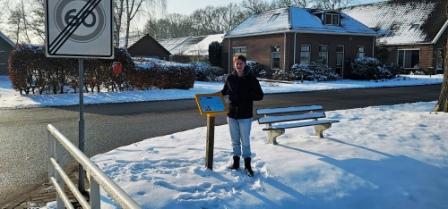
Yannic Wethly by the Halifax DT630 panel in Odoornerveen. (Photo courtesy of Yannic Wethly – Stichting Luchtoorlog Onderzoek Drenthe)
March 18, 2026. Occasionally, one story takes us in unexpected directions. In February 2023, we posted on this blog the story about Jack ‘Douglas’ MACKENZIE, of Winnipeg, Manitoba, the pilot of Halifax DT630 that was shot down by a night fighter over the province of Drenthe in The Netherlands on February 3, 1943. (See https://onthewarmemorialtrail.com/2023/02/19/on-the-war-memorial-trail-the-wwii-pilot-killed-at-the-controls-of-his-halifax-bomber/)
A few months later, we were contacted by Yannic Wethly, one of the volunteers with Stichting Luchtoorlog Onderzoek Drenthe (Air Research Drenthe Foundation) in The Netherlands. This non-profit organization researches WWII air crashes in the province and places information panels near the crash sites.
Yannic asked for help in finding a photo and family of a crew member, Eric ‘Raymond’ MARQUAND, the bomb aimer on that flight, who was also from Winnipeg. Raymond survived the crash and spent the remaining war years in prisoner of war camps before being liberated. We were very happy when his niece, Jamie Nelson-Dixon, got in contact and provided a photo. (Raymond’s story is coming up in a future posting.)

Jamie Nelson-Dixon, Craig MacKenzie, and Daria had a chance to meet in Winnipeg. (Photo courtesy of Valkenburg Family)
In May 2024, when we were in Winnipeg, we met Craig MacKenzie, nephew of Douglas, and his wife Sue, plus Jamie and her husband Don. (See https://onthewarmemorialtrail.com/2024/11/10/on-the-war-memorial-trail-remembrance-week-2024-reflections-and-updates/)
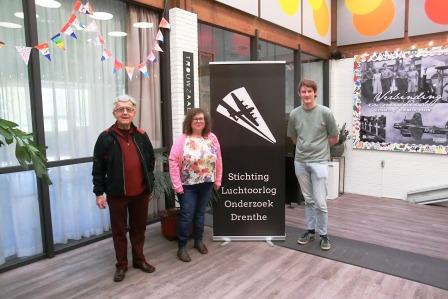
Pieter and Daria with Yannic Wethly of the Air Research Drenthe Foundation. (Photo courtesy of Valkenburg Family)
And in April 2025, when we were in The Netherlands, we had a chance to meet Yannic. (See https://onthewarmemorialtrail.com/2025/06/15/on-the-war-memorial-trail-a-visit-to-sleen-general-cemetery/)
On January 30, 2026, Yannic sent photos of an updated memorial panel for Halifax DT630, which now includes photos of all 7 crew members, who wrote us saying “….Thank you for your efforts. They played a key part in getting to this moment, where now all seven crew members have their faces back….”
….The last flight of Halifax DT630…

Halifax Mark 3 bomber. Photo source: http://www.raf.mod.uk Public Domain, https://commons.wikimedia.org/w/index.php?curid=751869)
On February 3, 1943, Douglas was the pilot of Halifax DT630 (call sign VR-T), one of 8 heavy Halifax bombers sent on a night raid to Hamburg, Germany. They took off at 6:34 pm from the airbase at Middleton St. George, England. (See https://aviation-safety.net/wikibase/52181)
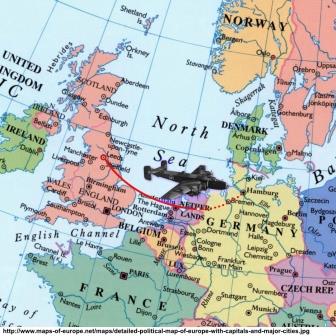
Map showing the plane’s path from England towards Hamburg, but being shot down over The Netherlands. (Map prepared by Wendy Nattress)
According to the Aviation Safety Network Wikibase report on Occurrence # 52181, the Halifax bomber was shot down by night fighter pilot Oberfeldwebel (Senior Staff Sgt) Karl-Heinz Scherfling of the 10./NJG 1, flying a Bf 110 F-4 from Leeuwarden airfield, in the province of Friesland in The Netherlands. At 8:55 pm it crashed in Odoornerveen. (Scherfling died when his plane was shot down in July 1944 near Mol, Belgium by a Mosquito night fighter of No. 169 Squadron. See https://military-history.fandom.com/wiki/Karl-Heinz_Scherfling)
….The crew of Halifax DT630….
4 crew members lost their lives and are buried in Sleen General Cemetery in The Netherlands. The other 3 crew members spent the remainder of WWII in POW camps before returning home.
- Pilot P/O Jack ‘Douglas’ MACKENZIE of Winnipeg, Manitoba, RCAF, killed
- Flight Engineer Sgt. William Peter DUTHIE of Winnipeg, Manitoba, RCAF, killed
- Navigator Sgt. William Nelson GARNETT, RCAF, survived
- Bomb Aimer Sgt. Eric ‘Raymond’ MARQUAND, RCAF, survived
- Air Gunner W/O II Raymond Hepton HILL of Montreal, Quebec, RCAF, killed
- Rear Air Gunner F/Sgt. Alexander Henry MILTON, RAF, survived
- Air Gunner W/O II Lennox Alwin GONNETT of Westmount, Quebec, RCAF, killed
….The memorial panel honouring the crew of Halifax DT630…
On January 30, 2026, a few days before the 83rd anniversary of the crash on February 3, 1943, Yannic wrote that “…we updated the information panel for Halifax DT630 today. The panel stands near the Scholtensbrug on Zuidzijde, Odoornerveen.…” (See https://www.facebook.com/slodrenthe/posts/pfbid0a7d47BcHoD5scBZERjEctYj2mmWbuvgrotFqLzG8USnReGYxbVN83wzoATAuTkLil)
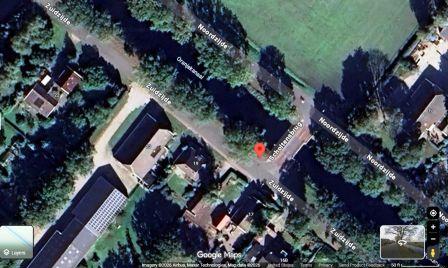
Location of the panel stands near the Scholtensbrug on Zuidzijde in Odoornerveen. (Map source: Google maps)
When we saw the photos, we were astonished to see snow! It could have been Canada, not The Netherlands! “…Quite exceptional times here….” he explained. “…We had sleet and 10-15cm of snow. Then it all disappeared and now, a week later, it’s back!…”
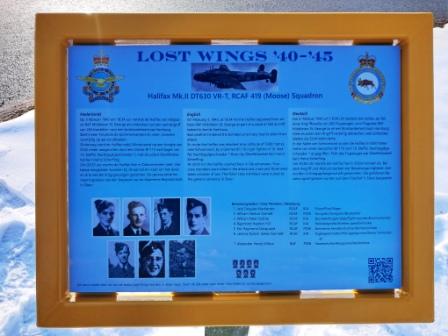
The Halifax DT630 panel summarizes what happened on the night of the crash, and includes photos of all 7 crew members. The 4 who died are shown above the 3 that survived. (Photo courtesy of Yannic Wethly – Stichting Luchtoorlog Onderzoek Drenthe)
The panel is located along a canal, next to the Scholtens bridge, in Odoornerveen, in a residential area.

Yannic Wethly by the Halifax DT630 panel in Odoornerveen. (Photo courtesy of Yannic Wethly – Stichting Luchtoorlog Onderzoek Drenthe)
….Excerpt from the Foundation’s report on Halifax DT630….
Yannic shared information on the Air Research Drenthe Foundation’s report on Halifax DT630, an excerpt of which is below. (See https://www.slodrenthe.nl/halifax-mk-ii-dt630-vr-t/ for more information, which is available in Dutch, English, French, or German.)
“…On February 3, 1943, Halifax DT630 VR-T, “T for Tommy,” of RCAF 419 (Moose) Squadron, departed RAF Middleton St. George at 6:34 p.m. as part of a raid wave of 263 aircraft. The target of this attack was Hamburg. On the outward journey, the bombers were hampered by bad weather, forcing many of them to abort the raid prematurely.
The crew of Halifax DT630 VR-T was five minutes late crossing the Channel on the night of this bombing raid on Hamburg. This delay caused pilot Jack D. MacKenzie to pitch the nose down slightly, increasing speed. The fact that Halifax DT630 VR-T was late and therefore flying behind the formation wasn’t the pilot’s only problem: contact with the tail gunner, Alexander H. Milton, had been lost. The entire intercom system had stopped working. Jack D. MacKenzie had to choose between turning back or continuing on and hoping the intercom would work again soon.
About 25 minutes out from the target, Halifax DT630 VR-T was attacked from behind and below by what they thought was an Fw 190. Only bomb aimer Eric R. Marquand noted in his report that he believed it was a Bf 110.
In reality, Halifax DT630 VR-T was indeed attacked by a Messerschmitt Bf 110. It was a German Bf 110G-4 night fighter of the 10th Staffel, Nachtjagdgeschwader 1, with pilot Oberfeldwebel Karl-Heinz Scherfling on board. He attacked the Halifax and its crew over Schoonoord at an altitude of 5,300 metres.
Tail gunner Alexander H. Milton later testified that an evasive maneuver, a so-called “corkscrew,” had been executed. Somehow, this command from Alexander H. Milton to pilot Jack D. MacKenzie got through, and Jack D. MacKenzie executed the maneuver.
The evasive maneuver was to no avail: the entire fuselage of the aircraft was pierced by the German night fighter’s cannon fire. Jack D. MacKenzie and probably also Lennox A.J. Gonnett, the dorsal turret gunner, were fatally wounded. The cannon fire also ignited the incendiary bombs on board, burning the vital cables and lines leading to the engines and controls.
Flight engineer William P. Duthie attempted to extinguish the fire but was unsuccessful due to the flammable and difficult-to-extinguish nature of the incendiary bombs. Navigator William N. Garnett later reported that he gave the order to abandon the aircraft following a previously arranged sequence of flashes. This implies that the intercom system was still inoperable.
Eric R. Marquand, the bombardier, was the first of the crew to abandon the aircraft. He was followed by William N. Garnett, who was checking on the condition of the rest of the crew. He saw that radio operator Raymond H. Hill was still in his position, as was William P. Duthie. Both, however, were preparing to abandon the out-of-control aircraft. At this point, the German fighter returned and attacked the falling Halifax once more.
Eric R. Marquand was hit in the ear area as he prepared to bail out. Alexander H. Milton continued to fire at the German fighter to drive it off, allowing the other crew members to bail out. He continued firing until he fell from his turret in the dark night. It is unknown what happened to the radio operator and flight engineer or why they did not bail out. The second attack by the German fighter may have prevented them from bailing out.
At 8:55 p.m., Halifax DT630 VR-T crashed in Odoornerveen. Only Eric R. Marquand, William N. Garnett, and Alexander H. Milton managed to evacuate the aircraft. All three were quickly taken prisoner of war and interned at Stalag VIIIB (Lamsdorf). The four remaining crew members perished in the crash….”
Thank you to Yannic Wethly for sending photos of the new memorial panel, and to Wendy Nattress for preparing the map showing the flight path for Halifax DT630. And thank you to Craig MacKenzie and Jamie Nelson-Dixon for providing photos of Douglas MacKenzie and Raymond Marquand. Thank you also to Judie Klassen for doing the research that led to finding Jamie Nelson-Dixon.
Pieter’s research efforts to find photos and families of soldiers continue, doing his part to ensure that each individual soldier is remembered. If you have photos or information to share about soldiers buried in The Netherlands or Belgium, please email him at memorialtrail@gmail.com, or comment on the blog.
© Daria Valkenburg
….Want to follow our research?…
If you are reading this posting, but aren’t following our research, you are welcome to do so. Our blog address: https://onthewarmemorialtrail.com/
 4 countries, 6 weeks, 7,000 km – an unforgettable war memorial journey in Europe…. Daria’s book ‘No Soldier Buried Overseas Should Ever Be Forgotten‘ is available in print and e-book formats. Net proceeds of book sales help support research costs and the cost of maintaining this blog. For more information see https://nosoldierforgotten.com/
Subscribe to our YouTube Channel: On The War Memorial Trail With Pieter Valkenburg: https://www.youtube.com/channel/UCJ591TyjSheOR-Cb_Gs_5Kw.
Never miss a posting! Subscribe below to have each new story from the war memorial trail delivered to your inbox.
 On The War Memorial Trail Research Project........ with Pieter and Daria Valkenburg