March 11, 2025. In 2021, in a period when we were all at home due to Covid, we translated, into English, ‘Holtense Canadezen’, Jan Braakman’s book about some of the soldiers buried in the Canadian War Cemetery in Holten, The Netherlands. In October 2023, this was published in English as ‘Holten Heroes: Stories from a Canadian Field of Honour’. (See https://onthewarmemorialtrail.com/2023/11/01/new-book-about-soldiers-buried-in-the-canadian-war-cemetery-in-holten-the-netherlands/)
One story in the Chapter ‘Drama On The Ems’ was about a tragic incident during the Battle of Leer in Germany on April 28, 1945, one of the final actions to end WWII in Europe. Operation Duck, which involved the crossing of the Ems and Leda rivers in northern Germany in order to take the port of Leer, turned out very badly for 19 men of the Stormont, Dundas and Glengarry Highlanders.
Two Maritime soldiers mentioned in the chapter, one from Nova Scotia, and one from New Brunswick, were on the photo wish list from the Canadian War Cemetery in Holten, The Netherlands. Pieter was successful in finding family and a photo of these men, who were both with the Stormont, Dundas and Glengarry Highlanders.
James Edward SULLIVAN, from Rexton, New Brunswick, was one of the Maritimers. (See https://onthewarmemorialtrail.com/2025/03/05/on-the-war-memorial-trail-tragedy-on-the-ems-part-1-the-wwii-soldier-from-rexton-who-drowned-during-operation-duck/) Frank Eugene MUNROE, of Halifax, Nova Scotia, was the other Maritimer.
…Frank enlisted in December 1943…
Born February 1, 1923 in Halifax, Nova Scotia, Francis ‘Frank’ Eugene MUNROE was the son of Francis ‘Frank’ Harold and Mary Gertrude Munroe. He had 3 brothers, two of whom also served during WWII, and 3 sisters.
When he enlisted at the No. 6 District Depot in Halifax, Nova Scotia on December 13, 1943, he stated that he’d been employed for 3 years as an iron worker at the Halifax Ship Yards. His father had died in September 1943, just a few months before his enlistment.
Frank’s niece, Sharon Carvery, the daughter of his sister Margaret Frances Jeffery, sent Pieter a photo, saying “…this is the only picture I could find with Uncle Frank with his sister Aunt Dot…” Aunt Dot was Frank’s sister Dorothy Donnelly.
After completing his basic training at No. 60 Canadian Army (Basic) Training Centre (CABTC) in Yarmouth, Nova Scotia, Frank was sent to the A14 Canadian Infantry Training Centre (CITC) in Aldershot, Nova Scotia on February 27, 1944 for additional training on various rifles and mortar.
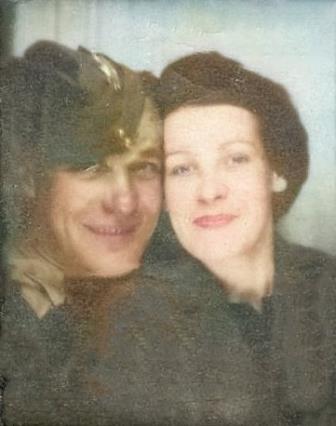
Frank Munroe with his sister Dorothy. (Photo courtesy of Sharon Carvery. Photo colourization by Pieter Valkenburg)
Upon completion of the courses at A14, he was attached to S-5 Canadian Driving and Maintenance School (CD & M School) in Woodstock, Ontario on May 5, 1944, for a Driver i/c course. On June 14, 1944, he qualified as a Driver i/c Class III (Wheeled). (The term ‘Driver i/c’ refers to ‘Driver, internal combustion’. Class III meant he was qualified to drive heavy trucks and armoured cars, but not tanks.)
He was reassigned back to A14 CITC in Aldershot in preparation for overseas service, before being granted embarkation leave from June 23, 1944 until July 6, 1944, the last chance he would have to see his family before going overseas.
….Frank left Canada for overseas service….
On July 21, 1944, Frank left Canada for the United Kingdom. Upon arriving on July 27, 1944, he was assigned to No. 4 Canadian Infantry Reinforcement Unit (CIRU).
Unfortunately, on August 4, 1944, while in England, he failed to requalify as a Driver i/c Class III (Wheeled), and was “…remustered for general duty…” according to his service file.
On August 16, 1944 he was assigned to the X-4 reinforcement list of No. 2 Canadian Base Reinforcement Group (CBRG) and shipped to France, arriving the following day.

Frank joined the Stormont, Dundas & Glengarry Highlanders in Trun, France. (Map source: DuckDuckGo)
On August 22, 1944, he was transferred to the Stormont, Dundas & Glengarry Highlanders Regiment, joining them in Normandy, France, where they were based in Trun, following a heavy day of fighting by the Regiment, which had resulted in a number of casualties. The next day the Regiment moved north of Trun.
Frank remained with the Regiment as it fought across France, and into The Netherlands. It was in Nijmegen to relieve the airborne troops, and helped guard the bridge while the Rhine crossing was prepared. The Regiment then fought through the Hochwald in Germany, and continued north as it prepared to cross the Ems River and take the city of Leer on April 28, 1945, in what became known as Operation Duck.
…Operation Duck…
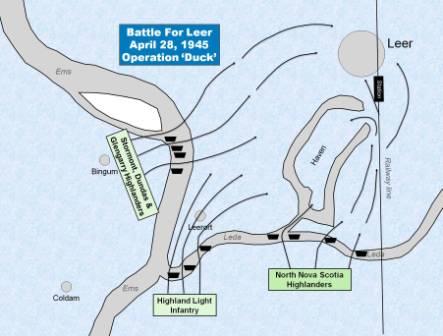
Map showing the Ems and Leda Rivers, and position of Regiments during the Battle for Leer. (Map courtesy of and ©Jan Braakman)
In the plan for Operation Duck, the North Nova Scotia Highlanders would cross the Leda River in assault boats and secure the northern bank of the river in preparation for the attack to capture Leer. The Highland Light Infantry of Canada would cross the Leda River at the point where the Ems and Leda rivers meet. The Stormont, Dundas and Glengarry Highlanders would go across the Ems River towards the western edge of Leer.
These three Regiments were part of the 9th Canadian Infantry Brigade. (See https://www.canadiansoldiers.com/history/battlehonours/northwesteurope/leer.htm)
While the men from the Highland Light Infantry all crossed safely, the North Nova Scotia Highlanders lost 5 men, and the Stormont, Dundas & Glengarry Highlanders lost 19. It was a terrible tragedy, so close to the end of the war.
To see what an assault boat looks like, take a look at this short YouTube video, which shows troops preparing to cross the Ems:
…Why Operation Duck Was Important…
A translated excerpt from Jan Braakman’s ‘Holtense Canadezen’ explained why Operation Duck was important. “…At the end of April 1945, Canadian troops stood just across the Dutch-German border in Ostfriesland (East Frisia) in front of the river Ems….” (See https://en.wikipedia.org/wiki/East_Frisia)
Leer was a challenge to capture. “…The town of Leer was on the other side of the river on the route to Emden. Surrounded by inaccessible lowlands in the north and with rivers (Ems and Leda) in the west and south, Leer was a well defensible and therefore difficult to capture port city. All access bridges over the Ems and Leda were blown up by the Germans. For the Canadians there was no other option than to reach the city by water….”
River crossings can be tricky due to currents and tides, and in wartime, there is always the risk of enemy fire. “….The Ems River has an open connection with the Wadden Sea, which means that tides influence water levels and currents in the river. Tides made the currents unpredictable, and the Canadian Army didn’t have accurate information about the tides. What was clear: high tide was the best time to make the crossing. Aerial photographs showed that German troops had fortified themselves well behind the dikes that surrounded the city….”
A decision was made on how to cross the two rivers – the Leda and the Ems.. “… Only under the protection of a smoke screen and solid artillery support would it be possible to successfully complete the attack on Leer, using boats … General Simonds ordered that on April 28, 1945, before darkness fell, there had to be a solid bridgehead, from which the capture of Leer could be initiated. That meant that the attack had to be launched during the middle of the day, around three o’clock, when the water level was at its highest…”
The Highland Light Infantry crossed safely “… at the point where the Leda flows into the Ems, about three kilometres south of the city centre…”
The other two regiments ran into trouble. “…The crossing was made at three different places. At the same time, artillery fire and attacks from the air put the German defence line to the test. The North Nova Scotia Highlanders would cross the Leda from the south bank and take the harbour of Leer, which abutted the city on a peninsula…”
…The Stormont, Dundas & Glengarry Regiment ran into trouble…
The Stormont, Dundas & Glengarry Highlanders Regiment was to cross the Ems River “…from the west bank of the Ems at Bingum to attack the city from the west.…”
All three Regiments launched their attacks at the same time. “….It began at half past two with fierce shelling, during which the positions of the German defence forces were fired upon. The attack from the south was spectacular and successful, with relatively few losses….”
This wasn’t the case for the attack from the west. “….A number of boats….” from the Stormont, Dundas & Glengarry Highlanders Regiment “…showed motor defects or capsized. Some of the drowning men were rescued, but at the end of the day at least nineteen men from the Regiment were dead, drowned, or missing….”
….Why did the men drown?….
After WWII ended “…a team from the Stormont, Dundas & Glengarry Highlanders returned to the Ems. They dragged the river, looking for the bodies of the missing men. Some of them were found with their full kit still attached to their bodies….”
Why did the men drown? In ‘River Assault – Operation Duck: The 3rd Canadian Infantry Division’s Attack On Leer 28th April 1945’, author John Sliz noted that “…These men sank, never to rise again, even though life belts were worn. The reason for this was the heavy equipment worn by the men was too much for the life belt that was used….”
Sliz quotes from a report by Brigadier John M. Rockingham. “…The equipment was worn….. in such a way that the waist belt alone had to be unbuckled to permit the soldier to shake it free. There was, however, a tendency for this equipment to slide down the arms, pressing them into the side, preventing any swimming motion, until it was finally clear….” It would have been like trying to swim while wearing a straightjacket!
….Frank was one of the fatalities….
Major J.A. Forman and Lance Corporal V. C. Abrams, who survived the crossing, had recorded in their witness statements that at “….approximately 15:15 hours on April 28, 1945….” They were in an assault boat “…crossing the Ems River in the assault on Leer. Enemy fire sunk the craft….” and 10 men were “…thrown into the river…”
In the ‘Drama on the Ems’ chapter, a third survivor listed was Private Whitcombe. The three survivors “…explained what had happened to the boat in which they tried to get across. They were in an assault boat with fourteen men. Their boat ran into problems because the gunner in the front of the boat (the bow man) almost fell overboard, possibly because he was hit. The man was hanging over the bow. Perhaps because of that, but at least practically at the same time, the prow of the storm boat dipped after being sucked into the bow wave of the boat ahead. In a matter of seconds their boat disappeared under water and the crew was in the cold river water.….”
Frank was one of the 10 men who drowned, losing his life at the age of 22.
….Frank is buried in the Canadian War Cemetery in Holten….
Frank was originally buried in Bingum, Germany, before being reburied on March 26, 1946 in the Canadian War Cemetery in Holten, The Netherlands.
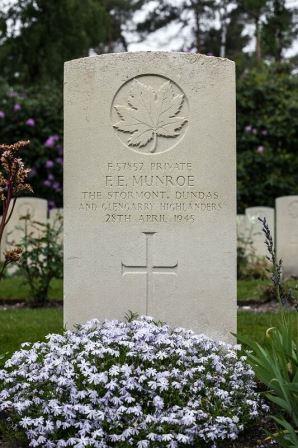
Grave of Frank Eugene Munroe in the Canadian War Cemetery in Holten, The Netherlands. (Photo courtesy of Canadian Virtual War Memorial)
In November 1947, Frank’s grave was adopted by Mr. Arend Jan Markerink from Almelo, The Netherlands. He sent a letter, plus an international postage reply coupon, to the Department of National Defence, asking for Frank’s next of kin to be notified. A note in the file stated that the letter and postage reply coupon were sent to the family on December 9, 1947.
….Other soldiers from the Stormont Dundas Glengarry Highlanders who lost their lives that day…
In addition to Frank Eugene Munroe, 18 more soldiers from the Stormont, Dundas and Glengarry Highlanders lost their lives on April 28, 1945, and are listed below. If there are asterisks beside the name (****) it means there is a brief anecdote in the ‘Drama On the Ems’ chapter in ‘Holten Heroes: Stories from a Canadian Field of Honour’.
- A/Cpl John SAWATSKY of Petaigan, Saskatchewan, aged 20
- L/Cpl Merle Coleman MOORE of Breckenridge Station, Quebec
- L/Cpl James Edward SULLIVAN of Rexton, New Brunswick, aged 28 ****
- Pte Frank Joseph BIERNASKI of Barry’s Bay, Ontario, aged 32 ****
- Pte Walter James BROOKS of Toronto, Ontario, aged 28
- Pte Leonard Gordon BROUGH of Sudbury, Ontario, aged 21****
- Pte Steven John GRAVELLE of Peterborough, Ontario, aged 23
- Pte Joseph Gerard HINDS of Orillia, Ontario, aged 20
- Pte Earl Harcourt JOSLIN of Kingston, Ontario ****
- Pte Ira Charles LANGILLE of Milton, Nova Scotia, aged 32 ****
- Pte Cecil Albert LAWES of Frankford Ontario, aged 28
- Pte Sidney Alexander OSLUND of Haileybury, Ontario, aged 29 ****
- Pte Samuel Donald POWELL of Newcastle, Ontario, aged 22
- Pte Edgar Douglas SMITH of Parrsboro, Nova Scotia, aged 28 ****
- Pte Francis Wilber SPENCER of Stonecliffe, Ontario, aged 35 ****
- Pte Jack Allan STEWARD of Belleville, Ontario, aged 24 ****
- Pte Roy Ivenson THACKERAY of Peterborough, Ontario, aged 20 ****
- Pte George Sidney WAKELY of Port Hope, Ontario, aged 31****
….A Tragic Drowning On The Leda River….
As mentioned in the ‘Holten Heroes’ excerpt, the crossing of the rivers to reach Leer involved three Regiments – Stormont Dundas and Glengarry Highlanders, North Nova Scotia Highlanders, and the Highland Light Infantry.
The North Nova Scotia Highlanders were tasked with crossing the Leda River from the south bank and then take the harbour of Leer. 5 soldiers from this Regiment lost their lives when the storm boat they were in capsized, and their stories were told in previous blog postings as a 4 part series:
- https://onthewarmemorialtrail.com/2021/05/15/on-the-war-memorial-trail-a-tragic-drowning-on-the-leda-river-in-germany-part-1/
- https://onthewarmemorialtrail.com/2021/05/16/on-the-war-memorial-trail-a-tragic-drowning-on-the-leda-river-in-germany-part-2/
- https://onthewarmemorialtrail.com/2021/05/17/on-the-war-memorial-trail-a-tragic-drowning-on-the-leda-river-in-germany-part-3/
- https://onthewarmemorialtrail.com/2021/05/18/on-the-war-memorial-trail-a-tragic-drowning-on-the-leda-river-in-germany-part-4/
….Blog posting about another soldier mentioned in the book Holten Heroes…
- James ‘Jimmy’ Oliver THOMAS https://onthewarmemorialtrail.com/2024/02/18/on-the-war-memorial-trail-the-wwii-soldier-from-manitoba-who-died-shortly-after-being-liberated-from-stalag-vii-a/
Thank you to Jan Braakman for permission to quote from his book and use of the map showing the position of the Regiments, and to Sharon Carvery for a providing a photo of her uncle. If you have a story or photo to share, please contact Pieter at memorialtrail@gmail.com or comment on the blog.
© Daria Valkenburg
….Want to follow our research?….
If you are reading this posting, but aren’t following our research, you are welcome to do so. Our blog address: https://onthewarmemorialtrail.com/
 4 countries, 6 weeks, 7,000 km – an unforgettable war memorial journey in Europe…. Daria’s book ‘No Soldier Buried Overseas Should Ever Be Forgotten‘ is available in print and e-book formats. Net proceeds of book sales help support research costs and the cost of maintaining this blog. For more information see https://nosoldierforgotten.com/
You are also invited to subscribe to our YouTube Channel: On The War Memorial Trail With Pieter Valkenburg: https://www.youtube.com/channel/UCJ591TyjSheOR-Cb_Gs_5Kw.
Never miss a posting! Subscribe below to have each new story from the war memorial trail delivered to your inbox.
 On The War Memorial Trail Research Project........ with Pieter and Daria Valkenburg