February 20, 2025. Living on Prince Edward Island, it’s unusual to not only meet someone who has a shared Eastern European heritage, but whose family history was impacted by WWII. My father was taken at age 14 from his home in Western Ukraine to work in Germany and over several years, Pieter and I ‘walked in his footsteps’ in an attempt to understand what he experienced, and documented our findings in a 4 part series that saw him go from Germany to England and then finally to Canada:
- https://dpcampohioresearchproject.wordpress.com/2017/12/31/walking-in-my-fathers-footsteps-in-grupenhagen-part-1/
- https://dpcampohioresearchproject.wordpress.com/2018/01/01/walking-in-my-fathers-footsteps-in-grupenhagen-part-2/
- https://dpcampohioresearchproject.wordpress.com/2019/07/21/the-2019-camp-ohio-reunion-part-3-what-was-your-fathers-experience-in-camp-ohio/
- https://dpcampohioresearchproject.wordpress.com/2021/07/01/leaving-camp-ohio-for-great-britain-under-the-westward-ho-program/
My father was in Germany at the same time as Nikola ‘Nick’ OSTOJIC, grandfather of Bedeque resident Liz Hubert. While my teenaged father was a labourer, Liz’s grandfather was a prisoner of war. After WWII ended, both ended up in displaced persons’ camps before finally finding freedom and a new life in Canada….but neither man was ever freed of the memories of what they had experienced.

Daria (standing) with Liz Hubert. (Photo credit: Pieter Valkenburg)
….Nikola was born in Croatia….

Zirovac (indicated by red marker) is in the Banija region of Croatia, not far from Bosnia and Herzegovina border. (Map source: DuckDuckGo)
Born in the Serbian village of Zirovac, in what is now Croatia, but was then part of Austria-Hungary, on November 1, 1896, Nikola was the son of Mladen and Maria (nee Momic) Ostojic. His father was an Orthodox bishop and a senator in pre-WWI Croatia. According to Nikola’s 1972 obituary in the publication ‘Voice of Canadian Serbs’, in a family that had “…produced priests for 300 years…Nikola was supposed to continue the episcopal tradition, but he loved medicine….” (Translation from the original Russian by Liz Hubert)
The oldest child, with 9 younger sisters, Nikola became the head of the family after his father died when he was 18, and his mother died a year later. Liz proudly noted that her grandfather “…sent money home to his sisters after he joined the army…” and made sure that “…all of his sisters were educated…”
….Nikola’s medical school training was interrupted by WWI….
The ‘Voice of Canadian Serbs’ obituary noted that 19 year old Nikola’s medical school training was interrupted in 1915 when he was “…mobilized by the Austro-Hungarian military…” and sent to a “…school for Officers in the Reserves. Upon completion of training, he was immediately sent in 1916 to the Russian front. He deserted the Austro-Hungarian Army in Russia and joined the volunteer corps in Odessa, destined for the Salonika Front….”
Serbia had resisted the attacks of the Austro-Hungarian Army in the opening months of the First World War. But, in October 1915, the combined forces of Austria, Germany, and Bulgaria overwhelmed her armies and conquered the country.
As Serbia was an ally of Britain, a multi-national Allied force, under French command, with French, Serbian, British, Russian, and Italian troops, fought against the Bulgarians and their allies in what became known as The Salonika Campaign.
In 1918, when Nikola arrived in Salonika, he was “….deployed to the battle front. As a Major in the 6th division of the Drina Infantry, he participated in the breakthrough of the Salonika front, freeing his homeland…”
Liz explained that Nikola received the Medal of Honour after being wounded during the rescue of soldiers trapped in trenches.
The Salonika Campaign ended with an armistice signed by Bulgaria on September 28, 1918, and resulted in the defeat of Bulgaria, the liberation of Serbia and strategic exposure of Austria and Turkey. (For more information on The Salonika Campaign, see https://www.nam.ac.uk/explore/salonika-campaign)
Salonika, today known as Thessaloniki, is a port in the northern Greek region of Macedonia, and is a city I’d visited many decades ago after I graduated from university.
….Nikola remained in the military post WWI….
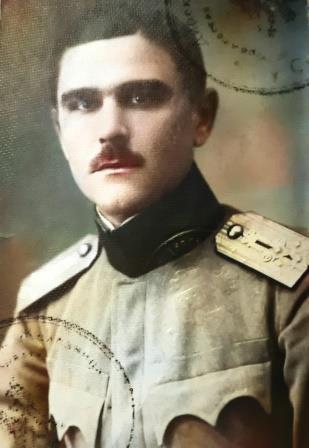
Nikola Ostojic. (Photo courtesy of the Nikola Ostojic Family. Photo colourization by Pieter Valkenburg)
After WWI ended, Nikola remained in the military, in the Royal Yugoslav Army, which existed from the establishment of Yugoslavia in December 1918 until its surrender on April 17, 1941 to an invading force of Germans, Italians, and Hungarians. (See https://en.wikipedia.org/wiki/Royal_Yugoslav_Army#April_1941_Campaign)

Nikola Ostojic and Marija Lovas on their wedding day in 1938. (Photo courtesy of the Nikola Ostojic Family)
Before that fateful day, Nikola had married Marija Lovas, who he’d met at a dance, in February 1938. Their daughter Radmilai, Liz’s mother, was born on July 28, 1939. The family lived on a farm in Backi Petrovic in Serbia, near the Hungarian border. Liz explained that the farm that Nikola grew up on had been sold prior to WWII after his sisters were no longer living there.
At the time of the surrender of the Royal Yugoslav Army, Nikola, now a Colonel, was, per the ‘Voice of Canadian Serbs’ obituary, on the “…main General Staff in Belgrade where he was serving as the head of a classified Intelligence unit…”
….Nikola became a POW and was sent to Oflag XIII B….
Liz’s research unveiled a Red Cross document summarizing what happened to Nikola when the Royal Yugoslav Army surrendered. “….The Red Cross filed my Grandfather as captured in Sarajevo on April 17, 1941 and sent to OFLAG XIII B, POW # 99104. At this time he ranked as Pukovnik, which translated into Colonel…. He was captured by the German-Italian Military in Sarajevo…”
An Oflag was a Prisoner of War (POW) Camp for officers, as opposed to a Stalag, which held mostly enlisted men. Oflag XIII B, opened for Yugoslav officers, was originally in the Langwasser district of Nuremberg.
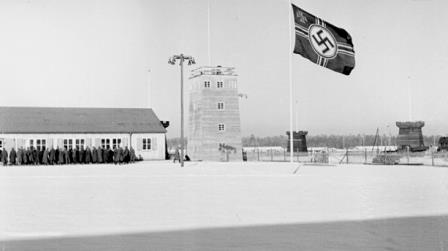
Oflag XIII B in Nuremberg, Germany. (Photo source: https://krijgsgevangen.nl)
In April 1943, about 3,000 officers, many who had been, like Nikola, members of the Yugoslavian General Staff, were moved to a site 3 km (1.9 miles) south of the town of Hammelburg, just north of Schweinfurt in Bavaria, Germany. (See https://en.wikipedia.org/wiki/Oflag_XIII-B)
Life in the POW camp was difficult, and one that Nikola endured for 4 years. In Part 2, Nikola’s story continues with his time in the POW camp until the camp was liberated on April 6, 1945 by American troops.
Thank you to Liz Hubert for sharing photos and information on her grandfather, and translating his obituary into English. If you have a story or photo to share, please contact Pieter at memorialtrail@gmail.com or comment on the blog.
© Daria Valkenburg
….Want to follow our research?….
If you are reading this posting, but aren’t following our research, you are welcome to do so. Our blog address: https://onthewarmemorialtrail.com/
 4 countries, 6 weeks, 7,000 km – an unforgettable war memorial journey in Europe…. Daria’s book ‘No Soldier Buried Overseas Should Ever Be Forgotten‘ is available in print and e-book formats. Net proceeds of book sales help support research costs and the cost of maintaining this blog. For more information see https://nosoldierforgotten.com/
You are also invited to subscribe to our YouTube Channel: On The War Memorial Trail With Pieter Valkenburg: https://www.youtube.com/channel/UCJ591TyjSheOR-Cb_Gs_5Kw.
Never miss a posting! Subscribe below to have each new story from the war memorial trail delivered to your inbox.
 On The War Memorial Trail Research Project........ with Pieter and Daria Valkenburg
Hi Pieter & Daria,
What a captivating story—Nikola’s journey from Oflag XIII-B to raising horses in PEI is a testament to resilience and reinvention. His transformation from a Serbian officer to a beloved community figure in Canada is both inspiring and humbling. The blend of personal history with broader wartime context adds depth to this narrative. Looking forward to the next installment to learn more about his post-war life.
LikeLike
Thank you for your kind words, Barbara. It was indeed a compelling story. Parts 2 and 3 are on the blog, so do check them out for the rest of Nikola Ostojic’s story…..Daria and Pieter
LikeLike