On The War Memorial Trail….. The WWII Signaller From Oxford Who Was Fatally Wounded in Sögel

January 25, 2025. When Pieter begins research into a soldier’s file to find family members who might have a photo, he never knows what to expect. Sometimes, serendipity smiles, as he explained to colleagues in The Netherlands about what happened last fall in researching a WWII soldier from Nova Scotia.

 “…A few days ago I started trying to find a photo of George Allan Buchanan of Nova Scotia…” Pieter wrote.  “… When I looked at his estate form, my heart sank a little. He was married but had no children. Both parents died early. He had a half-sister, Jean Anderson, and that was all. However, I found her obituary from 2012. She was married to Gerald Allen and they had 3 sons and 3 daughters. I chose one of the daughters, Ramona Emslie, and called her in Nova Scotia and – you won’t believe it – but she had a picture!…” (Translation from the original Dutch.) 

Not long after Pieter received a photo, we were in Nova Scotia, and visited with Ramona and her husband Roger. Not only did we learn more about George, we were also treated to the most delicious apple pie!
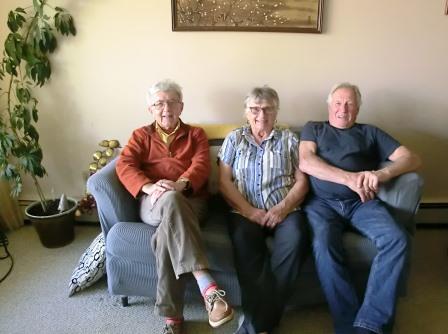
Pieter (left) with Ramona and Roger Emslie.  (Photo credit: Daria Valkenburg)

.….George was born in Oxford – the wild blueberry capital of Canada….
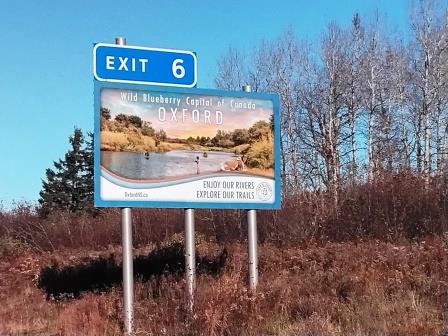
Sign for the turn-off to Oxford, Nova Scotia.  (Photo credit: Daria Valkenburg)

Born in Oxford, Nova Scotia on September 9, 1914, George Allan BUCHANAN was the son of George Allen and Margaret Jennie (nee Redmond) Buchanan.  George’s father died while he was a child, and his mother remarried in 1926 to Orval ‘Orlo’ Anderson.   

At the time of his enlistment with the 1st Anti-Aircraft Battery in Dartmouth, Nova Scotia, on August 8, 1940, George was working as a farmer for Geo Chase of Port Williams, and was also a carpenter.  He and his wife, Nancy Eva, who he’d married on December 18, 1939, were living in Lower Canard, Nova Scotia.
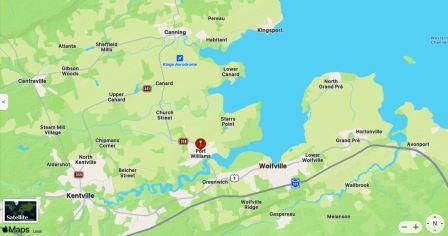
George Allan Buchanan lived in Lower Canada and worked for a farmer from Port Williams at the time of his enlistment in August 1940.  (Map source: DuckDuckGo)

….George served on the West Coast as part of Pacific Command….

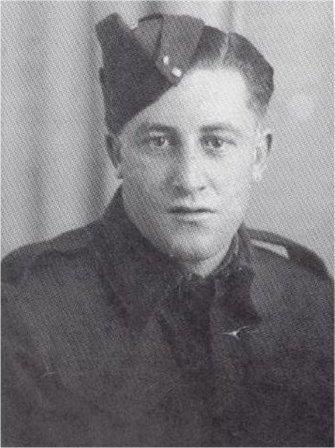
George Allan Buchanan.  (Photo courtesy of Ramona Emslie.  Photo colourization Pieter Valkenburg)

On January 11, 1942, George was attached to the 5th (BC) Coast Brigade of the Royal Canadian Artillery (RCA) and the No. 11 District Depot in Vancouver, British Columbia, remaining there until May 1, 1942, when he was posted to the 9th Anti-Aircraft Battery of the RCA in Sidney, British Columbia.  On October 9, 1942 he was assigned to the 27th Anti-Aircraft Regiment in Esquimalt, British Columbia.  

George’s West Coast posting was part of Pacific Command, which had two key functions.  The major function was to strengthen and administer home defence facilities on Canada’s Pacific Coast against possible Japanese attack. A second function was to train reinforcements to be sent to the Canadian divisions in Europe. 

On November 1, 1942 George was sent to the Coast Artillery School of Instruction in Esquimalt, for a Heavy Anti-Aircraft Artillery course, which he completed on December 12, 1942.  

George was transferred to the No. 1 Transit Camp in Windsor, Nova Scotia on August 8, 1943 for further training. 

….George was sent for a driver operator course ….

On October 29, 1943, George was transferred to A2 Canadian Army Training Centre (CATC) in Petawawa, Ontario.  As of December 17, 1943 he was attached to A7 Canadian Signal Training Centre (CSTC) at Camp Barriefield, Ontario for a Driver Operator Course, after having qualified as a Driver Class III on December 10, 1943.  Class III meant he was qualified to drive heavy trucks and armoured cars, but not tanks. 

On March 25, 1944, he had qualified as a Driver Operator Class ‘C’. He then returned to A2 Canadian Army Training Centre (CATC) in Petawawa on March 31, 1944.

On April 29, 1944, George was given embarkation leave until May 12, 1944, the last chance he had to see his family. 

….George left Canada for overseas service….

After returning from his embarkation leave, George was sent to the No. 1 Training Brigade in Debert, Nova Scotia on June 14, 1944 for final training in preparation for overseas service. 

George left Canada on June 26, 1944, arriving in the United Kingdom on July 4, 1944, and assigned to No. 1 Canadian Army Reinforcement Unit (CARU). He continued to take courses, to upgrade his skills as a Driver Operator.

On October 16, 1944, George was assigned to the X-4 Reinforcement list of the Royal Canadian Artillery, and left the United Kingdom the following day, arriving in Belgium on October 18, 1944.   

….George was transferred to the 23rd Field Regiment….

On November 18, 1944, George was transferred to the 23rd Field Regiment of the Royal Canadian Artillery, joining them in Boxtel, The Netherlands.

In ‘The History of the 23rd Canadian Field Regiment (SP) RCA’, the Regiment was on a rest period following heavy fighting, and making “….a frantic attempt to get the guns calibrated despite horrible weather conditions….”  (Note: SP refers to self-propelled)
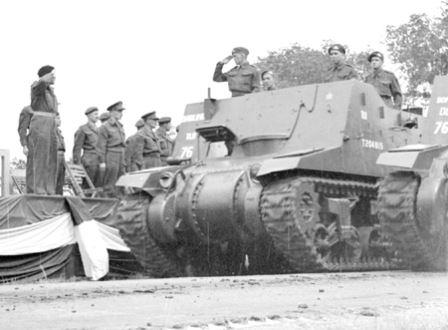
A self-propelled gun.  (Photo source: Kevin T of WW2Talk)

On December 6, 1944, the Regiment “…moved back into the line….” near ‘s-Hertogenbosch.  “…We were now living once more in a veritable “buzz-bomb alley” as the Germans intensified their efforts to knock out the port of Antwerp and render it useless to the Allies….

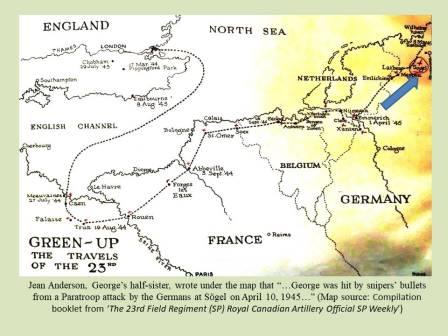
An excerpt from a compilation booklet from ‘The 23rd Field Regiment (SP) Royal Canadian Artillery Official SP Weekly’ included a brief description of George.  “…He was attached to the 36th Battery, as a Signaller, and was soon rated as an efficient, conscientious soldier, who did his assigned job quietly and well. It was not long before the boys were calling him ‘Buck’….

.….The 23rd Field Regiment moved into Germany in February 1945….

In February 1945, the History recorded that “about the middle of February the news arrived that we were to have a part in the next operation which would bring the forces of 21 Army Group to the banks of the Rhine – and possibly win the war then and there…

By February 22, 1945, the Regiment was in the Reichswald Forest in Germany, in place for Operation Blockbuster.  (See https://en.wikipedia.org/wiki/Operation_Blockbuster) “….In preparation for the attack the Regiment left the concentration area on the night of the 24th and moved south to deploy near Louisendorf. The roads were in terrible condition, and the heavy volume of traffic which had to roll over them ceaselessly only made matters worse. On the first deployment most of the soft vehicles were left in concentration areas back along the road, partly due to bad traffic conditions and partly due to enemy shelling in the more forward areas….

Then, “….on the 27th the Regiment made another move, going into action just east of Keppeln….”  The Regiment fought their way through Germany in March and into April. 

.….George was fatally wounded in Sögel….

The History explained that “…at the crack of dawn on April 9th the Regiment was on the road again, but had to spend two hours sitting on the road before crossing the canal into Meppen and striking north along the canal to Lathen. Then the axis of the advance swung east until we reached Sögel…

The Regiment was successful in taking the town of Sögel in Niedersachsen on April 9, 1945, but the following day the Germans made an unexpected counterattack.  “….The Regiment was getting packed in anticipation of another move when small arms fired began to whistle around the area….. Then mortars started dropping in to the area…. It was a counter-attack and there didn’t appear to be any infantry in front of us…

Just after 9:30 am, George was seriously injured in the fighting that had ensued, receiving shrapnel wounds in his left thigh and lower abdomen. “….Every man in the battery did an excellent job in beating off this first major counter-attack ever suffered by the unit. But although it was successfully repelled, three men paid the supreme sacrifice. They were Lieut. Doug Denton who was wounded as he lifted a casualty into a half-track and died next day, Gnr. George Buchanan who died later that day, and Gnr. Vic Hubacheck who was instantly killed by a ricochet bullet. Four or five other lads were wounded….

George was initially treated at a Field Dressing Station, before being transported to the Canadian military hospital in Almelo, The Netherlands.  Unfortunately, the medical report stated that he was dead on arrival at 9:40 pm that evening.  He was 31 years old.

.….George is buried in Holten….

George was temporarily buried in Almelo, before being reburied in the Canadian War Cemetery in Holten, The Netherlands on February 4, 1946.
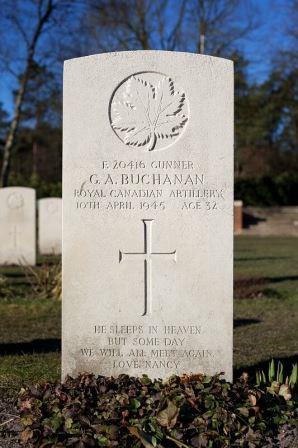
Grave of George Allan Buchanan in the Canadian War Cemetery in Holten, The Netherlands.  (Photo courtesy of Canadian Virtual War Memorial)

….George’s grave was adopted by Jo Visschers of Bathmen ….

After his reburial in the Canadian War Cemetery in Holten, George’s grave was adopted by Jo Visschers of Bathmen, The Netherlands.  Jo’s letter advising of the grave adoption was forwarded to George’s widow in March 1948 by the Department of Veterans Affairs.

Thank you to Ramona and Roger Emslie for providing photos and information, to Kevin T of WW2Talk, and to Edwin van der Wolf, a volunteer at the Canadian War Cemetery in Holten, for sending us an account of what happened in Sögel in No. 156-April 2016 ‘Informatieblad Over Verdedigingswerken En Militaire Geschiedenis – De Opmars Van De Canadezen In Noordwest Duitsland’ (Information Sheet On Defensive Works And Military History – The Rise Of The Canadians In Northwest Germany).

If you have a story or photo to share, please contact Pieter at memorialtrail@gmail.com or comment on the blog. 

© Daria Valkenburg

….Want to follow our research?….

If you are reading this posting, but aren’t following our research, you are welcome to do so.  Our blog address: https://onthewarmemorialtrail.com/
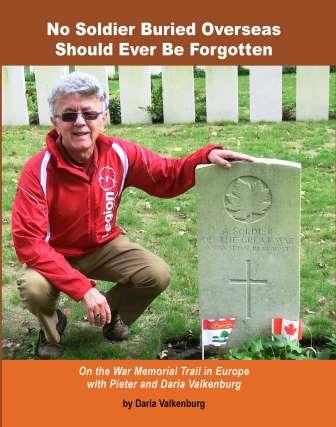
4 countries, 6 weeks, 7,000 km – an unforgettable war memorial journey in Europe…. Daria’s book ‘No Soldier Buried Overseas Should Ever Be Forgotten‘ is available in print and e-book formats.  Net proceeds of book sales help support research costs and the cost of maintaining this blog. For more information see https://nosoldierforgotten.com/

You are also invited to subscribe to our YouTube Channel: On The War Memorial Trail With Pieter Valkenburg: https://www.youtube.com/channel/UCJ591TyjSheOR-Cb_Gs_5Kw

Never miss a posting!  Subscribe below to have each new story from the war memorial trail delivered to your inbox.

On The War Memorial Trail….The WWII Soldier From St.-Georges Who Lost His Life On His Birthday

January 20, 2025.  When we were in Manitoba last year, we visited the Winnipeg River Heritage Museum, in the village of St.-Georges, in order thank Diane Dube in person for helping us with the photo searches of Edmond COULOMBE and Philip LAFORTE.  (See https://onthewarmemorialtrail.com/2021/12/24/on-the-war-memorial-trail-the-successful-search-for-a-photo-of-ww2-soldier-edmond-coulombe/ and https://onthewarmemorialtrail.com/2022/03/22/on-the-war-memorial-trail-remembering-ww2-soldier-philip-laforte/)

Daria and Pieter with Diane Dube (centre) at the Winnipeg River Heritage Museum in St.-Georges, Manitoba. (Photo courtesy of Valkenburg family)

During our visit, Diane mentioned that she had a relative from the area who was buried in the Canadian War Cemetery in Holten, The Netherlands – Omer VINCENT.  “…His father and my grandfather were brothers. He was first cousin to my father….

Diane wondered if the cemetery had a photo of him, and we assured her it did, as the researchers did not include him on their photo wish list for Manitoba soldiers.  She sent us an excerpt about Omer from a book about the Vincent family, ‘Et la rivière coule toujours 1892-1992’ (‘And the river is still flowing 1892-1992’), published by Hector H. Vincent.

Born April 13, 1920 in St.-Georges, Manitoba, Omer was the son of Fortunat and Marie-Louise Vincent. He came from a large family, with 5 brothers and 5 sisters alive at the time of his death.  Two brothers, Philippe and Wilfred, also served during WWII.

….Omer worked with his father and brothers prior to enlistment….

Omer’s brief biography in ‘Et la rivière coule toujours 1892-1992’ explained that he helped his father and older brothers “…with the farm work.  He soon joined them cutting pulp wood during the winter and would also haul the wood by sleigh and horse team to Pine Falls…”  There was a pulp and paper mill in nearby Pine Falls, Manitoba.

Omer with his horses. (Photo source: ‘Et la rivière coule toujours 1892-1992’)

The entry went on to say that Omer’s “…favourite pastime was hunting with his brothers.  They kept the bush cutting camps well supplied with fresh meat during the winter…

Omer had worked with his father for several years when he enlisted on October 29, 1941 in Winnipeg, Manitoba with the No. 10 District Depot Anti-Aircraft Artillery, Royal Canadian Artillery (RCA). Omer’s fluency in both English and French was noted on his Occupational History Form.  It was also recorded that he could drive a vehicle, a motorcycle, and a tractor, and liked to play baseball.

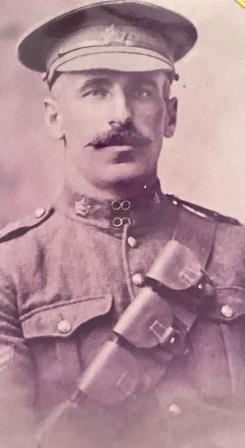
Omer Vincent.  (Photo source: ‘Et la rivière coule toujours 1892-1992’)

On November 13, 1941, he was sent for basic training at No. 12 Canadian Army (Basic) Training Centre (CABTC) in Chatham, Ontario.  After completing the course on February 3, 1942, he was transferred to A1 Canadian Artillery Training Centre (CATC) at Camp Petawawa in Ontario for advanced training as a gunner. 

Omer was in Petawawa until April 4, 1942. While there, he received embarkation leave, the last time he would see his family.  He returned briefly to Petawawa until April 29, 1942, when he travelled to Halifax, Nova Scotia, the port of embarkation to the United Kingdom.

….Omer left Canada for overseas service….

On May 4, 1942, Omer left Canada for the United Kingdom.  Upon arriving on May 12, 1942 he was assigned to No. 2 Canadian Artillery Reinforcement Unit (CARU).  He continued his training and then was transferred to the 7th Anti-Tank Regiment of the Royal Canadian Artillery on July 31, 1942. 

Omer was reassigned to No. 2 Canadian Artillery Reinforcement Unit (CARU) on August 26, 1943 and sent for specialized training at the Canadian Military Headquarters in London, and then for a series of gun fitter courses at Stoke-On-Trent, where the Artillery Equipment section of the Royal College of Military Science was based during the war.

Upon completion of the courses, Omer was transferred to the X-4 reinforcement list of No. 2 Canadian Base Reinforcement Group (CBRG), part of the 21st Army Group, on August 16, 1944.  The next day he was on his way to Normandy, France, disembarking on August 18, 1944.

A few days later, on August 23, 1944, he was assigned to the 3rd Anti-Tank Regiment of the Royal Canadian Artillery. The Regiment was responsible for coordinating anti-tank defences, with troops supporting the infantry as they fought their way across Boulogne and Calais in September 1944.

In October 1944, the Regiment moved into Belgium, under the command of the 10th Canadian Infantry Brigade. On November 10, 1944, the Regiment began moving from Ghent, Belgium towards Nijmegen, The Netherlands.  On November 17, 1944, Omer was admitted to No. 12 Canadian General Hospital and remained there for a week before returning to his Regiment, now based in ‘s-Hertogenbosch, The Netherlands.

.….Omer’s Battery was tasked with holding the east bank of the IJssel River….

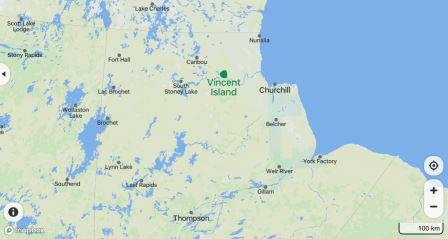
Map showing locations where Omer Vincent was in April 1945.  (Map source: DuckDuck Go)

The April 5, 1945 war diary for the 3rd Anti-Tank Regiment reported that “…Lt JR Cameron of the 4th Battery contacted the QOR this morning and 4 Battery is to aid in holding the east bank of the IJssel between Zutphen and Doesburg…”  QOR referred to Queen’s Own Rifles.  Omer was part of the 4th Battery.

On April 8, 1945, the war diary for the Regiment recorded that 4 Battery was involved in “was under command 8th Brigade for their part in the holding role from Zutphen to Doesburg….” as part of the “….defence system they are holding along the IJssel…..

The following day, the war diary for the Regiment noted that 4 Battery’s new position was “taken up in Steenderen….

.….Omer lost his life on his 25th birthday….

On April 13, 1945, the municipality of Bronkhorst was liberated. However, Germans were still across the IJssel River by Brummen. The war diary for the 3rd Anti-Tank Regiment for that day recorded that “….4 Battery – had skirmish with enemy in barn. Battery suffered two men killed and shot up and burnt down buildings with a Valentine SP.….”  A Valentine Self Propelled (SP) was a tank destroyer.  For more information see https://en.wikipedia.org/wiki/Archer_(tank_destroyer)

Edwin van der Wolf, a volunteer at the Canadian War Cemetery in Holten, explained that “…On the ‘t Hammink farm,  Mr. Buil, a farmhand, saw that night, through the basement window, that German soldiers were coming back and going in the back side of the farm. Farmhand Bruil went to a farm that was 1.5 km further, as he knew that Canadians were billeted there, and informed them about what he had seen….

…Then four Canadian soldiers with a tank went on patrol to ‘t Hammink. Two of them went to explore the farm, but were met by a barrage of bullets. Both were slain. The men were Gunners Omer Vincent and Leslie Temple. The ‘t Hammink farm was then set on fire….Leslie Phillip Carl TEMPLE, from Regina, Saskatchewan, was 23 years old at the time of his death. Sadly, April 13, 1945 was Omer’s 25th birthday.

Edwin went on to write that “…Mr. Breukink, the owner of ‘t Hammink, had fled because he was a member of the NSB…” NSB was the acronym for Nationaal Socialistische Beweging (National Socialist Movement), whose members were Nazi collaborators. (See https://en.wikipedia.org/wiki/National_Socialist_Movement_(Netherlands))

.….Omer is buried in Holten….

Edwin’s account noted that “…the two Canadians killed were temporarily buried in the yard of the Half Welle…” Per Omer’s service file, this was in the vicinity of Baak, south of Zutphen and near Steenderen.  On April 1, 1946, Omer was reburied in the Canadian War Cemetery in Holten, The Netherlands.

Grave of Omer Vincent in the Canadian War Cemetery in Holten, The Netherlands.  (Photo courtesy of the Information Centre Canadian Cemetery Holten)

….Omer’s grave was adopted by a doctor from Gorssel ….

After his reburial in the Canadian War Cemetery in Holten, Omer’s grave was adopted by a Dr. B. H. Upmeijer of Gorssel.  On April 6, 1947, he wrote to Omer’s family, saying that “…today we remember in our village the day of our liberation….” 

He went on to explain that he and others from the village had gone to the Canadian War Cemetery in Holten, “…15 miles from the village of Gorssel and placed flowers on the graves of those who are fallen in the neighbourhood of Zutphen, Eefde, and Gorssel…” 

Dr. Upmeijer noted that he had adopted Omer’s grave, and went on to share his own personal loss.  “…The grave of my brother is in Burma… and for me it would have been reassuring, when I knew where and how he is laying exactly…”  (Burma is now called Myanmar.)

….Vincent Island in northern Manitoba is named in Omer’s honour…..

Vincent Island in Mullin Lake was named after Omer Vincent. (Map source: Mapcarta)

Vincent Island, located in Mullin Lake in northern Manitoba, west of Churchill, was named after Omer in 1995. 

Thank you to Diane Dube for providing information on Omer Vincent, to Edwin van der Wolf for the account of what happened at the ‘t Hammink farm, and to Sheldrake of WW2Talk for information about the gun fitter course.  If you have a story or photo to share, please contact Pieter at memorialtrail@gmail.com or comment on the blog. 

© Daria Valkenburg

….Want to follow our research?….

If you are reading this posting, but aren’t following our research, you are welcome to do so.  Our blog address: https://onthewarmemorialtrail.com/

4 countries, 6 weeks, 7,000 km – an unforgettable war memorial journey in Europe…. Daria’s book ‘No Soldier Buried Overseas Should Ever Be Forgotten‘ is available in print and e-book formats.  Net proceeds of book sales help support research costs and the cost of maintaining this blog. For more information see https://nosoldierforgotten.com/

You are also invited to subscribe to our YouTube Channel: On The War Memorial Trail With Pieter Valkenburg: https://www.youtube.com/channel/UCJ591TyjSheOR-Cb_Gs_5Kw

Never miss a posting!  Subscribe below to have each new story from the war memorial trail delivered to your inbox.

On The War Memorial Trail…..The WWI Soldier From Tryon Who Became A Mailman In New Brunswick

January 7, 2025.  Several months ago, Pieter received a phone call from Carmen Ross, explaining that his granddaughter Lauren was doing a school project on his great-uncle, WWI soldier John Joseph FOY, who was born in Tryon, Prince Edward Island, very near to where we live. Could Pieter help with information about his great-uncle’s military service?

In 2021, we’d written about another WWI soldier from Tryon with the same surname, Maynard FOY.  Was he a relative? Pieter asked.  It turned out that the two families were distantly related.  (See https://onthewarmemorialtrail.com/2021/04/24/on-the-war-memorial-trail-the-ww1-soldier-who-returned-to-tryon/)

CIMG7040 Sep 4 2024 Pieter with Carmen and Margaret Ross

Pieter with Carmen and Margaret Ross.  (Photo credit: Daria Valkenburg)

Like Maynard, John Foy survived the war and returned to Canada.  As one of the goals of the ‘On The War Memorial Trail’ research project is the opportunity to tell the stories of Islanders who survived their war service, Pieter not only helped provide information for Lauren’s school project, we also met with Carmen and his wife Margaret. 

…My grandfather, Alfred Foy, known as Allie, was John’s brother…  Carmen explained.  He also recalled his mother Hilda telling him that John “…was such a nice man!…

….John enlisted in 1915….

John Joseph Foy

John Joseph Foy.  (Photo courtesy of Carmen Ross)

Born on October 25, 1882, John was the son of Philip Morris Callbeck and Rachel (nee Bynon) Foy.  A farmer at the time of his enlistment on September 25, 1915 in Charlottetown, Prince Edward Island, John had served in the No. 2 Heavy Battery Depot since July 1915, when it had been first organized in Prince Edward Island under the command of Major A. G. Peake, and which became No. 2 Overseas Battery, Canadian Siege Artillery, on September 29, 1915.

….John left Canada for overseas service shortly after enlistment….

File written by Adobe Photoshop? 4.0

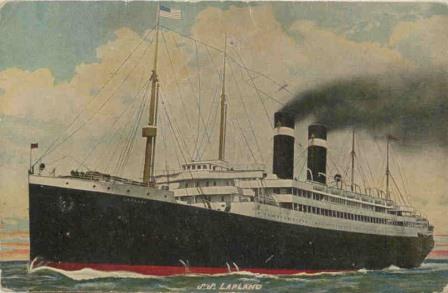
SS Lapland.  (Photo source: https://www.wikitree.com)

With his Battery, John sailed aboard the SS Lapland, leaving Halifax, Nova Scotia on November 28, 1915, and arriving at Plymouth Sound, United Kingdom on December 7, 1915. 

The Battery was housed at Raffey Camp, at Horsham Siege Artillery School, in West Sussex.  As a gunner, John and the other members of his Battery underwent four months of training there. While in England, the Battery was re-designated as No. 98 (Canadian) Siege Battery, Canadian Siege Brigade.

He remained with No. 98 (Canadian) Siege Battery Artillery until January 19, 1916, when he was transferred to the 3rd Reserve Brigade, Canadian Field Artillery, which was at Shorncliffe, for further training, and as part of reinforcement troops.

….John was sent to France for the Battle of the Somme….

DAC_Pack_Ammo_Apr17

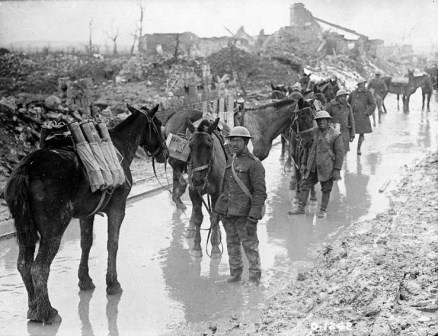
Ammunition Column Pack horses transporting ammunition to a brigade in France.  (Photo source: Library and Archives Canada, MIKAN no. 3194763)

On August 25, 1916 he left for France and was assigned to the 1st Divisional Ammunition Column (DAC), whose role was to bring ammunition forward to the gun positions of the 1st Division batteries for the Battle of the Somme. (See https://en.m.wikipedia.org/wiki/Battle_of_the_Somme)

Ammunition was moved by motor and horse drawn transport, heavy and light rail, and tramways.  From his service file, it appears that John worked in the stables and in the transport of ammunition by horses.

….John was reassigned to his artillery battery….

John remained with the 1st DAC until September 12, 1916, when he returned to the 2nd Brigade, and continued to work with horses, which were used in transporting the heavy guns and ammunition to the front lines, as the Battle of the Somme continued into the fall of 1916.  The Brigade served continuously behind the United Kingdom’s 4th Army’s front until December 1916, when troops were ordered to dig their guns out of the mud and move northward.

In January 1917, the battery became part of the Canadian Corps Heavy Artillery and was renamed No. 2 Canadian Siege Battery, Canadian Garrison Artillery (CGA).  On January 22, 1917, John was admitted to a field hospital in France with bronchitis and pneumonia, and remained there until January 27, 1917, when he rejoined his unit.

Preparations were underway for the Battle of Vimy Ridge, a three day battle from April 9 to 12, 1917, which John survived. (See https://en.m.wikipedia.org/wiki/Battle_of_Vimy_Ridge) Following Vimy Ridge, John’s unit was involved in the Battle of Hill 70, just east of Loos and north of Lens, which was fought between August 15 and 25, 1917. (See https://en.m.wikipedia.org/wiki/Battle_of_Hill_70)

On October 4, 1917, John was sent to a rest camp in Boulogne for 2 weeks, returning to his unit on October 19, 1917.  A few weeks later he was sent to England on leave for a few weeks, returning on November 30, 1917, where he and his unit were assigned to the 48th Battery, Canadian Field Artillery. 

….A handkerchief from Belgium remains in the family!….

LAC_BL_6-inch_26_cwt_Howitzer

Crew positioning a BL 6-inch howitzer. (Photo source: Library and Archives Canada MIKAN No. 3395353)

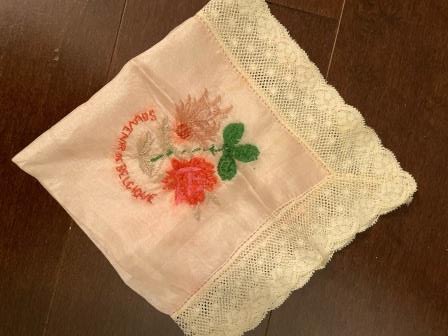
John’s battery was involved in the March 1918 German Spring Offensive in West Flanders, Belgium. (See https://en.m.wikipedia.org/wiki/German_spring_offensive) While in Belgium, he managed to buy an embroidered handkerchief, which was given to Carmen’s mother Hilda.

image0 Belgian hankie 2 from Jen Huber

Embroidered handkerchief from Belgium that John Foy brought back to Canada.  (Photo courtesy of Jen Huber)

As fighting continued, troops were involved in the Hundred Days Offensive, which began in August 1918 and continued until the end of the war. (See https://en.m.wikipedia.org/wiki/Hundred_Days_Offensive) They moved frequently, through the Hindenburg Line, and advancing north during the Battle of Cambrai in France, from October 8 to 10, 1918.  (See https://en.m.wikipedia.org/wiki/Hundred_Days_Offensive)

In December 1918, the battery moved briefly into Germany, positioned on the west bank of the Rhine at Cologne to protect the crossing of the 1st Canadian Division on December 13, 1918.  The battery returned to the United Kingdom, leaving France from Le Havre on March 30, 1919, and arriving in the United Kingdom at Weymouth.

….John was discharged from the army and returned to Canada….

By April 14, 1919, John was on his way back to Canada, leaving Southampton aboard the SS Olympic.  He was discharged from service on April 30, 1919 in Charlottetown, aged 36.

Screenshot 2025-01-07 at 09-48-24 Lewisville Map - Locality - Westmorland County New Brunswick Canada

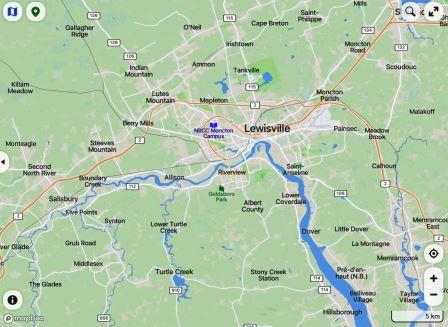
John Foy lived in Turtle Creek and was a mailman in rural Lewisville, now part of Moncton.  (Map source: http://www.mapcarta.com)

John never married and moved to New Brunswick. He was involved in harness racing as a driver and worked as a rural mailman in Lewisville (now part of Moncton), while living in nearby Turtle Creek, before he retired due to ill health.

….John is buried in St. John, New Brunswick….

He died on July 1, 1964, aged 81, at the Lancaster Department of Veterans Affairs Hospital in Lancaster, New Brunswick, following a lengthy illness, and was buried in the Field of Honour at Cedar Hill Extension Cemetery in St. John.

cemetery where he is buried Find a Grave

Grave of John Joseph Foy in Cedar Hill Extension Cemetery in St. John, New Brunswick. (Photo courtesy of FindAGrave)

Thank you to Carmen and Margaret Ross, and Jen Huber, for sharing photos and information about John Foy, and to Shawn Rainville and Etienne Gaudet for newspaper research. If you have a story or photo to share, please contact Pieter at memorialtrail@gmail.com or comment on the blog. 

© Daria Valkenburg

….Want to follow our research?….

If you are reading this posting, but aren’t following our research, you are welcome to do so.  Our blog address: https://onthewarmemorialtrail.com/

Front cover OnTheWarMememorialTrailinEurope4 countries, 6 weeks, 7,000 km – an unforgettable war memorial journey in Europe…. Daria’s book ‘No Soldier Buried Overseas Should Ever Be Forgotten‘ is available in print and e-book formats.  Net proceeds of book sales help support research costs and the cost of maintaining this blog. For more information see https://nosoldierforgotten.com/

You are also invited to subscribe to our YouTube Channel: On The War Memorial Trail With Pieter Valkenburg: https://www.youtube.com/channel/UCJ591TyjSheOR-Cb_Gs_5Kw

Never miss a posting!  Subscribe below to have each new story from the war memorial trail delivered to your inbox.