
The Cenotaph site in Cornwall, Prince Edward Island. The WWI cenotaph is on the right, and the WWII cenotaph on the left. (Photo credit: Daria Valkenburg)
October 12, 2024. When Pieter was asked to give a presentation on September 22, 2024 at the 105th Annual Remembrance Service in Cornwall, Prince Edward Island, one of the names on the WWII Cenotaph was that of Private William Ernest STONE, who was serving with the Black Watch of Canada, when he was killed during a fierce battle in Hoogerheide, The Netherlands on October 10, 1944, at the age of 25. (See https://onthewarmemorialtrail.com/2024/09/26/on-the-war-memorial-trail105th-annual-remembrance-service-at-cornwall-cenotaph/)
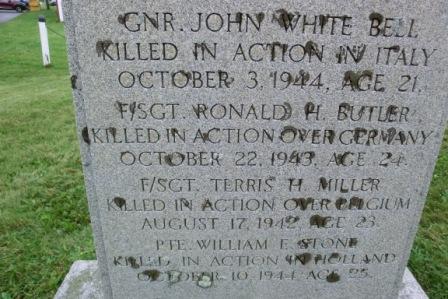
William Ernest Stone was one of 4 casualties listed on the WWII Cenotaph in Cornwall, Prince Edward Island. (Photo credit: Daria Valkenburg).
William is buried in the Canadian War Cemetery in Bergen Op Zoom, The Netherlands, located near the Belgian border. 2024 is an important anniversary for this area as 80 years ago, in October 1944, Belgium and the southern part of The Netherlands were liberated, following tremendous casualties during the Battle of the Scheldt. (See https://en.wikipedia.org/wiki/Battle_of_the_Scheldt and https://www.thecanadianencyclopedia.ca/en/article/canada-and-the-battle-of-the-scheldt)
It seems only fitting that 80 years after his death, William’s story is told. He was born August 19, 1919, in Clyde River, Prince Edward Island, the son of Edward Earnest and Sadie Stone.
William had two brothers and two sisters. With the help of Brenda Graves and Arlene Roberts, a photo was soon provided by Faye MacNutt, the daughter of William’s sister Ruth.
…..William enlisted under the NRMA in 1941….
William originally enlisted under the National Resources Mobilization Act (NRMA) in Charlottetown, Prince Edward Island on April 17, 1941 and underwent basic training at No. 62 Canadian Army Basic Training Centre (CABTC) in Charlottetown. (See https://en.wikipedia.org/wiki/National_Resources_Mobilization_Act)
At the time of his enlistment he had been working for two years as a stoker at Storms Construction Company Ltd in Charlottetown. Among his tasks he also worked at Charlottetown Airport for several months in 1940, tasked with running a cement mixer and doing odd jobs, when the airport was transferred to the Royal Canadian Air Force (RCAF) and the airport and runways were enlarged in preparation for using the airport to train pilots and aircrew.
William also noted that he also had six years of farming experience from helping on his family’s farm. He had an interest in mechanics, played tennis, volleyball, and baseball, and enjoyed singing.
…..William received training in both Canada and the USA….

William Ernest Stone. (Photo courtesy of Faye MacNutt. Photo colourization by Pieter Valkenburg)
On June 6, 1941, he transferred to active service at No. 62 CABTC in Charlottetown, and was immediately sent to No. 6 District Depot in Halifax, Nova Scotia for trades training in motor mechanics and welding at the Halifax Technical School.
After successfully completing the two month course in Halifax, William was attached to No. 14 Infantry Training Centre in Aldershot, Nova Scotia as of August 2, 1941. A few days later, he was sent ‘on command’ to Automatic Course in Motor Mechanics at the Quartermaster Motor Transport School at Fort Holabird in Baltimore, Maryland, USA. He successfully completed the course on October 15, 1941.
Next, he was sent to the Canadian Army Trade School (CATS) in Hamilton, Ontario for more training in motor mechanics. His time there was from October 28, 1941 until June 6, 1942, when he was transferred to the A9 Canadian Armoured Corps (Advanced) Training Centre (CACATC) at Camp Borden in Ontario for wireless training.
William received a furlough from May 20 to June 2, 1942, during which time he returned to Prince Edward Island to marry Eileen Younker in Winsloe on May 27, 1942. The couple only had a few days together before he had to return and continue his training.
On July 26, 1942, he was assigned to the 28th Armoured Regiment in Debert, Nova Scotia for final training before going overseas. On August 4, 1942, William received embarkation leave until August 7, the last chance he had to see his family.
….William left Canada for overseas service….
William left Canada with the 28th Armoured Regiment on August 22, 1942, arriving in the United Kingdom on September 1, 1942. He was sent for more training, and qualified as a Driver i/c Class III (Wheeled) on December 6, 1942. (The term ‘Driver i/c’ refers to ‘Driver, internal combustion’. Class III meant he was qualified to drive heavy trucks and armoured cars, but not tanks.)
On May 15, 1943 he was sent to 21 Canadian Armoured Regiment (CAR) for a few weeks and then on to receive training as a Driver Mechanic (Tank) Class ‘C’. He successfully completed this training on December 3, 1943.
William was transferred to No. 3 Canadian Armoured Corps Reinforcement Unit (CACRU) on January 29, 1944. Then, on July 25, 1944, he was transferred again, this time to No. 1 Canadian Armoured Corps Reinforcement Unit (CACRU), and re-mustered from the Canadian Armoured Corps (CAC) to the Royal Canadian Artillery (RCA).
On August 13, 1944 William was temporarily assigned to the Canadian Fusiliers (City of London Regiment) before being placed on the X-4 Canadian Infantry Corps Reinforcement List, part of the 10th Battalion, on September 21, 1944 and sent to France.
On September 28, 1944, William was transferred to the Black Watch (Royal Highland Regiment) of Canada, and joined them in Rijkevorsel, Belgium. The war diary for that day noted that “….in the last two days, 42 reinforcements have joined us, 11 for general duty, the remainder being for the most part signallers and drivers...”
The Regiment had surged through France and into Belgium, where William joined the Regiment. From Belgium, the Regiment made its way into The Netherlands on October 7, 1944. While the main goal was helping to clear the Scheldt Estuary, necessary to liberate the vital port of Antwerp, their first task was to attack the town of Hoogerheide.
….Attack On Hoogerheide….
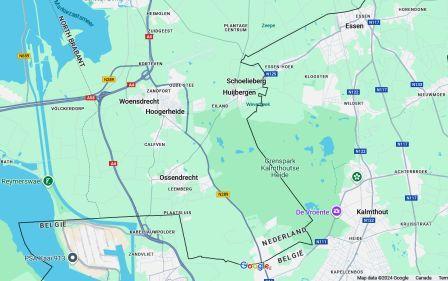
Map shows location of Calfven, Hoogerheide, and Ossendrecht in The Netherlands, just over the Belgian border. (Map source: Google maps)
The War Diary for October 7, 1944 noted that the Regiment had begun their journey into The Netherlands “…at 0930 hours and shortly thereafter crossed the frontier into Holland at the town of Putte…and went on to our area at a farm….In the afternoon we moved forward again into the Calfven area….”
On October 8, 1944, as the troops moved up to the attack on Hoogerheide in the early morning, they found that the Start Line hadn’t been secured. When the attack did begin, at 10:30 am, troops came under machine gun and mortar fire.
The War Diary entry for October 8, 1944 stated that “…very heavy fighting ensued and it was over two hours before the enemy decided that he had had enough….” The respite didn’t last.
The following day, the War Diary recorded that “…during the night, mortaring and shelling continued on a heavy scale….It is apparent that there has been heavy reinforcement of this area, and that the enemy is determined to make a stand. The troops we are now meeting are definitely the cream of the crop. They belong to paratroop battalions, with a sprinkling of glider troops and Luftwaffe personnel…..”
The war diarist noted that the German troops were young and in good physical condition, “…keen to fight and with excellent morale. All day long there was heavy fire from artillery and mortar on our positions, and his snipers are very busy. At 1600 hours the Germans opened an artillery barrage which lasted for two hours, then came in on a counter attack…”
On October 10, 1944, the War Diary continued the account of the attack. “…Weather – Misty and rain. The heavy mortaring and shelling to which we have been subjected continues without respite…” The attack continued for the Black Watch until 3:00 pm, when they were relieved by the Royal Hamilton Light Infantry.
The Black Watch casualties for the Hoogerheide attack were counted, and totalled 81, with 12 fatalities. Among those who were recorded as having died on October 10, 1944 was William Ernest Stone.
….William is buried in Bergen Op Zoom….
William was initially buried in the village cemetery in Ossendrecht, before being reburied in the Canadian War Cemetery in Bergen Op Zoom, The Netherlands.

Grave of William Ernest Stone in the Canadian War Cemetery in Bergen Op Zoom, The Netherlands. (Photo courtesy of the Canadian Virtual War Memorial)
Later this month, the cemetery in Bergen Op Zoom is holding its 80th Anniversary of Liberation Commemorations. Private William Ernest Stone will be one of the 968 Canadians buried there who will be remembered.
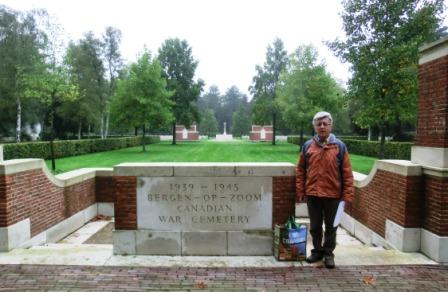
Pieter at the entrance to the Canadian War Cemetery in Bergen Op Zoom. (Photo credit: Daria Valkenburg)
Thank you to Brenda Graves and Arlene Roberts for their help in finding a photo. Thank you to Faye MacNutt for submitting a photo of her uncle.
If you have photos or information to share, please email Pieter at memorialtrail@gmail.com, comment on the blog, or tweet to @researchmemori1.
© Daria Valkenburg
….Want to follow our research?….
If you are reading this posting, but aren’t following our research, you are welcome to do so. Our blog address: https://onthewarmemorialtrail.com/
 4 countries, 6 weeks, 7,000 km – an unforgettable war memorial journey in Europe…. Daria’s book ‘No Soldier Buried Overseas Should Ever Be Forgotten‘ is available in print and e-book formats. Net proceeds of book sales help support research costs and the cost of maintaining this blog. For more information see https://nosoldierforgotten.com/
You are also invited to subscribe to our YouTube Channel: On The War Memorial Trail With Pieter Valkenburg: https://www.youtube.com/channel/UCJ591TyjSheOR-Cb_Gs_5Kw.
Never miss a posting! Subscribe below to have each new story from the war memorial trail delivered to your inbox.
 On The War Memorial Trail Research Project........ with Pieter and Daria Valkenburg