September 7, 2024. When Pieter has to choose which name on a photo wish list to research, we never know what to expect. Sometimes a name is chosen because of the location where the soldier came from, sometimes it’s because of a particular battle in which he died, or because the surname seems to be rare enough that any information found would be relevant….and might lead to a family member who has a photo.
..…A lion featured in an old TV program led to one successful photo search …..
Sometimes, word association helps us decide on a name to search. That’s what happened when scanning the list of names of Nova Scotia soldiers, and I noticed that one soldier, Ronald ‘Ronnie’ Eugene SMITH, came from Clarence. That reminded me of Clarence, the cross-eyed lion, from a TV program I watched as a child.
Daktari was a children’s program that followed the work of Dr. Tracy, a veterinarian at the fictional Wameru Study Centre for Animal Behaviour in East Africa, his daughter Paula, his staff, and a cross-eyed lion named Clarence.
“…That’s the soldier whose photo you need to look for next….” I told Pieter. The look on his face when I told him why was priceless! But, Pieter began his research and quickly found a great-niece, Jennifer Wallis, the granddaughter of Ronnie’s only sibling – his brother Allison, who confirmed that yes, the family had a photo of the soldier. A few months later, Jennifer wrote to let us know that photos were “… found after searching many boxes at my father’s home….”
Before telling the story of the Canadian soldier from Clarence, Nova Scotia, take a look at the opening sequence from Daktari…
..…Ronnie enlisted in January 1944 …..

Ronald ‘Ronnie’ Eugene Smith was born in Clarence, Annapolis County, Nova Scotia. (Map source: Google)
Ronald ‘Ronnie’ Eugene SMITH was born in Clarence, Nova Scotia on August 28, 1925, the son of Floyd Murdock and Ruby Gertrude (nee Palmer) Smith. When he enlisted with the No. 6 District Depot in Yarmouth, Nova Scotia on January 3, 1944, he stated that he had left school after 2 years of high school and was working on his parents’ farm in Bridgetown, Nova Scotia as a farm hand.

Ronald ‘Ronnie’ Eugene Smith. (Photo courtesy of Donnie Smith. Photo colourization by Pieter Valkenburg)
On January 4, 1944, he was sent to the No. 6 Depot in Halifax, Nova Scotia for basic training, and then on January 14, 1944 to No. 60 Canadian Infantry (Basic) Training Centre (CIBTC) in Yarmouth, Nova Scotia, where his father, Captain Floyd Smith, was a trainer at this centre.
From February 11, 1944 until April 17, 1944, Ronnie was in and out of Yarmouth Military Hospital. While he was recuperating he worked as a clerk in the Quartermaster stores between March and May 1944, after which he returned to general duties.
On July 30, 1944, Ronnie was transferred to A14 Canadian Infantry Training Centre (CITC) in Aldershot, Nova Scotia for further training. He received embarkation leave, from September 23 to October 6, 1944, the last chance he had to see his family.
….Ronnie left Canada for overseas service….
On November 25, 1944, Ronnie left for Great Britain, part of a group to provide reinforcements to the Canadian Army in the field. Upon arrival on December 6, 1944, he was assigned to No. 3 Canadian Infantry Training Regiment (CITR).
Ronnie continued receiving further training until January 23, 1945, when he left the United Kingdom for Italy, as part of the X-4 Reinforcements of the 1st Infantry Battalion, arriving on February 7, 1945.
As he arrived at No. 3 CITR a few days after Frank GALLANT of Prince Edward Island, perhaps the two Maritime soldiers had a chance to meet. The two men also left the United Kingdom for Italy on the same day. Once in Italy, although they were in the same location, their paths diverged as they were assigned to different regiments. (See https://onthewarmemorialtrail.com/2024/06/30/on-the-war-memorial-trail-the-wwii-soldier-from-mount-carmel-killed-during-the-liberation-of-posterenk/)
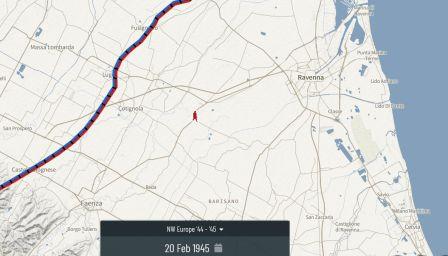
The West Nova Scotia Regiment was near Rossi, indicated by the soldier in the centre of the map, on February 20, 1945. (Map source: Project ‘44)
On February 20, 1945, Ronnie was transferred to the West Nova Scotia Regiment, joining them north of Rossi (Russi), part of a group of reinforcements, at the tail end of the Italian Campaign. (See https://en.m.wikipedia.org/wiki/Italian_campaign_(World_War_II))
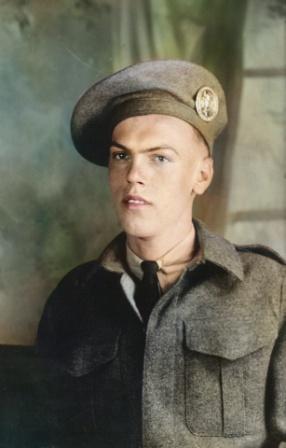
Ronald ‘Ronnie’ Eugene Smith joined the West Nova Scotia Regiment in February 1945. (Photo courtesy of Donnie Smith. Photo colourization by Pieter Valkenburg)
On March 20, 1945, he left Italy at the port in Livorno as part of Operation Goldflake, arriving in Marseilles, France two days later. Operation Goldflake was the codename for moving troops from Italy to North-West Europe. (See https://en.wikipedia.org/wiki/Operation_Goldflake)
After one night of rest, the Battalion left Marseilles for Belgium, arriving in Berlaer on March 28, 1945.
….Ronnie was part of Operation Cannonshot….
On April 4, 1945, the Battalion arrived at a concentration area in the Reichswald Forest in Germany, where they stayed briefly for training in preparation for Operation Cannonshot. The 49th British Division was to clear Arnhem in The Netherlands, and launch the 5th Canadian Armoured Division on a drive northwards. The 1st Canadian Division would bridgehead the IJssel River and head west to meet them.
On April 10, 1945, they moved to Hummelo, The Netherlands. Operation Cannonshot began on April 11, 1945, with Allied troops preparing to cross the IJssel River the following night and then advance towards Apeldoorn, The Netherlands. (See https://www.liberationroute.com/stories/190/operation-cannonshot)
The Battalion moved to the Royal Canadian Regiment area at Zutphen, just across the IJssel River on the night of April 12 into 13, 1945, crossing it at 2:30 am and establishing its Tactical Headquarters.
On April 13, 1945 the Regiment was committed to a breakout of a bridgehead on the IJssel River. According to the war diary for that day, the attack was expected to begin at 8:30 am “…but the attack did not begin until approximately 1100 hours, at which time ‘A’ Company, supported by tanks, started for their first objective. They were barely on their way when, due to an artillery concentration called down by Carleton & York Regiment, it was necessary to hold up until 1130 hours….”
By noon, ‘A’ Company was making good progress allowing both ‘A’ and ‘C’ Companies to advance on a two-company front. Progress slowed as resistance increased and ended at 7:45 pm.
….Ronnie lost his life near Zutphen….
On April 14, 1945, Tactical Headquarters was established in Zutphen area early in the morning. Companies sent out reconnaissance patrols during the rest of the night and into the early morning hours. The battalion was now in brigade reserve with the Royal 22nd Regiment on the left and the Carleton & York Regiment on the right. The Battalion attacked at 3:30 pm through the Royal 22nd Regiment to clear the woods on both sides of the highway leading to Apeldoorn but was held up by enemy fire and the attack was postponed.
At some point on April 14, 1945, Ronnie lost his life. He was only 19 years old. He was killed near a house beside a wooded area, and was initially buried in a field behind a house on the crossroads near Wilp/Achterhoek, The Netherlands.
Henk Vincent, a volunteer at the Canadian War Cemetery in Holten, explained that “…only from December 1945, when the construction of the cemetery in Holten was completed, did the final burial take place….”

Red marker shows temporary burial in Wilp/Achterhoek area southeast of Appeldoorn. (Map source: Google maps)
….Ronnie is buried in Holten…
After being exhumed from the temporary cemetery in Wilp/Achterhoek, Ronnie was reburied in the Canadian War Cemetery in Holten, The Netherlands on January 26, 1946. When the cemetery was first opened, metal crosses were used to mark each grave.

The original metal grave marker at the Canadian War Cemetery in Holten for Ronald ‘Ronnie’ Eugene Smith. (Photo courtesy of Donnie Smith)

Grave of Ronald ‘Ronnie’ Eugene Smith in the Canadian War Cemetery in Holten, The Netherlands. (Photo courtesy of the Information Centre Canadian Cemetery Holten)
..…We met with Ronnie’s family …..
We love meeting family members, and were delighted when we had a chance to meet Jennifer Wallis and her husband Kevin at a restaurant in Enfield, Nova Scotia.

Kevin and Jennifer Wallis with Pieter in Enfield, Nova Scotia. (Photo credit: Daria Valkenburg)
Thank you to Jennifer and Kevin Wallis and Jennifer’s father Donnie Smith. Do you have photos or information to share? Email Pieter at memorialtrail@gmail.com, comment on the blog, or tweet to @researchmemori1.
© Daria Valkenburg
….Want to follow our research?….
If you are reading this posting, but aren’t following our research, you are welcome to do so. Our blog address: https://onthewarmemorialtrail.com/
 4 countries, 6 weeks, 7,000 km – an unforgettable war memorial journey in Europe…. Daria’s book ‘No Soldier Buried Overseas Should Ever Be Forgotten‘ is available in print and e-book formats. Net proceeds of book sales help support research costs and the cost of maintaining this blog. For more information see https://nosoldierforgotten.com/
You are also invited to subscribe to our YouTube Channel: On The War Memorial Trail With Pieter Valkenburg: https://www.youtube.com/channel/UCJ591TyjSheOR-Cb_Gs_5Kw.
Never miss a posting! Subscribe below to have each new story from the war memorial trail delivered to your inbox.
 On The War Memorial Trail Research Project........ with Pieter and Daria Valkenburg