On The War Memorial Trail….. The WWII Soldier From Clermont Killed During Operation Veritable

September 30, 2024. When you visit a Canadian War Cemetery and place down a flag by a soldier’s grave, it stays with you, and makes you wonder about the person who is buried there.  Before our first war memorial tour in 2017, Pieter asked the Canadian War Cemeteries in The Netherlands for a list of soldiers from Prince Edward Island who are buried there, and we made sure to place flags at their graves.
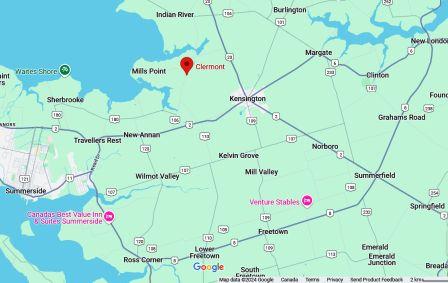
Screenshot 2024-09-30 at 09-15-25 Clermont - Google Maps

Clermont is located in Prince County, Prince Edward Island.  (Map source: Google)

Over the years, Pieter has researched many of the soldiers from Prince Edward Island who are buried in The Netherlands, and he continues to do so. One of these WWII soldiers was John ‘Weston’ CAMPBELL, born May 29, 1916 in Clermont, Prince Edward Island, the son of Archibald Joseph and Lavinia Helen (nee Brennan) Campbell.  

brant

C.G.S. Brant in Charlottetown around 1930.  (Photo source: https://sailstrait.wordpress.com)

Weston’s father was Captain of the Canadian Government Ship ‘Brant’, a buoy and lighthouse tender that operated from the Charlottetown Marine Wharf.  The family also operated a farm, and Weston worked there after leaving school upon completing Grade 10.

On June 29, 1937, Weston joined the 1st Battalion of the Prince Edward Island Highlanders Militia, before enlisting in active service with the Regiment on October 3, 1939. His basic training was taken in Charlottetown, Prince Edward Island, and Dartmouth, Nova Scotia. (See https://en.wikipedia.org/wiki/Prince_Edward_Island_Highlanders)

….Weston was transferred to the North Nova Scotia Highlanders…

Weston was promoted to Corporal and then Acting Sergeant by the time he was transferred to the North Nova Scotia Highlanders, 3rd Division, on June 20, 1940, and joined them at their headquarters in Amherst, Nova Scotia.  Training in preparation for overseas service continued.

According to his Personnel Selection Record, Weston played hockey, soccer, baseball, and softball.  His brother Vernon was a Chief Petty Officer in the Canadian Navy.  He had 4 sisters and 1 other brother.  The interviewer described Weston as…sturdy, good-looking, well-balanced, with keen pride in regiment….

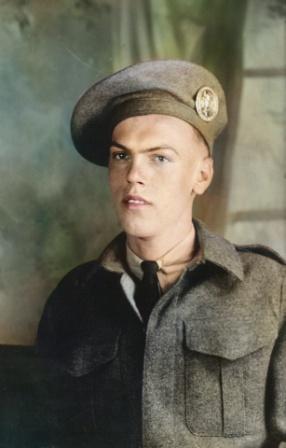
CAMPBELL John Weston

John ‘Weston’ Campbell as a Sergeant.  (Photo courtesy of North Nova Scotia Highlanders Museum)

On July 5, 1941 he was promoted to Sergeant, just as the Regiment moved to Debert, Nova Scotia for final preparations before going overseas.  InNo Retreating Footsteps by Will Bird, he noted that “…the 3rd Division units were moving to Debert….Word came that the North Novas would be included in the 9th Highland Brigade along with the Highland Light Infantry and the Stormont, Dundas and Glengarry Highlanders

….Weston left Canada for England….

On July 19, 1941, Weston and his Regiment left Halifax, Nova Scotia aboard the Orion, arriving in Avonmouth, England on July 29, 1941.  Two days later, they were allowed to disembark and left by train for Aldershot, where…the North Novas arrived at Albuhera Barracks

He continued to train and take courses, and then was transferred to the No. 1 Non-Effective Transit Depot (NETD) on July 7, 1942Tweedsmuir Camp in Surrey, near the village of Thursley, was set up as Number One Transit Depot for handling thousands of medical and psychological cases during WWII.  

It was also used as a base for returning Canadian and American troops, and that appears to be why Weston was there, as shortly after his arrival he was sent back to Canada, arriving on July 29, 1942.  The following day he was assigned to No. 6 District Depot in Halifax, Nova Scotia, for a short period.

….Weston returned to Canada for officer training….

On August 14, 1942, Weston was sent to the No. 30 Officers Training Centre in Brockville, Ontario for training. After successfully completing his 12 week course on November 7, 1942, he was recommended for promotion and appointment to the rank of 2nd Lieutenant.

With his new officers’ rank, he was transferred to the A-14 Canadian Infantry Training Centre in Camp Aldershot, Nova Scotia on November 13, 1942.  He was sent for additional training to the A25 Canadian Army Small Arms Training Centre (CSATC) in Long Branch, Ontario from November 14 to December 12, 1942, after which he was promoted to Lieutenant.

On January 9, 1943, Weston was transferred to No. 61 Canadian Army (Basic) Training Centre in New Glasgow, Nova Scotia for additional training, before returning to A-14 Canadian Infantry Training Centre in Camp Aldershot on April 14, 1943.

….Weston left Canada again for overseas service….

On June 19, 1943, Weston left Canada for overseas service.  After arriving in the United Kingdom on June 24, 1943, he was assigned to No. 7 Canadian Infantry Reinforcement Unit (CIRU).   He arrived there just as a fellow Islander, Harold ‘Hal’ Gabriel BULGER, whose story was previously told, was transferred to the Princess Louise Fusiliers.  (See https://onthewarmemorialtrail.com/2024/08/05/on-the-war-memorial-trail-the-bulger-brothers-part-i-the-wwii-soldier-from-foxley-river-killed-during-the-battle-of-moerbrugge/)

On July 29, 1943, Weston returned to the North Nova Scotia Highlanders, who were still in the United Kingdom. Training and exercises continued, as extensive preparations began for Operation Overlord (the larger Normandy invasion) and Operation Neptune (the English Channel-crossing portion of Operation Overlord) on June 6, 1944 – what we know today as D-Day.

InNo Retreating Footsteps by Will Bird, he recorded that among “…the officers selected to land in France on D Day with the North Novas….” was Lt. J.W. Campbell who would be leading an anti-tank platoon.

…Weston survived D-Day….

The North Nova Scotia Highlanders left England for Normandy, France on June 6, 1944, after waiting in place in the English Channel on landing craft earlier.   The war diary for Sunday, June 4, 1944 noted that “…we are tied up with two other landing craft tank.   The Padre is on one, so he had a church service at 10:30 hours on the quarter deck of the middle craft…

On June 5, 1944 the war diary recorded that “…at 14:00 hours the flotilla moved out to the open sea and formed up with the other craft taking part in the invasion…

After landing on the beaches of Normandy on June 6, 1944, as part of the 9th Infantry Brigade, 3rd Canadian Infantry Division, 21st Army Group, the war diary noted that the Regiment had 10 casualties that day– 4 killed, 6 wounded. 

Weston had survived D-Day and received a promotion to Acting Captain on June 22, 1944. The Regiment continued to fight in North-West Europe, including the Battle of the Scheldt, which began October 2, 1944. (See https://en.wikipedia.org/wiki/Battle_of_the_Scheldt)  Weston was confirmed as Captain on October 4, 1944.

On December 19, 1944, he was promoted again.  The war diary entry for that day reported that “…Captain J. W. Campbell was made Acting Major today, and is to command ‘B’ Company…

On January 10, 1945, while on leave in the United Kingdom, he married Mary Margaret Taylor in Sheffield, Yorkshire, England. 

He returned to the Regiment on January 15, 1945 and the war diary entry for that day recorded that “…the battalion officers held a party for Major J. W. Campbell who has just returned from his privilege leave to the United Kingdom.  It appears that he was married during this leave….

….Weston lost his life during Operation Veritable…
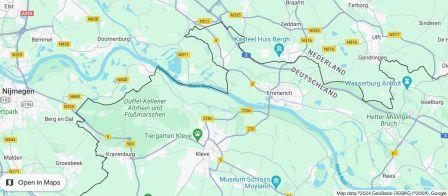
Screenshot 2024-09-30 at 11-09-38 emmerich germany - Google Search

Map shows Emmerich, Germany located on the Rhine River. Allied troops had to cross the river in amphibious vehicles.  (Map source: Google maps)

The Regiment was informed that they were to take part in Operation Veritable. (See https://en.wikipedia.org/wiki/Operation_Veritable) After leaving Nijmegen in The Netherlands, they reached Kellen, Germany near Kleve, just on the other side of the border with The Netherlands, on February 12, 1945. 

On February 14, using amphibious vehicles, the North Novies made their way towards Emmerich.   The war diary for that day reported that “….we have been given the job of taking out the triangle formed by the road running southwest … and the canal running south east….

Three Companies were involved. …The attack is to be made across the river which has overflowed its banks and now forms a barrier over 200 yards wide. Buffaloes are to be used for the attack

The action began at noon, with ‘C’ Company on the left, and ‘A’ Company on the right of the road.  “… ‘B’ Company, which arrived late at the rendezvous, set out at 12:10 hours with their axis along the main road…

The war diary entry continued, explaining that “…the assault companies landed on the shore with terrific fire support from field and medium artillery, plus the machine guns of the Buffaloes…

The attack, which ended at 6:15 pm,  was ultimately successful, but “…our total number of casualties for today’s action was 3 killed and 8 wounded, including Major J. W. Campbell, commanding ‘B’ Company, who was killed…”  Both ‘B’ and ‘C’ Companies had been heavily mortared during the day.

….Weston is buried in Groesbeek…

Weston was initially buried in a churchyard in Warbeyen, Germany, located halfway between Emmerich and Kleve, before being reburied in the Canadian War Cemetery in Groesbeek, The Netherlands.  He was 28 years old and had been married just over a month.

CIMG9018 Sep 16 2017 Groesbeek Cemetery grave of JW Campbell from Daria

Grave of John ‘Weston’ Campbell in the Canadian War Cemetery in Groesbeek, The Netherlands.  (Photo credit: Daria Valkenburg)

Seven years after we placed flags at his grave, we finally know John ‘Weston’ Campbell’s story! If you have photos or information to share, please email Pieter at memorialtrail@gmail.com, comment on the blog, or tweet to @researchmemori1.

© Daria Valkenburg

….Want to follow our research?….

If you are reading this posting, but aren’t following our research, you are welcome to do so.  Our blog address: https://onthewarmemorialtrail.com/
Front cover OnTheWarMememorialTrailinEurope4 countries, 6 weeks, 7,000 km – an unforgettable war memorial journey in Europe…. Daria’s book ‘No Soldier Buried Overseas Should Ever Be Forgotten‘ is available in print and e-book formats.  Net proceeds of book sales help support research costs and the cost of maintaining this blog. For more information see https://nosoldierforgotten.com/ 

You are also invited to subscribe to our YouTube Channel: On The War Memorial Trail With Pieter Valkenburg: https://www.youtube.com/channel/UCJ591TyjSheOR-Cb_Gs_5Kw

Never miss a posting!  Subscribe below to have each new story from the war memorial trail delivered to your inbox.

On The War Memorial Trail……105th Annual Remembrance Service At Cornwall Cenotaph

September 26, 2024. On Sunday, September 22, 2024, the 105th Annual Remembrance Service was held at the Cornwall Cenotaph in Cornwall, Prince Edward Island.  Pieter was invited by fellow Legion member John Yeo to be the keynote speaker at this event. 

John asked that excerpts from Pieter’s presentation in July for the 75th Anniversary of NATO be included in the presentation. (See https://onthewarmemorialtrail.com/2024/07/15/on-the-war-memorial-trail75th-nato-anniversary-commemoration-at-seacow-head-lighthouse/)

….There were two Cenotaphs – 1 for WWI and 1 for WWII….

After Pieter agreed to give a presentation, we visited Cornwall and saw that there were actually two Cenotaphs – one listing casualties from WWI and the other listing casualties from WWII.

A preliminary visit to the Cenotaph site in Cornwall. The WWI cenotaph is on the right, and the WWII cenotaph on the left. (Photo credit: Daria Valkenburg)

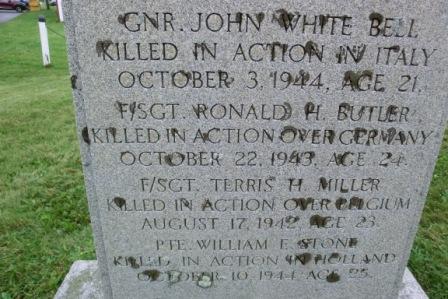
The WWII Cenotaph listed 4 names, with one of the men killed in The Netherlands.  In preparation for the presentation, a decision was made to briefly mention these 4 men. 

There were 4 casualties listed on the WWII Cenotaph in Cornwall.  (Photo credit: Daria Valkenburg)

 ….Pieter explained why he researches Canadian soldiers….

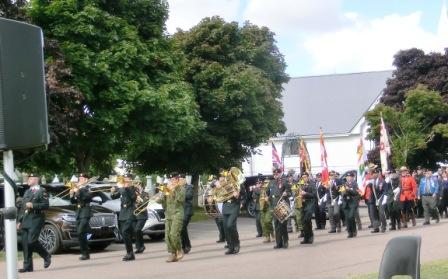
The PEI Regimental Band led a march past the Cenotaph just prior to the start of the ceremony.  (Photo credit: Daria Valkenburg)

Sunday, September 22, 2024 saw many citizens, veterans, and dignitaries arrive in Cornwall.  The PEI Regimental Band led the march past the Cenotaph just prior to the start of the ceremony.  Following the laying of the wreaths, Pieter was introduced as the keynote speaker.

He began by thanking the organizers for the invitation to speak “…as we gather around these two Cenotaphs commemorating those who died in WWI and WWII, on this, the 105th annual service ….” 

Pieter then briefly explained the motivation for researching Canadian soldiers.  “…If it wasn’t for the Allied soldiers fighting against tyranny in WWII, I might not be here. I was born in The Netherlands during the Hunger Year of 1944, when there was little or no food.  Our family lived in the countryside and my father spent many nights, sneaking out after curfew, looking to trade items for food to feed his family.  He wasn’t alone.  Anyone caught with food by the Nazis had it confiscated. 

So many people starved to death that winter! Allied soldiers – in particular the Canadians in our area of The Netherlands – not only liberated us from Nazi rule, they saved us from starvation.

In gratitude, now that I’m retired, one way for me to honour those who lost their lives in war is to research and share the stories of Canadians who served and died in the First and Second World Wars, helping to ensure that they will never be forgotten…

…. 2024 was a year of important anniversaries ….

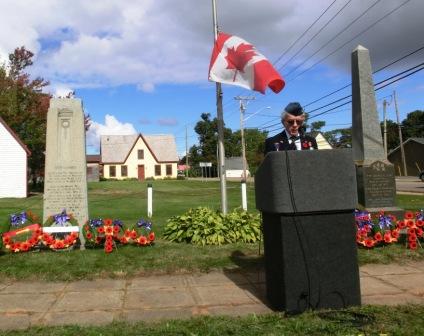
Pieter at the podium in Cornwall, with the WWII Cenotaph on the left, and the WWI Cenotaph on the right. (Photo credit: Daria Valkenburg)

Pieter reflected that 2024 was a year of important anniversaries, and referenced the 80th anniversary of D-Day and the 75th anniversary of NATO.  He then explained that “…80 years ago, in October 1944, Belgium and the southern part of The Netherlands were liberated, following tremendous casualties during the Battle of the Scheldt. 

One of the names on this Cenotaph, that of Private William Ernest STONE, was serving with the Black Watch of Canada, when he was killed during a fierce battle in Hoogerheide on October 10, 1944, at the age of 25.  He’s buried in the Canadian War Cemetery in Bergen Op Zoom, which is near the Belgian border. 

The cemetery in Bergen Op Zoom is holding its 80th anniversary of liberation commemorations next month, and Private Stone will be one of the 968 Canadians buried there who will be remembered….

…. The other 3 names on the WWII Cenotaph were mentioned….

As was decided back in July when we first visited the Cenotaph location in Cornwall, Pieter briefly mentioned the other three names on the WWII Cenotaph.

…Gunner John White BELL was serving with the Royal Canadian Artillery when he died on October 3, 1944 in Italy, at the age of 21. He’s buried in Ravenna War Cemetery in Italy.

RCAF Flight Sergeant Ronald Harris BUTLER died over Germany on October 22, 1943, at the age of 24. He was the bomb aimer aboard Lancaster ED366, which was on its way to bomb a target in Kassel, Germany when it was damaged by flak and finished off by a night fighter over Obermeiser, Germany. He’s buried in Hannover War Cemetery in Germany. Out of 7 crew members, only the pilot managed to bail out safely and survived. 

RCAF Flight Sergeant Terris Haggie MILLER died on the night of August 28, 1942, at the age of 23.  He was the wireless operator aboard Halifax W7809 which was shot down over Belgium by a German night fighter, and crashed southeast of Brussels, at Overijse-Tombeek.  The bomber was on its way to a bombing mission in Nürnberg in Germany, but never made it. All 7 crew members lost their lives and are buried near the crash site in the Overijse-Tombeek Churchyard.….” 

…. An appeal for photos ….

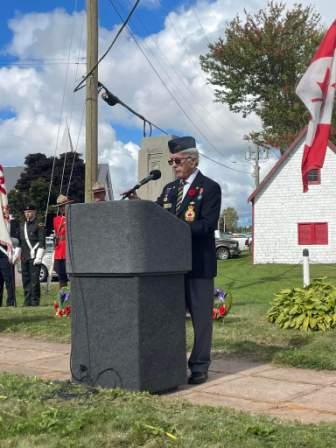
Pieter at the podium in Cornwall.  (Photo courtesy of Heath MacDonald)

Pieter had been invited to give a presentation because of his research, and he wasn’t going to let an opportunity go by without reminding those present of the need to preserve the past.  “…Volunteers like me work diligently to find photos of the Allied casualties in the many cemeteries in which they are buried. This is my 10th year of research.  There are over 7,600 Canadians who lost their lives during WWII that are buried in The Netherlands.

While many photos have been found, there is still much research to do. It gets harder as each year passes, with so many photos, letters, and other mementos of those who served and didn’t return home get lost to the dustbin of history….” 

…. ‘They’re not just names on a Cenotaph’ ….

The presentation ended with Pieter saying that “…those who sacrificed their lives in war are not just names on a Cenotaph or buried in a war grave.  They were children, siblings, spouses, parents, friends… Each one has a story that can be told and they should not be forgotten.

Let us always remember the memories and sacrifices made by those who did their best to answer the call to fight for freedom.  Thank you….

As Pieter left the podium and returned to where he had been seated, he was both humbled and surprised as the audience gave him a standing ovation. Afterwards, many people came up to him and told him how his speech had touched them. 

Thank you to John Yeo and the organizers of the Annual Remembrance Service at Cornwall Cenotaph for inviting Pieter to speak. 

Do you have photos or information to share? Email Pieter at memorialtrail@gmail.com, comment on the blog, or tweet to @researchmemori1.

© Daria Valkenburg

….Want to follow our research?….

If you are reading this posting, but aren’t following our research, you are welcome to do so.  Our blog address: https://onthewarmemorialtrail.com/

4 countries, 6 weeks, 7,000 km – an unforgettable war memorial journey in Europe…. Daria’s book ‘No Soldier Buried Overseas Should Ever Be Forgotten‘ is available in print and e-book formats.  Net proceeds of book sales help support research costs and the cost of maintaining this blog. For more information see https://nosoldierforgotten.com/ 

You are also invited to subscribe to our YouTube Channel: On The War Memorial Trail With Pieter Valkenburg: https://www.youtube.com/channel/UCJ591TyjSheOR-Cb_Gs_5Kw

Never miss a posting!  Subscribe below to have each new story from the war memorial trail delivered to your inbox.
On The War Memorial Trail….. The WWII Soldier From Clarence Who Lost His Life During Operation Cannonshot

September 7, 2024. When Pieter has to choose which name on a photo wish list to research, we never know what to expect. Sometimes a name is chosen because of the location where the soldier came from, sometimes it’s because of a particular battle in which he died, or because the surname seems to be rare enough that any information found would be relevant….and might lead to a family member who has a photo.

..…A lion featured in an old TV program led to one successful photo search …..

Sometimes, word association helps us decide on a name to search.  That’s what happened when scanning the list of names of Nova Scotia soldiers, and I noticed that one soldier, Ronald ‘Ronnie’ Eugene SMITH, came from Clarence.  That reminded me of Clarence, the cross-eyed lion, from a TV program I watched as a child. 

Daktari was a children’s program that followed the work of Dr. Tracy, a veterinarian at the fictional Wameru Study Centre for Animal Behaviour in East Africa, his daughter Paula, his staff, and a cross-eyed lion named Clarence.

…That’s the soldier whose photo you need to look for next….” I told Pieter.  The look on his face when I told him why was priceless!  But, Pieter began his research and quickly found a great-niece, Jennifer Wallis, the granddaughter of Ronnie’s only sibling – his brother Allison, who confirmed that yes, the family had a photo of the soldier.  A few months later, Jennifer wrote to let us know that photos were “… found after searching many boxes at my father’s home….

Before telling the story of the Canadian soldier from Clarence, Nova Scotia, take a look at the opening sequence from Daktari…

..…Ronnie enlisted in January 1944 …..

Screenshot 2024-09-02 at 12-28-34 Clarence · Annapolis County NS B0S 1C0

Ronald ‘Ronnie’ Eugene Smith was born in Clarence, Annapolis County, Nova Scotia.  (Map source: Google)

Ronald ‘Ronnie’ Eugene SMITH was born in Clarence, Nova Scotia on August 28, 1925, the son of Floyd Murdock and Ruby Gertrude (nee Palmer) Smith.  When he enlisted with the No. 6 District Depot in Yarmouth, Nova Scotia on January 3, 1944, he stated that he had left school after 2 years of high school and was working on his parents’ farm in Bridgetown, Nova Scotia as a farm hand.

Ronnie Smith colourized improved_photo(44)

Ronald ‘Ronnie’ Eugene Smith. (Photo courtesy of Donnie Smith. Photo colourization by Pieter Valkenburg)

On January 4, 1944, he was sent to the No. 6 Depot in Halifax, Nova Scotia for basic training, and then on January 14, 1944 to No. 60 Canadian Infantry (Basic) Training Centre (CIBTC) in Yarmouth, Nova Scotia, where his father, Captain Floyd Smith, was a trainer at this centre.

From February 11, 1944 until April 17, 1944, Ronnie was in and out of Yarmouth Military Hospital.  While he was recuperating he worked as a clerk in the Quartermaster stores between March and May 1944, after which he returned to general duties.

On July 30, 1944, Ronnie was transferred to A14 Canadian Infantry Training Centre (CITC) in Aldershot, Nova Scotia for further training.  He received embarkation leave, from September 23 to October 6, 1944, the last chance he had to see his family.

….Ronnie left Canada for overseas service….

On November 25, 1944, Ronnie left for Great Britain, part of a group to provide reinforcements to the Canadian Army in the field.  Upon arrival on December 6, 1944, he was assigned to No. 3 Canadian Infantry Training Regiment (CITR). 

Ronnie continued receiving further training until January 23, 1945, when he left the United Kingdom for Italy, as part of the X-4 Reinforcements of the 1st Infantry Battalion, arriving on February 7, 1945.

As he arrived at No. 3 CITR a few days after Frank GALLANT of Prince Edward Island, perhaps the two Maritime soldiers had a chance to meet. The two men also left the United Kingdom for Italy on the same day. Once in Italy, although they were in the same location, their paths diverged as they were assigned to different regiments. (See https://onthewarmemorialtrail.com/2024/06/30/on-the-war-memorial-trail-the-wwii-soldier-from-mount-carmel-killed-during-the-liberation-of-posterenk/)

Screenshot 2024-09-07 at 11-06-35 Project '44

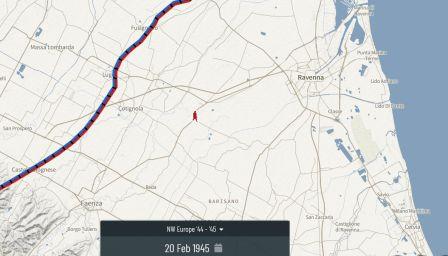
The West Nova Scotia Regiment was near Rossi, indicated by the soldier in the centre of the map, on February 20, 1945.  (Map source: Project ‘44)

On February 20, 1945, Ronnie was transferred to the West Nova Scotia Regiment, joining them north of Rossi (Russi), part of a group of reinforcements, at the tail end of the Italian Campaign. (See https://en.m.wikipedia.org/wiki/Italian_campaign_(World_War_II))

Ronnie Smith colourized improved_photo(43)

Ronald ‘Ronnie’ Eugene Smith joined the West Nova Scotia Regiment in February 1945. (Photo courtesy of Donnie Smith. Photo colourization by Pieter Valkenburg)

On March 20, 1945, he left Italy at the port in Livorno as part of Operation Goldflake, arriving in Marseilles, France two days later.  Operation Goldflake was the codename for moving troops from Italy to North-West Europe.  (See https://en.wikipedia.org/wiki/Operation_Goldflake)

After one night of rest, the Battalion left Marseilles for Belgium, arriving in Berlaer on March 28, 1945. 

….Ronnie was part of Operation Cannonshot….

On April 4, 1945, the Battalion arrived at a concentration area in the Reichswald Forest in Germany, where they stayed briefly for training in preparation for Operation Cannonshot.  The 49th British Division was to clear Arnhem in The Netherlands, and launch the 5th Canadian Armoured Division on a drive northwards. The 1st Canadian Division would bridgehead the IJssel River and head west to meet them.

On April 10, 1945, they moved to Hummelo, The Netherlands. Operation Cannonshot began on April 11, 1945, with Allied troops preparing to cross the IJssel River the following night and then advance towards Apeldoorn, The Netherlands. (See https://www.liberationroute.com/stories/190/operation-cannonshot)

The Battalion moved to the Royal Canadian Regiment area at Zutphen, just across the IJssel River on the night of April 12 into 13, 1945, crossing it at 2:30 am and establishing its Tactical Headquarters.

On April 13, 1945 the Regiment was committed to a breakout of a bridgehead on the IJssel River. According to the war diary for that day, the attack was expected to begin at 8:30 am “…but the attack did not begin until approximately 1100 hours, at which time ‘A’ Company, supported by tanks, started for their first objective.  They were barely on their way when, due to an artillery concentration called down by Carleton & York Regiment, it was necessary to hold up until 1130 hours….

By noon, ‘A’ Company was making good progress allowing both ‘A’ and ‘C’ Companies to advance on a two-company front. Progress slowed as resistance increased and ended at 7:45 pm.

….Ronnie lost his life near Zutphen….

On April 14, 1945, Tactical Headquarters was established in Zutphen area early in the morning. Companies sent out reconnaissance patrols during the rest of the night and into the early morning hours. The battalion was now in brigade reserve with the Royal 22nd Regiment on the left and the Carleton & York Regiment on the right. The Battalion attacked at 3:30 pm through the Royal 22nd Regiment to clear the woods on both sides of the highway leading to Apeldoorn but was held up by enemy fire and the attack was postponed.

At some point on April 14, 1945, Ronnie lost his life.  He was only 19 years old.  He was killed near a house beside a wooded area, and was initially buried in a field behind a house on the crossroads near Wilp/Achterhoek, The Netherlands. 

Henk Vincent, a volunteer at the Canadian War Cemetery in Holten, explained that “only from December 1945, when the construction of the cemetery in Holten was completed, did the final burial take place….

Ten zuid oosten van Apeldoorn(1)

Red marker shows temporary burial in Wilp/Achterhoek area southeast of Appeldoorn. (Map source: Google maps)

….Ronnie is buried in Holten…

After being exhumed from the temporary cemetery in Wilp/Achterhoek, Ronnie was reburied in the Canadian War Cemetery in Holten, The Netherlands on January 26, 1946.  When the cemetery was first opened, metal crosses were used to mark each grave.

Ronald E Smith - Marker in Holten

The original metal grave marker at the Canadian War Cemetery in Holten for Ronald ‘Ronnie’ Eugene Smith.  (Photo courtesy of Donnie Smith)


smith, ronald eugene gravestone photo from Holten Info Centre

Grave of Ronald ‘Ronnie’ Eugene Smith in the Canadian War Cemetery in Holten, The Netherlands.  (Photo courtesy of the Information Centre Canadian Cemetery Holten)

..…We met with Ronnie’s family …..

We love meeting family members, and were delighted when we had a chance to meet Jennifer Wallis and her husband Kevin at a restaurant in Enfield, Nova Scotia.

CIMG6571 Oct 25 2023 Kevin & Jennifer with Pieter in Enfield

Kevin and Jennifer Wallis with Pieter in Enfield, Nova Scotia.  (Photo credit: Daria Valkenburg)

Thank you to Jennifer and Kevin Wallis and Jennifer’s father Donnie Smith.  Do you have photos or information to share? Email Pieter at memorialtrail@gmail.com, comment on the blog, or tweet to @researchmemori1.

© Daria Valkenburg

….Want to follow our research?….

If you are reading this posting, but aren’t following our research, you are welcome to do so.  Our blog address: https://onthewarmemorialtrail.com/

Front cover OnTheWarMememorialTrailinEurope4 countries, 6 weeks, 7,000 km – an unforgettable war memorial journey in Europe…. Daria’s book ‘No Soldier Buried Overseas Should Ever Be Forgotten‘ is available in print and e-book formats.  Net proceeds of book sales help support research costs and the cost of maintaining this blog. For more information see https://nosoldierforgotten.com/ 

You are also invited to subscribe to our YouTube Channel: On The War Memorial Trail With Pieter Valkenburg: https://www.youtube.com/channel/UCJ591TyjSheOR-Cb_Gs_5Kw

Never miss a posting!  Subscribe below to have each new story from the war memorial trail delivered to your inbox.