January 21, 2024. After Pieter noticed that four names on the photo wish lists from the Canadian War Cemetery in Holten had lost their lives on April 24, 1945, and that all four were with the North Shore (New Brunswick) Regiment – 2 from New Brunswick and 2 from Nova Scotia – he began to investigate what had happened that day.
Nine men from the Regiment died during the Attack On Weener in Germany. Pieter decided to research all four soldiers and was able to find family and photos for two. Unfortunately, while family was found for the other two soldiers, there were no photos. Those two soldiers ended up on our Cold Case List when all other research possibilities were exhausted. (See https://onthewarmemorialtrail.com/our-cold-cases/
In the last blog posting, the story of François ‘Frank’ GUIMOND was told. See https://onthewarmemorialtrail.com/2024/01/13/on-the-war-memorial-trail-the-wwii-soldier-from-st-louis-killed-during-the-attack-on-weener/
….The search for a photo of Sydney was successful….
The photo search for Sydney Guy MOSHER of Nova Scotia was ultimately successful. After quite a bit of research, Pieter was able to get in contact with Shirley McIlmoyl and John Gosling, the children of Sydney’s sister Myrtle Gosling, and it was John who had a photo of their uncle. John’s son John sent us a photo.

Sydney Guy Mosher. (Photo courtesy of the Gosling Family)
Sydney was born August 22, 1914 in Feltzen South, Lunenburg County, Nova Scotia, the son of James Roger and Ida Selena (nee Spindler) Mosher. He was one of four children, and had a brother and two sisters.
…. Sydney enlisted in the fall of 1943….
On August 9, 1941 he married Olive Sarah Copeland in Mahone Bay, Nova Scotia. When he enlisted on October 19, 1943 at the No. 6 District Depot in Halifax, Nova Scotia, he was working as a meat cutter for J. A. Leaman Co. Ltd., a wholesale business, in Halifax.
Sydney was sent to No. 60 Canadian Army Basic Training Centre (CABTC) in Yarmouth, Nova Scotia for basic training on November 19, 1943. Then, on January 23, 1944, he was assigned to A14 Canadian Infantry Training Centre (CITC) in Aldershot, Nova Scotia.
On March 25, 1944, Sydney had embarkation leave until April 7, the last time he would see his family before leaving Canada.
He sailed to England on April 30, 1944, and upon arriving on May 7 was assigned to No 4 Canadian Infantry Reinforcement Unit (CIRU). Coincidentally, he arrived there on the same day as James ‘Jim’ Andrew MACLEOD of New Brunswick, whose story was previously told. (See https://onthewarmemorialtrail.com/2023/11/29/on-the-war-memorial-trail-the-wwii-soldier-killed-by-mortar-fire-when-his-brother-was-two-years-old/)
On June 1, 1944 he was transferred to the 12th Battalion, Canadian Base Reinforcement Group (CBRG) for a very short period before being sent to the 11th Battalion of the 21st Army Group and the unallocated list for the North Nova Scotia Highlanders on June 12.
…. Sydney left the United Kingdom in July 1944….
On July 22, 1944, he left for France, joining the Regiment as part of a reinforcement group. He remained with the North Nova Scotia Highlanders until October 20, 1944, when he was transferred to the North Shore (New Brunswick) Regiment. Both Regiments were in Mollekot, a rural area on the Belgium/Dutch border at the time, for the tail end of the Battle of the Scheldt. (See https://en.wikipedia.org/wiki/Battle_of_the_Scheldt)
The War Diary for the North Shore (New Brunswick) Regiment for October 19, 1944 noted that at 5 pm they were ordered to replace the North Nova Scotia Highlanders of 9th Brigade. “…We were to take charge at first light. The Battalion moved to IJzendijke for the night…”
Sydney was with the Regiment as they moved deeper into The Netherlands, fighting near the Bergsche Maas River at Kapelsche Veer. In February 1945, the Regiment moved into Germany, fighting in the Rhineland, the Hochwald, before returning to The Netherlands.
On April 3, 1945, the Regiment was back in The Netherlands for the liberation of Zutphen, on the east bank of the IJssel River, an attack that began on April 6, 1945 and ended on April 8. Canadian and Polish troops then worked until April 19, 1945 to liberate the Dutch towns of Heino, Meppel, and Makkum.
…. Sydney’s Regiment was ordered near Weener to relieve Polish troops….
On April 20, 1945, the Regiment’s war diary reported new orders, requiring them to advance 140 km (87 miles) back into Germany, to relieve a Polish Armoured Division near Weener. “…We are to take over from the Poles on the night of April 21…”
On April 23, 1945, the Regiment’s war diary reported that the “…plan is for North Shore to capture Weener….” The Attack on Weener began. “…At 1045 hours C Company reported sniper fire was bothering them and the road was cratered. The tanks were trying to get around the crater. At 1100 hours enemy were reported … and a heavy gun was firing… At 1245 hours C Company and the tanks were moved back a short distance to allow the artillery to engage a road block which was now holding up our progress …”
After encountering quite a bit of resistance, the Regiment noted that “….by 1800 hours all companies were on objectives and were taking prisoners of war from houses and cellars…. A total of 103 prisoners of war were taken from the town. These were identified as Kriegsmarine fighting as infantry…” Kriegsmarine was the navy of Nazi Germany.
…. Sydney lost his life on April 24, 1945 ….
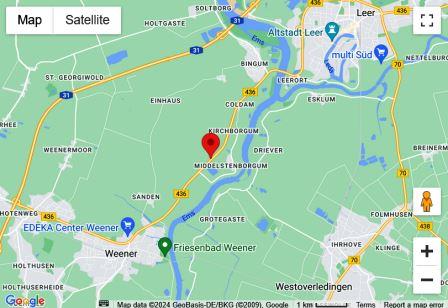
The distance between Weener and Leer is 11 km (7 miles). The red marker shows where the carriers were attacked, according to the map coordinates provided in the war diary. They were 3 km from Weener and 8 km from Leer. (Map source: Google maps)
The war diary entry for April 24, 1945 was not as positive. The Battalion was unsure if the bridge over the Ems River to Leer was intact and sent out a reconnaissance party to check it out. This was important information needed for the upcoming push to Leer a few days later.
“…This morning at 0900 hours a battle group consisting of A Company mounted on the Carrier platoon were sent to recce the bridge to see if it was intact, but ran into heavy enemy fire… It was found the enemy was using a new device for mining the roads, which had not been encountered before…The first two carriers passed over the mined area, but the third was blown up and created a crater approximately 40 feet by 20 feet…”
All on board of that third troop carrier were casualties. Things got worse as two German self-propelled guns then opened fire and a second carrier took a direct hit. Among the casualties was Sydney Guy Mosher, dead at age 30.
…. It turned out the bridge to Leer no longer existed ….
In ‘Fields of Valour’ by Ken Smith, it was noted that soldiers had been killed trying to locate a bridge that was no longer there. Lives might have been saved if information from air surveillance had been received.
Smith wrote that “….the attack on Weener was supposed to be an easy affair using ‘A’ Company, but ‘C’ Company had to be brought in to outflank the enemy, as ‘A’ Company was attempting to take the Leer bridge when a carrier was lost to a mine with casualties. At the same time several dreaded 88 guns began firing. The men were pinned and Typhoons had to be called in to finally silence the big guns.
The whole affair was useless as the Leer Bridge was already out of commission, with the attack costing the lives of men, mostly by mines or shelling….”
Either an Allied strike took out the bridge or the Germans had blown it. Given that the area was mined, it suggests that it was the Germans who had blown up the bridge to delay the Allied advance.
….Other soldiers from the North Shore (New Brunswick) Regiment who lost their lives on April 24, 1945….
Besides Sydney Guy Mosher and Frank Guimond, those who were killed on April 24, 1945 included:
- Private Emile Joseph ARSENEAULT of Lewisville, New Brunswick, age 22
- Private Ronald Burton DOHERTY of St. John, New Brunswick, age 19
- Private Wallace Herbert LARLEE of Perth, New Brunswick, age 19 (on our Cold Case List)
- Private Andrew MEEHAN of Hammondvale, New Brunswick, but born in Ireland, age 21
- Private Owen Burton MILLER of Deseronto, Ontario, age 21
- Private Francis Leslie MULCAHY of Halifax, Nova Scotia, age 21 (on our Cold Case List)
- Private Edmund SAMPSON of Cannes, Nova Scotia, age 30
….Sydney is buried in the Canadian War Cemetery in Holten….
Sydeny was initially buried on April 26, 1945 “…in front of the school…” in Niew Schans, “…about 4 miles southwest of Weener…” before being reburied the following year in the Canadian War Cemetery in Holten, The Netherlands.

Grave of Sydney Guy Mosher in the Canadian War Cemetery in Holten, The Netherlands. (Photo source: http://www.findagrave.com)
Thank you to John Gosling Sr, John Gosling Jr, and Shirley McIlmoyl for ensuring we received a photo of Sydney Guy Mosher.
If you can help with photos for two other soldiers killed on April 24, 1945 who are currently on the Cold Case List, please let us know. The names: Wallace Herbert LARLEE of Perth, New Brunswick, and Francis Leslie MULCAHY of Halifax, Nova Scotia.
Do you have photos or information to share? Email Pieter at memorialtrail@gmail.com, comment on the blog, or tweet to @researchmemori1.
© Daria Valkenburg
….Want to follow our research?….
If you are reading this posting, but aren’t following our research, you are welcome to do so. Our blog address: https://onthewarmemorialtrail.com/
 4 countries, 6 weeks, 7,000 km – an unforgettable war memorial journey in Europe…. Daria’s book ‘No Soldier Buried Overseas Should Ever Be Forgotten‘ is available in print and e-book formats. Net proceeds of book sales help support research costs and the cost of maintaining this blog. For more information see https://nosoldierforgotten.com/
You are also invited to subscribe to our YouTube Channel: On The War Memorial Trail With Pieter Valkenburg: https://www.youtube.com/channel/UCJ591TyjSheOR-Cb_Gs_5Kw.
Never miss a posting! Subscribe below to have each new story from the war memorial trail delivered to your inbox.
 On The War Memorial Trail Research Project........ with Pieter and Daria Valkenburg