November 20, 2023. When Pieter began his research into WWII soldier Leonard William PORTER of Moncton, New Brunswick, he discovered they had something in common, as he wrote to Leonard’s son, Peter Porter. “…I noticed that he was born on the same day as myself but 26 years earlier, on the 25th of March 1918….”
This was a promising start to the research, which continued after he quickly received a photo of Leonard after reaching out to Peter, and then we were able to meet Peter and his son Shane. Asked how he felt about being approached for a photo, Peter said “…I think this is wonderful…”

Shane and Peter Porter with Pieter. (Photo credit: Daria Valkenburg)
Born March 25, 1918 in Moncton, New Brunswick, Leonard was the son of Andrew and Ella Elizabeth (nee Beers) Porter.
At the time of his marriage to Kathryn Doris Meaghan on December 6, 1941 in Moncton, Leonard listed his occupation as Sergeant in the New Brunswick Regiment (Tanks), a non-Permanent Active Militia unit. He didn’t mention that he was also employed by the T. Eaton Company.
….Leonard was in the militia for several years….
Leonard had joined the militia on March 12, 1939, and qualified as a Sergeant on June 20, 1940. He served in Borden, Ontario, St John, New Brunswick, and Shediac, New Brunswick. As of August 11, 1940 he had been appointed as an Instructor with A & T Staff 19th (Reserve) Army Tank Regiment.
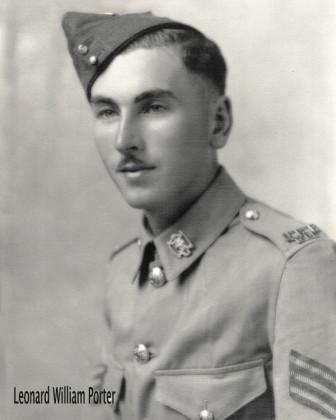
Leonard William Porter while serving with the New Brunswick Regiment (Tank) militia. (Photo courtesy of Peter Porter)
He qualified as a Driver i/c Class III on June 4, 1942, after successfully completing a 6 week driving course at the S-5 Canadian Driving and Maintenance School (CD & M School) in Woodstock, Ontario. This meant he was qualified to drive heavy trucks and armoured cars.
On June 10, 1942, Leonard was promoted to Squadron Sgt-Major Warrant Officer II (SSM (WOII)).
On October 3, 1942, he was sent to the A-30 Canadian Infantry Training Centre at Camp Utopia, located northeast of St. George, New Brunswick to attend a Mortar and Grenade course.
On January 13, 1943, he was sent to Buctouche, New Brunswick. While posted there he took a Browning Machine Gun course.
Leonard and Kathryn’s son Peter James was born on February 19, 1943 in Moncton, New Brunswick.
From March to August 1943 Leonard served in Richibucto and Sussex, then from September until November 15, 1943 he was in Tracadie and Fredericton, all in New Brunswick.
While he was in the Militia, with the New Brunswick Regiment (Tanks), Leonard also held a full time position for 5 years as a grocery clerk with the T. Eaton Company, a department store, in Moncton.
….Leonard enlisted for active service in the Canadian Army….
On November 16, 1943, he enlisted in the active service force at the No. 7 District Depot in Fredericton, New Brunswick. In the interview for his Personnel Selection Record, it was noted that Leonard was “...fond of bowling. Does some hunting and fishing. Reads Esquire, Readers Digest, and fiction….” Peter Porter mentioned that his father also “….played a piano-accordion...”
Although Leonard had spent several years in the Militia, he was still sent for basic training, like any new recruit. On December 7, 1943, he reported to No. 70 Canadian Army Basic Training Centre (CA(B)TC) in Fredericton. But, he was given a 5 day pass for Christmas leave, from December 23 to 28, the last Christmas he would spend with his family.
On February 15, 1944, Leonard returned to the A-30 Canadian Infantry Training Centre at Camp Utopia, located northeast of St. George, New Brunswick. After his 5th week of training, his Personnel Selection Record was updated. “….Leadership ability is apparent, exerts influence over his fellows. Quiet, steady, confident… Interested and ambitious…..Watch for promotions….”
Leonard was selected for the 3 inch mortar training course, which ran from April 10 to April 29, 1944. After receiving his qualification in this course, on May 4, 1944 he was sent to Woodstock, Ontario for a Carrier Driver Course at the S-5 Canadian Driving and Maintenance School (CD & M School). He had been there in 1942 while with the militia.
On June 14, 1944, he received his qualification as a Driver i/c Class III (Wheeled) (3 inch Mortarman). The term ‘Driver i/c’ refers to ‘Driver, internal combustion’. Class III meant he was qualified to drive heavy trucks and armoured cars. Wheeled refers to wheeled vehicles. As a mortarman, Leonard could not only drive vehicles containing bombs, but also be part of the mortar crew firing them. (See https://www.canadiansoldiers.com/weapons/lightweapons/mortars/3inchmortar.htm)
On June 24, 1944, Leonard returned to the A-30 Canadian Infantry Training Centre at Camp Utopia in preparation for overseas service. He received two weeks of embarkation leave, from June 29 to July 12, 1944, the last time he would see his family.
… Leonard left Canada for overseas service in July 1944…
On July 20, 1944, Leonard left Canada for the United Kingdom. Upon arriving on July 27, 1944 he was assigned to No 4 Canadian Infantry Reinforcement Unit (CIRU).
His stay in the United Kingdom was short, as on September 1, 1944 he was sent to France with the X-L infantry reinforcement troops of the 21st Army Group.
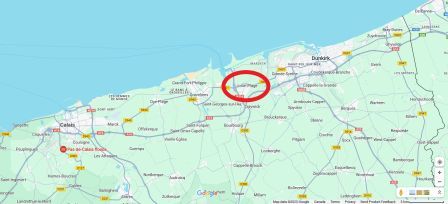
Leonard joined the Calgary Highlanders in Loon Plage, France. (Map source: Google maps)
On September 12, 1944, he was transferred to the Calgary Highlanders, joining them in Loon Plage, France, not that far from the Belgian border. The Regiment, part of the Canadian 5th Infantry Brigade, was engaged in patrolling operations and needed to be constantly on the alert from the heavily fortified Dunkirk (Dunkerque in French).
The War Diary entry for September 12, 1944 for the Calgary Highlanders reported that “…. during the evening, heavy bombers were heard roaring out toward German territory and heavy shelling and mortaring were heard coming from the direction of Dunkerque….” The situation intensified in the days that followed. On September 14, 1944, the War Diary entry recorded that “…forty-four other ranks arrived as reinforcements to the Battalion...” Leonard would have been one of these men.
… The Regiment was in the Battle of the Scheldt…
By September 18, 1944 the Calgary Highlanders had crossed into Belgium and were temporarily based in Wommelgem, just outside Antwerp, while the Regiment was engaged in the preparations for and participation in the Battle of the Scheldt, which began officially on October 2 and lasted until November 8, 1944.
The Battle of the Scheldt’s objective was to free up the way to the Port of Antwerp in Belgium for supply purposes. Canadians suffered almost 8,000 casualties (wounded and dead) in what turned out to be the battle with the most Canadian casualties in The Netherlands. (See https://www.veterans.gc.ca/eng/remembrance/history/second-world-war/scheldt)
During their stay in the Wommelgem area, several members of the Calgary Highlanders lost their lives, and were temporarily buried there, before being reburied in the Canadian War Cemetery in Bergen Op Zoom. (See https://onthewarmemorialtrail.com/2021/02/13/on-the-war-memorial-trail-the-search-for-soldiers-who-died-in-wommelgem-belgium-in-fall-1944/)
On October 7, 1944, the Regiment left Belgium and arrived in The Netherlands in the early morning, with the War Diary recording that “…at 05:50 hours the group crossed the border into Holland…” and was based at Jansen Farm.
On October 11, 1944, the Regiment moved again, to De Geest, then on October 15, 1944 to Hinkelenrood and based at Van De Maegdenburg’s Farm. Their task was mainly recce patrol. On October 22, 1944 the Regiment arrived in Ossendrecht. Then, on October 26, 1944, the Regiment arrived in Woensdrecht.
… The Regiment was involved in the Battle of Walcheren Causeway…
The stay in Woensdrecht was short, as on October 28, 1944 the Regiment made its way across the isthmus towards South Beveland. By October 31, 1944, the Calgary Highlanders were to cross the Sloe Channel in assault boats towards the German-held Walcheren Island.
The original plan to cross the Sloe Channel failed, as the Black Watch of Canada, the troops of the 5th Canadian Brigade that were in the lead, found that assault boats were useless in the deep mud of the channel.
The only route open was the Walcheren Causeway (known as Sloedam in Dutch), a land bridge from South Beveland to the Island. The Causeway was a dyke – 1,600 metres (1 mile) long and just 45 metres (40 yards) in width.

Map showing troops at the beginning of the Battle of Walcheren Causeway. (Map source: Wikipedia)
In what became known as the Battle of Walcheren Causeway, part of the larger Battle of the Scheldt, the struggle to cross the Causeway was hampered. A deep crater on the causeway had been blown by German engineers as an anti-tank obstacle and the surrounding landscape was severely damaged by bombing.
After the Black Watch of Canada suffered heavy losses during the crossing on the evening of October 31, 1944, the Calgary Highlanders sent two companies over in succession, one close to midnight on the 31st and the other just before dawn on November 1. The first attack, on October 31, stalled just past the bomb crater on the Causeway.
In the November 1 early morning attack, carried out under artillery fire, Canadian troops reached the other side of the dam and opened up a bridgehead on the island. The Germans continued to fire upon troops, and it wasn’t until that evening that Canadian survivors succeeded in getting back to the Beveland side.
The November 1, 1944 War Diary entry for the Calgary Highlanders starkly summed up what happened. “…Fighting along the Causeway had been terrific for the last 40 hours and words are inadequate to express all the difficulties that had to be surmounted to make an advance along the ….narrow Causeway. The memory of it will live long in the minds of the Calgary Highlanders….”
(For more information, see https://en.m.wikipedia.org/wiki/Battle_of_Walcheren_Causeway and https://www.canadiansoldiers.com/history/battlehonours/northwesteurope/walcherencauseway.htm)
… Leonard lost his life in the Battle of Walcheren Causeway…

Leonard was initially buried in Lewedorp. (Map source: Google maps)
64 members of the Calgary Highlanders were either killed or wounded in this battle. One of them was Leonard, who died on November 1, 1944, aged 26. He was initially buried on Walcheren Island in Lewedorp, behind the Roman Catholic Church.

The Roman Catholic Church in Lewedorp. (Photo source: Wikipedia)
The Germans surrendered the area on November 5, 1944. Today, the Causeway that caused so many casualties no longer exists. Land on both sides of the dyke has been reclaimed and the Sloe Channel is now farmland. However, remnants of German concrete fortifications still exist both on Walcheren Island and South Beveland.
… Leonard is buried in the Canadian War Cemetery in Bergen Op Zoom…
Leonard was reburied in the Canadian War Cemetery in Bergen Op Zoom, The Netherlands in 1946.

Grave of Leonard William Porter at the Canadian War Cemetery in Bergen Op Zoom. (Photo source: Find A Grave)
Leonard’s widow never remarried. Her son Peter explained that “….my mother was a hairdresser, and owned her own business. She became president of the Ladies Auxiliary of the Royal Canadian Legion and was involved in the Poppy Campaign. She also used to send money to people in The Netherlands who were adopting graves…”
Peter reflected that being involved in the Legion was his mother’s “…way to commemorate. Every September until November 11, she was busy….”
Thank you to Peter Porter for providing a photo and information about his parents. Do you have a story to tell? Email Pieter at memorialtrail@gmail.com, or comment on the blog.
© Daria Valkenburg
….Want to follow our research?….
If you are reading this posting, but aren’t following our research, you are welcome to do so. Our blog address: https://onthewarmemorialtrail.com/
 4 countries, 6 weeks, 7,000 km – an unforgettable war memorial journey in Europe…. Daria’s book ‘No Soldier Buried Overseas Should Ever Be Forgotten‘ is available in print and e-book formats. Net proceeds of book sales help support research costs and the cost of maintaining this blog. For more information see https://nosoldierforgotten.com/
You are also invited to subscribe to our YouTube Channel: On The War Memorial Trail With Pieter Valkenburg: https://www.youtube.com/channel/UCJ591TyjSheOR-Cb_Gs_5Kw.
Never miss a posting! Subscribe below to have each new story from the war memorial trail delivered to your inbox.
 On The War Memorial Trail Research Project........ with Pieter and Daria Valkenburg