July 15, 2023. The route to finding family and a photo of a soldier has many twists and turns. Sometimes a family member contacts us about a relative, usually after a media interview, but most of the time it’s sheer detective work to find a living family member. If no family connection can be found, then an appeal is made through the media.
In the majority of cases, possible family connections are found. Then Pieter has the challenge of making contact – through genealogy sites such as Ancestry, Facebook accounts, Legion branches, and by email if an address is found.
Quite often, though, an initial inquiry is made by phone. If you’ve ever had to cold call a stranger and explain the purpose of your call, you know it’s a daunting prospect. With a few exceptions, people are generally very polite, listen carefully to Pieter, and are good enough to let him know if he’s reached the right person (a relative) or not.
Over the years, he’s had very engaging calls and met delightful people. That was the case when he was looking for a photo of WWII soldier Lawrence Edward LUCAS of Guysborough, Nova Scotia.
Lawrence was born December 9, 1925, the son of Charles and Amelia Hattie Lucas. He had a brother Charles, and three sisters: Caroline, Mildred, and Vivian.
…The photo search was successful thanks to two nieces…
“…It’s usually the women who have the photos…” Pieter told me, “…so I’m starting with the sisters….” It was a wise decision.
Lawrence’s sister, Mildred O’Connor, had been president of the Ladies Auxiliary in the Royal Canadian Legion in Guysborough. Pieter spoke with her daughter, Marie Ehler, who told him that her mother “….had placed a photo in the Legion….”
Unfortunately, the Legion never seemed to be open, and there was no response to inquiries made by phone and social media.
Pieter then contacted Mildred McLeod, whose mother Caroline ‘Carrie’ Tovey, was another sister of Lawrence. When Mildred heard that the Legion had not responded, she got involved. Within a few days, a photo was emailed to Pieter from Lorne MacDonald.
…Lawrence enlisted at the age of 18…
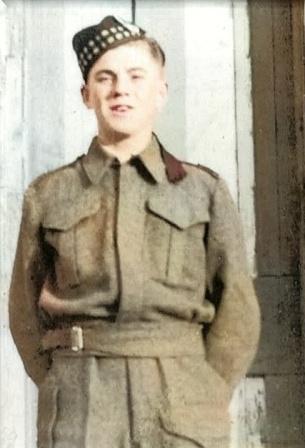
Lawrence Edward Lucas. (Photo courtesy of the Lucas Family. Photo colourization by Pieter Valkenburg)
When Lawrence enlisted with the No. 6 District Depot in Halifax, Nova Scotia, on June 23, 1944, he had been working as a carpenter at Eastern Wood Works in New Glasgow, Nova Scotia. He also noted that he had served with the 2nd Reserve Battalion Pictou Highlanders from September 1941 to May 1942. As a teenager during that period, he would not have been eligible for active service.
On July 6, 1944, he was sent to No. 60 Canadian Infantry Basic Training Centre (CIBTC) in Yarmouth, Nova Scotia. Then, on September 3, 1944 he was transferred to the A14 Canadian Infantry Training Centre (CITC) in Aldershot, Nova Scotia.
…Lawrence completed an anti-tank course…
Among the training that Lawrence completed was a 6 Pounder Anti-Tank Gun course, for which he received his qualification on October 16, 1944. This was a relatively small gun that could be pushed by its crew when necessary. Towed by a Universal Carrier, it could be brought into action quickly. (For more information, see https://www.canadiansoldiers.com/weapons/ordnance/6pounder.htm)
You can get an idea of how this gun works at this short re-enactment video on YouTube:
On December 12, 1944, Lawrence was transferred to the Training Brigade Group in Debert, Nova Scotia, for final training and preparations for going overseas.
…Lawrence arrived in the UK on Christmas Day 1944…
Lawrence left Canada on December 19, 1944, and after arriving in the United Kingdom on Christmas Day, he was assigned to No. 3 Canadian Infantry Training Regiment (CITR) for further training.
On February 10, 1945 he was in North West Europe with the X-4 reinforcement troops of 10th Battalion. Then, on April 6, 1945, he was transferred to the Algonquin Regiment, which was in the vicinity of Almelo, The Netherlands.
…Lawrence joined The Algonquin Regiment in The Netherlands…
The Algonquin Regiment was part of the 1st Canadian Army, which had two tasks: liberate the western Netherlands, and advance to the North Sea while protecting the left flank of the British 2nd Army as they advanced into northern Germany.

Green arrows mark the movement of The Algonquin Regiment through The Netherlands and Germany. (Map source: http://www.canadiansoldiers.com)
By April 17, 1945 the Regiment had passed Friesoythe, Germany and was engaged in clearing a bridgehead over the Küsten Canal. The war diary for April 20, 1945 recorded that “…in four days of steady fighting, the bridgehead has been slowly but steadily enlarged, both in depth and width, always against fanatical opposition and over terrain that is definitely in favour of the enemy….”

Clearing of the Küsten Canal in Germany. (Map source: http://www.canadiansoldiers.com)
By April 22, 1945 more reinforcements had arrived, and the various companies of The Algonquin Regiment had been moved. Lawrence was in ‘D’ Company, which, per ‘D’ Company’s war diary entry, stated that “…at 0230 we got orders to move so we packed up and moved …. and bedded down in a barn to await orders. We came under cover of the Argylls today…”
…Lawrence lost his life due to artillery fire in Germany…
On April 23, 1945, ‘D’ Company recorded that just after midnight they “…moved up the road 600 yards as far as ‘C’ Company of the Argylls….” After a two hour wait for further orders, they were “… to infiltrate a platoon across the water obstacle to determine the strength of the opposition. Things went OK, not a shot was fired and at first light we found ourselves dug in with the Jerries almost in the same trenches…”
Then things weren’t so rosy as the day unfolded as “…16 Platoon hung on to the east side of the river all day and we took a lot of shelling. Our casualties were one killed and three wounded. At 1900 hours we received orders to move onto the railway and take up positions at the road and rail crossing. We teed off at 2145 and 17 Platoon came under our own artillery fire and lost 14 men in killed and wounded…”
At some point during that fateful day, Lawrence lost his life. It’s unknown if he was the casualty killed by German shelling or one of the casualties from the Regiment’s own artillery fire.
…Lawrence is buried in the Canadian War Cemetery in Holten…
He was temporarily buried in Edewecht, Germany before being reburied in the Canadian War Cemetery in Holten, The Netherlands a year later.

Grave of Lawrence Edward Lucas in Holten, The Netherlands. (Photo courtesy of the Information Centre Canadian Cemetery Holten)
Thank you to Mildred McLeod and Marie Ehler for ensuring that Pieter received a photo of their uncle. Do you have a story to tell? Pieter encourages you to email him at memorialtrail@gmail.com, comment on the blog, or tweet to @researchmemori1.
© Daria Valkenburg
…Want to follow our research?…

If you are reading this posting, but aren’t following the blog, you are welcome to do so. Our blog address: https://onthewarmemorialtrail.com/.
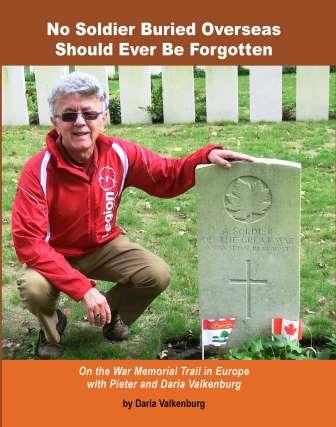 4 countries, 6 weeks, 7,000 km – an unforgettable war memorial journey in Europe…. Daria’s book ‘No Soldier Buried Overseas Should Ever Be Forgotten‘ is available in print and e-book formats. Net proceeds of book sales help support research costs and the cost of maintaining this blog. For more information see https://nosoldierforgotten.com/
You are also invited to subscribe to our YouTube Channel: On The War Memorial Trail With Pieter Valkenburg: https://www.youtube.com/channel/UCJ591TyjSheOR-Cb_Gs_5Kw.
Never miss a posting! Subscribe below to have each new story from the war memorial trail delivered to your inbox.
 On The War Memorial Trail Research Project........ with Pieter and Daria Valkenburg
Your research skills are amazing! Another photo found, another story of his young life told.
Mary Ann
LikeLike
Thank you Mary Ann. It’s so important to remember those who lost their lives in war. Pieter and Daria
LikeLike
Hello Daria,
You write in the middle of your very nice article that Lawrence Lucas arrived on Christmas 1945 in the UK and this must be 1944.
Regards
Edwin
LikeLike
Great catch on this typo Edwin! Thank you. The correction has been made…. Daria
LikeLike